
Hiring in the Age of AI: Ethics, Authenticity, and Tech
December 9, 2025
AI makes hiring faster, but it also makes a polished answer easier to fake. Watch hiring experts on using AI for scale without losing human judgment.
AI has completely reshaped the workplace, raising the bar for speed and efficiency, especially in critical functions like HR and talent acquisition (TA). So how do you leverage powerful automation while maintaining human connection and ensuring genuine candidate quality?
Check out this insightful discussion from Hacking HR’s 2025 AI Experience Summit, where our panel of hiring experts tackles the central paradox facing HR teams today: using AI to achieve speed and scale without sacrificing the critical human element. Key takeaways:
- Learn how to navigate the challenges of “too much AI,” promoting ethical usage, and developing strategies to prevent candidates from using AI to cheat or misrepresent their fit for a role.
- Discover how AI in hiring is moving beyond simple automation to become a strategic engine for forecasting candidate success and empowering HR teams of all sizes.
- Learn reliable strategies for evaluating AI-enabled solutions that accurately assess soft skills, cultural add, and deeper candidate qualities, ensuring you hire genuine competence, not just a perfectly polished AI response.
- Explore how to equip TA and HR teams with the data literacy needed to effectively use AI to surface insights. This frees your team to focus on high-value, human-centric tasks like relationship building, employee retention, and strategic partnerships.
Thank you everyone. Just up, here we go.
All right, look at this crew.
Morning, afternoon, I guess, right?
Good day, good day.
Good afternoon, good evening, good night.
All right. Well, thank you all for joining. We’re gonna wait a minute or two, especially now with that new LinkedIn link for people to rejoin.
I’m sure some people have to jump back into LinkedIn or do whatever they have to do. So we’ll hang on for a minute. While we’re hanging on for a minute, it is the perfect opportunity to get an assessment of where everyone is streaming us from. Where are you located? Always great to see those locations pop up in the comments. So feel free to add that there. I will say I am in Westchester, just about twenty five minutes north of New York City.
I am in Highland Park, Illinois, and that is about maybe twenty minutes north of Downtown Chicago.
It is very, very white and snowy around here. Lots of snow on the ground over the last week.
Very nice.
I’m I’m Adam’s neighbor. I’m call I’m calling in from New Jersey about 15 miles outside of New York City.
Fortunately no snow but it is cold and winter is upon us.
Yeah. I’m calling from Fishers, Indiana which is about thirty minutes outside of Downtown Indianapolis. I’m south of, Josh, but I still have the snow. Not quite as bad wind as, up there in the Windy City Chicago, but still, colder than I like.
Excellent.
Safe to say we all have space heaters next to us right now trying to keep us all warm.
I actually have my window open.
This is my space heater all day.
All right.
All right. Well, we’ve given it a minute and a lot of people have put in some amazing locations. I always just think it’s you’re primarily going to be dominated by U. S.
Locations, but really seeing a global audience here, which is incredible. And I think it really speaks to AI has taken over the world in a sense. So let’s dive into our topic today. Incredible group of speakers today.
So let’s start with the title, Hiring in the Age of Ethics, Authenticity and Tech. I dare you to say that three times fast. Okay, let’s let’s start here. My name is Adam Kaczanski. I’m going to be your emcee today. I am I work at Spark Hire, so I am here on behalf of Spark Hire, one of the sponsors for today’s event. So I’m just gonna give you a brief summary about who we are and what we do, and then I’ll introduce our incredible speakers, give them an opportunity to introduce themselves as well, and then we’ll dive into some great questions that we have.
Okay. So who is SparkHire? We are we help hiring teams create a more human, connected, and consistent hiring process, especially when resources are stretched thin and AI is everywhere. Our platform makes it easier to truly get to know candidates beyond what’s in their resume while automating a lot of the busy work that’s slowing just about every hiring team down when resources are getting lower and the demand is getting higher.
We offer two solutions. We have SparkHireRecruit, which is our applicant tracking system and SparkHireMeet, which is our assessment suite, which offers, one way videos, behavioral assessment, and automated reference checks. And the beauty is it’s all modular, so you can you don’t have to get it all. You can pick and choose what you like, whatever works for your team, and go forward with that.
So finally, in short, SparkHire exists to create meaningful connections, bringing employers and talented individuals together in a faster, authentic way. Now let’s get to our panel. First of we’ll wrap up the whole SparkHire thing with Josh. So Josh, CEO of SparkHire, please feel free to introduce yourself.
Yeah. Enough said. Thank you for the introduction. A great background on SparkHire. Happy to be here today.
Happy to be a sponsor. But more importantly, happy to join all these wonderful panelists to talk about something that is, really top of mind for all of us in our day to day. So I’ll toss it over to Felicia. You’re the next person on my screen I see, so I’ll toss it over to you.
Well, you. I’m Felicia Blasberg. I’m a global talent architect. I have a background in HR and it’s just a it’s a great pleasure to be here today. I’m very passionate about the hiring process in general. So excited for today’s topic. And I’ll pass the baton to Tom.
Awesome. Thanks, Felicia. Yeah. I’m Tom Hundley. I am HR for a startup named Arrive AI, which we facilitate drone and robot autonomous delivery. I’ve been in HR toward talent acquisition for, let’s call it 17 plus because anything else makes me feel old, and always been a fan proponent of HRIS and just technology to facilitate the recruiting process. I’m passionate, like Felicia, about recruiting, So real interested to talk today.
Excellent. Well, you all so much.
And as we start diving into the questions, we’ll be sharing the links to the LinkedIn profile of our guest speakers today. Please connect with them. Again, we’re all here to make meaningful connections, so feel free to connect with any of the speakers today. Love to share ideas, thoughts and reactions to AI in the workforce.
Okay. So this question, let’s get it started. Let’s set the stage. This question is open to everyone.
Really want to hear everyone’s response. We’ll start with Tom, then Felicia, then move over to Josh on this one. But from your perspective, what are some of the biggest changes AI has introduced to the world of hiring over the last year? Tom, if you want to get it kicked off.
Yeah, probably the biggest change is just the access to knowledge information and allowing me to act faster.
Whether it be using whatever gender of AI I like to research a role to the tons of solutions out there, both in systems like SparkHire and outside that automate things, make things a lot easier for me to move into so that I can ultimately get to those conversations. Talked about putting the human back in recruiting. I love those conversations. So that’s probably the biggest change and the one I like the most is allowing me to get to that that much quicker.
Excellent. Felicia, love to hear your response to the question to come and learn from you. What are some of the biggest changes in AI you’ve seen over the past twelve months?
Absolutely.
So I think AI has kind of had a dual impact on hiring.
As Tom mentioned, it’s streamlining hiring processes by automating the repetitive tasks that nobody really likes to do.
But it’s also freeing up recruiters to be more strategic partners to their businesses.
And by doing this, by automating the routine tasks, by augmenting the human decision making by AI is creating a demand for a new skill. It’s starting to shift organizations towards a more agile data driven kind of collaborative model. As Tom noted, it’s people are using it for research and recruiters are benefiting from the efficiency. They’re maybe better able to match candidates to their open recs. The one thing that I’m noticing though is organizations need to balance these enhancements with the ethical considerations of AI, the transparency of AI and something that I think came up a lot in the prior panel is the employee trust. So those are some of the things that I feel like I’ve seen in the past twelve months.
Totally. And yeah, ditto to both of what you guys said. I think, you know, Tom, you hit on it. There are so many solutions and I think that’s good and that’s also bad. I think there’s so much that’s possible now with AI.
And I think, Felicia, to your point, we can often end up in a pursuit of trying to solve everything using AI, using AI for AI’s sake. And that can lead to both some, you know, responsible use cases for AI, but also, I think, to stretch an organization thin where they’re not focused on solving the real challenges that need to be solved, where AI is the appropriate solution to solve. The other thing, and I know we’ll get into it as well and just talking about candidates, we’ve all talked about what has changed on the employer side. But part of that is what’s also changed on the candidate side and for a lot of good, right?
I think AI has given candidates the ability to do a lot more things at scale in their job search, such as personalize their resume, research companies. Candidates are just really well equipped or equipped in this AI era, And that creates challenges downstream for employers. It’s not necessarily a bad thing that candidates are enabled with this. I think it’s actually a good thing, but it creates some challenges nonetheless that I think we’ll definitely talk about today.
Great points, everyone. It’s, you know, when I speak to a lot of HR professionals and recruiters and they’re always like, why are these candidates using AI? And I’m like, you are. You kind of have to expect it to happen on the other side as well.
You know, It’s like football players, why is the why is the other side wearing a helmet? Well, you get to wear a helmet too. Okay. So let let’s dive into AI’s impact on the hiring landscape.
I have a few questions here. I wanna direct the first one to Tom. The next question I’m gonna direct to Felicia. But again, everybody can jump in on every question that I ask.
Tom, from the recruiter seat, how has AI impacted you and your daily workflow?
Well, you know, like I kind of mentioned, it is giving me more speed to action. By that, I have so much going on. I’m not just a recruiter, right? I’ve got benefits enrollment.
I’ve got all the other HRE of the HR world that I got to do. So the time saved from, like I said, researching roles or even internally researching roles. You know, get a job description from one of my hiring managers and we hire high end recruiting engineers or excuse me, robotics engineers, manufacturing engineers, AI. And it’s been a minute since I had been a technical recruiter.
So coming back in that role and figuring out okay what is this language? What is this process? So using AI to research that.
And then you know once I get that job description and obviously go through that for my hiring manager because it’s probably too technical and ethically making sure they’re saying the right thing and not saying the wrong things.
Once I put that job description through and then my system prioritizes the candidates, again, that’s another few minutes per resume or per candidate that I can make that decision quicker to get to that conversation. Because ultimately that’s where I’ve always flourished in talent acquisition is I like talking to people and getting out that those off the resume type of you know skill sets and you know being human and human resources. And so that AI has allowed me to along with all the other I can talk about being strategic HR with AI and using it as a sounding board to do ideas.
But from a talent acquisition role, that’s really sped me up in that regard.
And it’s it’s a great point you bring up. Right? We have a big portion of our audience, our small to medium sized organizations where the recruiter is not just the recruiter. The recruiter is doing 10 different roles. And Felicia, I mean, you’ve worked at companies as large as Samsung, where a recruiter is a recruiter. So how AI impacts their daily workflow is inevitably gonna be different than how it would impact Tom or the benefit that it would provide.
But the next question to you, Felicia, excuse me, is when organizations oh, I’m sorry. What changes have you observed specifically in candidate behavior as these AI tools have become more prevalent for them, easier to access, easier to use?
So I would say candidates are definitely better polished because maybe they’ve used something like, for example, Grammarly to refine their cover letters or their resumes. Or maybe they rely on practice bots to provide them with real time feedback on tone or like body language, right?
Or they’re spending a lot of time rehearsing the perfect answer to the behavioral questions that they anticipate a recruiter might ask them.
But the idea of kind of being so polished is diminished. It doesn’t necessarily mean that they’re prepared because true preparation really requires understanding the role, the company culture and even industry context.
If candidates are relying so much on rehearsing that perfect answer, they may struggle with follow-up questions. And so that compromises their authenticity during the interview process.
What I would say is I think it’s important for candidates to kind of find that balance.
Preparedness still requires a human effort. You still need to research a company, you still need to reflect on your personal experiences, your professional experiences and most importantly candidates need to make that authentic connection with the hiring manager or the recruiters. As Tom noted there, you still need to be, you still need a human element in the process and thinking back to the earlier session, think they said something like the human in the loop or I thought that was a great little, a great line because you still need a human in the loop, whether it’s on the recruiting, on the organization side or it’s on the candidate side.
Absolutely, thank you so much for that.
So, you know, thinking about now the candidate’s access to this information and Felicia, you really talked about the balance there, right? Like using it in a smart way and kind of having it expedite the the research you should do preparing for an interview.
What now kind of impact does this have on an employer? What challenges does this create for an employer now with knowing that the candidate is sitting in their seat, having access to AI or typing on the side the question and having it pull up an answer. Like, what are all three of you seeing in that regard?
Yeah. I’ll jump in here. I think Felicia made some really good points in terms of what candidates are doing. I think ultimately this presents, you know, us as employers with the challenge of if if we run a good interview process, we will eventually get to the right candidate for the position.
We will be able to vet out how qualified they are, what their previous experience is, how it aligns with the role, the behavioral competencies, all those things that go into making a good decision. The challenge though comes at, I would say at least from my perspective and what I’m seeing is at the front end of the process and how much energy and resources need to go into the screening and vetting of candidates. And when you have candidates that are using these tools, which they should to polish everything, it’s really hard to get to the authentic version of that candidate. And so you couple that with the fact of, you know, easy apply and how simple it is to apply to a lot of different jobs to personalize your application for a lot of different jobs.
Employers now are not only dealing with volume, but they’re dealing with at the front end of the process, a lot of things looking very, very similar.
So, yes, eventually they can get to the right outcome, but it takes a lot of work, to get there compared to, you know, what what it previously took. And so I think that’s something, you know, that a lot of recruiting teams are facing. I’d be I’d be curious to hear from Tom, you know, if he’s seen that on the front end of the process when candidates are applying.
Oh, yeah.
Seeing a lot of use of AI. And what was funny is I saw a survey just the other day that said about 20% of recruiters would reject a cover letter if they knew AI generator if they find out. And then I think 15% of hiring managers don’t want people using AI at all, which I’ve had in the last two months situations where I think I saw some people looking over and you know reading off you know had something listening to my questions and then the AI bot just populated the answers. But I had a conversation with the hiring manager right after and it’s like what let’s step back and think about the role.
This person’s not going to be customer facing. They’re kind of back of the house, data driven. We want them to use AI tools. So are we going to chastise them for using every tool at their disposal?
You know, it’s is it cheating if they’re doing that? But you could also say, is it cheating if I, as a recruiter, every every interview I go on, I look at their LinkedIn profile. I look at their Facebook profile. I know their kids play golf.
So I talk about how my kids play golf. Is that cheating? You know, it’s old school methods, but just using the new tools. And I think we all have to put ourselves in that situation.
Know, you can’t I think Adam said, well, we’re using AI. You can’t, you know, chastise them for using AI because it’s going to happen. And if if you don’t just square with it. And I’ve I’ve got an interesting perspective.
My company, it’s actually Arrive AI. AI is in the name. And we I every interview, I say we not only use AI in our product, we use it in our process. So it’s part of my interview question process is how well do you use AI?
And so that opens it up.
But ultimately what I one thing I do like about it is it facilitates and requires on-site interviews which I know a lot of people are not a big fan of going back in the office but we are and I kind of like it because I’m sitting across from people from the desk again having conversations talking about the weather you know that kind of stuff and it just makes it again, and I hate to say it again and again, a more human process.
Absolutely, that’s a great point. It’s funny as AI is automating a lot more processes, it’s forcing us to be more human in a lot of the different processes as well. So hopefully it’s kind of balancing itself out.
Okay, up next, do see a bunch of questions coming in from the comments. We’re definitely gonna get to some of them. I wanna get to a few more questions that we have here, then we’ll definitely pick out a few questions from our attendees and bring them in. Felicia, we’re now gonna go into employer AI strategy or hands on getting one of my very favorite questions that we’ve put together today.
And when organizations say they want to start using AI in hiring, what are some of the things they should consider first? And the reason why this is one of my favorite questions is because I feel like the majority of people say, we need AI and they don’t even know why or where or when.
So what should they consider first, Felicia, before they start bringing it in?
That’s a great question. I think the first priority for organizations should absolutely be defining a clear implementation plan. I’m seeing that there’s a huge to your point Adam, there’s a big disconnect with maybe CEOs and the C suite saying AI, AI, we want more AI but there’s a real disconnect on how to even implement that. They don’t even know how you know they don’t even know what that looks like. So I think having that clear implementation plan, aligning your key stakeholders, establishing a strong communication strategy that delivers consistent and transparent messaging, creating feedback loops to understand what’s working, where adjustments are needed. And then along the way in organizations as part of this implementation plan should consider highlighting and amplifying the success stories to help build on their AI journeys momentum as well as the trust of their employee base.
Above all, I think organizations need to understand the, their employee base needs to understand why AI, what’s the purpose behind adoption. This way your employee base is going to embrace the journey and grow with it rather than completely resist it or think that their job is going away. And so I think that all of that makes up an implementation plan and revisiting that implementation plan periodically is critical. And honestly, and I think that goes for really using AI in anything, whether it’s hiring or even maybe a completely different process.
Couldn’t agree more. I think it all comes back to the objective.
I think I said in the beginning of this is there’s a lot of AI for AI’s sake rather than focusing on what is the business objective that needs to be solved, just like any other business problem we want to solve within the organization.
And then assessing whether AI is part of or the best solution for that problem. And so I think it’s all about specificity, you know, the vendor side of things. And, Adam, I’m sure you could attest to this too. You know, sometimes our team will be on a demo, and the team comes with, like, the question of what AI features do you have?
And other teams will come with the question or more of a statement of we have this problem within the business that we’re trying to solve. Help us figure out how you solve that problem, and AI can be part of the solution. And I think the latter is really where you need to start. So I think Tom brought up a good example, you know, to to tie it to, let’s just say, hiring manager collaboration.
That’s a big challenge in small and medium sized organizations. You’ve got a lean HR team. Like in Tom’s case, he’s doing more than just recruiting. They need hiring managers to be an active part of the hiring process.
And so we really need to have a good collaboration with our hiring manager as well. In Tom’s case, he gave the example of how he’s using AI to research positions like a robotics engineer.
And not only does that help him for when he’s talking to candidates, but that makes him more prepared to do a kickoff with the hiring manager where he doesn’t come in with, like, you know, no information about the position other than with the bullet points the hiring managers provided. And so you’re kinda starting from ground zero and building up knowledge and building trust with the hiring manager. So that’s just like one example that Tom pointed out that you could tie to a specific objective around improving hiring manager collaboration. So all that to say, I think the first thing is be specific would be my takeaway.
Yeah. Thank thank you so much, Josh and Felicia. And Tom, from your perspective, you know, what hiring problems do you believe AI is best suited to support you with? And what ultimately still requires a human? And you kind of alluded to it a little bit before about getting people back into the office face to face, but we’d love to hear you elaborate on where you think AI does make a lot of sense.
Oh, mean, I think it makes sense across the board, but where it’s really helping me now and a lot of people are probably also seeing this, I’ve gotten a deluge of candidates.
You know, this hiring environment, I’ve had so many for the open positions, they have software developers and different kinds of engineers. AI has helped me prioritize and, you know, allow me to reach out to the right candidates first while not missing out on the other candidates. You know, I’ve been in the industry for long enough. I’ve seen the whole rack and stack and rank.
You know, I’m using SparkHire now and it’s a much better platform because the AI is telling me why it’s better. And you know it’s a much better, it just does better. It’s a better AI. I’ve seen all kind of other AIs and it’s like that’s kind of shady. There’s some hallucinations.
So giving me that, okay, I need to talk to these five people first so that I can get those out of the way. I mean, not just the automations of scheduling and things like that. Those are super helpful to get through. But then, you know, transcribing and ranking, you know, answers to video questions.
You know, that kind of AI is super helpful, you know, so I don’t have to go through and source. I don’t have to make those 100 phone calls of, oh, are you ready now? Are you ready now? Can you meet this time?
Okay, are you qualified? Are you qualified? Are you qualified? What are you looking for? Those are out of the way and so then, I can jump to that real either virtual or on-site interview where we have substantive conversation and I can, you know, I don’t worry about people cheating because I’m talking to them and say, okay, here’s this question, how have you implemented this?
You know, it’s not just your resume or not just what you’ve polished yourself on. I can go deep and figure out if you’re a great fit.
Excellent. Thank you so much, Tom. So I will get now just I’ll pivot to one question that’s in our chat and then I’ll come back.
But I’m asking this question and I already feel like I can predict everyone’s answer here. Can AI replace HR roles?
But I would love to hear from Tom, you’re already nodding no. So Tom, let’s jump to you and then Felicia obviously would love to hear your thoughts as well.
HR rules in general, no, because you always have the, hey, somebody stole my lunch questions and AI is not gonna fix that. There’s also going to be the hey, is that person a good cultural fit? Are they going to vibe with the third shift hiring manager who’s kind of an interesting person to be around? AI I don’t think is ever going to do that.
Now it’s going to up level. You know, personally for HR strategy and I tell people this so my hiring managers already know. I have conversations with ChatGPT in my car on the way to work about strategy, about performance management strategy, about talent acquisition strategy. I’ve got the voice. So I always say AI is kind of like your imaginary friend that knows everything. So there’s absolutely a place in it but replacing me now it’s not going to happen because you know I try to make myself feel like Tony Stark talking to the AI in his suit and it just up opens me that much.
Tom that’s so funny about having an imaginary friend because when I tell my daughter that I say thank you to Microsoft Copilot, she’s like, you’re not supposed to be doing that. They don’t care.
I can’t believe you know he did a good job today.
I’ve told my children it’s it’s not that I think the robot overlords are gonna come take us over. I don’t wanna stop being polite to people that sound like a human.
Yeah.
Tom, I’m on the robot overlords side and I am nice to them so when they do take over they’ll be like, he said please when he asked.
He’s one of the good ones.
All right.
Right. Let’s get back over to our panel here. And I now wanna go into like a big area that we have as the title of our session today. So I do wanna talk about authenticity and transparency, and that will actually hit upon a lot of the questions that have come into the chat as well.
So with polished resumes, emails, polished interview responses that are specifically tailored to companies because of AI. How can employers genuinely get to know the person behind the tools?
So I open this up to anyone first to jump in if you have any thoughts about some of those best practices for an employer to kind of figure out who’s doing the real talking.
I’ll jump in. Oh, sorry, go ahead, Felicia. Go ahead, Josh.
Was just gonna say, I saw another question pop up in the chat a little bit earlier when we were talking about this same topic. And I think it was something along the lines of what’s the difference between a candidate getting help with their cover letter from a person, you’re a resume writer or something like that, versus now using AI? And I think the reality is there isn’t anything different. And I think what we’ve all been saying here is it’s not a bad thing that candidates are doing this. They should do this. Why wouldn’t you try and present the best version of yourself?
It just creates challenges. Right? And the challenges of, well, if everybody’s doing it, everybody kind of regresses to the mean and everything looks similar. And so from an employer standpoint, it’s how do you get to know the authentic candidates behind all these similar looking resumes?
And from a job seeker standpoint, it’s how do I stand out now when everybody’s resume everybody’s doing the same thing as me. So I think that’s that’s really the challenge that we’re met with. And and, again, nobody’s saying anything bad about candidates using AI. I think they should.
So back to the question around how how do you get to know your candidates more authentically?
I think there’s a number of ways you you can do it. I think what we’re seeing is there’s a diminishing value of the written word earlier in the hiring process. And so how do you gain context on somebody’s experience? Now that can come through interviews, that can come through asynchronous types of interviews or assessments.
And a lot of that, I think, comes back down to what questions you’re asking, what are you focusing on, how do you ensure you’re focusing on what truly matters for the role, and then aligning your assessments or questions to make sure that you’re gathering that additional context in a way that draws on their real world experiences. So those can be things like really good behavioral or situational questions where it’s like, yeah, you can throw the question to chat GPT, but is it gonna give you an authentic story about when you dealt with the situation at your previous job and are you gonna be able to articulate that as a candidate? So I think as an employer, that’s where we have to get really good about what we’re asking and how we’re asking it post application. So I’ll turn it over to Tom or Felicia, if you guys wanna jump in. Curious from your experience, how you’re tackling this challenge.
Yeah, I look at it like this.
Having a thirty minute interview is basically speed dating. You barely get past. So tell me about yourself before the clock runs out. And I think what I’m seeing as a common trend is that everyone’s talking about hiring being a two way street.
But both sides need more than a quick coffee chat to determine if something is a fit. I think what organizations to Josh’s point, think what organizations really need to be doing is they need to stretch the time of interviews. They need to really give space for some real dialogue and let candidates highlight more than just they’re highlight real. Otherwise, is basically like leaving a Bruce Springsteen concert after the first song, right? You miss the encore, you miss the stories, you miss the entire magic of what makes the whole experience unforgettable. And in thirty minutes, it’s just I get people are busy, but thirty minutes is just not enough to get employers to generally know the person behind the tools, nor is it enough for a candidate to know whether or not an organization is the right place for them.
I love the speed dating aspect.
Well, and because I think I’m using and I think other people are using AI to get all that stuff out of the way of that entry level, are you qualified? I don’t know how many times I’ve been on an interview with somebody and I’ve watched their video assessment. I forget to introduce myself because I think I already know them, Because I’ve already listened to him for twenty minutes or so. And so there’s been multiple times, five minutes, I’m like, I’m sorry, I forgot to introduce myself.
I’m being rude. Know, but part and parcel to a startup, you know, we’re running fast and things like that. So I think AI is allowing us to be more authentic because we get the grunt work out of way on both sides. The candidates get it out of the way and I get it out of the way.
You know, by the time they actually talk to me, they’ve seen my video, my introduction videos of those video assessments. They’ve done the research. They’ve probably researched me.
So they know what’s going on. So those interviews are more rich because of it. And then when I move people through the cycle talking to different interviewers the whether it the hiring manager and so forth, they have more time to talk and get to know each other.
Absolutely. Felicia, brings I up a great point is like both parties need more signals of fit.
And it’s just a challenge right now because there’s a lot of people coming in, to the application funnel, and that means there’s a lot of, you know, work on HR and talent acquisition teams to vet through that, get the necessary signal to make decisions. And they’re always afforded the opportunity of doing a long interview, but you still need to give candidates the information that they need to make a decision about you, and you need to get information from candidates to make a decision about them. And so that’s, you know, going back to what we were talking about of where AI can be used in the hiring process, like that could be an objective that you focus on.
And it’s like how, in the absence of being able to run ninety minute interviews with every candidate that looks good on paper, how might we still get similar signals? How might we still be able to deliver information to candidates so they can make decisions even if it’s not ideal? Right? Like ideal world, we can bring every candidate in.
We can sit down on the couch. We can have a cup of coffee, have a great conversation.
But it’s challenging just in the pace and volume at which we work at.
So I think that’s something that everybody here could break down with different stakeholders in their hiring process of like, okay, Here’s the info we need to get. Here’s the info candidates need to get. How might we still deliver this? Even if it’s not, you know, on paper, the ideal dream, you know, state of what we wanna get to, there’s still solutions out there that can help you get the information and get candidates the information they need. So a challenge that needs solving, for sure, but something that, you know, I think can be very actionable for people to focus on with AI and even some non AI solutions, just process type stuff.
Absolutely. Great points by everyone. I will say Bruce Springsteen, Tony Stark, imaginary friends, speed dating. I don’t think anybody had that on their bingo card going into the session today on AI.
So all amazing. We have five minutes about five, six minutes left. So I’m gonna do things in a little bit of a different way. I really wanna make sure we have time for our final question, which is a really important question for everyone.
And then if there’s a minute or two after that, we can jump back to one of the earlier questions. But I think we need those five minutes to really dig in deep here.
What is the first practical step a company should take if they’re just beginning to build AI into their strategy for hiring? I think that’s like really the crux of what everyone is here for is to understand like, alright, I wanna use it.
Where do I, how do I start? What do I do?
So this is a question for everyone. So Tom, you’re unmuted. Felicia, I see the mute. So Tom, since you’re already unmuted, we’ll start with you and then we’ll go to the rest of our panel.
Yeah, absolutely.
I think like a lot of things, you gotta know your own process. You know, really map out, you know, from, you know, first look at the job description with the hiring manager all the way to hire. What is your process And map that out so that you can integrate how AI can go into that. I used to be a consultant for actually a professional service consultant and worked with teams around the globe, recruiting teams.
And knowing their process, have that outside observer to say, okay, this is where you guys are deficit, this is deficit. So if you need a consultant, cool. If you can’t afford that, use AI and ask, you know, put in your process, where am I deficit? And then, figure out, okay, do we want a AI sourcer?
Are we good with just people interviewing, video assessments? Do we want some of the newfangled when I’ve I’m not a big fan of them yet but the the bots, the agent bots that call you and do the screening questions or does that work for the population that we’re hiring for? You got to worry about your audience just like everything else, right? I mean if you’re hiring for robotics engineers it’s gonna be completely different than if you’re hiring for fry cooks.
The velocity and the volume plays into that as well. So I don’t Let’s quote Socrates and know yourself, you know, if we’re going and bingo cards there, Adam. Know yourself and know where you’re really deficit and what tool is really gonna work for you and understand the tool and how that fits in.
I would echo what Tom said. I think having like a like your like an organization needs to have the what is their overarching philosophy that they’re going to adhere to when it comes to AI, right? So if you’re putting AI in the hiring process or this process or that process, each implementation ladders up to that philosophy. And now I can’t take credit for this because it was recently in an AI, it was recently in the Forbes article, but it’s that the article said something like organizations that succeed treat AI adoption as a human journey, not just a technical one.
And I think that’s a very, that is an extremely powerful statement. Because it’s again, it’s finding that balance between what’s the human element and what’s the AI element. And I think if you can fund, if you can have that philosophy that this is not just one or the other, it’s both. I what think will drive success for any organization, big, medium, small.
Great. Thank you, Felicia and Josh.
I I mean, yeah, I I think what what both of the Felicia and Tom said were great. I I think it goes back, you know, I’ve said it a few times throughout this panel is being specific, having an objective in mind, what are you actually aiming to solve? Don’t use AI for AI’s sake. And I think one of the things we touched on a little bit in the question about, is AI gonna replace HR roles?
I think that also ties into it as well is part of implementing AI or using AI in the hiring process is also getting other stakeholders bought in, oftentimes leadership stakeholders. And so I think once you have your objective and you want to present your business case, it can’t just be to save time. You have to really think about, of course, yes, it’s gonna free up time. It’s gonna make you more efficient, but what are you doing with that time?
What are how are you reallocating resources that used to be used for x but now is available? And I think that’s what your leadership team wants to hear. And now to use Tom’s example, know, Felicia even said humans in the loop. I think it’s it’s really looking for those areas where as a human, you can make the biggest impact on the process.
And oftentimes when you’re talking to recruiters, you’re gonna hear it’s all about talking to candidates. It’s about building the relationships. It’s nurturing candidates. It’s all those things that you can personalize throughout the candidate experience are gonna leave an impact on those candidates that are in your hiring process now and may think about your company down the line when they’re looking for a new role.
It’s those moments that you really have an opportunity to influence. And I don’t think, you know, AI will do that for you. And so I think, you know, as you’re thinking about where to start, be specific, have a goal, and then to get buy in, it’s all about, okay. This is gonna help us do x, and we’ve now got more time freed up, how are we reallocating that to something that’s more impactful for the organization and in case more impactful for our hiring?
Excellent. Thank you so much, Josh, Felicia, Tom. Such amazing insights across the board, not just as hiring people here, but also for candidates and what we should be on the lookout for with candidates. So thank you all so much. And just like a final note for anyone who’s like, I don’t know whether or not we should be incorporating AI into the process, lean in a little bit because it’s going to find its way everywhere. So opening the door a little bit and just testing it out in some of those areas based on Josh, Tom, and Felicia’s recommendations. It’s gonna set you on the right path.
I wanna thank everyone. I wanna thank Hacking HR. It’s been a wonderful session. Please feel free again to connect with all of us on LinkedIn. We’d love to hear from all of you and look forward to future conversations. Everyone have a great rest of the week. Thank you so much.
More Webinars
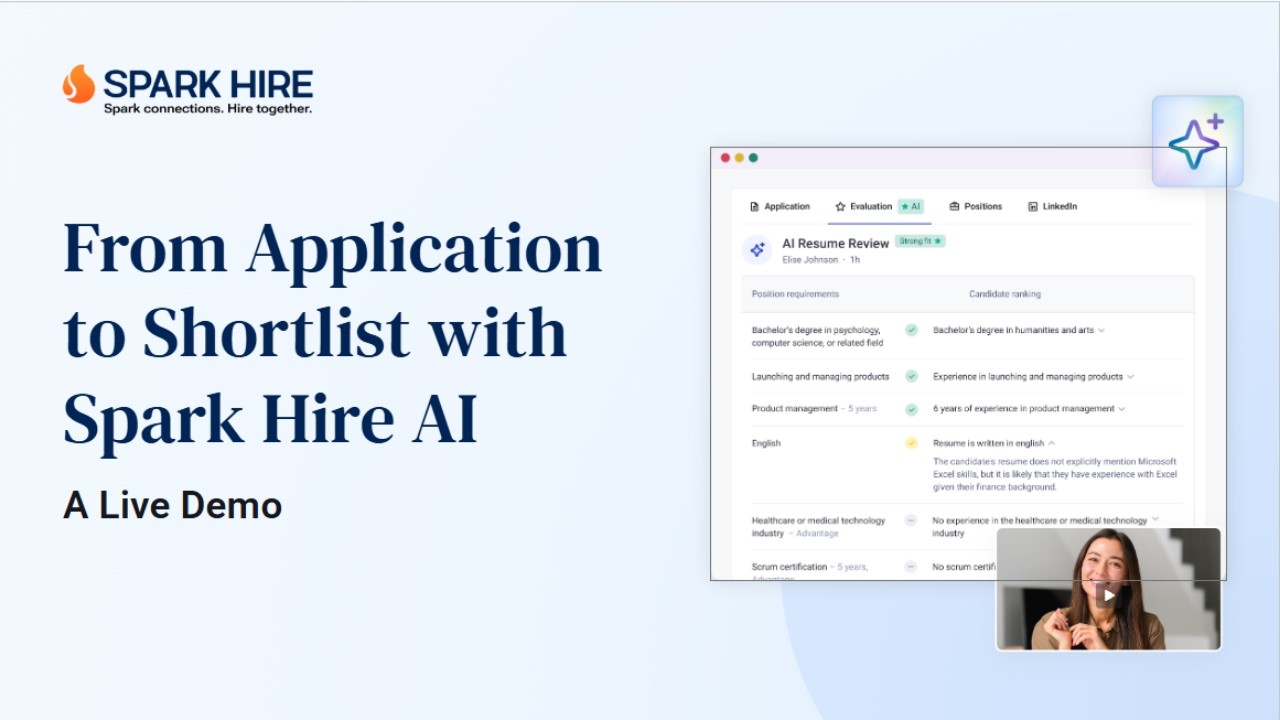
What’s New in Spark Hire: From Application to Shortlist with Spark Hire AI
Sorting applications takes time lean HR and TA teams don't have. Watch Spark Hire AI narrow a stack to a shortlist, while humans still make the call.
How SMBs Build an Intentional Hiring Process that Protects Trust, Clarity, and Team Capacity
As SMBs grow, hiring often turns reactive and inconsistent. Watch two hiring leaders share how to build a process that protects trust and team capacity.
Become an AI Powered Recruiter: Leveraging AI to Find Your Next Great Hire
Spark Hire's Josh Tolan and Adam Kazansky talk with 1Password's Amber White about adopting AI responsibly in recruiting, without losing the human touch.