Summary
No matter the size of your hiring team, your speed to hire is impacted by your team’s ability to streamline communication and team collaboration from early screening through making a job offer. Having a lean team presents unique challenges and opportunities when building a roadmap for hiring success.
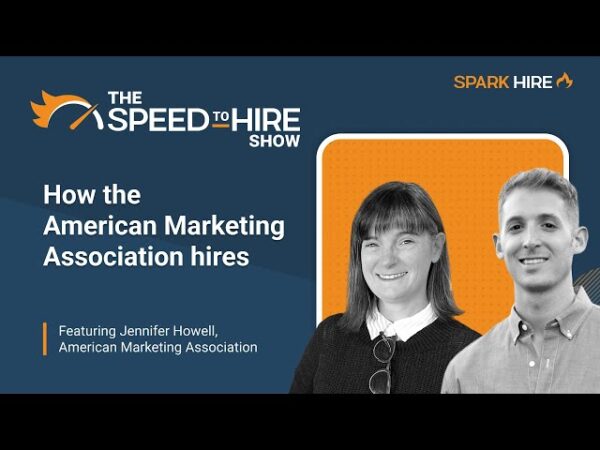
Join Spark Hire CEO, Josh Tolan, as he sits down with Jennifer Howell of the American Marketing Association to discuss the secrets to hiring and retaining top talent.
Key Takeaways:
- [07:27] Create a hiring roadmap: Hiring team collaboration and efficiency are key to any hiring team, whether lean or with many stakeholders
- [11:16] Focus on the hiring experience: Creating a structured, fair, and accurate hiring process ensures a consistent experience for candidates and hiring professionals
- [25:34] Make communication clear and personal: Authenticity, connection, and communication are what candidates crave
- [29:10] Set clear and accurate expectations: Retention starts and ends with making expectations clear in the early stages of screening
- [40:16] Offer a hiring experience that models employment: Be thoughtful and deliberate with your questions and interactions, but it doesn’t have to be perfect.
Transcript
So I guess, you know, first thing, if you could just tell me a little bit about AMA and yourself and your role there.
Sure. So the American Marketing Association is a nonprofit association. So we serve the individual marketer. So for human resource nerds, like, we have SHRM, Society of Human Resource Management.
For marketers, it’s the AMA. So, we are providing them with solutions-based content to help them grow in their careers.
We have three different communities: our collegiate community of emerging marketers and students. We have our professional community, which is marketing practitioners, and then we have our academic community, which is professors and researchers who are providing best practices. They’re writing for our journals, you know, all of that kind of stuff.
We have been in existence for about eighty years, but how we have served our members has wildly changed over the years.
I have been with the AMA for a little over four years. I’m the senior manager of people and culture at the AMA, and, kind of my sweet spot where I love is talent acquisition.
And, I love training hiring managers in, you know, how to get how to write the best job descriptions and job postings.
Who are we? Who are you looking for? Conducting really thorough intake meetings, making sure that I am as fluent in what this job that they are looking to fill is as humanly possible, so that we can tailor the questions that we ask and we can make sure that the experience for them is great.
I also do a lot of training for hiring managers and hiring teams on, you know, etiquette. And, you know, what are best practices for interviewing candidates, and why is that important?
And then we’ve also set a recruitment and selection process map. So, what our process looks like is unified. So if anybody doesn’t know what is expected of them or what they have to do next, we have a map. Like, refer to that. That’s gonna be kind of your end-all be-all for where we are in the process.
So we have a really solid, really successful model in place, and Spark Hire has played a really big part in our success with it in the past few years.
That’s great. Awesome to hear. So, tell me, what’s the makeup of your team? How many people? And then, I guess, how big is the organization as a whole?
Sure. So the number of people that work for, not members of the AMA, but who work for the AMA, we are a seventy-person employer.
The people and culture team is comprised of three people. So our director of people and culture, who handles all of our strategy and kind of builds everything, builds the architecture around it. I manage the day to day of kind of the entire operations of human resources, and then we have a people operations specialist who is the steward of all of our data.
Got it. Okay. So it sounds like while talent acquisition is your jam, you’ve got a lot more than just that on your plate.
Oh, yeah.
And as a nonprofit, it probably makes it even more challenging, right, just given the resources that you guys have available to you.
Yep. It really and truly does.
Yeah. So, what kind of challenges does that present for you in just, you know, being in a nonprofit organization, having a lean team that’s supporting a lot of different things, with talent acquisition just being a piece of that?
I think the challenge of being a lean team, not just in people and culture, but as an organization means that people have really high accountability, and they also have a a high level of they can feel they have the opportunity to have a really high level of engagement with what their team should look like and the impact that themselves and what their teams will have on the organization and the future of the organization. So, because we are lean, there are fewer levels of fat to cut through.
And no idea is a bad idea. And so we do a lot of business cases and, like, what’s a process that’s not working or something that could be optimized better? Like, let’s interrogate it a little bit and let’s see where we can focus on continuous improvement and move the needle and not be so stuck in a certain way of doing things. So that’s a real benefit.
I think a challenge is time management.
Yeah. And, we like to have from a talent acquisition standpoint, I am an enabler of the process and a steward of the process, but I also want hiring managers to know that they’re ultimately responsible for moving people through the pipeline and for taking full responsibility to provide accurate and complete feedback about these candidates at every single step. So it’s very high accountability because if somebody else is unilaterally making the decision for a hire, then it’s low accountability for a manager. But if they’re engaged and there’s a high level of, like, this is my person. Like, they went through this entire process for us. I have multiple data points that I can pull from to show why I believe they’re the best person for this role.
Yep.
Then you’re more invested as a manager.
Yep.
So that’s, like, the dividends of the work that has to happen during talent acquisition.
Sure. So it sounds like efficiency is obviously key as a lean team, so collaboration is.
And then it sounds like maybe that’s a selling point you guys are using within the recruitment process, is just the level of ownership and accountability, and the change that an individual you bring into the organization can impact.
Absolutely. Absolutely.
That’s great. And how many hiring managers are you guys supporting?
Twenty-seven.
Oh, wow.
There are twenty-seven managers above us.
Three people, but you’ve got a director, then you said you’re doing are you the are you the primary person on talent acquisition?
I’m the only person.
I was mainly supporting twenty-seven hiring managers.
That’s a lot. And it sounds like you guys have done a lot to put the right systems and processes in place to empower, as you say, enable them to do what they need to do and take ownership of their responsibilities within the hiring process.
Absolutely. Absolutely.
And across with all those different hiring managers, what types of roles are you guys, you know, recruiting for?
Sure. So the roles that we hire for really vary.
You know, they could be a customer service representative who is managing incoming calls and emails, questions and queries, and, you know, questions coming in through social media.
It could be a community manager or an assistant manager of our communities who is dealing with one of our three academic, professional, or collegiate.
We just hired a data analyst because the person who was in the data analyst role before was promoted to a production or product manager.
We might be looking, you know, we’ve looked for and found several directors, you know, director of product development, director of professional development, director of learning, director of content production. Yeah.
So, it’s kind of in every level in between. I think the only one that I don’t touch is our CEO, and that that like, everything else is, you know, it comes through me, and then either people are promoted upwards or we hire at a director level.
Sure. Well, that everything you just said really speaks to why that collaboration is so important between you and the hiring managers because with twenty seven different managers and it’s not like you’re recruiting for the same type of job over and over, you need to have a really solid process to ensure that, like you mentioned, you have a solid grasp of what you guys are trying to hire for. And then that, you know, factors its way all throughout the hiring process. You’re trying to figure out what questions we should ask and what stages we should put in our hiring process to make sure that we’re best vetting people for the position.
You mentioned you have a map, and it sounds like a hiring manager intake before you start recruiting for any role. Can you just tell me a little bit about that?
Of course. So we were very intentional about our recruitment selection and process map, because we didn’t want hiring managers to feel overwhelmed. And so we sort of set it up as swim lanes so that it could be easily digestible. The top level is the hiring manager. This is just the hiring manager’s path in this process. The middle chunk is people and culture, so me, essentially.
And then at the very bottom end is our executive team. So it’s identifying the need for headcount and approving it.
And then it’s like the hiring manager is responsible for creating the internal job description and the levels of responsibility and requirements, and then using that information to create the job posting. And then, once we have that, then I’m able to do a compensation study and make sure that is what we have budgeted and what the market can bear, those in alignment. Do we need to recalibrate a little bit?
Once we have the job description and the posting set, this is what we need. This is what the budget is. This is what we can afford. This is what the market can bear. Then I have the intake meeting with the hiring manager. And, depending upon their experience, we will review the job posting so that I am fluent.
I am not always. So, like, if I’m looking for a data warehouse architect, I know.
Yeah.
I couldn’t tell you. Yeah. I’m not gonna ask you about writing code and, like, the cloud. Like, I don’t know how to do that. Sure. But I can become fluent enough to make to be able to engage in these conversations and critically think about them.
Sometimes those a lot of those intake meetings are also what wins for your team? What are the things that you think would best round out your team? So it’s asking them to interrogate what areas you’re not so strong in. What are skill gaps or emotional gaps in the team that we can kind of look for and target and think about when we’re asking questions?
So, for example, we just hired a data analyst, and that entire team is super strategic, and they are very, they’re very direct, and they’re always the smartest people. And so what they were looking for was a data analyst was somebody who could be more relatable to the organization and make data accessible.
And so those were things that we looked for in crafting our interview questions, and this was what we were looking for from an observational standpoint, and how they communicated.
Yeah. And, shared that with the hiring team so that when interviews started happening, they knew what to look for. So we’re asking all of these questions in the intake meeting. We’re also asking I’m also asking the hiring manager, you know, here’s our number one question we ask everybody, like, what interests you in the role in joining the team, and then a question about diversity, equity, and inclusion. There are three questions in the middle. Let’s figure out what the things are that you need to know that you can glean from this to determine whether or not somebody should move forward. So those are the things that happen within the intake meeting.
Got it. And that’s a great point because I feel like a lot of times when folks come up with what questions they want to ask in any type of interview, they’re always thinking about, like, okay. How do I what what the exact questions I need to know that are specific to this job? But they often don’t do the second part. What you guys are doing in your intake is okay. But what do I need to know to make sure this person is the right fit for the team and for the organization, and fill the gaps that we have?
So I think there’s, you know, there’s often that is missed with a lot of different organizations as they don’t factor in both of those things. They might Google interview questions for whatever role and come up with what they wanna ask, and that helps them get a feel for, like, if technically speaking, somebody has the experience and skill set to do the job, but there’s way more than that that goes into making some somebody successful in the organization.
Right. And I think one of the things that we use Spark Hire for, in particular, is to get to know somebody. And let them get to know us. So, like, I have an intro and an outro video recorded.
It’s me with this background asking them questions so that they know you’re not speaking into the void. Like, somebody’s looking at it, and it’s gonna be this chick. And, but it’s also we ask them questions about, you know, what’s something that, you know, tell us about a time when you had, and some of these are specific to the world that we’re we’re hiring for. Tell us about a time when you, you know, had several deadlines for several different events and a lot of competing priorities.
How did you determine what to deprioritize, and what was the result of that?
And so it’s specific to the role that we’re hiring for, and so we’re getting our, you know, predictive behavioral questions in.
And we’re also figuring out how they communicate and how they process their thoughts and how they can communicate those thoughts. Yep. And, I think that’s really important. Yeah. And so a lot of the really specific stuff about the role, we save that for the phone screen, which I do, or the virtual interviews. Like, that’s something that the hiring manager should be asking.
Yep. Makes a lot of sense. So we’re in 2023 now. What goals do you guys have as an organization, specifically as it relates to talent acquisition?
We are going through a change in leadership. We have a new CEO in place, and he is setting a new strategic vision for us. So we haven’t had a new strategic vision in about six years. So we are all very excited about where this is heading and what that means for us. And we know that some of it might mean some internal shifts and saying what we need, who is the talent that we already have that we can capitalize on, and then what’s left. So, from a talent acquisition standpoint, I think we’re looking internally, and then we’re going to be looking externally quite a bit as we grow the team. I’m interested I I I was told to get ready.
That’s good. That’s good. Well, you won’t have a dull day. That’s for sure.
No, sir.
So, I mean, with that, did you have to go back to the drawing board at all? Like, with the new strategic vision for the organization, did you have to go back to the drawing board, like, with your messaging that you’re taking out to market and your job ads or communication with candidates? Or how does that impact?
I think some of that is going to be impacted by the new strategic vision.
I think some of it is just treating candidates with respect and treating them, like, calibrating expectations right away with them.
You know, even if the strategic vision is shifting a little bit, the work isn’t gonna change. So, making sure that our process, as it pertains to talent acquisition, is still respectful and is achieving the same goals. We’ve been in the past; in 2022, we had to rescind an offer to one person after our background check. But outside of that person, we have a one-hundred-percent offer acceptance rate.
Wow. And that is absolutely due to maintaining the integrity of a really solid recruitment and process plan. And so regardless of what, our strategic vision is gonna look like in twenty twenty three and beyond, we are set up for success because we’ve already we’ve we’ve built the house. We can rearrange and rehab if we need to.
But our structure is seen in the results of, you know, all of the people that we’ve hired in the past four years, and they are the lifeblood of who the AMA is.
Yep. Yep. I like that house analogy. And, yeah, I mean, I think that’s so important in any candidate experience is the biggest thing is managing candidates’ expectations about your process, your timeline, the job, the company. And I think that’s why you guys have such a strong offer acceptance rate as it sounds like you’re you’re you’re enabling that at every step along the way in your hiring process. So candidates can keep opting in to continue that process, with transparency on, you know, what they can expect moving forward in your process and at the company.
Yep.
Absolutely. So speaking of process, can you just take me through, like I know it’ll probably vary somewhat from role to role, but, like, generally speaking, what’s the hiring process look like at the AMA? What types of review stages are there?
Sure. So outside of our CEO, it’s it is the same. So there are a couple of variations. So the very first step is, once somebody has applied, the hiring manager reviews the application, and the first step in the process is Spark Hire.
So it is, we know right away. If they are engaged and if they want this and if they are interested, then they are going to, you know, click that link and click that invite. We have, I think, at last check, it was, like, an eighty-five percent acceptance and completion rate. So that’s pretty high.
Got it.
After the Spark Hire interview is completed, the hiring manager evaluates each candidate, each question, and it’s a lot of work. And then, they move people through to the phone screen, which is thirty minutes with me on the phone. And if there are questions that emerged in Spark Hire that they want more information on, it gives me the chance in the phone interview to say, so one of the things that you mentioned in your Spark Hire was that this was an initiative that you are part of. I’m curious as to what the metrics of success for that looked like.
So it’s also telling the candidates we hear what you told us in Spark Hire, and we’re curious about more.
And then once the phone interview happens, the hiring manager will determine who they want to give if there’s an assignment. So, like, if we’re hiring, for a role right now that has a writing assignment. And so once that phone interview is completed, the hiring manager says, “yep”. Go ahead and send the assignment out to, you know, all five of these candidates.
And then once those assignments are received, they say, yep. Here are my three finalists. And then we do a virtual on-site interview, which is a Zoom interview with the hiring manager, me, and then, other members of the organization, not necessarily their team. But before the virtual on-site interview happens, we have a kickoff meeting with the hiring team.
And I tell I go back to my intake meeting notes, and I ask the hiring manager during the intake, what are three to five key talking points that we should share with the interview team? So, thinking about it right away. This is a backfill for this role, but we’re looking to retailer this. So we’re not looking for a replacement for the thing that was, or this is a brand new role within the AMA, and we are super excited that we are now able to have it.
We need somebody who is, you know, actively engaged with this, this, and this. You know, some of these are observable things, and then it’s also that we’re really looking for somebody who can relate to whoever it is that they’re speaking to. So a lot of it is expressing the importance of the role that they’re hiring for, observable things. And then in a kickoff meeting, the hiring manager, I remind them of it in a private chat.
Hey. Just as a reminder, what we said in intake, and then they’ll say, this is what we’re looking for for this role. The interview team will be able to ask questions about the job posting, what it is that they’re looking for. They know that the finalists who get to this point have already been vetted really thoroughly.
So they’re not gonna meet people who are, you know, you know, a dumpster fire. They’re not gonna meet somebody who is thoroughly unqualified.
If they’ve gotten to this point, that’s for good reason.
And then once the virtual on-site happens, they submit their feedback within twenty-four hours, and then we have a roundtable after all of the interviews are completed. I pull up everybody’s feedback. We go through. And so, Josh, here’s what you said about this candidate. Is there anything else you’d like to add? So you have the immediate feedback, and then any reflection that you may have in the time between the interview. So then the hiring manager has the candidate’s resume, their spark hire, their phone interview, and my evaluation, an assignment if it’s there, virtual on-site, feedback and roundtable.
That’s so many data points. If they make a decision, that is, if the roundtable determines there’s a real split, some people are hard no’s, some people are hard yeses. If you decide on that candidate, you have a lot of stakeholders since a lot of stakeholders are involved with the hard no.
Sure.
And so it’s, again, it’s making sure that they feel accountable and that they’re making a decision about, you know, this person with intent.
Yeah.
And so that’s our process every time. And one of my favorite things also is that once somebody is hired, I conduct interviewing one on one training with them so that they can then be asked to be on an interview team, and they can be on the other side of the table. And so it’s a recruiting culture.
That’s awesome. I love it. And so a couple of questions there. So with the hiring team, the members that aren’t the hiring manager, are you providing them with the Spark Hire interview, notes from your phone screen, that package beforehand, or what’s their “No”? Okay.
So we do not want to enable group things. So, we want them to evaluate candidates purely. So we have six core competencies, and we’ve already done the work by giving ten to twelve questions that are behavioral interview questions for each competency. When somebody is asked to join an interview team, it’s determined by the hiring manager.
I’ll ask the hiring manager which competency you would like this person to tackle, and then we’ll say, alright. You know, Josh, you’re getting stakeholder sensitive. So I’ll send the competency guide to you, and then my ask of you in the kickoff meeting is, alright. Pick one or two questions that you ask every candidate.
So you are comparing apples to apples.
Got it. That makes sense because now you’ve got that team interview is more of, like, another independent data point, if you will, that you use as the comprehensive package to ultimately make the decision.
That’s right. And there are and there are some things that emerge in the virtual on-site that don’t emerge or didn’t emerge before.
An example that we have that I can speak to is, in February, March of last year, we were hiring for a role. And, at the very last stage, one of the two people who were on the hiring team, one was a Muslim woman, one was a black man, and the black man is our director of DEI. And he had asked, so how do you feel that DEI integrates with this role? And the candidate, like, immediately got really anxious, responded.
But then, when I wrapped up with the candidate at the end, I said, so you met with these two folks. How did that conversation go? And their response was, well, they started talking about DEI, which was really awkward, and my response was, and then she clawed it back as fast as she could. And so I was a hard no.
And so my feedback up until that point had been yes. Yeah. But I said, okay. This is somebody who is not comfortable speaking about this, and this is a really important part of who we are as an organization.
So Sure. In my evaluation, after the virtual on-site, I was the only no. I was the sole dissenting voice. And when it came time for me to provide my feedback in the roundtable, the Muslim woman said, I I didn’t experience that at all.
And, like, she ended up taking herself off camera. And, after the end of the roundtable, she asked to stay on with me, and she said it felt like a secondhand microaggression. And I said, well, that’s the thing. I don’t want that to happen.
And so I said, alright. How can we avoid this in the future? This is important to us. I’m going to build a Spark Hire question at the front of our process so that we know and our candidates know this is important to us.
And so if they’re uncomfortable with it in the very first step, that tells us something. And now we haven’t wasted their time, and they haven’t wasted ours.
Yep.
And so this was a place where we were able to learn, and then I was able to integrate that into Spark Hire in order to make it really evident why it’s important.
Yeah.
And because of that, we’re learning more about how our candidates feel about it, and it’s informing hiring decisions, and it’s informing the directions that we’re going in.
So Yep.
It’s really impactful, the way that we can amend the processes that we have. And it’s it’s been it’s been really wonderful.
That’s awesome. And then the other thing I wanna circle back to is you have the team giving feedback. They have to deliver it before the roundtable.
I think you said within twenty-four hours.
Of the interview. Is that built into your map that level of accountability and expectation? Yeah.
Yes. And, our applicant tracking system, once you kind of schedule the interviews in it, then it will send, you know, the interview team members, hey. This is your evaluation form. And we’ve got it. Custom-built it to say, how do you rate this candidate on the competency that you’ve been assigned? You know?
Excellent, good, fair, poor, or not applicable because we have all six. So if they didn’t have it assigned to them, they can click not applicable. Yep. Are they suited for the position?
Yes, no, or maybe. Not like, do you like them? Are they suited for the position? And then, like, a text box.
What else would you like to add? Yep. And it’s submitted right away. It’s their immediate.
It’s not impacted by groupthink, anybody else’s opinion. It was what I observed in my interview, the questions that I asked, and then I submitted it. And a lot of times, a maybe turns into a yes. A yes turns into a no based on the roundtable.
So it’s not, think now or forever hold your peace.
You have time to reflect, sure. Which is important.
Yeah. That’s awesome. So as you think about your hiring process as a whole, and I’m sure you know, building out the map like you have and layers of accountability is a big part of this. But what are, like, the metrics that are important to you guys? Like, how are you measuring the success of your hiring process?
Retention. If we’re hiring the right people for the right roles, they’re gonna stay.
And if we’re setting expectations right away, then there’s not gonna be a mismatch later. So that’s what means the most to me. And it’s okay if people grow out of their role. It’s okay if it’s no longer a good fit. That’s okay.
Yep. Yep. So it sounds like retention quality is, like, the ultimate goal. That’s what, you know, you need to deliver for the business.
Right.
And then your processes and the strategies that you deployed throughout the hiring process are where the efficiencies and collaboration that are important with a lean team at your organization. It’s just built into the process.
Yeah. And, I mean, there’s, you know, metrics that our CEO care COO cares about, which is, you know, time to fill.
Exactly. Like, we need people. We need them now.
We need them now. And through the process that we have, we reduced our time to fill for the first half of twenty twenty two. We reduced the average time to fill from forty-two days to thirty-five days. Which is over a week.
But, there are extenuating circumstances always if a hiring manager doesn’t have the bandwidth.
You know, that’s gonna be extended. So, I think a lot of the work that we do is predicated on the quality of the process and the accountability, and making sure we’re hiring the right people for the right roles. Because if we don’t, we’ve done something wrong. Yeah. Because we do.
That’s what I tell people all the time is you have to balance speed and quality. That’s, like, ultimately the dilemma. You’re you know, the business needs people. There’s lost productivity by not having somebody hired. But at the same time, you don’t want to rush it and cut corners because you’ll end up with somebody who’s not the right fit. And in ninety days, you have to do it all over again.
That’s right. And one of the things that we also found, which, is might be unorthodox, was that we realized that for our customer service roles, these are remote roles.
And so, traditionally, these could be seen as, like, it’s a temp. It’s, like, you know, low impact. It’s not low impact. This might be the first point of contact for a potential member. We need to invest in this. So we actually go through the entire process with Spark Hire and everything, pretend to hire.
And it makes them feel considered and seen in a way that it’s not, you know, they’re more invested because our process is this way. And so our attempt to hire, they’ve all stayed and moved up within the organization. Because they felt immediately that they were seen and considered at the very, very start. Yep. And I think that’s important too.
Definitely important. Set yourselves up for a strong candidate experience no matter what role you’re hiring for, and that ultimately trickles its way into bringing on people that are again, they’ve self-selected into your process. They’ve opted in the whole way, high acceptance rate on your offers, and then ultimately people that, you know, are engaged and you retain, down the road. So that’s awesome.
One, one more thing, and then we’ll transition. I just had a few questions specific to Spark Hire that I think our customers, you know, would find a lot of value in. But one more thing I was just curious about, like, being the AMA, like, I imagine integrating some aspect of marketing into your recruitment process is important. So I’m just curious how you weave the brand of the AMA into your hiring process.
And then are you using, you know, anything that might be thought of as, like, a marketing strategy, to boost your hiring results?
I wish I could say that we do. We’re also a nonprofit. Sure.
Fair enough.
We have limitations on what we have access to.
So, as much as I would love to say we have a super extensive, you know, LinkedIn slice page, we don’t. I just have I don’t have the bandwidth to do it.
Sure.
But what we try to do is make sure that our job descriptions are well thought out and very clear, knowing that you have, like, ten seconds to engage with a candidate. So, like, what’s the job? Is it exciting? Is it clear from the job posting what it is? And then once they get into Spark Hire, like, the communication of, like, every single step in the process, like, congratulations.
Like, “We thank you so much for applying. We are so we are very interested in your candidacy. And the first step in our process is a one-way virtual interview through the Spark Hire platform.”
Here’s what to expect.
You know? You’re gonna have X number of days to complete it once you accept it. You’ll have unlimited think time. You’re gonna meet the boundless cheer of our people and culture team.
You know? If you have any questions, please feel free to reach out. And then once I’ve sent that link out, and a couple of hours later, I text them. So they know they’re the person there.
And if they run into problems, which they never do because Spark Hire is pretty seamless, they do it. And then they see my intro of, like, hey. We know this might be a new experience for you. Here’s what to expect.
Sure.
You’re gonna get unlimited think time. You know? We want you to bring your best self. Treat this like you would a normal job interview. Be yourself. Like, we wanna get to know you.
Yep.
And then at the end, it’s like, good job. Congratulations. We will be in contact soon. And then, again, communicate, thank you for being so giving of your time. Our hiring manager is gonna review your Spark hire. We will get back to you soon.
Yep.
And so it’s calibrating the messaging at every step before Spark Hire, within Spark Hire, and after in a way that lets them know that we’re there.
Yeah. Yeah. And it keeps them bought into your process. Right? Like, if people know what to expect at every step, including the timeline, they’re gonna see everything through. Right? And they’re gonna be still excited about what’s next.
That’s right. And so in terms of your question about how we market, my marketing strategy is to provide a really wonderful candidate experience.
And sometimes that means, you know, really poking hiring managers of, hey. Look. Help me help you.
Yep.
Like, I can’t do some of this. You have to evaluate some of this.
Like, your responsibility as a hiring manager is to go through this.
And really poking them. Any delays are usually due to the you know, they’re going through Spark Hires on a weekend or they’re going through Spark Hires in the evening, and you know? But I aim to make sure that candidates, even if we don’t select them, feel as though they had a good enough experience with us that if we ever reach out to them, they know that they had a good experience. And so that’s, you know, how I think about it, and that’s how, you know, as it comes to employment branding from a recruitment standpoint, that personal touch and being really intentional in my communications with candidates.
And I think there are a lot of parallels to what you’re doing to sales and marketing in general, like you talk about, you know, ensuring that hiring managers are doing what they need to do and doing it quickly. Like, I relate that to, you know, on the sales and marketing side, speed to lead. Like, when you get a lead, you wanna get in touch with them as soon as you possibly can. So there’s that layer of accountability.
The touch points that you’re putting throughout all of your communication, like, those are no different than what a marketing team might do with, like, nurture campaigns where it’s like somebody might not be ready to buy from you now, but if you continue to nurture them and tell and, you know, tell them what to expect as they opt in the different parts of your sales process, like, that leads to a good buying experience. So there are a lot of parallels between what you guys are doing on the candidate experience side and the buying experience. If you’re looking at a product or service. So okay. A few more questions, then, as it relates to Spark Hire. And you already gave, you know, what I think is one of the best practices, which is just informing your candidates, educating them, setting expectations upfront.
So, again, they’re nurtured through the process, and they know what to expect and all those types of things. But if we just start at the top and, like, initially, what problems were you having that made you start looking into Spark Hire to start with?
Accessibility.
Our previous platform that we used did not have a mobile app, and so it limited the quality of candidates and accessibility for candidates if they didn’t have a desktop computer. So having the free Spark Hire app or being able to access, you know, Spark Hire from their mobile device, that was a really big piece for us.
And, we also knew that the intro and outro, and being able to record questions, was something that we really wanted to do. And, pre-pandemic, we even said, well, they’re gonna meet us. So, you know, having us be a friendly face before they even, you know, get further in the process. We’re real people. And so the problem that we were really trying to solve was, how can we make this more accessible?
And our previous platform was built into our applicant tracking system, and it wasn’t mobile-friendly. It didn’t allow for recording the video question, and it automatically had, you could only do one retake. And I didn’t I don’t think that that’s, especially now, and knowing what I know about neurodiverse candidates, like, now you’re being even less inclusive.
Right. And we’re assessing your hiring process and what you’re trying to gather from the interview.
Yeah. So, those were the problems that we were trying to solve initially.
Yeah. And so it sounds like you were using video interviewing before Spark Hire. So what was, like, the initial catalyst for you to just get a solution in general, like, regardless of it ending up being Spark Hire?
As the sole person dealing with talent acquisition, I said there has to be a better way. And, our director of people and culture said years ago, we used Spark Hire. We really liked it. And there was already executive buy-in about Spark Hire, so we already would have buy-in.
So reach out. And, the AMA was my first exposure to a one-way video interview. So I was very excited.
And when I met with the representative back at the end of twenty nineteen, he kind of explained, hey. These are the capabilities, and these are the things that you can do, and, like, you can make this accessible. This is accessible on mobile. It’s accessible, you know, you can have multiple people kind of reviewing candidates.
You can just have the hiring manager review candidates. You’re using a rating system. You can have unlimited think time. You can have, you know, limited think time.
You know, there are so many options that we could choose from, and we kind of said, why not?
Yeah.
And so we signed up for a year, kind of saying, well, let’s give it a try. And two months after, we signed a contract, the pandemic started, and all hiring seats. Yeah. And so I had two months of experience utilizing Spark Hire from a talent acquisition standpoint and and then six months where we didn’t get to use it at all.
And, but then when we rebooted our recruitment effort, I was like, this is why I love Spark Hire is because it doesn’t rely on an in-person experience. We are already we’ve already done this work to make sure that this is great.
Sure.
And then it was a volume game. At the end of twenty twenty, we had a high volume of hires, a high volume of candidates, and we saw the value in it immediately. So there was, like, a six-month gap. Yeah. But in twenty twenty, it really kind of, like, we made the right call.
Yeah. That’s awesome. And so, obviously, it’s solving, you know, an efficiency challenge for you guys. Did it replace a step in your hiring process, or was it an additional step? I know you’re going to the hiring manager resume screen on Spark Hire now. So, how would hiring managers previously get insight on the candidates, like, after the resume screen?
They would review the video interview questions and simply vote yes or no. Okay. And it was not an in-depth, like, discuss your answer, and so it was, it introduced the opportunity for a multitude of biases.
And so when we introduced Spark Hire, because there were only, I think, two or three people who had used it prior from the previous kind of administration, we gave them advice on, you know, one of the things that we like to do. And I think it was our Spark Hire rep who told me, in the first place, something to think about when people are putting feedback in, what I heard, my impression. And so you could literally just like, I’m hearing them talk about blah blah blah blah blah blah blah and then stop. And then my impression of this is that.
And so it’s a well-thought-out, well-calibrated reasoning after every question. And so if they decide against that candidate, I can go in and say, so why? Yep. You gave them, like, a five-star rating.
Why? Yep. If somebody comes back to us and says, I’m perfect on paper. And then in Spark Hire, they saw that I was recording it from my bathroom, and I speak with a stutter.
They didn’t hire me based on discrimination. Or we can go in and say, actually, you know, you didn’t answer this question.
The scorecard and all that, yet.
You know, and we have the backup, and we have we’re ensuring that hiring managers are being more thoughtful.
Sure. Sure. That’s awesome. And so well, I guess one more question related to your hiring managers.
How did you get them to buy in? I know you had a few people who had previously used it. Was it a challenge for you to get hiring managers on board, or was there anything specific you needed to do?
Conduct training with them, and some of that was beforehand, but then it was, I built it into our intake meeting. Yeah. So it was if they hadn’t had experience with Spark Hire before, you know, I would give them a license. And then I would say, we’re going to review this in intake, and I’m going to show you what this looks like.
If you have problems, if you have questions, come back to me. And some of them do, but then most of them, once they’ve done it, they’re like, no. I love this. And sometimes they’ll share the feedback with them if they’re trying to get buy-in, on a certain candidate, then they’ll share the feedback from Spark Hire with others, but not always.
So it’s, but they’ve bought into it. I think the only time when it’s not benefited us or it didn’t appear to benefit us was in a technology-heavy role. And folks that are in the tech sector are very particular about privacy and storage of their information, and they’re resistant to completing Spark Hire.
Got it.
So for a role that we had recently or last fall, we were not getting we would get people who applied, but then they wouldn’t complete Spark Hire. I would reach out via text and then via email to ask why. And they’re like, yeah. I don’t do I don’t do this.
Got it. And so after some time, the hiring manager escalated it and said, Listen, I need a candidate. And his chief said, Okay.
We’ll skip Spark Hire and just have Jennifer ask all the questions we were asking in Spark Hire on the phone screen.
Yep.
We did not successfully hire anyone for that role.
Interesting.
So it’s, right now, it’s like our big challenge is resistance to it in certain segments.
Yep. Yep. That makes sense, though. And so as you think about I know, like, generally, and you mentioned that you’ve got a high interview completion rate across all of your roles. Like, is there a best practice or something that you feel like you guys are doing really well that, you know, for other customers that are just starting out, that you would try to impart on them to make sure that they have the most success they can possibly have?
Do the intro. Record a video intro.
I think candidates and and kind of who are looking for work, you know, if you’re a hiring manager or you’re an HR leader, you know what that feels like.
And there’s a distinct lack of empathy.
To candidates.
And so this is your opportunity in an intro to say, I see you, and you have gotten to this step, and this is what to expect. And be really clear.
Let them know what to expect. So one of the things that we changed in the pandemic was that we stopped having limited think time. We have unlimited think time for all of our questions. I would rather somebody provide a thoughtful, crafted, written response that they are reading to me than, feeling like they’re under pressure to find a response and find an answer and then put it forth and then knowing that it’s not the right one and it’s not complete and having anxiety around it. It doesn’t benefit anyone.
Yeah. It’s not necessary, and that’s not the reality of the workplace either. Right? Like, you’ll be able to think about the work that you’re doing.
That’s right. And, it’s also the more that we learn about neurodiverse candidates and barriers to their success in getting jobs, it’s video interviews that have really limited scope, and having limited think time is a hard one. So being able to provide that for candidates, I think, has been a really big thing as that’s been repeated back to us and repeated back to me of something that they were very grateful for.
Yep. And it’s fair. Right? Do you give every candidate unlimited takes?
So Everyone.
The other thing that I would say to an HR leader about why Spark Hire is a worthwhile endeavor is that the more that you invest in this process, the more you will get back. So it’s a really simple, it’s the simple math of return on investment. If you and your hiring managers are investing your time in crafting questions that matter, do not ask “If you were an item in a refrigerator, what would you be?” You are absolutely wasting somebody’s time.
Sure.
If you are asking them, tell me something that you are really proud of, and this does not have to be about your work. They are going to it’s gonna take them by surprise. It’s gonna delight them. Yeah. You know? So be thoughtful in the questions that you’re asking. And if you can record the questions, great.
You don’t have to, but it’s nice to put a face to it’s nice to put a face to it.
And our candidates report to us that they already felt like they knew me by the time I had a phone screen because I said, yeah. It’s my goofy face asking you these questions.
Yeah. Yeah. And it does look. It doesn’t have to be perfect. Right? Like No. I think that’s the thing is sometimes a barrier to, you know, HR leaders doing it is, you know, they think it has to be perfect and the perfect background and perfect quality and and edited and all that type of stuff.
And the reality is, like, candidates just wanna hear from you. They want your authentic voice. They wanna get to meet you. And so to your point, you recorded at home in the background you’re on right now.
Right. I’ve recorded them in a variety of different settings, because the reality is it’s more the substance of the video than the production of the video that ultimately matters.
That’s right. And it’s really and truly, and don’t judge a candidate based on, you know, where they’re recording it from.
You know, if you’re setting, if you’re telling them at the start, so to prepare you, make sure that you’re away from distractions.
Other people or pets. Make sure you’re somewhere where we can hear you.
Try and have a stable place where you can have your device so that you know nobody’s distracted by what’s happening behind you. So we’re giving them all the tools. We’re not we’re giving them the keys to the kingdom. We want you to succeed in this process. And if we don’t look forward with you and you ask us why, I’m gonna have feedback as to why, and that’s gonna help you the next time. So I think it’s a really valuable tool. And I think that if you use it right, it can play into the strategic vision of your organization in whatever direction that is.
Yeah. That’s awesome. Well, thank you so much. That was super helpful. This whole conversation has been really enlightening. You guys are doing great work over there. You, specifically, you’ve got a lot going on.
And it’s awesome to see all the processes and strategies that you’ve rolled out. It seems to have been leading to really awesome results for you. So that’s, that’s that’s the best case scenario.
It is. Well, thank you so much, Josh, and thank you for reaching out. And thank you for having such a really wonderful team, for candidates, if they’re having a problem, if I need assistance, I have never had anything less than stellar customer service and a stellar experience on the back end. And our candidates, I ask everyone when I get to a phone screen, thank you so much for doing the Spark Hire interview.
You know? I hope it was an okay experience for you. And resoundingly, they say, Oh, it was new, but it was okay, or no. It was great.
I really loved it. So if I were to get negative feedback, I would share it, but I don’t have any negative feedback.
Well, that’s great to hear, and I appreciate it. And thank you for all of your support, and of course, we look forward to continuing to partner with you for many years to come.
Likewise. Thank you so much, Josh. I appreciate it.