
Hiring for Cultural Fit (Not Vibes): Building an Intentional Hiring Framework
February 17, 2026
When culture fit becomes a stand-in for vibes, bias and inconsistency follow. Hear talent leaders on building a structured, repeatable way to evaluate it.
Hiring for “culture fit” often turns into hiring for vibes — and that’s where bias, inconsistency, and misalignment creep in.
In this webinar, Hiring for Cultural Fit (Not Vibes): Building an Intentional Hiring Framework, talent leaders from Spark Hire, Avid4 Adventure, and Acelero Learning break down how to move beyond gut feelings and build a structured, fair, and repeatable approach to evaluating culture alignment.
You’ll learn why culture fit gets a bad reputation, how unstructured interviews create risk, and what it actually looks like to translate company values into observable, job-relevant behaviors during the hiring process. In this session, we cover:
- Why “culture fit” often becomes a proxy for bias — and how to fix it
- The difference between vibes, culture fit, and values alignment How to define culture in actionable, measurable terms
- Using structured interviews, scorecards, and behavioral questions to assess fit
- The role of one-way video interviews in creating consistency at scale
- How to involve multiple stakeholders without slowing hiring down
- Practical first steps to move away from vibes-based hiring (without overhauling everything)
No matter how much you’re hiring, this conversation offers concrete, real-world strategies you can apply immediately.
Josh, Torian, Zanora, welcome everyone.
Hey.
Well, before we dive in, wanna thank everyone for joining. As Danielle said, this is called hiring for culture fit, not vibes. This is all about staying away from vibes. It was cool in high school, it’s not cool now. Building an intentional hiring framework.
Before we get started, I just wanna wait a minute, make sure everyone pops in. It is 12:59 Eastern. So we have a few more seconds to make sure that everyone catches the very beginning.
While we’re doing that, please feel free to log in where you’re from, let us know where you’re watching us from, and as you’ll see, Josh put everybody’s LinkedIn here. I know Josh, Zanora, and Tory would love for you to reach out and connect as I would, always about building that bigger HR network.
Hey Jess from Denver. All right.
I’m in Highland Park, Illinois.
Zunora, where are you?
Don’t don’t get mad at me, but it’s finally warming up here. It’s been so cold. It’s been freezing from Miami thirties, which is unheard of, but I’m a New Yorker, so pretty used to it. But, I’m in Miami.
I was just saying to Danielle, I was hearing about an iguanas falling out of trees.
They’re dying. They’re just dying. And it’s funny because they supposedly come back to life, but it’s been so cold that the iguanas are just dropping.
Sorry to hear it. All right. And Tori, where are you joining in from?
Oh my goodness. That’s a crazy story. So I’m calling in from Charlottesville, Virginia.
So it’s also been very cold here. The entire town is still a sheet of ice. So we are hopeful that things will warm up soon on our end. My team is from Boulder and Denver, most of my teammates. And we’ve been joking. We’ve been treating weather this season because it’s been fifties and sixties there and freezing cold in Virginia.
We on a webinar the other day, we had everybody drop their location, but we also asked everybody to drop the temperature in their location because it’s just been so crazy. Where I’m at, it’s like in the twenties today, which is like a heat wave compared to the last couple couple weeks.
Well, let’s warm things up with some great topics.
I like it, let’s do it.
Segue, right? I was planning that one. So again, thank you everyone for joining.
I’m Adam Kaczanski, I’m gonna be your MC today. So I’m here on behalf of SparkHire, the company I work with, and we are sponsors of the event that’s been transpiring. And I wanna give you a quick sense of who we are and what we do, and then we’ll dive deeper into our three great speakers today and then jump into questions. So SparkHire helps lean hiring teams create a more human, connected and consistent hiring process, especially when resources are stretched thin and AI usage is high.
Our platform makes it easier to truly get to know candidates beyond what’s on your resume, while automating the busy work that usually slows tiring teams down. We help you screen, assess, and select candidates using one way video interviews, behavioral assessment, as well as an easy to use applicant tracking system. And the best part, it’s all modular. You can pick out the piece that you want and use that or bring aboard the entire solution so you don’t have to buy a giant all in one system.
And in short, SparkHire exists to make meaningful connections, bringing employers and talented individuals together in a faster, more authentic way.
Alright. So let’s get to our guests. Thank you very much. First, let’s start with I’ll work my way around the screen. We’ll start with Josh. Josh, please feel free to introduce yourself.
Hey, everyone. So Adam did a great job introducing SparkHire. I am the founder and CEO of SparkHire. I have been doing we launched in 2012, so I’ve been doing this for a very long time, but really excited to be here today and connect with Zanora and Tory, who are really the stars of the show.
I will kick it over in my bottom left is Tori. So I’m going to kick it over to you for your intro, then if you could pass it over to Zanora.
Great. Thank you. So my name is Tori Madsen. I use sheher pronouns, and I manage the talent acquisition team at Avid4Adventure.
So we’re a bit of a unique organization, I think, for function. We manage summer camps across four different states. And so I am the only full time TA or TA team member, and I lead a very lean team of three seasonal TA specialists. And in a very short time, our goal is to hire over 600 seasonal staff in a seven month timeline, which means that speed, efficiency, and culture evaluation is very, very important, which is why we’re big fans of SparkHire and all the tools that we use there.
And I’ll pass it to Zanora.
Zanora, can’t hear you right now. I know if Tory or Josh, if you’re having issues as well hearing, Zanora?
I couldn’t yet. I heard earlier.
Can hear me now?
Yep. You hear me well.
Okay, wonderful. Hi everybody, Zanora Willis. I’m the senior director of talent acquisition at Ocelero Learning. We provide early childhood education to hundreds of thousands of kids across many different states. We also provide curriculum and a lot of technical and training assistance to our partners.
And like Tory, we are using SparkHire to, really be that first pass of one way interviews for our candidates. It has been phenomenal. We have used that to really pass the culture fit check, not the vibe check. So excited to talk about that.
Great. Well, thank you all again for like the fifth time I’ve said thank you. Let’s dive in.
This is what’s So really unique about this session is not only are we gonna have great conversations, but we also have some really incredible insights as well. So let’s start with setting the stage why culture fit still fails even when we believe in it. So in partnership with Hacking HR, we did survey their audience and gathered some great insights. And the first stat that I do want to throw at everyone is that 61% of organizations say that their culture is clearly defined.
So when you think about that, that means the majority of companies are pretty confident in who they are, but the real question is whether or not this erodes during the hiring process. So for my first question, I do wanna kick it over to Zanora.
When we talk about culture fit today, what do most organizations think they’re evaluating and how’s that really different from what they’re actually evaluating?
Can’t hear you again, Zanora.
How about now?
We Yes.
Okay, sorry about that. So I think culture fit has been defined traditionally as people like us.
And I think the true definition of culture fit is people being aligned to how we work and being able to integrate that, whether that’s communication, whether that’s operating using our core values, even when there’s pressure, I think that’s the true definition of culture fit.
I think there’s traditionally, do we like this person? Will we go with them to happy hour? Will they make someone smile and people please them? And I think that that’s shifting a little bit with the way in which we decide and define what culture fit means.
Great. Tori, anything to add to that?
Yeah. Well, I just wanna plus one to what Sonora said about the idea of culture being, do I like this person? Because the reality is that culture is much more than just how you spend time and hang out with people. We talk also, Zanor, about the avid way, which is really for us, what actions do people take and demonstrate in the workplace versus what can they say they can do?
And versus evaluating for, can they hack the interview process? Which I think can often be the case of trying to say what you want to hear in the interview or listening for that versus actually evaluating, is this person going to be a good fit in the organization for the actions that they will take?
Yeah. And I agree with both of you. I think, look, at the end of the day, it is important there’s rapport between colleagues when they’re working together, but I think that’s what’s often misunderstood in the hiring processes. That’s what’s often evaluated by hiring teams when they’re thinking about culture fit, that’s why in the title of the session, we talk about vibes. It’s not a vibe check. It’s a culture fit check. Some people don’t even like the word fit because it implies that you’re just trying to get somebody that’s gonna fit into the organization.
To me, it’s all about, I think Zanora said it, Tory just hinted at it too with the Avid way. It starts with the core values of the organization and how does a person align with those core values because that’s who we are as an organization, that’s in our DNA. Then it goes to how do we work? What’s the work environment like?
How do our managers lead? How do we give feedback? Those are all the things that are going to make or break somebody within the organization, whether they thrive in the organization and if the organization is a good fit for them. And to me, that’s really where culture fit or whatever term you use really starts.
It’s a bonus if you have that great rapport and can build relationships with good people.
But I think it really starts with those things, value, work dynamics, leadership, all that type of stuff.
Great, thank you. So that brings me to my next question. So why do we think culture fit has earned a mixed reputation even though we rely on it and leaders agree that it has such a huge impact on retention and engagement? Tori, let’s start with you on that one.
Yeah, well, I think culture fit has historically been used as a way to find whether or not someone would get along with others. And I think that there’s been this difficulty with actually putting down what it is. So first it was culture fit, and then people realized that wasn’t quite getting at it. And then it was culture add, which also wasn’t quite getting at it.
And so I think that part of it is being better. Sorry, could you restate the question? I just wanna make sure I’m answering it correctly.
It was why, if culture fit gets such mixed reviews, why do leaders rely on it so much on impacting engagement and retention?
Yeah, okay, thank you.
So I think the reason why it’s so relied on is because it is trying to get at, I think, this intangible. And it sounds like a nice thing for a lot of candidates and also internally.
I think that there is this term that might be familiar. It’s like employee value proposition, that when you are evaluating candidates and speaking to the organization, it is this way to culture and talking about culture fit is a way to try to impart what it’s like to work there. But I think that one of the challenges is that when evaluating culture fit, I think that a lot of companies are just struggling to craft questions that actually get at how someone will actually be in the workplace. And I think that when speaking about culture fit, candidates are not always getting the reality against a value proposition, not always getting the reality of what it’s actually like to work there. And I think there is this misalignment oftentimes between hiring managers and what they say what the culture is like and what the actual experience is.
And so, you know, tools like SparkHire, I think for that piece, just to speak to how that’s actually helped us, is we’ve been able to, at Avid, be able to communicate that culture with showing, not saying with the video. So you’re able to connect to the interview questions, which has allowed us to be able to impart a little bit more of what our culture is like by showing it through the interview process, which I think has helped candidates feel more comfortable during the one way interview in being able to authentically demonstrate how they actually align with what our culture looks like.
Yeah, and Tori, you bring up a really great point. We’re talking about how do we assess whether a candidate’s a culture fit, but there’s also the candidate assessing whether we are the right culture for them as an organization. And I think hiring leaders, some leaders don’t recognize that it’s their decision too as to whether or not the cultures align.
Sunora, next question for you. And I think everyone can really resonate to this because it also builds off of what you were just saying, Tory. What’s the risk of treating culture as something like, just know it when you see it. Like I’m in the interview with them, they’re telling me all the right things, they love to travel, like this is the kind of person I want at the organization. So I feel it and I see it with them.
What’s the risk of that?
Volume again.
Not yet.
I’m done.
Oh, yep, you got it.
There we go.
Yep. So, to answer your question, the risk with you just know it when you see it is that, essentially, everyone’s showing up as their best self for an interview. So they are saying all the right things. They are you know, some people overpromising, you know, everything that you want to hear.
But then when that’s what they’re saying doesn’t translate into the work that they’re doing or what their onboarding plan looks like when they get there, I think that is the risk behind doing that. And I think also what you start to do when you’re just I just knew it the moment I met them is now you’re thinking about what that bias is for you. What’s that confirmation bias? This person is going to do the things that I want them to do because they said it when I met them.
And you can click very well, but when there’s a deadline, whereas there’s something on the line, I think we’re not thinking about that objectively. And I think when you do that at the very beginning, you have to be very intentional on what culture fit looks like in general, not just in the interview phase, but what that will look like when that person gets there. What’s their, first day plan, their thirty day plan, sixty, ninety day plan, and how that culture fit and when that with that instinct that you had when you first met them, how does that translate over into what you’re doing to serve that person?
That way they can keep the same energy that they gave you in the beginning where you just felt like you knew it when you saw it.
Yeah. A 100%. I couldn’t agree more. I think it goes both ways. I think it’s very easy in the interview process to have these rose colored glasses where you’re getting really positive vibes from a candidate and that starts to outweigh all the things that you should be evaluating for in the interview process and vice versa.
As a candidate, the company is feeding you all these amazing things, but have they actually demonstrated it? Have you talked to people within the organization? Have you actually gotten to evaluate that yourself? I think that goes both ways and ultimately the risk is that whether it’s you bring somebody on board because you weighed vibes higher than the actual scorecard and the competencies that you’re looking for, or somebody joins the organization because you oversold things or didn’t give them the full picture of what the work dynamics were like.
At the end of the day, you’re going to be starting that hiring process over or looking for somebody because had the wrong fit. I think we see that a lot, and I think that’s really the big risk. The other thing I think we should call out here is I feel like oftentimes culture fit is like a cop out in the hiring process, especially at the leadership level.
How do you know it when you see it if you haven’t defined it? And that’s what we saw already in the surveys. Only 60% of people have defined culture in their organization, and we’ll see with some of the other stats that those numbers start to go down and down as we think about defining in the actual hiring process and what we’re looking for. I think often it just becomes a reason to move forward or a reason to not move forward with a candidate, but it’s not based on any objective criteria that you actually design the process or questions around to evaluate for those things.
I’m sure we’ll get into that here in a second. Adam, maybe that’s a good transition to the next stat and stat.
It is, it’s a perfect So going from vibes to value, defining culture into actionable terms. So, Josh just re referenced it, you know, 61% of organizations say they had culture clearly defined, but looking at the stats here, only 48% are using any types of standardized tools to assess that culture fit. So what we’re starting to see now is a gap, right? It’s a gap between people saying we’ve defined the culture versus those that are actually using tools and a methodology to deploy that in the actual hiring process.
Okay. So I have two questions teed up. First will be for Zanora, and second will be for Tory. So Zanora, for you, what does it mean to move past these vague ideas like good vibes or culture ad?
Moving past that means instead of, could I grab a drink with you, specifically where I work, it would be, do I trust you with and families to get the job done? Do I trust you to actually bring the core values that we have, whether that be transparent communication, championing equality, different outcomes for different children? Can you perform the success outcomes that are outlined in the scorecard and the competencies required for the role to the best of your capability based on your experience rather than, you know, someone who, like I said, could I grab a drink with them, or could they, you know, listen in on this meeting and just share, you know, whatever frustrations I have?
It’s really, do we trust you to push forward the values that we have and also the business needs, which is essentially what we really want people to do, and we wanted them to do it authentically to the best of their capability. But I think it’s beyond just what we think about them and what’s on their resume. It’s really about what’s on those scorecards, and how can they bring their expertise, their experience, and their uniqueness to the role.
Absolutely.
All right, thank you so much. So the next question I have goes directly to you, Tori. So how do organizations translate values into observable behaviors that can actually be evaluated during hiring?
Yeah, and so, thanks for that question. I think this goes back to what I alluded to earlier, which we talked about the AVID way. So we do have six core values at AVID, and, we’ve, as a team, have started to break that down into what does that actually look like in practice? So when we talk about things like living smart, how are people problem solving and try to identify the problem and collaborate with others to come to a solution versus just running to other people to solve it for them?
Talk about live truth. Are people able to clearly communicate challenges that they’re coming across to have the constructive conversations, to be able to have robust conversations with each other versus holding in information since it is a very collaborative environment? So trying to piece out what those specific behaviors are that speak to our culture as a company. And then we, as a team, have built out several structured interview questions based off of, I’ll share that for our organization, again, 600 seasonal positions.
There’s 40 unique roles that we hire for in a seasonal basis that have different requirements. So we’ve built out structured interview questions in Spark Hire as an initial step to get to specific tangibles we might want to see in behaviors based on our values based on the type of position that someone might fill. So it’s not just blanket questions for everybody. It’s trying to evaluate based off someone’s technical skills or their application, what specific actions would we want to see in this specific realm based off of our values.
And then from there, we built structured interview questions, every question bank with over 200 potential interview questions that we can build into the live interview based on the one way interview, as well as structured candidate rubric that was made collaboratively between our program leadership who is in the field actually seeing what these actions are, and the talent acquisition team who is able to know, okay, well, how do you build a question to actually get to that and not creating leading question or creating question where people are trying to hack the interview process. Or as Sonora said, answering how we want to hear versus actually being able to demonstrate those behaviors.
Yeah, totally. I see Tiffany dropped in the chat behavioral interviewing. That sounds like exactly what you’re doing. I think it first starts defining what you’re looking for, what you have.
Culture, obviously, to you guys is a really strong alignment with those core values. To your point, I think a lot of organizations when they go into the interview process, if they have done the job, which is a good first step of defining those things, then the next step is how do we actually assess for those? Too often, it’s leading questions. For us, one of our core values is always be accountable. A leading question might say, what does always be accountable mean to you?
Tell me about would other people say you’re accountable? Those aren’t really drawing on any real world experiences where I can’t really get a sense of how that person behaves in a real world environment because they’re just gonna give me the answer that I want to hear based on a leading question that I gave them. So it’s up to us as HR talent acquisition leaders to not only define what those things are that are important to us, values, culture fit, define all that type of stuff, but then think about what are the behaviors that would show up in the workplace that would show that somebody is aligned with those core values and then ask questions that have them draw on previous experience that demonstrate those behaviors.
So as an example, if I’m trying to evaluate a candidate for how well they align with the core value of always be accountable, I might ask them about a time where they made a huge mistake at work and take me through the steps they took after they realized that mistake was made. I’m looking for, did they take responsibility for the mistake? Did they escalate it to the appropriate people? Did they take part in remediating whatever that situation was?
Who did they get involved? Like, I wanna hear their thought process of I made a mistake, and here’s what I did about it. And to me, those are the behaviors that I’m looking for when I’m assessing, for that particular core value, and I can go on and on about other core values. But, I think that’s the really important thing here is just aligning what we’re looking for with the behaviors we would expect to see in the workplace and then questions that help us assess that.
Yeah. I’ll actually, I’ll jump in to piggyback off of what you said, Josh, which I’ll share another thing that we do during interviews is we are big on role plays.
And the benefit of a role play is that you can there is a lot of opportunity to ask for tangible examples. Uniquely for us is that we’re working with people again, we’re a summer camp, so we might have someone who is extremely qualified in a particular sport but has never worked with kids before.
Or someone who is a long term educator but has never gotten on a mountain bike before. And so for us sometimes, doing role plays for some of these, types of values is that you’re pushing the candidate to be able to follow their instincts and how they would approach something versus that’s something that candidates probably aren’t gonna prepare for. And so putting together a role play, something that might happen in the workplace will give you a much better sense to how would someone actually approach the situation in interview and what does their instincts tell them to do. Because that can give you a better sense of the emergency situation, deadlines due, how they are, conflicts happening, how would they respond.
For sure. Yeah. And just to piggyback off that, and Adam, I know I’ll wanna jump to the next question here in a second. But think just one example I can think of here recently, we were hiring for a head of marketing role, and I think it’s very easy to get into the interview process and just come up with a list of questions that you think are aligned with the job description and what you should be asking for that role.
But in one of the interviews for that position, we actually brought myself and our CRO. We did the interview together, and we did it as like a live workshop. We tried to simulate similar to what Tory is saying in role play. We tried to simulate like, hey. If we bring this head of marketing on board, what would be something we would actually work through with them, and how would we do that in this work environment on Zoom, on a screen share, in a Google Doc, or in Figma, or whatever we’re doing?
So we took an exercise and instead of just going through a list of questions in an interview, we just worked on a problem together, not only to get a sense of how that candidate would interact in that environment, but also for the candidate to get a sense of like, hey. If you were here, this is what we’d be doing, you know, on a weekly basis. This is how we we get together. And so through that, we’re able to see how they’ll not only align with some of our values, but also give them a sense of, like, the dynamics that are at play here. So, you know, we could talk about collaboration and all these buzzwords in the job description all we want. But at the end of the day, it’s like, how do we actually assess for that, in the process? And for us, the easiest way to do it was to work through a live scenario of, like, this is what we would do on the regular.
So like, why not just make this part of the hiring process?
Yeah, that’s great. And Tori, what you’re saying with the role play and Josh doing the exercise, their openness and willingness to commit to even that is a great example of culture, you know, being open to stretching themselves and partaking in something that will reflect in how they’ll actually work can say a lot about who they are, how they’ll engage and how they’ll work with other teammates. So all great stuff. Let’s move to our next statistic. So this one is really surprising to me that it’s only at the halfway point, but 52% of people surveyed rely on unstructured interviews to assess culture alignment, and only 28% consistently use standardized assessments across roles.
So the takeaway we’ve got here is, now there’s a gap between organizations who say they’ve defined it versus those that are actually like deploying across various roles this like level of consistency that they can then use as like benchmarks and metrics. Okay. Why do unstructured interviews remain the default for assessing culture even when teams know they’re inconsistent? Zanora would love to know your thoughts there.
Great question because this is something that we do not do at SORO. But in my previous experience, I think relying on unstructured interviews sometimes comes from a sense of urgency, and a lot of what I have seen is the unstructured interview is typically when you’re trying to hire for the person and not the role. So you’re trying to hire the person that you think is going to do the job the best, but you’re not necessarily hiring for the role of what that requirement is and what that succession for that role looks like. And so I think even though people know it’s inconsistent, it’s like, you know, I saw this person on LinkedIn or I know this person through a referral or I know this or I know that.
And so the unstructured interview could be a part of hiring for the person and not the role. And I also think sometimes in the urgency of wanting to host and hire the person as quickly as possible, you are not looking at what does this role consist of, not for the project that you need or the product you need built in the next twelve months, but what does this role look like as it continues to evolve? Whether that be, you know, changes in administration which affect many organizations. It could be changes in, you know, budgets and product scopes and stuff like that.
And so I think the unstructured interview is sometimes wanting to solve for a quick fix and, you know, replacing someone that was really great or maybe building that role based off the person that was there before and not necessarily what the role looks like and what would be the best success outcomes for who is going to be in that role because you can hire for the role, but if you’re not doing it yourself, you need to make sure that the person is going to be set up for success, and I think that starts way at the beginning at the interview phase, making sure that it’s structured, making sure that you’re thinking of fairness, you’re thinking about success outcomes and that those things are measurable, not just, hey, you know, you have to have such and such qualities or such and such experience, is what can you do within the first six to twelve months?
What does twelve to eighteen months look like? And if this is just a a two to three year plan, what do the what does that look like across the board? And I think if you don’t have it at the beginning, you’re just going to be kind of running in a race, trying to fix whatever problem you’re looking for.
Great. Thank you. And Zunor, your volume was a little bit low on that. So we were able to hear it, but it was low.
So just She nailed it.
I heard it.
But yeah, if you could turn it up a little bit.
She nailed it. She’s spot on. I think it does start at the beginning. The reality is, as Nora just said, there’s an urgency to hire.
A role opens up, a backfill happens, hiring managers are like, oh my gosh, we need to hire for this role.
We need to do it so fast. We don’t have time to think through this. Let’s use the job description we previously used. Let’s use old questions, like and it just off to the races because we succumb to the pressure of the hiring manager. But we have to go to the beginning, and the reality is slow is smooth, smooth is fast.
And ultimately, we want to get to the best outcome as Anura said for somebody that’s gonna be successful here six, twelve months from now. And so we have to do those things in the beginning of the process. So I think it’s slowing down in the beginning to make sure that we create that structure. Then I think it’s also about you know, maybe we’ll talk about this in the next section, but it’s making sure that everybody who’s on the hiring team knows what they’re responsible for evaluating because it’s really easy when you pull somebody into the interview process for them to even start with some structure, but then they get into the rapport building part of the process.
They start talking, and they quickly lose sight of the objective that they’re on the hiring team for. So I think it’s really important to orient people as early as possible in the process of like, here’s what you’re responsible for, here’s what you’re evaluating for, here’s the criteria against what you’re evaluating that, here’s how you’re gonna document it, and that’s it, right? You can do your rapport building in the beginning, but don’t let it sway you off course of the real purpose for your involvement on the hiring team.
Excellent, thank you.
All right, so we only have ten minutes left, so I want to go into our last topic for five minutes, and then the last five minutes, we’ll do a great takeaway for the audience here. So let’s talk about multiple stakeholders involved in this journey. So, again, some stats for everyone.
47% involve three to four reviewers, 18% involve five or more, 46% use no standardized scorecards, a little risky there, and 46% cite scheduling and process delays as a top challenge. So many organizations involve several stakeholders to assess culture fit.
When does that help? And when is it just too many cooks in the kitchen? Tori, kicking that one over to you.
Yeah, thank you. And this is something I’ll share that has at times been an experience with previous employers and why when I was moving to AVID, that was a big thing we aligned on was not too many cooks in the kitchen. Because I would say it’s really important for stakeholders who will be directly working with this individual to be involved. So that might be manager, manager’s manager is often at least a pulse check, potentially a final review as is necessary for certain roles. And then for us, it’s often a peer might be part of the a peer of the individual might be part of it, whether it’s a casual coffee chat or a little bit more structured interview, as well as someone from a function that is gonna be working directly with this person.
One thing we try to avoid is having everyone who is on a team who this person will be working with involved. Or the entire C suite interviewing for a manager. And the reason why that’s helpful for such a culture fit, we talk a lot at AVID with right person, right seat, where culture might show up differently in different teams because the actions that are being taken, again, will look differently for talent acquisition versus marketing versus compliance versus program operations. And so by inviting too many people in, one, it slows in the process.
I’ve seen so many times where if you skip a one way interview to start or you are getting a poll check for multiple stakeholders, it’s just, well, this person needs a phone screen, or this person should probably interview. And it just spirals until now it’s two months and you still haven’t selected a person. And, for me, I’ve seen it just go on and on. Or you have so many people interviewing that no one aligns on it.
And so you end up just going through trying to find your purple unicorn, and you lose out on an amazing person who could grow into that role.
So that’s where I’ve seen it be a big challenge.
So just keeping the teams small, trusting your teams to follow the rubric. And I would say also just making sure everyone involved who are stakeholders are very well trained on best practices. So know the questions, understand the rubric, understand the why of why we’re asking the questions we are.
Yeah, that’s great. And I think also it says a lot to a candidate of an organization if you’re being interviewed and that one manager is the final stop and they say, wow, that manager’s manager has so much faith in that person to make the decision that they’re not gonna pass me around to seven other people at the company to make sure they’re all aligned. So I do agree. I think keeping that number reasonable is not only beneficial for your own sanity, but it also reflects really well on the candidate.
So we’ve got five minutes left. Thank you all. Really appreciate everyone’s insight, really fantastic. So we always like to leave with a question that gives our listeners something that they can take away and act upon immediately.
So here’s my final question for everyone. If an organization wants to move away from Vibes based hiring this year, what’s the first practical step they should take without overhauling their entire process?
So Zenora, let’s start with you.
First thing, can you guys hear me? Flawlessly.
Only towards the end. I would say the first practical step they should take is to understand what needs to be done in this role and what does success look like and what are, there’s no need to over complicate it, what are three outcomes that this person will be successful in and just defining what that looks like Before we talk about anything else, what is the absolute most important three things that need to be done in this role before we think about anything?
Excellent. Tori, how about yourself? Any takeaways for the listening audience?
Yeah, definitely. I would say for anyone who is looking to just start with this process, do some investigation as to you’ve had someone in this role before, figure out who your rock stars were in the past and what specific things did they do that made them rock stars. So that’s a good start to figure out what the tangibles are. You had people who were successful in this role.
What was it that they did? Because that’s really what you’re looking for, the actions, behaviors, the things that they did. And that will give you your list of things to look for in the next individuals versus trying to come up with it completely whole cloth. So figure out who your great people were.
Try to define what was they were doing, and that will give you a good idea of what you would want to look for in the next person.
Yeah. Think those are both great points.
Was actually going to talk about defining values and then what are the behaviors associated with those values and how they show up in the workplace, I actually like, where you’re going with that, Tory, even better because in some cases maybe organizations haven’t defined their values and that’s a broader thing that makes them kinda have to reinvent the entire process. So if you can start with the people that you already have and what actions and behaviors, are correspond with success in the position, I think that’s a really good place to start. So I’ll throw out one more. I think, you know, as Nora did a great job of tying it to what’s needed for the role, Tory said what behaviors are needed, what actions do people need to take.
For me now, it’s about pulling all the stakeholders together. And so I think the people that you can have the biggest influence over are the hiring managers that you’re working with directly as you kick off these processes. I think trying to think through how you can align them with a structured behavioral based format to make sure that you can evaluate candidates what’s actually needed for success in this position.
I think that’s one of the most critical things in any hiring process, getting all those stakeholders on the same page. So I’ll leave it with that.
Great. Well, thanks again, Truly appreciate it. To our audience, thank you for joining. Thank you for your comments and your questions. Sorry, we didn’t get to questions, but we had so many other questions on our list that we couldn’t even get to. But Tore, Zanora, Josh, amazing insights, great takeaways for everyone.
Everyone stay warm, have a great rest of your week. And I’ll turn it back over to Danielle to take us over to the next.
More Webinars
What’s New in Spark Hire: From First Look to Final Notes with Spark Hire AI
Spark Hire leaders introduce Role-Aligned AI Video Review and AI Notetaker, two new features connecting screening and evaluation in one process.
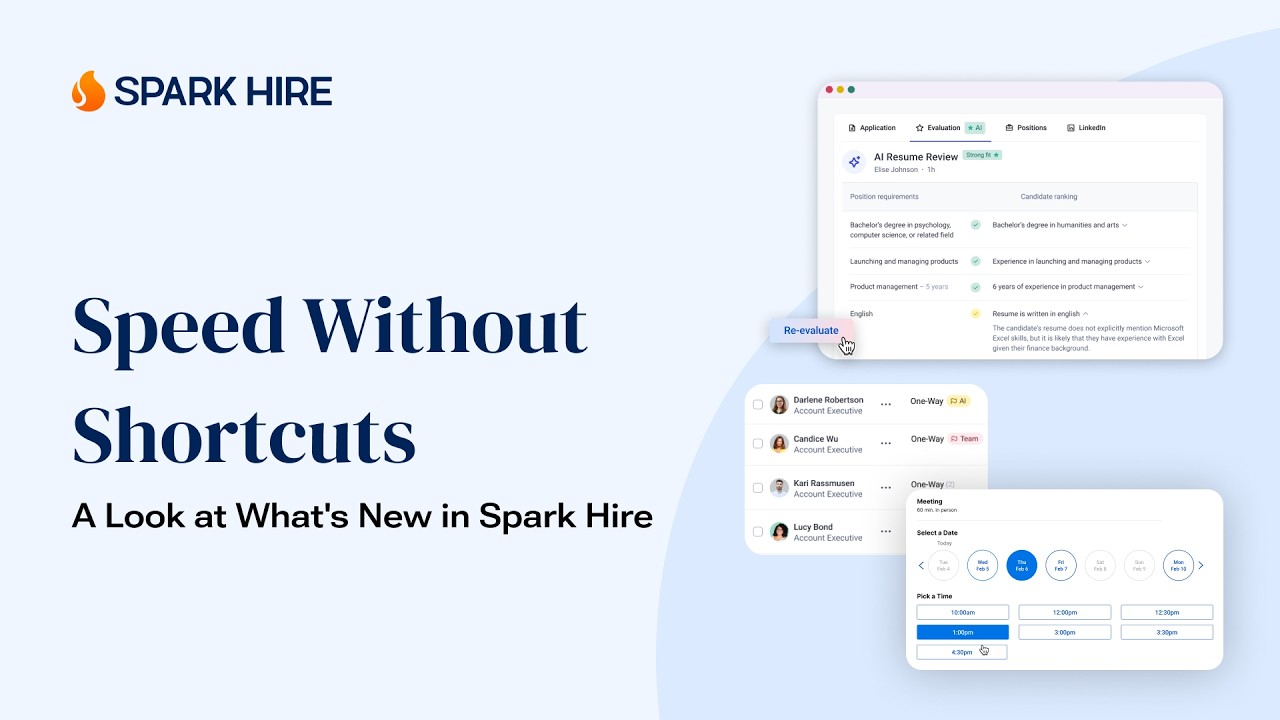
Speed Without Shortcuts: A Look at What’s New in Spark Hire
See what's new in Spark Hire: smarter AI resume ratings, less scheduling overhead, and clearer assessment review, all in one live walkthrough.
Pulling Back the Curtain on Modern SMB Hiring
More applications, more AI resumes, leaner teams. See how Spark Hire's video interviews, AI insights, and ATS work together to help you hire faster.