
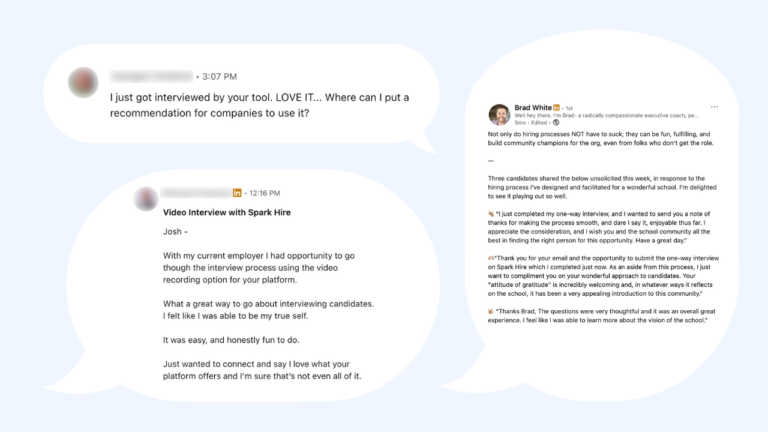
We love that you’re prioritizing your candidates’ experience in your hiring technology decisions.
(Nice work).
But the white rabbit may have led you down a deep, dark hole of scary Reddit threads about how things like video interviews, AI capabilities, talent assessment tools, and other modern hiring software are actually bad for candidates.
We’re here to set the record straight.
And before you say it (yes, we’re reading your mind), you sell hiring software, aren’t you biased?
Yes, yes, we are, which is exactly why in this article we’re handing the microphone over to candidates, so you can hear what they have to say in their own words.
Roll up your sleeves — it’s time to bust some hiring tech myths.
Table of contents
Key Takeaways for Candidates (Employers, You Too!)
- Modern hiring software, when thoughtfully implemented, empowers candidates with flexibility, transparency, and the ability to present their best selves throughout the process.
- Most candidates appreciate features like one-way video interviews, user-friendly platforms, and job-relevant assessments, which help them feel more comfortable and confident.
- Clearly communicate how AI and assessments are used, ensure data privacy, and use validated, unbiased tools to build trust and create a level playing field for all applicants.
- Not every tool will be perfect for every candidate, so it’s essential to listen to feedback and continually improve the hiring experience to make it more human-centered and supportive.
Myths About Video Interviews
Issues with video interviews in hiring? In the era of remote work?
We don’t buy it.
Here’s what people really say about video interview software.
Myth 1: “One-Way Video Interviews Are Impersonal.”
Sometimes people describe one-way video interviews as overly corporate or detached — who even watches them, anyway? Aren’t you just talking to yourself?
You know, questions like that.
While the concept is different than a traditional one-on-one interview, candidates appreciate the flexibility to record responses on their own schedule, in a comfortable environment of their choosing, and often with the option to view questions ahead of time and re-record answers, helping them present their best selves.
We talked to a candidate who used that functionality, and she described it as
“A gracious gift…that feels like you’re being taken seriously. You can contribute in a way you feel good about.”
Hear more about her experience:
Custom features, such as branded welcome videos from the hiring team or hiring manager, and branded experiences that introduce the individual to your organization’s culture and working environment early, can also make the process feel more human.
In a survey of over 20,000 candidates, Spark Hire’s one-way video interview experience was rated 4.5 out of 5 stars for ease and comfort.
Many candidates describe the process as “refreshing” and “user-friendly,” highlighting that, while it’s a new and different experience from traditional video interviews, it helps them feel more comfortable in the process and makes them more confident in their ability to stand out.
Myth 2: “You Have to Be Tech-Savvy to Use Video Interviewing Tools.”
Let’s be honest, trying something new can feel…intimidating, especially if you’re not a tech whiz.
But the idea that you need to be a technology expert to complete a one-way video interview just doesn’t hold up.
Modern video interview platforms are built for simplicity. If you’ve ever used Zoom, FaceTime, or YouTube, you already have all the skills you need.
Quality platforms are designed to walk candidates through each step, making the process intuitive even for those who aren’t tech-savvy.
One candidate put it simply:

The numbers back this up.
Spark Hire’s video interview solution consistently earns high marks for ease of use, with a 9.3 out of 10 rating for both setup and usability on G2.
Real users highlight how the platform “walks you through the process step by step,” eliminating the need for lengthy instructions or technical know-how. Even candidates who are less familiar with technology report that video interview tools are straightforward and accessible.
Not to mention, Spark Hire offers 24/7 candidate support to ensure the experience is seamless.
Myth 3: “Video Interviews Deter Candidates from Applying.”
It’s easy to assume that video interviews might scare off candidates or make the process feel less inviting.
But the reality is that video interviewing attracts innovative candidates and can boost the quality of candidates moving through your pipeline, especially among those who value flexibility, modern hiring practices, and the ability to showcase the skills they highlighted in their resumes and applications.
Candidates with prior video interview experience are often enthusiastic about the format. In a recent Software Advice study, nearly half of the respondents who had completed a video interview said they preferred it over other long-distance interview formats, like phone screening.
Why?
As mentioned, video interviews let candidates showcase their personality, communication skills, and professionalism in ways a phone call or resume simply can’t (no matter how much AI helps jazz it up).
In our experience, candidates love it.

Sorry — typo — candidates LOVE IT.
Far from deterring applicants, video interviews are helping companies attract forward-thinking talent and giving candidates a platform to shine on their terms.
Myths About AI in Hiring
Okay, this one is a little more divisive, and that’s likely because there are many different ways to use it (not all of which are the best).
Myth 1: “AI Will Auto-Reject Me.”
It’s a real worry: candidates fear their application will be filtered out by an algorithm before a human ever sees it. This concern is fueled by stories of “gaming the ATS” and the sense that a single missing keyword could mean instant rejection.
The reality is that while not all AI systems are the same, most are designed not to auto-reject candidates. Many modern platforms use AI to help prioritize and organize applications based on must-have qualifications, but not to make final decisions.
So, while some candidates express frustration about feeling reduced to keywords, others appreciate the fact that AI helps them get to a human faster, especially if the process is clear and fair.

Myth 2: “AI in Hiring Is Biased or Unfair.”
This is one of the most important — and valid — job seeker concerns. AI can inherit bias if it’s trained on biased data or used without proper human oversight.
However, high-quality AI tools are built to reduce hiring bias by focusing on skills, qualifications, and job-relevant competencies, not personal characteristics like gender, race, or age. When implemented thoughtfully, AI can help standardize evaluations, reduce unconscious bias, and create a more level playing field for all candidates.
However, transparency and regular audits are essential. The best platforms are open about how their AI features work, avoid using demographic data in scoring, and regularly conduct third-party bias audits to ensure fairness.
Candidates report that structured, video-based assessments and AI-driven scoring can give everyone a fairer chance to present themselves, especially those who may not shine on paper but excel in person.
Some candidates, especially those from underrepresented groups, see AI as a way to reduce human prejudice — if it’s used responsibly.
Myth 3: “AI in Hiring Puts My Data at Risk.”
With AI handling more personal information, candidates are increasingly concerned about how their data is collected, stored, and used.
The same as our previous note about AI hiring bias, responsible hiring platforms will prioritize data privacy, comply with all regulations, and be transparent about their data practices.
Employers who use strong security measures, obtain explicit consent, and only collect data necessary for the hiring process will explicitly state that they are doing so; if you don’t see this, always ask for transparency in how your personal data is being handled and used.
Rightfully so, candidates want and deserve assurance that their information is safe and won’t be used for unintended purposes.
Myths About Talent Assessment Tools
Talent assessments have a reputation problem. Some candidates see them as just another hoop to jump through, while others worry they’re little more than digital fortune cookies.
But the reality is far more nuanced — and a lot more candidate-friendly.
Myth 1: “Assessment Software Is Just Another Personality Test.”
It’s easy to assume that all assessments are cut from the same cloth, but modern tools are built to do much more than slap a label on your personality.
Assessments, such as Spark Hire’s Predictive Talent Assessment, are designed to measure job-specific behavioral competencies — strategic thinking, teamwork, adaptability, and more — that are directly linked to success in a particular role.
What candidates actually experience through quality talent assessment software:
- A fairer shot at the job: Assessments highlight strengths that matter for the role, not just generic traits.
- Flexible process: Most assessments can be completed at your own pace, on your own time, from any device, and often allow you to pause and return later.
- Actionable feedback: Candidates receive insights into their strengths and areas for growth, making the process feel relevant and supportive, even if the role you’re applying for isn’t quite the right fit for you.
One candidate says: “I enjoyed the virtual interview as it gives employers an understanding of my personality and characteristics before doing a formal interview, which benefits them, and it allows me to see how I respond.”
Myth 2: “Assessment Software Is Biased, Unfair, or Irrelevant.”
The biggest objections candidates have aren’t about the format — they’re about fairness, relevance, and accuracy. Here’s how modern assessment software addresses these concerns.
High-quality assessments are designed to evaluate everyone on a level playing field, using objective, job-relevant criteria. Plus, they are tailored to the competencies required for specific roles, so candidates are evaluated on what truly matters for the job, not just generic abilities.
Often, candidates appreciate when it’s clear how the assessment links to the role and how their results will be used. Many platforms provide easy-to-understand reports and even share individual feedback with candidates.
Address Concerns With Empathy
No hiring tool is perfect for everyone, and not every candidate will love every step of the process.
Some may find video interviews unfamiliar, others might worry about AI, and a few may feel assessments are just another hurdle. That’s why listening to real candidate feedback is so important.
At Spark Hire, we believe that every candidate’s voice matters. We use feedback — both positive and critical — to continually improve our platform and make the hiring experience more approachable, transparent, and human.

The Future of Candidate-Centric Hiring
The future of hiring belongs to organizations that put people first. When thoughtfully implemented, hiring software doesn’t just streamline processes — it empowers candidates to present their best selves and helps organizations discover talent that truly fits.
- For candidates: Modern tools offer flexibility, fairness, and transparency, making it easier to shine and feel respected throughout the process.
- For organizations: A candidate-centric approach leads to better matches, stronger teams, and a more engaged workforce.
By listening to candidate voices, embracing feedback, and prioritizing empathy, hiring technology can become a force for good, sparking meaningful connections and building workplaces where everyone can thrive.
Book a demo and see for yourself.


