
Candidate Screening and Selection
March 20, 2025
Spark Hire's Let's Talk Hiring dives into candidate screening and selection, building a structured process for confident, informed hiring decisions.
In this edition of Let’s Talk Hiring, we’re exploring the laundry list of challenges associated with screening and selection, a paramount stage of the complete hiring process.
For those outside the hiring team, it can be difficult to understand how truly important it is. Screening and selection is the step that sets the stage for everything else, ensuring you’re not just filling seats but finding the right people to fill them, to ultimately reduce the potential for costly turnover.
Screening isn’t just about weeding out unqualified candidates, it’s about paving the way for confident, informed decision-making during the selection phase, which begins with building a detailed, structured evaluation process that ensures smooth sailing once you’ve reached the later stages.
This workshop covers exactly how to do that, and a whole lot more.
Hello.
Welcome everyone to our LinkedIn live workshop here. We’re very excited to have everyone. My name is Gary Schwalke. I’m the chief revenue officer of SparkHire.
And today, we have, Josh, who CEO at SparkHire and Jennifer Howell with the American Marketing Association. So let each of them introduce themselves here quickly, and then we’ll get going. But as they’re doing that, if you’re here and you’re in the comments, just let us know from where you’re calling in, calling in. Sounds like a radio show.
Joining, number one. And then also, if you’re a current or former SparkHire customer, include the little flame emoji. That would be wonderful. So Josh take it away.
I love it. Hey guys Josh Tolan, CEO of SparkHire founded the company or I should say launched it thirteen years ago. So I’ve definitely seen a lot of different organizations and their hiring processes and I’m excited here to be here today with Jennifer and Gary to talk about screening and selection in particular since everybody’s dropping their location. I am in the Chicagoland area particularly up in the North Suburbs and I’m excited to be here today. But here’s the real star. I’m gonna pass it over to Jennifer.
Hi everybody. My name is Jennifer Howell. I’m the director of people and culture at the American Marketing Association.
We are a leading global professional marketing association. We are the essential community for marketers. We’ve got students. We’ve got executives. We’ve got practitioners and academic members, and we aim to elevate the profession, deepen knowledge, and make a lasting impact on the world of marketing. I have been here at AMA for six and a half years, and I lead the people and culture, department here. And I am also in Chicago.
So speaking of Chicago, so we do have some Chicagoans are joining us, but check this out. Montreal, Canada, Ohio, Calgary, Canada, couple of days, Germany, Houston, Texas, Langley, British Columbia, New Jersey, India, Charlotte, North Carolina, where I am, New York, Oregon, Atlanta with the words fire emoji, which is great. Lots of fire emojis there. Barbados, we all have envy for your location. New York City, Poland, and and somebody mentions they grew up in the Northern Burbs of Chicago.
So, very excited to have everyone here.
Thanks for joining us from all over the world especially those of you who are joining at, the wee hours of the evening from other parts of the world. So, thank you for that. Alright. Quick introduction for today.
So, we’re gonna this is a workshop, by design. So, we want it to be interactive. Definitely put your questions or comments in there. We wanna share along the way.
So, put those in the comments and and we’ll be referencing those throughout. We’re gonna go through a quick structure, quick introduction of, you know, what what Jennifer can kinda kick us off. Honestly, with the post that she recently put out there that was really helpful. We’re gonna go through some steps to kind of an evaluation of a screening process.
Talk about how we can fix some common bottlenecks. We definitely talk about AI and automation and screening because that’s obviously a a a growing segment that we’re all curious and interested in and many things many people are doing many different things. And then lastly, we want you to walk away. We’re gonna have a little action plan section.
We’re gonna build an ideal screening process as we thought about some of these building blocks. So, so be prepared for that. So, we also just FYI released a couple of polls on LinkedIn. Would love for you.
We’ll put that in the in the comments here. Check that out. Josh put one out. Comment on that so we can, get some feedback from y’all as we keep going there.
So Josh, why don’t we we we talked a little bit about those challenges. Maybe we start with that poll just here, you know, we can put the comments here and then, we can kick off and and have Jennifer opine on that.
For sure. Yeah. So we ran or I put a poll out there on LinkedIn, got a handful of responses but would love to know everybody in the chat what you guys think of this question. We asked what’s the top challenge that you’re seeing in candidate screening and selection right now and the options were A) too many applicants, b, lots of unqualified applicants, c, slow internal processes, d, AI optimized applications, or other.
And if it’s other, drop your comment. But I’m curious what everybody in the chat is seeing as their top screening and selection challenges. I can say from the handful of responses that I got from people that are in TA, unanimously, the selection was lots of unqualified candidates. So I’m curious and it seems to be consistent with coming in the chat seeing lots of bees in here.
Alright.
Well I think that’s pretty indicative of how everybody’s feeling, about that question so maybe that’s you know, where we dive in. Jennifer, would love to hear from your perspective what you’re seeing in the market and what the big challenges, that you’re facing are.
I mean, I I echo the the b’s and the c’s in in the chat for sure.
For the AMA, think the challenge is twofold.
I’m the only person that does recruiting here. So I have to be really, really smart about my time on the front end and the job market is really intense.
So with only posting it on our website and having it go to LinkedIn, we regularly get more than 2,000 applicants within three to four days.
Yeah, I think there’s probably some of us in this room right now.
So that’s been a really big challenge is this high volume. So where I think the struggle is how do I provide a human approach to the candidate pool? And also thinking about the when I think about the candidates, we’re dealing with a lot of different generations. We’re dealing with baby boomers.
We’re dealing with Gen X. We’re dealing with Gen Y, millennials, Gen Alphas. So we have to start thinking about how do these job seekers, what are they going to get from this experience even if they’re rejected right away because they’re not qualified. So a big that’s been a big challenge for us.
Yeah. And I I definitely agree. I mean, that’s what we see too when we when we post a job. I mean, within twenty four hours, we’re already a 100, you know, a few 100 applications deep and, you know, then there’s a lot of bottlenecks at the front end of the screening process trying to get through those. I’m curious if there’s anything that you’ve seen, you know, in the market over the last few years that has caused that shift where it feels like we’re all inundated with the number of applications that we’re receiving and then as everybody’s saying in the chat, the large percentage of those that just don’t meet the qualifications for the position but you’re still going through the motions of, reviewing them.
I mean, I think bottlenecks can be avoided by good prep work.
So it means like for us TAs and people in recruiting, we have to do a lot of work on the front end.
Do I have the bandwidth to go through resumes?
Does the hiring manager have the time to dedicate brain space to the 50 that I’m narrowing it down to for them to review?
Is there a massive conference that’s gonna pull their attention away and fuel their overwhelm so that they’re not approaching candidate review in the mindset that I want them to enter into this process with?
So that’s been a big challenge. So I build in a lot of application questions that quite literally, like, ask you the things that, like, if I tell you that we need in the job description three to five years experience in this platform, I’ll say how many years experience do you have in this platform? And if it’s less than the threshold, then you’re gonna get an email the next day saying, you know, I’m so sorry we’ve decided to go with, different candidates.
Yeah. Yeah. That’s a really good point. I think a lot of people, you know, over the last few years, we’ve definitely over indexed on removing friction and trying to make the candidate experience as simple as possible, make it easy for everybody to apply. And then there was the birth of easy apply on you know some of the job boards that are out there that are driving a lot of the candidate flow.
But in doing so we forgot about like what really matters at the front end of the process and being very clear about what we’re looking for And I think by implementing something as simple as the right questions on an application, not only can you help, your team filter, you know, who is qualified or who meets what you’re looking for, but also from a candidate perspective, it allows you to get back to them much more quickly because you have that structured data to land on. I mean I can remember when we you know in the height of the pandemic when we first pivoted from being an in office company to being a remote company because of the circumstances We started hiring outside of the state of Illinois which is where everybody in our company was previously and we were just we were getting so many applications but a lot of them were from states that we weren’t even registered yet as an employer and.
Yeah.
And so, we just added some simple stuff to our application of where do you, which state do you reside in? Yeah. And that allowed us to at least prioritize people like we’re already a registered employer in these 12 states. Let’s prioritize those people because the reality is we’re not gonna hire somebody and then go through the whole process of registering as an employer for one employee. And so that alone helped us filter down probably half of the people that were coming in Yeah. Right out of the gate.
But then, Andrew, in the chat, I see, but are they accurate? That’s the thing. Like, there’s always going to be somebody that is going to click. I have the most experience in all the things because I know it’s gonna get me I still have to look at them all. So if I have 2,000 applicants or in a most recent one, had a data roll, we had 1,800 applicants in four days. And out of those 1,800, I looked at and saw the resumes and cover letters and applications for about three fifty.
That is staggering, 18 But out of those three fifty, there was still like, yeah, it’s not in your resume, I don’t see it.
I’m not seeing the correlation to what we are posting and looking for and in your resume. And if it’s not clear in your resume, I’m gonna have to say I’m really sorry. And like, so there is, Andrew, I think there is to the to your statement in the chat. There’s no way around it. Application questions can only go so far. There’s still a lot of like eyes on resumes this will have to happen.
Yeah, for sure.
And that’s a good segue to, you know, we’ve covered this a little bit is that, you know, how do we take a step back and evaluate the screening process? I think, Jennifer, to your point, you you described some things that you’re looking at the situation, the candidate, the people involved in the screening process before you just pull the screening process off the shelf and say, here’s the here’s the standard screening process so as you’re thinking about the you know what is the appropriate process maybe go through some of those steps as things as gates that you’re thinking about and what’s appropriate not only for the candidate and the circumstances where you are?
I mean, my aim so I I do the first review.
So any applicants that come through and, you know, meet the parameters that we have stated in the job that we have in application questions, they get to me. And then my goal is to narrow that to 50, which 50 applicants for a hiring manager, it seems like a lot, and it is for them. But if I’ve done a thorough intake, I am as fluent in the job as I can be. And so I know what they’re looking for. I’m not wasting their time.
From that 50, they are tasked with narrowing it down to 15 to 20 to go to the first step in our process, which is SparkHire. And so our first step of where they get to show up, candidates show up for us is in this one way video interview. And so then out of that 15 to 20, we traditionally have upwards of 80% to 90% of people who are sent that app. Here’s the invite to do the Spark hire.
75% or higher will usually complete it. So it’s a really high percentage. And then the hiring manager is tasked with reviewing those 15 to 20. They have to narrow it down to five to eight for me.
And then my goal from that five to eight is three for the hiring team.
Yep.
That makes a lot of sense. I’m curious and I would love to hear from other people in the chat because I saw somebody make a comment asking if there are any other one person recruiting teams out there but you just indicated how hiring managers are active participants in your process. I’m just curious from your perspective, know, with a one person recruiting team, how important is that to have your hiring managers be part of the screening and selection process when you don’t have, you know, all these specialists on a talent acquisition team to do all of those steps?
I mean, the AMA is a place that we talk about it. We talk about high accountability behavior and empowering our managers, and that’s something that is deeply ingrained in the work that I try to do.
And so if somebody is hiring somebody who’s going to be successful in their role, they have to be active in this process. So my intake meetings are intense.
And so any of my hiring managers, they would tell you, oh, yeah. No, Jen’s a big nerd about it.
But I’m not going to these are people, ultimately. So you have to have some empathy.
Putting yourself out there for a SparkHire interview, it’s not easy. And so like, some of the things so one of the questions one of the statements Jamie made in the chat is I wish 75% would would complete. I struggle with that.
Yeah, we struggled with it too for a while. But one of the things that I loved was being able to record an intro and an outro from the comfort of my living room, being able to record my SparkHire questions. So it’s like, yep, it’s me. And you can look me up on LinkedIn and you’ll see me, it’s still the same face.
It’s personal. It’s not an AI bot screening a resume.
It’s me. So the hiring managers know that I take a great amount of care, and I expect them to do the same. And if they don’t, I I hold them to task for it. It’s not a problem I have at the AMA. Our hiring managers are superb.
That’s awesome. And we definitely wanna get into how you’re personalizing the process and your communication with candidates because I think that does have a really important tie in to your effectiveness in the screening and selection process.
But if we backed up for a minute, you talked about your intake. Yeah. I love to unpack that with you and what it looks like for a hiring manager to do an intake with you, specifically as it relates to how are we figuring out what we’re looking for so we have to know so we can know what we need to evaluate throughout the screening and selection process.
Yeah. I mean, one of the things that we have is a recruitment and selection process map. And so it’s swim lanes of like, here are the things that I’m doing, here are the things the hiring manager is gonna do, this is what this process looks like. So they always know what’s expected of them. In intake, I will ask, who are they going to be working with? What is expected in the first ninety days, in the first year?
What challenges is the person in this role going to face? How often do you meet with them? What are three to five key talking points to share with me? So like, is this a new role?
Who is going to be best suited for this role?
Where are the spaces where I can brag about your department?
What are the best characteristics that can round out the team? So you don’t want everybody to be exactly like you. What point of view are we missing?
Those are the things that I ask and it really makes them think.
And so instead of just saying, Hey, Jen, I need you to hire this person. They have to be really thoughtful. And by starting the process like that, they’re thinking about candidates in that frame and in that lens. And so the intake meeting is a solid hour every single time.
Yep. And are you then taking that and is it a template hiring process for every role or how do you adapt what you’re hearing in the intake process to define what steps are needed in order screen candidates for that role?
I mean, it’s pretty unified because we wanna make sure that it’s equitable, like, for every role. The only time that it’s different is for interns. So for our interns, it’s the process is the same up until the virtual interview.
The virtual interview happens with the hiring manager. And if there’s a mentor, then it’s two people instead of a hiring team of five.
So every other step in the process is the same. So it’s hiring manager review, Spark Hire video interview, thirty minute phone screen with me, virtual interview. That’s it. If there’s an assignment, which rarely there is, that would be likely after the virtual interview. And they would use the virtual interview to inform, get as much more information to fill in the gaps that they need but that’s the outlier.
Yep and so you mentioned on that virtual interview there’s five or so people. How are you determining outside of the hiring manager who is included in that virtual interview? And are they responsible for evaluating different things with the candidates that get to that step of the process?
Yeah, they are. I mean, one of the first questions I ask is who are they gonna be working closely with outside of your team?
Because stakeholder sensitivity is a competency for the AMA. And so can they work well outside of the confines of the immediate team that they have? Can they work well with accounting? Can they work well with technology?
Can they work well with professional communities? Can they work well with the learning team? And so when they tell me that, I’ll say, great. Who from the learning team is going to be on?
Who are they going to be working closely with?
So nobody that a candidate is interviewing with is somebody that they will never see again. You’re going to be working with these people.
So it changes the way that a hiring manager will think about like this person is perfect. They’re perfect on paper. I love their Spark Hire video interview. Jen loved them. I love them.
But what if nobody else on the interview team likes them? You’re gonna have so much stakeholder work to do to justify hiring that person. Like, you have to think about who’s gonna be the best fit for the AMA, not just the role. And so that’s where determining who is on the hiring team is also it really matters.
That’s such a great point on, you know, really, you’re setting the candidate up for success ultimately by understanding what’s required to be successful, not just in the role, but across the company.
Yeah.
And you you kinda think it’s a a lot related to that. There you you mentioned the the diversity of generations that you have applying for roles and the the equitable process. Curious how you navigate, you know, as we think about some of the new tools that are coming out, or or have been around for a while, like the video interview that you mentioned, their behavioral assessments, skills test. There’s a lot of different ways to assess a candidate and they probably all have some degree of implication of like how does one generation see that versus another and in terms of you know of of being equitable. How do you how do you think about all that and balance those things? Because in some cases, it little, some of it is, some of those those those comfort levels and skill sets are part of what’s required actually to be successful in a particular role at this time and place and so, while some generations may be more comfortable with than others, it’s like it’s kind of a almost a requirement.
Yeah. But I think one of the things I mean, the barrier what we found five years ago was the barrier was, I don’t wanna do a one way video interview.
This feels like a test. Or I can’t be thoughtful.
Or I don’t want to do this. Well, in a remote environment, you can be off camera sometimes. But there’s going be sometimes when you have to be we have to see you and be able to read your expression and say, You seem uncomfortable. Let’s talk about it.
This is a requirement in a remote environment. But one of the ways that we have worked with that is by giving people so in SparkHire, if you’re not a current SparkHire customer, we give unlimited think time for all of our questions. There’s literally no job at AMA that is going to require somebody to think on their feet so hard that they have to provide like a life or death response, like in the moment. Like it’s not that kind of work. We’re not surgeons.
So by saying, we want you to think about your response and think about the situation or the task, the action that you took, the result of that action. If you’re reading your answer in SparkHire to me, that’s okay. I don’t care. It’s fine. And if you’re a neurodivergent candidate, having that time to thoughtfully think about it, script it out, be prepared, it’s gonna be better for you to be able to be thoughtful about it.
That’s a space where giving that unlimited think time for us, we’ve found that that’s been a real game changer. People don’t feel as rushed. And if they choose not to prepare, that tells us something. Right. And you keep telling their responses.
Yep. Yes. And I and I wanna back up for a moment because in the beginning of this workshop, you mentioned how, you know, a lot of bottlenecks can be resolved by just preparing ahead of time and so if we back up to when you’re doing the work with hiring managers I want to keep drilling into that with when you’re collaborating with them about what you’re actually looking for. I find that often it’s it’s hard sometimes for hiring managers to really get to what is actually required for the role versus what would be a nice to have and separating those things because the reality is you’re you’re just not gonna get a candidate that’s gonna have all of those things. So how do you help narrow them into what that ideal candidate profile looks like?
And and Jennifer, before you jump in on that, just for those in the comments, would love to see where you see bottlenecks as well. So throw them in there, and we’ll we’ll make sure we discuss those.
I think a bottle a problem that I find is the moment that a hiring manager says, I need a unicorn. I say, well, I would like I would like a Ferrari. That is not gonna happen.
So it’s the immortal words of **** Jagger is you can’t always get what you want. So like my goal is to try and like couch this in reality. Okay, think of it this way. Under the must haves, if they don’t have it, you’re not gonna see them. So I want you to think real And it’s also, if you’re expecting somebody to have ten years of experience in AI, we haven’t had AI for ten years. So I’m gonna push back on it. So I can be the bad guy a little bit of kind of saying, Is it realistic for you to want an intern to have three years experience working at HubSpot?
It’s not.
And it’s also looking at the job description and saying, why are you for a master’s degree? Why are you even asking for a bachelor’s degree? Why? Tell me why.
And you have to think critically, but you also have to have relationships with hiring managers where they feel okay and safe saying, You know what? You’re right. I actually don’t need that. But I do need somebody who can do this. And it’s like, Okay, well, is that tangible enough to ask about? If it’s not in an application, what Spark Hire question can we ask that’s going to tell you that they have experience in this space?
So those are things that are meaningful.
We go through SparkHire questions in the intake meeting.
So that if there’s anything that’s not, we keep SparkHire to five questions. So it’s like, what else is really important?
I can ask that question.
Right.
And phone screen. So what are the things that you have to know about these candidates before you even see them?
Yep. That makes a lot of sense. How are you balancing with hiring managers figuring out the skills that are needed for the job versus the behavioral competencies? For example, you mentioned how it’s so important for I can’t remember the term you used, but, for people to come on board and be able to work with all the different stakeholders that they’re gonna be required to work with. And you can argue that’s a skill, but I would also argue there’s a lot of behaviors That can be a predictor of somebody’s ability to do that. So how do you balance that with hiring managers? And then how does that flow through into the questions you’re asking or the screening steps that you’re taking in the process?
So the funny thing is is that, the AMA has six core competencies, which to be fair, I’ve worked at companies that have said, oh, we have these core values and they’re so meaningful. And then you get there and it’s Really?
Is it now?
But we interview on these competencies. And I’ll tell them to you now. It’s curious. God bless anybody from my organization who has to sit here and listen to this again because I talk about it too much.
Curious, courageous, joyful, grateful, customer centric, and stakeholder sensitive. We interview on these competencies. If not in SparkHire, then in the virtual interview. Every single person on the hiring team has a competency that they’re assigned.
And we have question guides. So it’s like this is And they’ve been trained to listen for the situation or the task, the action and the result. Like, it is very Like, we leave as little room for subjectivity as possible. And we do a lot of bias training.
So it’s like, you got to check it.
So those are things that are really vital for us.
Yep. That’s great.
Katie just mentioned it in the chat. So the must have versus the wish list. So one of the things that always comes into play is if somebody doesn’t have this skill, how long will it take for them to get it?
If it is a one day training with you, then this is a nice to have.
Like, if this can be part of your thirty day plan for somebody and they can nail it in thirty days, it’s a nice to have.
If you don’t have time to properly onboard somebody and upscale somebody, then it becomes a requirement. But if you don’t have time in the first thirty, sixty, ninety days to dedicate to training a new hire, then we got bigger problems than what they do or don’t have on day one.
Yeah. That’s a great point because I think often what you’ll get from a hiring manager is they need to be, very proficient in Salesforce. And when you unpack that, the reality is they’re like, well, if they’ve used HubSpot before, that’s fine. Right. They’re like, well, so Salesforce isn’t a requirement.
If they’ve you know, maybe the CRM experience is the require is the actual requirement, and Salesforce is a nice to have. And to your point, you can get them up to speed on your workflows or whatever they need to know in the first thirty days.
Yeah. And it’s also you know, if we’re hiring for a role and, the TA people in this room are going to know, pitfall is we needed this role yesterday.
Other people are doing this work. We need addition to staff. And so I think when companies are so focused on the work, it stops becoming about what the business needs from a people perspective. And the people drive the business forward. And so you have to recalibrate.
But there’s also a segment of depending upon where you work, there’s an arrogance. It’s the, I work at this company.
And if a company gets name recognition, they’re relying on that to drive candidates. And then that is reflected in laziness and job postings. So it’s like you have to be super intentional in the intake meeting, in the job description, in the job posting, in the questions that you’re asking in SparkHire, in the questions that your screener is asking. If you do that work ahead of time, that is going to do a lot of the filtering out of the unqualified people that you’re trying to like, I need to get to the meat of this.
And it does take time. But if you set up a good structure and a good plan of attack for it, then people are like, okay, I know what to expect.
This is this is how we do things.
Yep. A little twist on that. Jay brings up a really good point, which is that in some cases, have, call it a transformational role, right? Where it’s you need to bring somebody in who has the appropriate skill sets today, but you really are also looking for skill sets that allow them to take the the team department to the next level because of where the growth is headed. And sometimes those can be a lot more challenging to define and find.
And they can be. And that’s why those are what is the requirement? The requirement might be, you know, experience in a start up.
It might be being the first person in a specific role. It might be finding a new audience for your company.
And then that can be supplemented by a Spark Hire question that’s, tell us about a time when you came into a role that didn’t exist before. How did you, outside of the job description and the job posting that you responded to, how did you make that role your own?
Yep. Like that a lot.
So it’s like these are things that you can ask and you should be asking. Like, you should know this stuff before somebody starts. They’re going to feel set up for success if you do.
Yeah. We’ll put a pin in that because that is perfect place to start when we come down to the building your screening process. But what what is clear in your description here, Jennifer, is that it’s a continuum. Right? You’re starting with the intake process, which is really vetting, do we actually know the problem that we’re seeking to solve and what what is required for that role?
That person in order for them to have success to contribute not just to the role but to the organization. And then how does that reveal itself in the job description? And then how do we identify that in the question sets or whatever the whatever our screening process is. It’s it you know, that you can see this common theme and weave, and I think a lot of times in the tyranny of the now, we pull something off a shelf because that’s the process we used before. We have a they’re they’re done discreetly, and then we run it through the process, and then we wonder why we have the bottlenecks. Because it’s Yeah. As Josh has heard me say a thousand times, slow is smooth and smooth is fast.
So get get it right up front. Sounds like that’s really a big part of the success that you’ve had.
It is, but at the same time, you have to be amenable to change.
You know? And I I think, you know, one of the things that was said in the chat about, you know, ageism and all of these things, it goes both ways. It could be somebody who’s 21, 22, or it could be somebody who’s 58, 59. And it’s kind of like determining what the needs are and determining like what are the skills that you’re missing? You’re missing innovation. Okay, cool.
Somebody who has gone from being in customer service to being a salesperson to being an account exec to being an advertiser, then to a marketer, holy moly, they have had to innovate how they think every single time.
And recognizing that when you’re looking at a resume and saying, oh, wow, there is innovation in tenure. There is innovation in experience. And acknowledging that, recognizing it when I’m looking through a resume that can help to alleviate some of the ageism and kind of saying, wow, you had to jump around a lot. I’m not looking at it of, dang, you don’t have a whole lot of tenure. The reality is that people don’t stay at jobs for more than two years. So like, why are we still abiding by this old fashioned thing where you have to work somewhere for twenty five years? It’s not a thing.
Right. Right. Well, and it you bring up a good point too there. So so you have that expertise, and then now you’re working the next phase is working and putting in front of the hiring managers and the stakeholders who may not necessarily have that expertise. So how do you think then about a common rubric by which you’re going to assess and maybe either train or educate people to open up and think more broadly about innovation as an example?
One of the questions that I ask in intake is, is there a particular industry that somebody comes from that would be helpful?
When hiring managers are asked that, they usually are stumped because then they realize, well, everybody that we have comes from this one environment. You know what? We actually could use, you know what? Let’s just leave it open.
And so then that sort of starts that conversation of like, oh, somebody who has done this job already, great. How long are they going to stay?
Somebody who is ready to make this leap into this role, they’re eager to learn and they want to learn. They’re probably going to stay.
So those are some things to really consider.
But what that requires from talent people, like we know, we spend hours looking at resumes, hours looking at resumes.
And so it’s sort of translating that in our brain of what does innovation look like? I have the intake meeting notes and the job description on one screen, resumes on another. I’m endlessly looking, endlessly checking myself.
Am I looking at the right things?
And that’s my responsibility because every candidate deserves my attention, every single one of them.
I’m curious. You mentioned being adaptable throughout the hiring process.
How are you calibrating with your hiring managers as applications are flowing through and you’re screening resumes or you’re doing the SparkHire interview? How are you calibrating with hiring managers throughout the process to make sure, know, if see if there’s any changes you guys have to make to your criteria or to what you’re looking for?
Yeah.
What I found in the past has been if it is particularly if it’s a new role, if it’s data and strategy or if it’s data and business operations, then it’s we get a ton of people that have business operations or data.
And so it’s kind of like, okay, well, if we need both or we’re over indexing on this side, there’s nothing over here. Am I looking for the wrong things?
And so those are the times when I’m furiously Zoom chatting hiring managers to say, I’m getting all of these data analysts, but I’m not getting anybody with this. So that’s usually where I recalibrate. I also use feedback from candidates to tell me.
If they get into SparkHire and they’re not able to answer the questions that we’re asking, then I’m kind of thinking, Jesus, did I set them up to fail?
I don’t want And so that’s why having like a very solid, I am thinking about all of this at the front end, then I can let it flow. And the longer that I do this, the less bottlenecks I have or recalibrating I have to make. I’ve gone beyond the days of having to do AB testing on job titles.
Yep. Here’s a good question related to that is from Tanya.
Put that on the screen real quick. At what point in the screening process is it best to ask questions related to company values? I think the corollary to that is culture fit.
So we have six core competencies. And so it’s the things that we have in common regardless of the roles that we hold.
For interns, they’re only interviewing with me and the hiring manager and or mentor. So that’s three. So I build three competency questions in Spark Hire. If it is for a normal role, a full time role that’s an individual contributor, I usually take one competency and then the other five will take one each.
And that’s in the virtual interview stage.
Got it. And so so the and presumably, those core competencies are something that, like, it’s right out there front and center for everybody to see, right, in in the job description, presumably, and and on materials?
Or do you wait?
We kinda wait. I mean, some of I these I think it’s also it’s meaningless unless you’re experiencing it. So like me saying to you, if I were to say to you okay. So, Jay, in the chat, if I were to say to you, one of our core competencies is joyful, how would you interpret that? You might interpret that to be, oh, I have to be happy all the time.
What kind of weird monster are you? Are you a robot?
Joyfulness is not being happy all the time. Joyfulness is resilience. Joyfulness is understanding that all you have of me is on the screen.
And so how I show up for you, it matters.
And then what you take from that onto your next meeting, it permeates. So if I am a toxic black hole of suck, it’s gonna rub off on you. Then you’re gonna leave that black hole of suck and take it to somebody else. So for us, joyfulness is that. Whereas I can’t really say that in a job description. You’re gonna be like, joyful? What kind of nonsense is that?
Right.
So these are observable competencies.
Yep.
And so that’s not something that can be gauged in a resume.
Yeah, that’s a great point. Okay.
Right. Exactly, Jay. It’s subjective to either professional or personal. Grateful is another. So it’s like grateful for what?
Well, it’s like, do you make gratitude a habit?
When was the last time that you thanked somebody in the workplace?
If you can’t come up with an answer, I assure you this is not the right place for you.
Yeah. That’s a great point.
Alright. Well, in true livestream fashion, Josh is having computer issues, so we’ll, we’ll see if he’s able to join back in. There he is. He’s back on stage. There we go.
My whole computer and everything just went black. But Yeah. I couldn’t see you guys.
Like, this is what happens. Yeah.
There’s no there’s no take delay here, folks, and I’m dating takes and my computer just started overheating, I guess.
Yeah. But I’m done. Alright. So let’s let’s pivot over to AI and automation and screening. There’s a a obviously a lot of discussion, people on multiple sides here.
So as we get started in this, we’ll have a little conversation that and Josh, you can kick us off.
But before we do that, we’d really love to hear in the comments, you know, basically, your exposure to it, what have you seen work well, what have you seen not work so well, you know, unintended consequences of some of this, and, you know, share your experiences as we as we go through this and then I can bring that up during the conversation.
Yeah. Love to see what everybody has to say here as everybody’s responding in the chat too. I think it’d also be good for us to dive into just as we’re talking about AI and automation in general, Jennifer, some of the great examples and things that you do to still personalize the process for candidates even things like the LinkedIn posts that you make just to tell everybody who applied for a job, how many applicants you received and how what they can expect in terms of, hearing back from you guys. I think you know, when we’re all trying to make things more automated and more efficient, it’s still important to maintain those, know, personalized touch points.
Yeah. And that just related to that too, I think it’s the the being a how do you balance 1,800 candidates in four days with the need to the the the desire to still wanna have that personal intake, but at the same time, not taking so much time that it actually negatively impacts the experience. So there’s all these variables to balance. It’s really stressful time.
I mean, one of the things that I do is in our applicant tracking system, and most have them. I can’t imagine one that doesn’t, have triggered emails. So almost every organization has that, Thank you so much for applying. This is what the process looks like. We also put the hiring process in the job posting.
Fun fact, it’s a cool way to be transparent.
But every time that there is a transition from a resume comes through, I know that it happens. If somebody has moved through to hiring manager review, the hiring manager gets an email so that they know. When they say invite to Spark Hire, I am notified so that I can send them through. But then also say, here’s what to expect.
Which is then echoed again during the intro video that I record. When they’ve completed it, an email goes out to say, thank you so much for your time. We’re so grateful. Our hiring manager is going to review it. We will get back to you soon.
So that we are closing the loop in a reasonable time. So nobody who applies at AMA is not going to get ghosted. It’s not going to happen.
Right. Got it.
That’s interesting. I feel like that’s a big place where a lot of organizations miss are those touch points that happen in between steps or don’t happen in a lot of organizations. And I find from a candidate experience, that’s often where candidates start to make assumptions about your interest level or that you’re never gonna get back to them or Yeah. You know, those things start to fester, and they move on and go somewhere else. So even if there is a five day gap in between step a and step b, whatever that is, having some type of touch point in there to again reset expectations for when they’re gonna hear back from you, reset expectations as far as what happens next in the process. Those touch points like, well, that’s not a screening step.
Those are part of the screening and selection process because it keeps candidates engaged and informed, and those are the candidates that are ultimately, you know, gonna continue in progressing through your hiring process.
Plus, also, think of it this way.
People aren’t going to work for a machine.
They’re people. We’ve all been a job seeker at some point. And so their experience matters. Their experience with us, if we hire them or not, it matters. And their experience matters. What they’ve learned, what they’ve developed, every story, every anecdote, everything that they have put in their resume or a cover letter or their Spark hire, they’ve spent so much time thinking about it, worrying about it, trying to frame it in a way that is going to resonate.
It’s a lot on your heart. And so from the standpoint of an employer, you are also a human And you want to be able to hire the right people for the role that you’re recruiting for. And it’s worthwhile to get to know people in that process. And so there’s only so much AI that you can use for that. And on the flip of that though, I see it in resumes and in cover letters all the time.
It is such a boilerplate that I’m like, Okay, this is not super specific. Like, I would like to see something more specific.
And so it’s hiring managers were worried that people would be using unlimited think time to type in a chat GPT.
Well if their responses aren’t specific to experiences that are in their resume, it’s going to fall flat.
It’s like AI can only do so much.
Yeah. So it sounds like and, you know, what it looks like we’re hearing in the chat too is that AI and other automation tools, they’re helpful and they serve a purpose, but they’re not it’s not the complete picture. Right? And that goes both ways even when candidates are applying for a role or interviewing at certain steps.
Like, actually, when I’m screening candidates, like, I love to know how they’re applying AI to what they’re doing because that will be a part of their job. So I think that’s an important thing, but it has a place in the process. If you’re using it to give me the boilerplate cover letter and it’s like I can read through it, it’s like, you know, I I probably don’t think you’re that interested in the role like you could tell the difference between a candidate that’s put the effort in and somebody that’s not and I think a lot of this also goes back like if we touch on the candidate experience here too and we just think about the screening process and whole and what our goals are really from a talent acquisition standpoint is like we a good screening process is one in which we’re helping people make sound decisions, and that is not only us and TA, and it’s not only our hiring managers or stakeholders in the process, but that also includes candidates and so I think that’s like a really good takeaway here as we think about your touch points and the transparency you insert into your hiring process and in all the screening steps and all the different communication touch points that happen between those screening steps.
The information that you give candidates allows them to make a decision. Do I want to proceed to the next step of this process? And if that information is clear, they can make a sound decision. And if that means they say, no, I’m not gonna proceed to the next step of the process, that’s a good thing.
That’s okay.
Yeah. And that’s why, like, we one of the things is being transparent in the job posting itself and saying this is what to expect, I don’t know why you wouldn’t do that.
Once somebody does Spark Hire, if they move forward The email that they get if we don’t move forward with them is, Thank you so much for giving us an opportunity to get to know you a little bit better.
We’ve decided to move forward with another candidate. If they meet with me, the very first thing that I say after thanking them for their time is thank you so much for giving us the opportunity to get to know you better. I really liked this example that you showed in SparkHire about x, y, z.
That’s such a great point.
And if they make it to the virtual interview, the first part of that interview is with me and my colleague, and we tell them, Here’s who you’re meeting.
Here’s what their personalities are like. This is the kind of questions you’re likely going to get. Here’s what they’ve been trained to death to listen to in your response. It’s okay to say, That’s a really good question.
Let me think about that for a second. Think about the situation, the task, the action, and the result. Be clear. We’re giving them all of this information.
I want them to be the best version of themselves that they can be. It benefits us.
Benefits And if they don’t get the role, the best compliment that I can get is, What a great experience that I had. I think so much more of your organization than another organization because how I was treated in the process. That means so much to us. Yeah.
And that means six months down the road, if I’m hiring for another role and I’m like, you know, I talked to that person. Like, they were the number two, but God, you know what? Can we reach out to them? And because of their experience, they’re amenable.
So how you treat people in this process and how mindful and thoughtful you are in this screening process, it matters.
And it like it’ll pay off dividends later.
That’s such a great point. It’s a perfect segue to kind of the last segment, which is this idea of constructing, you know, a solid or I would say more of the elements of a screening process because they’re all going to be different depending on company and role and what have you. But before we go back to the pin we placed earlier, picking up what you just described which is this this concept of progress like, there’s an investment on both sides through each stage. Right?
There’s a progressive revelation of information and there’s places where you ask things Where the context is appropriate, and there’s others where it makes sense to to wait on that. But what stuck out to me was the idea of when when a candidate goes from one stage to the next, preparing them for what’s ahead. Yeah. Like, setting them up for success rather than like, okay, now you’re moving to the next stage and they have no clue of like who’s involved and what are you looking for and why are we here because the worst thing that happens to your point is you don’t do all that.
You you think you have a complete picture but they don’t have the complete picture of how you work and how you think. You go through all of that. You go to an offer, and they’re like, I’m just not comfortable.
Yeah. And, like, we have an offer acceptance rate of, like, 98% over the past four years.
Wow. That’s incredible.
But it’s also my hope is as a talent person, what do you want? Like, if you are a talent person, what you want are candidates who know what they’re doing. You want candidates who are clear, who are concise, who can contextualize something, who can tell a good story, who can work within the confines of the timeframe that they have.
If I don’t tell them that that’s what we are looking for, they might not ever know. So my hope is that somebody comes away from our process smarter.
And if they land another job somewhere else, if a tiny piece of information that we gave them along the way helped them, Yep.
That’s all I want. These are life skills. I’m never gonna be independently wealthy. I’m never gonna be So like, we’re all gonna have to look for work at one time or another.
So how can we do that in the best possible way? So I’m here to teach. And I’m here to teach hiring managers how to interview candidates, what to look for, how to check for their own personal biases, help them be prepared, help candidates be prepared. And that results you know, offers not being turned down.
It it results in people staying. It like, being thoughtful in this way, it pays off in really long term meaningful ways.
Right. Absolutely. And I think as an employer too, that’s a sign of what things will be like post hire. Right?
Yeah.
You know, the reality is like when we bring somebody on board, we want to set them up for success.
And so why wouldn’t you do that in the hiring process if that’s what you’re gonna do in real life if they work for you?
That’s ultimately how you’re going to see how they perform
In that type of setting.
And so I feel like it’s it’s a it’s a it’s not an easy thing to do, but it’s an easy win Yeah.
If you do it.
Because it’s also there’s a there’s a piece of this where and I remind hiring managers of this a lot.
Candidates are trying to think about their experience. They’re trying to think about the job posting. They’re trying to think of what a hiring manager wants to hear.
And it’s like, I want you to tell me what your experience is, not what you think we wanna hear. And if I’m clear with you as a candidate on what to expect every step of the way, I want you to be your most authentic self. It’s what’s got you here.
We’re not gonna get some weird artificial version of you when you start because you’re gonna be spending thirty seven and a half hours a week with us. So be your authentic self. It’s what makes you you. That’s what we want.
So if we can provide a psychologically safe space for them to feel that way, we are going to get the best out of them in this process.
Yep. Yep.
That’s deep feelings about this. I know.
This is You can tell.
The tax rate. That one’s evident.
So, Gary, I love to turn our attention to so, you know we’ll definitely get this out to everybody but we created a whole guide on our website about screening and selection so we’ll definitely drop a link or send it in the follow-up email I’ll leave it to the team coordinating that, to get into your guys hands but one of the things in this last part with these last few minutes we have here I just wanted to talk you know we summarize at the end of the guide of a few things the building blocks of a good screening and selection process and that’s starting with your goals, mapping your process, over communicating the whys and staying flexible.
I feel like we’ve touched on a lot of those things in this discussion. We talked about at the front end of the process starting with the goals and working with hiring managers to figure out what they really need. We talk about over communicating the why in a lot of the, candidate communication and those things that are happening in between screening steps. So it’s really transparent for candidates and they know what to expect.
We talked about staying flexible in terms of being adaptable throughout the process, calibrating with hiring managers if changes need to be made mid process. One of the things we touched on, which is really where I want to drill into now in these last few minutes here is mapping the process. We talked about how you have a somewhat standardized process across all these different roles. We also heard in the chat, about how when there’s a position that opens, hiring managers wanna move fast.
They need the person yesterday. There’s this eagerness and anxiety of I need the person now.
Yeah.
So if we go back to the beginning of the process, I don’t wanna talk about mapping the process in terms of the steps that are needed. Let’s talk about how you set hiring managers up for success and make it very clear what they’re accountable for and what those timelines are. So the hiring process moves at a pace in which you end up with the best outcome.
Yeah. I mean, I I’ll I’ll use an example that’s current right now is, we are looking for, an accounting intern.
And so we have 21 candidates in SparkHire right now. And so our hiring manager and our two mentors, I told them, I need your feedback on these candidates by end of day Thursday. So end of day today. I will be you will determine who is moving forward. I will know on Friday. I will schedule those phone interviews for next week. Like, whatever you don’t get to, like, count on me harping on you because I will not leave my candidates sitting, period.
So they have to be invested in this process. And the moment that they stop, then it becomes impersonal, and I can’t have that.
I assume, Jennifer, that you your very rigorous intake process, that’s a big part of it.
Like Yeah. Here’s what you, the hiring manager, can expect in terms of the process. Here’s what I’m expecting from you in order to make this a success for us and for the candidates.
Yeah.
Yeah. I mean, you have to be intentional. It’s kind of like my parting words is be intentional.
Don’t be afraid to be visible. Don’t be afraid to ask questions. Like we get a lot.
I mean, one of the things that we started saying and I say it in my videos in LinkedIn when we close a position is we get a lot of personal outreach from candidates.
And it’s overwhelming for people who aren’t in people and culture or talent acquisition, and it can be really overwhelming. So I give everybody a script. If somebody reaches out to you on LinkedIn, if you feel bad about leaving them unread, here’s a script of saying, like, if you have not applied, please do so now. We can’t consider anybody that’s not.
Please refrain from personal outreach to our team members. Like, they’re not part of the process. Like, it’s okay.
Things don’t have to be perfect.
Like, if you’re holed up on doing video interviews is my background screen is weird. My camera is kind of busted. Like, it doesn’t have to be perfect. Like, be authentic. It’s okay.
Don’t let perfection be the enemy of the good in your process and be okay. Be open.
Yep. That’s great. This has been so helpful. And so just as we wrap up here, any comments, any things that we did not cover or lingering questions out there, put them in the comments real quick.
We can get at those here quickly. But, as Josh mentioned, we will follow-up with the screening and selection guide. A lot of it evidenced and brought to life here today by Jennifer, so thank you for that. That was amazingly helpful.
So many great points, and we’re gonna honestly, we’re gonna take some of those and, put a little bow on it and make it available to folks. So appreciate you being so generous with your your thoughts and experience here today.
Of course. This is my very favorite thing to talk about. So if there’s if there’s anybody on this call who’s like, I wish my process was different. I don’t know how to do this.
There was a question earlier of how do you what questions do you have for these competencies? Reach out to me. I’m on LinkedIn, I love to talk about it. So please feel free to reach out at any time and I’ll I’ll get back to you as soon as I can.
That’s awesome. Jennifer, thank you so much. And in our follow-up to everyone, we will include our LinkedIn profile. So definitely connect with us, reach out if there’s anything we could help with.
Doesn’t don’t hesitate to hit us up.
Yeah. Excellent. Well, thank you. Jennifer, Josh, stick around. Otherwise, everybody have a great rest of your day or evening depending upon your geography, and, really appreciate you spending time with us.
Take care. Bye, guys.
Bye.
More Webinars
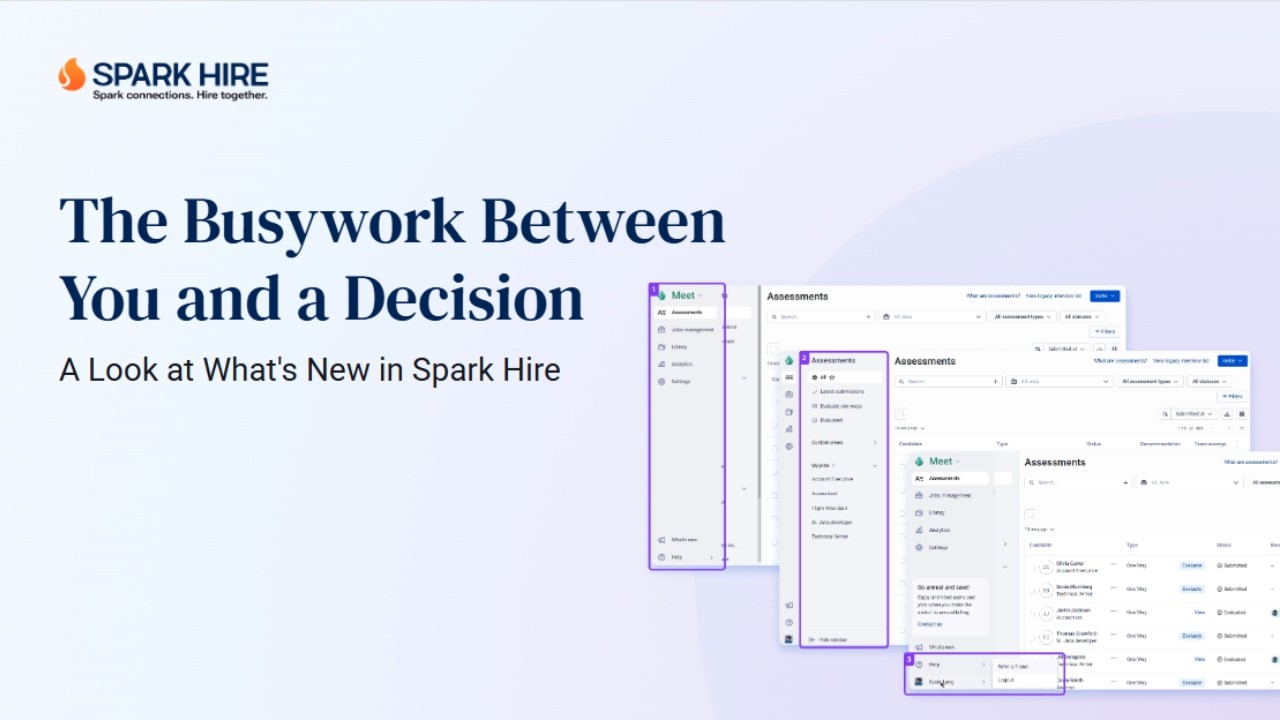
What’s New In Spark Hire: Less Busywork, Better Hiring Decisions
Spark Hire's Alisha Garlow and Ori Horvitz cover new updates for less manual work: smarter resume ranking, automated references, and AI interview sets.
Hiring in the AI Era: How to Embrace and Evaluate the AI-Enabled Candidate
AI-drafted resumes and coached interview answers make candidates harder to read. Hear a panel on evaluating AI-enabled candidates fairly and at scale.
Hiring in the Age of AI: Ethics, Authenticity, and Tech
AI makes hiring faster, but it also makes a polished answer easier to fake. Watch hiring experts on using AI for scale without losing human judgment.