
What’s New In Spark Hire: Less Busywork, Better Hiring Decisions
July 22, 2026
Spark Hire's Alisha Garlow and Ori Horvitz cover new updates for less manual work: smarter resume ranking, automated references, and AI interview sets.
Screening resumes against a full list of requirements. Chasing down reference checks over email. Starting interview questions from a blank page. These are the places hiring teams lose time they don’t have.
In this Spark Hire customer webinar, Alisha Garlow and Ori Horvitz walk through Spark Hire’s latest updates, built to cut down manual work and sharpen the signal your team acts on:
- AI Resume Review with Knockout requirements: Rank candidates against the must-haves that actually define the role, not a flat list of qualifications
- Automated Reference Checks: Collect structured reference feedback as part of the hiring workflow, without a recruiter chasing every email
- AI-generated One-Way Video Interview question sets: Go from a job description to a role-specific interview in seconds, fully editable before it’s sent
- Unified navigation: Move between hiring workflows without hunting for where things live
Hey, everyone.
Welcome.
We will give everyone a minute or two to jump in. Good morning. While everyone’s jumping in, I would love to know where everyone’s joining us from, and if there’s any specific features you guys are all excited about, I’ll pop it in the chat. Let us know.
I’m in Chicago, which has been very foggy and smoky lately, but it’s clearing up and getting nice and warm now.
Oh, we got a nice range of people all over.
I’m originally a Michigan person myself, so I love seeing Michigan represented in here. Love that.
All over the place. Okay.
I see Toronto as well. That’s nice. And Tel Aviv.
Okay. We got Taldiv, Indianapolis. You can’t hear me. Can everyone else hear me?
I can hear you.
Okay.
Awesome.
Thank you so much everyone for letting us know. We’ll go ahead and we have a good number of people here, so we’re just going give it just another minute or two. And right now, you’ll see actually, Dror just jumped in there. So before we even get started, I’ll let you folks know we have Dror from SparkHire here and John from SparkHire here monitoring the chat. So as we talk of his questions, they’ll go ahead and be able to answer them for you right within there, okay? So don’t hesitate to pop them into that chat while we’re going ahead and going over everything.
All right, it looks like we have a good number of people here if you want get started.
We’re happy to get I think so as well. Okay, so I’ll start by introducing myself. Nice to meet you all. My name is Ori. I’m the VP of Customer Experience here at SparkHire. Really excited to be here with you. I have Alicia with me here today.
Alicia, do you want to introduce yourself?
Absolutely. My name is Alicia. I am the Spark Hire. I am the manager of customer success here. I run a global team. I’ve been with Spark Hire for about five years, so I’m a true Sparky person here through and through, and I’m excited today to showcase a lot of different fun things with you folks and really help you see, you know, how there can be less busy work and how there can be better hiring decisions together.
Yeah. So before we get started and now we know where everyone is from, really excited to be here, I wanna make it clear that this session is being recorded, and we’ll share the recording with you as it finishes. So don’t worry if you wanna skip a bit or you enjoyed it so much that you wanna hear it again. That’s completely understandable.
And, yeah, today’s session, we’re gonna go through a few exciting new features that we rolled out. And if you haven’t seen, we’ve also talked about them in the product spotlight email that went out just a couple of weeks ago. I think overall, the theme is making sure that you spend less time doing manual work and making sure that you spend your time on actually where it actually matters and making smart hiring decisions. As we all know, as recruiting teams, there’s a lot of work that you’re doing that could be automated, and we actually automated a lot of it. And what we wanna do right now is to take you through that and making sure that you spend your time where it actually matters impacting company goals through strong hiring. That’s basically the idea.
We have a bit over thirty minutes to go over everything today, and we’re gonna leave some time for questions at the end.
So, yeah, let’s go over the agenda really quickly.
You can see it right here. And before I dive in, I’m gonna share with you that we’re gonna go through features from two different plans that we have. One is Recruit, and the other one is Meet. Recruit is our applicant tracking system, and Meet is a combination of one way video interview and other cool features.
And actually, they work really, really well together. Now I’m showing that because you might not have access to all of these plans that we have here. But if you’re interested in what you’re seeing today, we’re going to drop in a survey later. And you can answer that survey and your customer success manager will reach out to you to give you all the details you need to know.
So feel free to jump in. Alicia, anything I missed, or can we just, start?
I think we’re good. Let’s get started. Let’s take a look at this agenda and jump right in there.
Perfect. So we’re gonna start at the top of the funnel, AI resume review, what is also known as CV screening. This is where a lot of time is being spent, and we’ve done a lot of work to make sure that you’re focused on the candidates that actually matter. We’re gonna then jump towards the end of the funnel to the automated reference checks, another point in time where you can spend a lot of time chasing references. And we actually have a really strong solution that would help you make sure that all the data from the different references is located in a single place and that everything is automated, so you just need to go through everything and make the right decision.
You wanna take us through the rest of the agenda, Alicia?
Yeah. Absolutely. Then we’re gonna jump into the AI assistant, which is where gonna go ahead and review how to utilize that and how to set yourself up for success for those one way video question sets, those questions that candidates are gonna provide that video response from for. And then we’ll take a look at some upcoming features.
We’re gonna do a quick demo of the unified navigation that’s coming up, so you all are gonna be some of the first people to get a sneak peek at it, as well as talk about role aligned AI video review that’s happening. So we’re really excited about that. Now, obviously, we are always sending and shipping a lot of things out and creating a lot of new things, so you might not have a chance to we’re not gonna have a chance to review all of it today. I’m gonna pop in the chat a link that will get you to our roadmap to review upcoming things as well as things that we’ve recently completed.
So if you wanna take a look at that, it’s a great resource to have and to be aware of.
Here it is. So let’s get started. Yeah. So we’re gonna stop the presentation really quickly, and I’m gonna share my screen.
Awesome. Alright. Alicia, let me see it, Orey.
Perfect. So right now, I’m seeing the There we go.
There it is. There it is. We’re good now.
Perfect. Okay. So I’m in the Recruit platform, SparkHire’s applicant tracking system.
And what we’re gonna do is we’re gonna go follow the position of a software engineer and specifically a candidate called Brett Hart. And where I wanna start is actually with this little star here with the AI next to it. And this is actually the job of our AI resume review. And you can see that AI resume gave it gave it a strong fit, as you can see here. Now why did it gave give it a strong fit? Let’s go into the candidate page.
And if I scroll down here under evaluation, you can see a few things. First of all, can see the summary of AI resume review. In this case, this candidate meets all the different requirements, and there’s no concern. But we’re going to change that in just a minute.
If you want to go through even more details, you scroll down here and you see the specific requirements and how specific candidate is ranking against these requirements. Now you might ask, where is the AI resume review engine taking these specific requirements? And that is a great question. So if I go into the position itself and I go into the position description, you can see here two fields.
One is the requirement field.
This is a public field. You can see here the different requirements, and these are public. It’s on your career website, on the different job boards that you’ve posted it.
And below that, you can see interior requirements because sometimes there are just some requirements that are important for you, but you don’t want to publish them. So here, you have the ability to use these internal requirements, which are not public as well. This is a great option. If you haven’t used it, we strongly recommend that you use it.
The AI resume review takes all of these requirements and assesses them against the resume that the candidates are loading. Now let’s go into the step itself. If you go into the workflow and click on the resume review, you can see here that actually this step is auto started, meaning that as soon as a candidate adds the resume, the area review assesses it. If And you scroll down here, you can see even what are we doing with each specific ranking.
If it’s a strong fit, we continue. If it’s a low fit, we leave you to review and choose what to do with it.
Now you can see here that we can actually choose public requirements or only internal requirements. We can choose both, and we can choose only internal requirements. But there are situations where a specific requirement is just simply a must. It’s a must. Let’s say, for example, you’re hiring and you need a specific license or you need a specific language. Or in this case of the software engineer position, you need to know a specific programming language, for example.
And the fact that this is a great candidate that knows everything about programming in general and has a lot of experience, but he doesn’t know that specific language makes it a low fit for you. So what do we do in these specific situations?
What can we do?
You can see here that right now we’re choosing a flexible match. That means that the AI resume review assesses the different requirements and gives each one a different weight and then assesses the fit overall. But if I choose strict match, that gives me the ability to have specific requirements as a must. And if these requirements are not met, that means that this specific candidate is actually not a good fit.
So let’s go and do that right now.
If I go into the description here, description of the position, and let’s say I’m adding a new internal requirement in here. You can see here I’m adding this internal requirement.
Oh, I actually have it already in. Sorry. You can see must know how to program in the language, the best language in the world. This is a made up language.
Obviously, no candidate knows how to program with it because I just made it up. But for the purpose of the demo, I think it actually helps. What you can see is the moment I added something to the requirements, you can see this banner popping up. And this banner allows you to reevaluate or a single candidate or all of the candidates in the pipeline.
This is really, really useful because when you hire, sometimes you realize you need additional requirements and instead of going through all the CVs again, you can just reevaluate them. This is a really strong feature.
I love this. We recently hired, and the fact that we can go ahead and reevaluate was so helpful.
And the fact that we could add in internal and external, so many strong fits.
I realized that I can actually aim higher. So I changed the requirements for four years of experience and then click the reevaluate. And actually I got only, you know, the best candidates at the top and it really saved me a lot of time and made hiring much more significant. So this is great.
I love that.
So what I would do right now is I actually click the reevaluate and see what happens to this candidate that we’re following. But because this takes a minute or so, I actually duplicated this position. You can see here the software engineer position. It’s exactly the same.
The description is exactly the same. You can see here the meta programming language that I’ve added. And you can see if I click on workflow that this is actually strict. Now if we go to the candidate, which again is exactly the same candidate as before, it has the same resume review, but right now it’s listed as a low fit.
If we’re going into evaluation the same place as before and we’re scrolling down, you can see that this candidate actually fits all of the different requirements that we’ve had before, but it doesn’t fit the made up programming language that I’ve added here. And for that reason and for that reason alone, this is considered a low fit. So this really, really helps you save a lot of time and focus on the candidate that actually matters.
If you have any additional questions about this feature, Alicia’s gonna drop now a help center article that takes you through that feature in-depth and you can read all about it in ARSA review in general. And of course, you can also ask these questions over chat and below and John here would answer these questions for you.
Great.
Awesome.
Is I mean, I’m excited for everyone. That’s so it’s such a good feature here. And the continued updates that we’ve made is just the flexible and strict has just been such a game changer.
Yeah. I think it’s great as well. So let’s move on to the end of the funnel. So far, we were here at ARS review.
And let’s say this candidate went through the interview, the one we video interview, and now we’re at the reference check stage. This stage takes a lot of time. You need to contact the candidate. You need to ask them to add different references.
You need to go through their different references and contact them over email or phone and get some all of this information. And often this information gets lost in many different documents. So this is something that we’ve actually worked on quite a lot and we’re really, really excited about.
So what is the automated reference checks? To do that, let’s go into this type setting and clicking on workflow.
And then going into the automated reference checks step. And you can see here the different options that you have. So first of all, what this does, it actually sends an email to the candidate asking them to submit references. How many references should they submit?
This is up to you. You can see you’re up to five references. You can choose the number. And what happens is and I’ll show you a screenshot of the emails in a minute.
Once they submit the references, automatically, the system contacts these references and asks them questions. What questions do they ask them? Well, we have a few out of the box surveys here and I think these would cover 90% of the cases when it comes to reference checks. We have an open ended feedback, we have employment form, and we have a structured feedback.
You can use any of these. But if you have a specific need for references, you can also create your own survey, and that survey will automatically be added to here. You do it in the Meet platform, and Anisha will show you how to do that in just a minute.
And, of course, you can limit the time the candidate has to submit these references. So now that this happened, and actually this specific candidate went through all of these stages, I’m gonna stop sharing for a minute.
And I’m gonna add the presentation back in.
Alicia, can you see the presentation?
I can.
Perfect.
So let’s see how it looks like. So this is a screenshot of the email the candidate is getting. You can see here the due date, and you can see here the button to submit the references. And you can tell exactly what the candidate needs to add. It’s the email address, the phone number, really up to you on this. And then once done, this is an example of the email that the candidate sorry, the reference gets where he is asked to submit his reference. Now let’s say in the case of Brett that we’re following here, let’s look at where to actually find what references wrote about that specific candidate.
I love that it’s all right within Recruit now and that I can go ahead and view all of those pieces right in one spot. It makes it a really nice, you know, go it’s like a really nice one stop shop right there, readily available, which is something that’s, like, super beneficial. And I did see a comment in here that I’m just going to acknowledge really quickly while you jump in is references are available in this process right now in Recruit, but you can actually send out references a separate way via our higher Meet as well. So when we have this poll asking if your CSM you want them to reach out, do put yes in there, and we’ll have them walk you through that, Okay?
Yep. Definitely, you can do it in both ways. Alicia, can you see my screen now again? I can.
Perfect. Okay. So same candidate, same position. I’m going to the same evaluation tab as before.
If I scroll down here, you can see that this specific candidate was requested to have two references. You can see Eva. You can see Adam here. And you can see all the questions that we’ve added, what describes your working relationship with that specific candidate, how long have you been working together, what was his primary responsibilities, how did he perform, etcetera. This is the open ended survey, but again, you can choose which survey you want. And you, as the hiring manager or the recruiter, the talent acquisition specialist, all that is left for you to do is to go over all of these comments from the references and make a decision.
In this case, I went through all of this, and I think this is a really, really strong candidate. So all that is left for me to do is to click and go.
And immediately, this is move to an offer, which is another step, which we’ll probably talk about at a later time.
So that’s the automated reference checks in general.
If you wanna hear more about Recruit, Alicia’s gonna drop a survey in. Feel free to click on yes. You wanna hear more details, and your customer success manager is going to reach out to you. And yeah.
And Yeah.
Show you everything all there needs to know about recruiting. Now for you, HL.
They can let you know about that. They can let you know about other pieces too. So this will be a really great way, and just let us know. And then also feel free to pop it in the chat if you have specific pieces you want to hear. But, again, once we get your responses there, we’ll make sure that your CSM, your customer success manager reaches out because they can help you consult in multiple different things.
These features, how to use them, best practices, everything we covered today.
Now as I’m talking, I’m gonna start sharing my screen as well because I know that I am going to be sharing. I think jumping into Meet now. It’s my turn. I can take over. Right, Ori? I’m taking over screen from you. Yeah.
Yeah.
Awesome. Well, I wanna piggyback a little bit off of what Ori just talked about, before we jump into AI assisted question sets, and that is how to make those reference surveys right within Meet here. Now I logged in. I’m in Meet. This is going to be my home page, which is the assessment page, and I’m actually going to come over to the left hand side to my library.
I’m going to click on here, and I’m going to scroll down to reference surveys. This is where I’ll be able to see those ones that were already created, as well as make edits and make new ones.
So right within here, I’m gonna click this, and I can see these suggested ones. As you can see, the questions are anywhere from five to 10 questions. That’s a really great number to have. These have a lot of really great starting places and options there. For our example today, I am gonna create a new one. So I’m gonna go to the top right hand corner where it says create reference survey.
Now the reference survey name, this is a really great thing to think about. I am actually gonna say that this is for everything. It’s really important to name things what the position is titled. So I’m gonna name this software engineer, because that’s what our position is titled. So when I’m in recruit, on that drop down, I’m able to see exactly which survey I need, and so I don’t have any question of what I might be grabbing the wrong one, I might send the wrong thing. So as a general best practice, anytime you’re creating things, keep that name consistent there. It will help you out in the end.
Here is where I add those questions in. Again just to be clear, these are questions that that reference is going to answer for you about this candidate. So things like name, email, phone, you can have a single line text of what was your title, you can have a paragraph text of, you know, what did they do, what was their job description, a drop down question of, you know, would you rehire them, yes or no, were they a good fit, you can provide a number, a date, check boxes, radio button, a URL, lots of options here to go ahead and ask that reference. I’m gonna put name and make this required because knowing that reference is the same is quite important to me.
And then I’m also gonna go ahead and do a let’s see. We can do a drop down of, you know, What was your role over the candidate? And then the question’s gonna be supervisor. The answer’s gonna be supervisor.
Spelling is not my easiest trait today, apparently, and it can be peer. We’ll just add in these two and call today. I’m gonna make this required as well. Once I’ve added in these questions, I’m only gonna do two today. Again, you’ll see that those five to 10 were great. So we wanna have a happy medium in there, you know, six or seven, maybe even eight. I’m gonna hit continue.
And from here, this is gonna be who can view this. You know, right now, I’m gonna have everyone because I’m okay with my entire team doing these surveys. And hit create that survey.
Now I can go back to my list and view it. I can always edit them, clone them, take a look at them. When I’m in Recruit, this is now going to show up in that drop down as part of options for that workflow. So we’ll send those specific ones right out to those references, and then those responses will show up in that profile. Again, you can do this via Meet too, though. You can come in here and create it and send it right out to those candidates too, and create many different profiles here. Really great to use these suggested, but also individual per roles.
Okay, so now that we had a chance to take a look at this reference survey, I want to pivot a little bit and talk about one way video interviews and what makes them work best, which is very clear questions. Very role specific, clear questions. So I’m actually going to go into my jobs management tab here.
I’m going to go into the role that we’re currently working in, which is going to be that software engineer role.
I’m going to select view.
Here’s going to give me an overview, and I’m going to go over into assessments.
This is where we’re going to really work on this today. What I want to do is I actually want to do this drop down of create with AI.
So what is this doing? This is taking that hardest step out of my hands. This is helping me start fresh with really thought out behavioral questions that are not going to be yes or no answers. These are going to be things that are going to allow me to get those three tiers that I need.
Knowing if the candidate is going to be a good fit in this role, knowing if they’re going to have the skills to be successful and what I’m looking for, as well as knowing their gauge of their interest in this role. If a candidate doesn’t complete a step in your workflow, do you really want them to join your company? Is that showing that they’re not completing things A) on time, but also they’re not showing the interest that you want them to have to be a part of it? So that’s going to be a really great other deciding factor of the one way video interview and this question sets how do they answer it?
So let’s take a look at what this just created. This is utilizing my job title, my job description, to go ahead and to curate these questions for me. It will provide me with answers anywhere from, I want to say it is four to seven questions.
As you can see here, we have seven right here available for us to take a look at.
And now it’s also going to set me up with these defaults here, which we’re going to take a look and I’m going to talk to you about what those are. The thing that’s really great about this is that this is already setting me up some really great, tailored to this individual role questions.
It’s all built from those skills, description, everything that you need from it. It’s not a generic filler, and, also, it’s gonna have those behavioral questions by design of, you know, getting real examples, not just those yes, no answers and the really pieces that you need. I’m going to hit edit, because what I want to do is I want to I want to show you all what these settings are and how I initially started it.
So here, time limit. This is how long the candidate has to provide their answer for you.
Generally as a best practice, we suggest anywhere from one to three minutes, it will default to three. So that way the candidate can go ahead and provide you a very clear concise answer without having too much, you know, a five minute watch time for yourself and your evaluators.
Allow takes is how many times that candidate can record and rerecord their answer for you. It’s going to default to unlimited.
And then think time is how long the candidate has to view the question prior to answering it. Again, this will default to unlimited, and all those questions will. You can change these settings per question. The thing to think about is you want this candidate to showcase their best selves, but you also might have some very technical questions questions that you need a very strict immediate answer for. So those would be questions to have towards the middle of this interview. So things like, for example, question five, this is one that I might want their immediate response to, but it’s actually towards that middle end of my interview, so I don’t need to adjust where it’s located.
You should generally try to start off that one way video interview question set with those getting to know you questions. So a question like, why are you interested in this role? Why are you interested in working for our company? Which we can type right in here at the top.
I’m gonna hit the enter sign or this plus sign and add it in. It’s gonna put it at the bottom there, then I can rotate and move this up to the top there. So that’s gonna start us off at that beginning, which allows the candidate to really get to know it, get comfortable in the process, and then dive into those harder ones. Now here, I’m gonna go ahead and actually tweak it.
I’m gonna make the think time say only ten seconds. I want their initial immediate response. What you’ll notice is that it does go ahead and make the allowed takes one. That’s because you’re saying, I don’t want them to be able to rerecord it.
I wanna know right now what they’re saying. So this, including, you know, going ahead and having those AI generated questions, which are gonna be editable but also really available, you know, right within your job description. It’s going to really let you see this candidate truly the best way. Something you’ll note here at the bottom is you are going get a little bit of a warning.
Allowed takes as one, and that think time sometimes can go ahead and add that pressure where a candidate might skip that question, you might have a little bit of a drop off there. But again, that is something to discuss internally of what kind of priority do I need to have behind these questions? Is this something that I really need this candidate to be a true expert on it and go ahead and be able to answer that right away? Something for you to think about.
They’re helpful.
It really helps you see them, you know?
I’ve had people something to think about too is with that one, I have had people not follow the candidate’s best practices that we share with them, which is to sit still in front of a clear background, have a clean you know, no stripes, things like that. But we’ve had people who are, like, walking around and tripped and fell in the middle of it, but only had one recording, so they still submitted it from the floor. So it’s you know, you wanna go ahead and give them the chance to really showcase their best person and their So really what I would suggest now is, you know, this AI piece is really letting me go ahead and letting me open up my capacity so that way I don’t have to sit there and start from scratch on what do I need to do, what kind of questions do I need to ask.
It will create that consistency across the board, and it makes it a lot easier for myself and my team, which is really the goal of AI right here. The goal is to fight us towards better actions. It’s not replacing my human actions, but it’s guiding me towards better actions and more of a streamlined process and opening up my capacity to do other things like reviewing these, getting to know them, move them through, and making sure that I have the right person in the role for us.
So what I would suggest now is that everyone does go ahead and does take a look at this, try it out with a role, go ahead and play around with it. And that’s honestly for all of the features that we’ve talked about so far today is really allow yourself the chance to get to know it, practice it, and really, you know, get excited about it and play around with it. Now I’m going to stop sharing my screen while we transition to some up and coming features here, because what I would like to make sure that everyone knows and sees that we have available are going to be a lot of different pieces, along the lines of just one second here.
Oh, while I jump into something else.
Yeah. I just did it. I love how this helps us move past the what I call the the whiteboard syndrome. You have this new position.
You have no idea where to start.
And you just click the AI generated question sets. Even if you don’t use these exact questions, this gives you a good personalized customized starting point. That’s really great. This really helps you, you know, make sure you choose the best candidates.
It really does.
And now we now that we’ve kind of gone ahead and reviewed all the things that are currently released, I want to share that sneak peek I promised with you folks earlier on of the unified navigation. So I’m going to share my screen again.
And what this is is this is actually going to be within Spark Hire Meet. We’re going do some changes in Recruit as well. But for us today, what we’re going to take a look at is just right here. Let me know when you can see your screen. My screen? Not your screen.
Can everyone see it?
It’s loading. Not yet.
It’s thinking about it there. It’s going ahead.
Beautiful. It looks like we can see it there now.
Yep. So as you’ll all notice, this is pretty similar to when you first log in to Meet. However, there are some differences here. So over on the left hand side, this table of contents looks a little bit different. This is unified navigation. So what that means is that it’s keeping our two solutions of Meet, you know, with the one way video interviews, PDA, all those fun things, and Recruit very similar. It’s going to change a little bit of these table of contents on the side.
I can go ahead, and I have an app switcher here where when I’m logged into Recruit, I can flip back and forth between me and Recruit.
I can also see what’s new, and which is going go ahead and take me to that product road map and things we’ve recently done.
That link that we shared earlier is going to get you that same place as well. Now another two other pieces I want to make sure to show you all is the jobs. The really great thing is that now on this assessments dropout here, I can actually see all of my jobs that I’m included in, as well as all of the jobs that I have visibility for. And I can create a new job right from right here. So it’s really just making sure that I don’t have to jump into any other pages.
Now, additionally, let’s take a look at the settings section. This is going to be the big change here.
So on the settings section, this is actually going to be where you have settings for the entire platform.
So this is not just, you know, adding in users, changing my email address and my password. This is where I’m setting up the settings for all pieces. So for example, branding, integrations, as well as my default intro and outro videos that play at the beginning and end of those assessments.
Here is also a big piece, is those assessment and AI defaults here. So this is where you’ll toggle on in the future all of these pieces, you know, the suggestions, transcripts, summary, video review, proctoring, questionnaires, scorecards, all those fun parts.
Additionally, over here, user management, deletion requests, as well as your plan and billing. So it’s all available right in one These are going be those settings that make up your actual usage of the platform.
So I’m really excited about this. I think this is going to be super beneficial to keep it very clear that App Switcher is huge. Having jobs right here on this main assessments tab is so nice.
I love that I can just create a new one while I’m right here, as well as see all of the ones that I’m a part of. Super beneficial there. We’re really excited about this streamlining of it, and that’s gonna go ahead and really help you all have a very clear open image of everything you have going on. Now I’m gonna stop sharing this screen and show one other upcoming feature with you folks that I’m really excited about as well, and that is going to be our AI video review that’s being a little bit more role aligned.
So we actually have done some updates here. So what this is is right now in Spark Hire Meet, there’s AI video review, which will essentially go ahead and review that candidate’s responses based on these competencies here.
You know, there’s must haves, nice to haves, not required. So what this role aligned AI video review update is doing is it’s taking a look at a little bit more. It’s taking a look at the scorecard traits that you’ve added in that you find important for it.
You know, that job requirements for the job description. It’s taking a look at the questions that have clear expected responses, you know, based on those job descriptions, as well as takeaways. And then it’s also taking a look at that competencies there. So it’s adding all of these pieces in, which is much more than it currently does.
To go ahead, as soon as you add all those there, you’ll get a really full overview, and it’s going to take all these pieces to give you that strong, moderate, or not necessarily a good fit for the role there. So it’ll let you really take a look at that.
This is something I’m super duper excited about. I think that this is just enhancing this feature again a little bit more and it’s really allowing you to you know see that full story.
Everything that we’ve talked about today is truly letting everyone see what it is, what’s going on and what we have here, but also not just that, it’s letting you go ahead and get a little bit of clarity there.
I am going to sorry, everyone. Looks like we had a little bit of technical difficulties there.
Alicia, we can still hear you, though. Don’t worry about it.
Great. Apologies about that.
So I apologize about I can pick it up from here.
So really, I think we’ve showed you everything that we wanted to show you.
And I think this really gives you a more holistic view. Oh, Alicia, you’re back. Yay.
Okay.
This gives you a little picture of the features that we have in place that will help you, again, make sure you use your time where it actually matters, which is the most important thing. And again, if you’re interested in something and would like to learn more about, you have the help center articles, you have your customer success managers that can absolutely reach out to you.
And feel free to pop into our product update to see what’s coming up next and keep track on our, product spotlight emails. Anything I missed, Tricia?
No. I don’t think so. Sorry about that technical piece there, folks. Thank you for joining us today. We really appreciate your time. And I know we put in the chat, and, Orey, I’m sure you said it, but we’ll send out this recording as well. So we’re excited to open up your capacity and have less busy work for you folks.
Hope everyone Thank has a wonderful you. Have a great day, everyone.
More Webinars
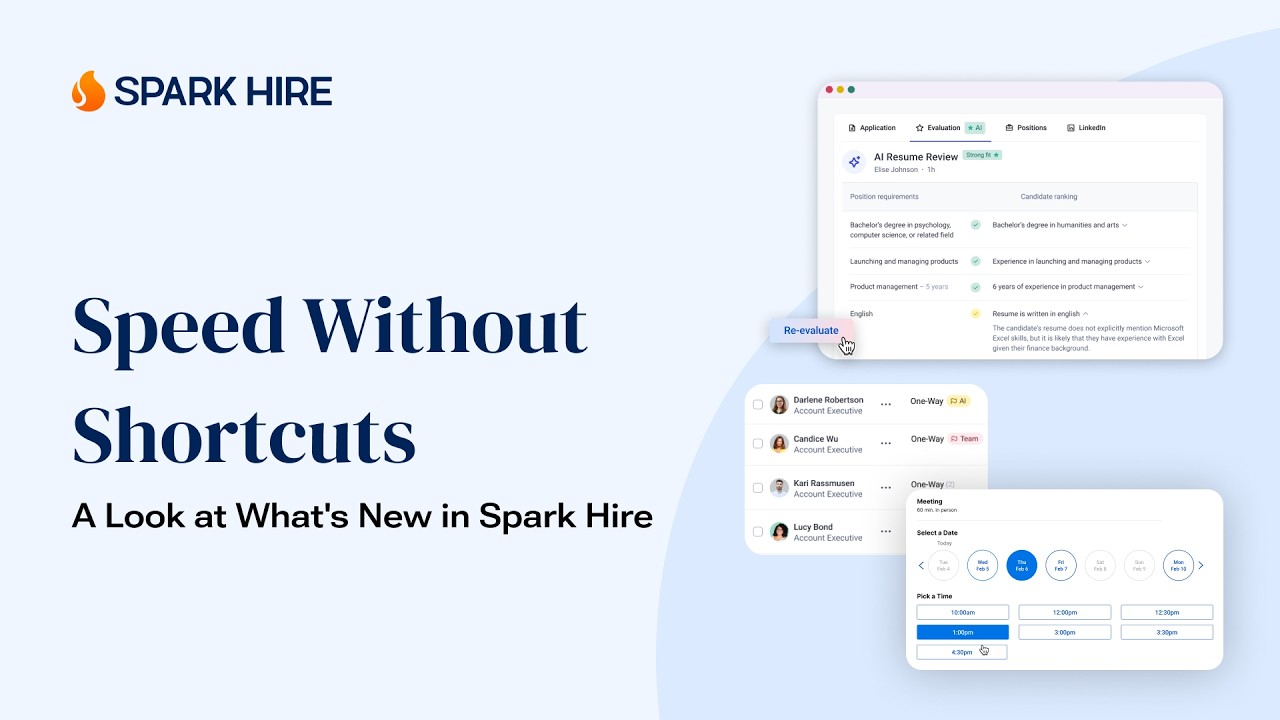
Speed Without Shortcuts: A Look at What’s New in Spark Hire
See what's new in Spark Hire: smarter AI resume ratings, less scheduling overhead, and clearer assessment review, all in one live walkthrough.
Assessing for Culture Fit: Why it Matters and How to Do it Right
Spark Hire's Josh Tolan and Gary Schwake talk culture fit with Concurrency's Meghan Focht, from defining company culture to interviewing without bias.
Candidate Screening and Selection
Spark Hire's Let's Talk Hiring dives into candidate screening and selection, building a structured process for confident, informed hiring decisions.