
Finding the Right Fit: Advice from a Pro on Evaluating Hiring Software
April 18, 2025
Spark Hire's Josh Tolan and Gary Schwake talk hiring software evaluation with SelectSoftware Reviews' Phil Strazzulla, from ATS needs to KPIs.
Struggling to choose the right hiring software or considering switching your Applicant Tracking System (ATS)?
Watch this webinar recording featuring Josh Tolan (CEO @ Spark Hire), Gary Schwake (CRO @ Spark Hire), and special guest Phil Strazzulla (Founder @ SelectSoftware Reviews).
In this hands-on workshop, the panel cuts through the noise of hiring software evaluation and dives into the common challenges people-powered organizations face when selecting and switching HR technology.
You’ll learn:
- A clear understanding of the hiring software landscape, with a focus on Applicant Tracking Software (ATS)
- Actionable insights for optimizing your hiring processes and overcoming common hiring software limitations
- Guidance on evaluating your current hiring needs, defining clear KPIs, and crafting a strategic roadmap for software implementation or switching
- How to effectively communicate your software strategy to stakeholders
- Expert knowledge to make more informed decisions about your hiring tools
- How to gain clarity, confidence, and control in your hiring software decisions
Hello.
Welcome to another edition of Let’s Talk Hiring. We’re thrilled to be here today with Phil Strazula of Select Software. Been in this space a long time. We’re excited to learn a ton with him. He’s a veteran in the space in hiring and HR technology, and, we’re we’re excited to dig deep for those that are trying to work through the maze of finding the right solutions for their business. Also, of course, Josh To land, who’s the CEO of SparkHire, and I’m Gary Shwachie, the chief revenue officer of SparkHire.
Alright. So, well, first, before we begin, let’s, have some comments. Just put in the comments, where you’re located.
We are across the, the East and Midwest. I’m in Charlotte, North Carolina.
Josh is in Chicago, and Phil’s in Boston, and we’ve got others from Colorado, Florida.
I know that.
Okay.
Alright. Well, let’s, let’s let’s dive in here. So first thing, we put up a poll, about a week or so ago. Actually, Josh put it up, and we’re talking through, as a talent acquisition leader, the biggest limitation or frustration as we think about hiring software.
And, if if, Patrick, you can go ahead and throw that up on the screen.
Love to get some some feedback here. So, really five different things, getting stakeholder buy in, too many software options, knowing what I actually need, and not enough time to research.
So if you could take a second and put the… Put some comments there.
But the the poll actually revealed, I guess not surprisingly, that getting stakeholder buy in was overwhelmingly the top choice. Three fourths of responses were around that.
And then also not enough time to research, which is probably a a close corollary to that. So I guess, Phil, in your experiences, does that surprise you as you think about, you know, people are… What they’re doing and how they’re doing, especially for those that are, you know, sub a thousand employees and relatively small, not only recruiting teams, but HR teams as well.
Yeah. And and thanks for having me, guys. I’m looking forward to the conversation and sharing stuff that we learned from helping companies find and buy the right software. I’m a bit biased because I think, you know, I’m so focused on the problem set of, like, how do you figure out which vendors to talk to? And I think that’s why a lot of companies come to us is, you know, there are so many options out there, and we’re looking for a new HRIS, ATS, whatever. Like, which ones do I even look at in the first place?
And what we find sometimes is, you know, somebody’s looking at a performance management system when they’re look…
Really trying to search for HRIS or or or something of that effect. But I I think, you know, when I see the results, then I get biased again. And I’m like, oh, yeah. That makes a lot of sense.
And, you know, you you just hear this recurring theme over and over again of, hey. I’ve got a problem. I know I’ve got a problem. Probably done some research, talked to vendors, done some demos, etcetera.
And then all of a sudden, I go to the CFO or I go to, you know, whoever the sort of power of b is, and they’re like, you know what? We just can’t get that right now. You know, let’s revisit next quarter or next year, whatever the case may be. You’re probably seeing that even more and more with the sort of macro environment, a lot of uncertainty.
I’ve got a couple of friends who are CFOs, and, you know, the the personality type is a bit cautious. And I think especially in in times where it’s like, hey. Where are we going sort of reown a recession? Are we are we going back to growth mode, etcetera?
So I think it’s not super surprising, especially from, like, the procurement perspective. And then even…
I I think another kind of important part of stakeholder buy in is implementation and and getting use out of tools as well. And I think that’s a lot of times where we see folks stumble is, hey. We bought this thing, but it’s not like just your TA team or just your HR team is is using the solution. Usually, it’s a lot of other folks within the organization, and it’s…
Can be hard to evangelize that. And it’s sort of an extra burden placed on these TA and HR teams, whereas, you know, your sales team implements a new CRM, the sales team’s using it. They don’t have to get the product team to use it or or something like that. So seeing that, I guess, it, is not crazy surprising, after I think about the data a little bit.
Yeah. It’s it’s interesting too because we were just recently at Sherm Talent, and we were asking people at the conference what their biggest hiring headache was and a lot of people were talking about collaboration with hiring managers being the top challenge and so, I wasn’t too surprised to see the results of this related to getting stakeholder buy in But that was going be my next question. I was curious for the audience or for the people that responded to the poll was if it’s more related to the buy in to get approval to use the thing.
You know, finance or execs or is it buy in once you’ve gotten the approval, you’ve bought the thing and now it’s time to actually use it and adopt it. And I think Phil to your point, you know, it’s such a cross functional environment when you’re talking about hiring. You know, you’re in sales, you buy a sales tool and really only have to worry about the sales team using it but when HR or the TA team buys something that’s meant for hiring, that spans every hiring manager within the company and every department within the company. So, it takes a lot of effort to make sure that people are bought in when it comes to implementation. From your experience, Phil, what do you see teams struggle with more? Is it more on the getting approval side of things? Or is it more on the implementation and making sure that what we bought ends up being successful by getting everybody to use it?
I think the more pointed one is the budgeting and and getting approval because I I think people there…
There’s hard dollars involved, and people really feel, almost like hurt by, hey. I I did all this work. We’ve got the problem.
Do you just not trust me? Like, what’s going on here? Why aren’t you get… Give me the budget?
I think in reality, like, probably the the second problem almost exacerbates the first where maybe there was a tool bot previously that didn’t get the adoption that you needed, and, therefore, it’s harder to get the budget the next time around. You know, we we bought a candidate assessment tool, and there’s a portion of the universe that’s using it. They’re… They like it, but we didn’t properly evangelize it, train people on it, reinforce why we’re doing this. And, therefore, when we wanna go and get a new ATS, there’s, some breaks. There’s some some yellow lights from the CFO’s office. There’s a tactic that somebody shared with me, a couple of years ago that I think can solve actually both of these problems or at least get you 95% of the way there.
And, basically, what… What’s interesting about these problems for the organization around hiring is that they don’t just impact the TA team. It’s the hiring managers. It’s the sales teams that aren’t hitting quota. And so what I found the most effective leaders in HR or TA do is they say, hey. We’ve got this problem. We can’t hire quota bearing sales reps fast enough for engineers or, you know, whatever it is for your organization.
I’m gonna work on this in the next quarter or two. Does anybody else wanna help me on this? And you’re gonna get people that raise their hand from, you know, the sales org, of course, but maybe other orgs that are feeling the pain. And the idea is to have these people almost be like your board of directors throughout this project.
So they’re not doing the work. They’re not, you know, on demos. They’re not spending a tremendous amount of time. Maybe you have a monthly or biweekly meeting that’s thirty minutes that’s like, hey.
Here’s the progress that we’ve made. Here are the ideas that we’ve made, etcetera. And this board of advisers really solves a couple of different problems for you. One, it’s diversity of thought.
So you’re gonna get the experience from the director of the SDR team and the, you know, VP of product and whoever else who are really smart people who have probably dealt with problems like this in previous organizations before. So diversity of thought, they’re gonna help you bet ideas. Then when you go to get the budget, they’re gonna be able to apply their juice to get it approved. Right?
So you go to the CFO and say, hey. We need an ATS. It costs x dollars. CFO says no.
The director of sales says, well, wait a minute. You know, I’m involved in this, and I’ve sort of been involved with this for the last six weeks as we’ve evolved this product, and here’s why we’re doing it. And, you know, you care about me because I’m the one driving all the revenue, so you really need to do this. And same with your other two or three people who are on this, like, board of advisers.
Then when you implement, you have these functional leaders who are able to help you better understand how to evangelize the product within each of these teams. And so…
And and, also, these people who are raising their hands to do extra work, in general, those are, like, the the gunners of the organization. Right? Like, those are the people who are doing a really good job and are very respected.
And so you basically get, you know, the power of their thought and then the power of their internal juice to get it approved and then And it looks like Murphy’s Law struck me.
I think I think I think he brings up a really good point, though. You know, the thing that I often see teams struggle with is when they approach buying a new tool they put a lot of emphasis on the tool and so they go to the stakeholder such as the CFO to buy that tool and all the focus is on we need an ATS or all the focus when it comes to implementation as they go to all the functional leaders like Phil was talking about and they say we bought an ATS and all the emphasis is around the tool.
But the reality is the tool isn’t the initiative. The tool is just part of the bigger picture of what we’re trying to accomplish as an organization. And so I think if you can zoom out both when you go to get approval for this new tool and when you go to implement this new tool and really focus on what is the objective we’re trying to achieve and the tool is just one of the five things we’re deploying in the organization to reach that objective. It becomes much easier for your stakeholders to conceptualize why we need this tool as part of the bigger picture.
And I think to Phil’s point, if you can get those functional leaders bought into that concept earlier, they can help you get that across the finish line when you need to get approval from the CFO and then help you you know evangelize that in the organization when you actually buy that thing because it becomes less about we bought this new ATS and it becomes more about we need to hire 20 sales reps in the second half of the year. So, we’re set up to hit our 2026 target or whatever the business goal is and I think when you get people to rally around that, that’s where you really get that internal buy in and get people driving the tool across the finish line as part of a bigger package of things you’re trying to work on.
Yeah. I like to feel where you started with, you know, we can’t…
We we have this particular role that is required for us to make business impact, and we’re having a hard time filling it, you know, velocity, quality, whatever that that core problem is, you’ve immediately connected it to some business challenge versus some operational headache, like time wasted or lack of efficiency or things like that. And then when you take that approach first and start with the problem, like we need to solve this problem before it’s like we need to buy this software. You also I think get a sense of like, to the CFO, this is one of many requests that he or she is getting, probably on a daily basis, right, for for allocation of resources or problems.
So it’s not that the…
In this case, hiring technology isn’t a priority. It’s just not the top priority. And so the goal is, like, how do we make it connected to those top business outcomes if we really believe that that’s the case? And then it holds helps hold us accountable then as we start to develop that plan of, okay, if we were to go out and buy this technology, how would this impact our ability to meet that goal and that target?
And I think it’s a good way to begin with the end in mind.
Yeah. I think I I think everything is sales, and we’ve all done sales obviously as, you know, founders, c r… CRO.
And it’s really about how do you articulate it to your point So it’s more acute and more important than the other things that are on the CFO’s list that day. And if you can do that, you’re gonna win the budget, win the win the mind share. And I I highly recommend folks to find someone in your organization who’s built, like, a mini ROI model before for something and partner up with them. If you can do it, you’ve got an MBA or something like that, then that’s awesome too.
But I find a lot of folks that are in TA and and, people leader functions, they they mainly are focused on sort of the the EQ and, you know, candid experience and things like that. They might not be our spreadsheet jockey. Otherwise, they would have ended up in the finance team and vice versa. Right?
Finance person, probably not gonna be a people leader anytime soon. But when you when you partner up with that person, even just buy them lunch, buy them coffee, buy them a drink, they can help you put together a short model that basically just says, hey. If we’re able to find…
You know, buy this technology that maybe it makes our recruiters more efficient, maybe decreases time to fill, maybe decreases cost to hire, that’s gonna end up saving the company a lot of money or generating a lot more revenues.
And that can be a really valuable weapon in your pitch.
What’s also really valuable is that six to eighteen months later after you implement, you can go back and see what you got right and what you got wrong. It’s basically a journal entry to some extent, and that just helps you become a better business leader as you start to think about, you know, how did this actually change time to fill or productivity or or whatever those KPIs were for you.
It’s… And Josh was gonna pivot to, like, let’s make you bring this down a level to the the… A common question which is around an applicant tracking system, and we can go to that unless you wanted to cover anything more there.
I think the question I had for Phil or what I was thinking about just now is we talk about how a lot of times teams have a problem or some objective in mind, but how do they connect that to what to go look for on the market? Like, as we know, there are so many different categories and then even within each category, it’s not apples to apples. So, how do you take a problem or something you’re trying to achieve in the business from a hiring standpoint and connect that to where should I be looking? Like, Phil, to your point, sometimes you’ll be talking to organization that says, hey, We need a performance management system, and, really, they need an HRIS or vice versa. So how do you help them connect the dots?
I think it’s hard because everybody has a million things going on, and I don’t expect any of you to become, like, HR tech expert because it’s just foolish. Like, Gary, I’m sure you’re not, like, a CRM expert. Like, you couldn’t tell me, like, everything about every CRM on the market. And if you could, that would be, like, a red flag.
Right? It’s like, why are you spending all your time doing that? I think that, you know, you can leverage an organization like ours, which is free research, and you can talk to any of our advisers for free as well. And and that’s always a resource.
I think your your community, whether that’s, you know, your local SHRM chapter or meetup groups you’re part of, WhatsApp groups, etcetera, those are great places to say, you know, hey. We’re we’re dealing with whatever the problem is, and it could be something that’s, like, a little bit more vague than you’re proud of. And and sometimes those people can help you drill down into what you’re actually potentially looking at. I also honestly think that, like, like a a ChatGPT can be a decent thought partner on something like this where you can give it sort of a nebulous product, problem and and use it as a thought partner.
It’s not gonna tell you the answer. It doesn’t know. It’s never, you know, run a recruiting team, but it has access to a lot of information out there and can probably stimulate some ideas. And so it can be challenging, but I also would not shy away from talking to other business leaders in your organization because it’s like, hey.
We’re all rolling in the same direction, and the thing I’m trying to deal with is x, y, and z. What have you seen from companies that you used to work at or peer groups that you’re a part of? Everybody’s network together and everybody’s sharing learnings.
Yep. Makes sense.
Yeah. And so with that in mind, you know, let’s let’s just use the applicant tracking system as, you know, the the common consideration for many organizations. And I think there’s a variety of different ways that they would, you know, organizations are faced with how to make that decision.
One is we don’t have one, and we’ve lived perfectly fine without it. Right? And for many organizations, you don’t know what you don’t know. And then a talent leader comes in and it’s like, wait, what…
Why are we doing it this way? Like, there is there is a better way to do this. There’s building that business case and how to think about it. Then there’s, you know, at the other extreme, maybe there’s the the good enough version where maybe it’s included with whatever, you know, broader HR tech you have that that does the job at the beginning, but starts to show strain as you, you know, put some more volume against it.
And then, of course, there are those that are purpose built that maybe were purchased at a time when the business was in a different spot, and, you know, there’s there’s those needs as well. So we think about that landscape of kinda working through that, back to your point of, you know, the the capabilities. If I just went out and searched applicant tracking system, right, we’d get a lot of them. And so how…
When you’re working with with your, you know, with your clients and advising folks in the space, how do you have them, like, back up and and start from the beginning on how to build their requirements what it is they’re…
What is they’re trying to solve and what they need to help solve them.
Yep. I think that, for sure, you wanna start with what are the actual problems versus…
We don’t wanna make an assumption that you need any ATS. Right? Because, again, everybody is so busy with their lives and their professional lives, and nobody… Very few folks are experts in this ecosystem, and the ecosystem evolves very, very quickly. And so we just wanna make sure that, hey.
You know, recruiter efficiency is a problem or, you know, scaling hiring is a problem or, you know, whatever the case may be that, like, actually makes us think, hey. We need it… We may need a new ATS here. Beyond that, there are considerations that are from all different stakeholders. So you’ve got sort of the primary TA stakeholders who are looking for what sort of automations are we gonna have to gain efficiencies, what sort of work we’re gonna take off our plate, how do we maybe increase the funnel for sourcing?
We’re looking at integrations with tools that we already use, whether that… Maybe that’s an HRIS, you wanna feed into onboarding, maybe it’s different assessment tools or sourcing tools. And then there are other folks in your organization that are important as well. You might be looking at hiring managers and what they’re looking to get out of it. You might be looking at the CFO, info security.
So you you wanna be mindful of those as well as you start to build this requirements list. And then the universe is large as you point out. And to be honest with you, you know, I don’t know of a better way than talking to our adviser team to figure out really what solutions you should look at. There’s obviously… You can do Internet research. You can ask your community, and those are are decent ways of doing it. You can even go on websites like a g two crowd that have lots of crowd reviews.
But you have only so much time in the day and you wanna get to the right decisions. You don’t just wanna have a list of 12 companies you have to go do demos of and then stay organized and take notes on and and and this whole thing. So it is, it’s very, very challenging. And to be honest with you, that’s why we start… We… Why we start our business, is to help people with this problem.
But those are sort of the the broader frameworks that I would use when starting out.
Yeah. So maybe let’s unpack that a little bit. The… You you mentioned the advisory team. So somebody approaches you for the first time. How do you start? Like, how are you helping them frame up the the steps to put them in a spot to be successful?
Yeah. So I think there’s some there’s some broad questions around how… What… How big is your company?
What integrations do you need? What feature sets are you looking for? Do you want the cheapest option, or do you want a better option that’s gonna cost more money? Are you looking for an all in one solution that maybe is also your HRIS and payroll and and everything else, and maybe you’re willing to sacrifice functionality to have something that’s more simple.
These are the sorts of questions that can take that universe of, you know, a 100 plus vendors and start to chisel it down to maybe five or six or or even two or three, which is really where you wanna be in my opinion, is you wanna be in that two to four grouping where you can spend a lot of time and do a thorough analysis of each of those and eventually select one.
Yeah. I…
I’m…
As you say that, I’m imagining, and maybe you already have this as basically a…
Think of it as a spectrum with…
You know, maybe it’s a two or three d matrix where you’re going through those questions and you’re you’re lopping off entire, you know, categories or providers of software because Yep. Although, my guess is that, just like you said, would you like a…
The simplicity of an all in one solution? People say, absolutely. I’m like, it comes at a cost. Right?
There’s there is these things. So then they start to really…
Now it becomes less binary and more waiting. Right? And I assume then starting to tie those things back to business outcomes. Like, how do you, how does your team, like, expose that aspect to it where you start thinking about, there are lots of problems to solve, but if you solve these one or two, you would actually have the greatest impact on your business.
Yeah. So we we actually have a couple of ATS ROI calculators with, some spreadsheets and some videos. And, again, I always encourage people to find somebody in your organization who you can up with on this who maybe has an MBA. Maybe they’re on the finance team or they’re on the strategy team or something like that, and they’ve done this sort of…
It…
It’s not unbelievably complicated, but for some reason, it it become…
It’s more intuitive to some people than others to think about, hey. If we decrease time to fill for salespeople by 20%, you know, what is the the dollar that comes out of that? Right? And you gotta multiply how many salespeople are we hiring and what’s their quota and and maybe what’s the impact to enterprise value if you’re a venture backed or private equity backed company.
Maybe you care about it if you’re a publicly traded company too. So, yeah, we basically are are trying to articulate it on mostly time to hire and and efficiency and and cost per hire when it comes to applicant tracking systems and trying to figure out…
For some companies, it’s like, hey. We’re we’re spending a ton of money on third party recruiters. And for others, it might be…
It honestly might be something as more nebulous as we’re just missing the right people. You know? We’re responding too late. We’re inundated with resumes. That’s something we hear over and over again these days is we’re just getting slammed with all of these applicants. We have no way to sort them and organize them and vet them effectively.
So those sorts of things you kinda know in your gut are big problems, and then it’s about how do you think about the sort of business case that you can take to the power of be that internal stakeholder, get back to that original polling question, to actually get the budget.
Excellent.
Yeah, it’s a it’s a really really good point. How do you think about Gary mentioned the, you know, the and you mentioned it to feel like the all in one solution of an HRAS plus an ATS versus the stand alone ATS especially when it comes to, you know, it sounds like what you were just referencing are organizations where they’re looking for their first ATS. So, to Gary’s point, like somebody could be easily enamored with, yes, of course, why wouldn’t I want the all in one and everything that comes with it? But it also comes at a cost of, okay, well, now you’re thinking about implementing really multiple solutions with the one platform. So how do you help organizations vet which direction should I go? Is it better for me to go with the HRS with the simple ATS, or is it better for me to go with a full on ATS and not worry about the HRIS for right now?
And if I can piggyback on that, especially when the… Typically, the HRIS platforms are selected by the CFO, and the CFO sees that their HRIS platform has an ATS and says, well, why don’t we just use that? Right? We’re already using that platform.
And it it probably goes back to, well, if you’ve defined the problem appropriately, then you’ll be able to, you know, better articulate why… What the differences are and and the impact it would have to the business.
So one of the biggest mistakes that we see when people buy software is they buy it from an existing vendor because they have a a prior relationship. So the canonical example of this would be we use ADP for payroll. So we’re gonna buy ADPs, HRIS, ATS, etcetera. And that was basically the strategy of a lot of these vendors for a really long time.
Right? We’ve got you for something through acquisition. We’re gonna add a product, and we’re just gonna kinda cross sell it into the base. And I think a lot of these companies got away with it for a very long time even though those products were pretty subpar.
And now the tide has turned, I believe. The reputation of a lot of those companies is damaged, pretty much, you know, for good, I would say, unless something crazy happens. And so a lot of companies that come to us to… Or a lot of HR teams, probably, like, 60 plus percent of them are moving off some sort of legacy system where they had, you know, one of the kinda core five or six vendors, legacy vendors, and they bought too much random stuff from them, and they regretted it because it’s just not very good software.
We’ve… Everybody… You know, the three of us plus anybody listening has used software before and knows that the devil is in the details.
And you can check the box and say, yeah. You know, we we take in applicants, and there’s a database, and you can leave feedback on them and, you know, collaboratively recruit all this stuff. And it’s like, alright. Check the box. Like, that’s that’s an applicant tracking system.
But the reality is at a lot of these all in one vendors, there’s, a product manager who is drastically under resourced versus a point solution and also probably is not, like, as economically incentivized as an entrepreneur to build the best in class solution for a given problem. So if you want an applicant tracking system that is just gonna be, like, good enough, then, yeah, you should you should do your your all in one because it’s gonna be simpler. It’s probably gonna be cheaper, and it perfectly integrates with the rest of your HR tech stack. But if you need all of these, like, idiosyncratic aspects, if you want, you know, really good automations, if you want a really good career site and candidate nurturing and, you know, lots of different complicated workflows for different types of candidates and, you know, a really robust integrations network, like, all all the stuff that a best in class solution would have, then you gotta go out and and buy one of those.
And so it…
It’s really just, thinking about those trade offs. But, Gary, to your point, if the problem is, you know, we we can’t hire the right people, Our recruiting teams are not very efficient.
Then you’ve answered your question for yourself. Right? You you know what you need to do. You need to go out and buy an ETS.
Yep. It it would…
Just this is kind of a tangent, related to that, as as people are considering maybe as as the first step that, you know what, maybe that does make the most sense is we’re familiar with this vendor. We already have a relationship. Either we, you know, regardless of how we were doing it before that we don’t have an ATS or we’re changing an ATS, and they move over to the ATS from their HRIS platform. Any advice you would give on how they might wanna structure the contract to maintain optionality?
I don’t wanna get a detail. And what I mean by that is, like, the tendency will be to just bucket it all in together. Right? And it looks great on the surface, but then you realize what you’re giving up is flexibility and optionality to be able to, you know, make those adjustments.
Is that something you’ve helped with your clients?
We usually don’t go as deep as contract negotiation, but what I think is really interesting is that, you know, your…
You you have a lot more leverage as a buyer these days than than you probably ever have, just because the state of the market. And if you don’t feel comfortable pushing hard, then get your CFO to do it.
And you should have the ability… If you’re contemplating, look, like, you know, we’re gonna buy rippling or bamboo or something like that that has an optimal tracking system in it. But I’m I’m… You know, the back of my mind, I’m super stressed because I’m pretty sure we’re gonna need something else, then you you definitely need that in the contract, and they’re gonna allow you to put it in there because they want your business. Right? Right. And so you can lower that PEPM cost pretty substantially by not having one of these modules. And after you’re you’re in the the system for a few months, you’re gonna know for sure if you if you needed another system or not. So try to preserve that optionality as much as you can.
I think in in general, that’s a that’s a good rule, especially where these systems are evolving so quickly.
Right. Right. Let’s You all… Sorry.
Go ahead.
One thing. Phil, you you also mentioned, you know, when you’re helping an organization determine if they need to buy, you know, the best in breed ATS versus using an HRS, you started mentioning and ripping off some different features and functionality that some ATSs have. I want to touch on that from the standpoint of I think a lot of teams fall in that trap of having a list of features that they’re looking for. And then when they go out into the market and talk to different vendors, a lot of the vendors are going to be able to check the box or say yes to the question when they ask the binary, do you have this feature or not?
And that’s how a lot of teams approach their evaluation. And the reality is, you know, different providers solve problems in different ways. And so one might not have the feature that you’re looking for, but they still solve the problem just in a different way and maybe better. So how do you help, you know, your clients have that perspective when they go into an evaluation so they don’t fall into the, you know, the the cross section feature comparison chart where they’re just looking for yes, no answers, and that’s how they ultimately make a decision.
It’s a great question. And this is… You know, my favorite example of this is the feature of, do do you have a mobile app? And a lot of… I think probably best in class vendors will say, no. We have a mobile first web web experience. Right? Like, we don’t want your team to have to download a new app to to use our solution.
And so that’s like a no. Right? It’s like, no. You don’t have a mobile app.
But the reality is, yeah, we have something better than mobile app. Right? So what’s interesting on the enterprise side is I think this is why a company like Workday has done so well is they basically check all the boxes. And so when you run an RFP, which is how these things are done mostly for big companies, you…
Your check of the 100 boxes, they check off 95 of them. But if you look at, you know, ask anybody if they like Workday and, you know, go on Reddit, and it’s like page after page of people being like, this is the worst software I’ve ever used. It’s gotten better in the last few years, but, pretty rough for a while, and it’s a, what, $100,000,000,000 publicly traded company or something like that. So I’ve done quite well selling the software, I think, because of this, like, checklist problem.
And the person who pays the price is the user, whether that’s a recruiter or an employee or a candidate.
So what we would recommend is build out your requirements list, and there’s probably, like, five or six, like, stuff we need to have. You know? Like, maybe there’s, like, an… A really important integration. Maybe we… We’re really jazzed about, like, having a… An an amazing career website, or we have a very specific talent demographic that, you know, we need SMS. Like, we need to have, like, some specific, like, SMS workflow or integration in certain job boards, etcetera.
After that, there’s there’s another, you know, bunch of stuff that’s, like, nice to haves or somewhat important. And instead of just putting an x or a check mark in each of these, you you do wanna have the context around, you know, what does the integration mean? Because integration could mean, you know, you gotta download a CSV and upload it back into a system, and that’s obviously a much different scenario than something that’s natively built through an API, or even something that’s facilitated through a Zapier or something like that. So I think those are really important criteria, and it’s important to have that context.
It’s important to stay organized. I think the vast majority of people buy software or not organized, and these these demos tend to bleed into each other. And you’re like, which one was that? And, I think the the kind of, like, hidden criteria for some of these buying processes is how much do you like your sales rep?
And I think why this is an important criteria is that really good salespeople can basically work anywhere. They just show up to a company and say, hey. Here’s here’s my comp plan last year, and here’s my number. And so you’re like, oh, okay.
Great. You hit…
You you crushed your quota, your president’s club. You’re hired. Right? And so that person who’s organized, who’s empathetic, who knows the industry, who can understand your business, If that that person’s working in a company that they can hit their quota and hit their number and make a lot of money.
And that correlates really strongly with a product and onboarding and customer success that they can stand behind. Because if they don’t have a good product, that means that they can’t hit their number, and so they’re gonna go on to the next company. And so when you’re talking to three or four companies, something to keep in mind that you’re probably doing a subconscious level anyways because that’s just how humans are. But something to even put in that spreadsheet is just how much did you like your rep?
Because the best reps tend to flock to really, really good good companies that are supported by good products.
That’s a really good point. And and, you know, having been a seller for a very long time, you know, the people that really are enabling the buyer to buy and empathetic and, you know, understand what you’re trying to go and actually help you be a better buyer in the process can… Are a good indication of, you know, what kind of company you’re gonna end up be partnering with.
Yeah, I think it’s also interesting and maybe a different way for folks to think about this is as I’m hearing you describe how somebody should set up their vendor selection or evaluation process. It’s not too different than what they’re doing from an interview process standpoint, right? When you have a new wreck and you’re thinking about the requirements like the the classic mistake is you get a laundry list of things from a hiring manager and here’s all the things we’re looking for in a candidate and then shocker, you can’t find that person and so, I think it’s it’s about being very concise and clear about what you’re looking for and the same goes for when you’re for software and so if HR teams take that same approach which they’re already doing for the most part in the hiring process and bring that to the software evaluation process, they’ll probably have much more success. One thing I also want to ask about is and it’s kind of related to checking the box.
If we go up a level and we think about and Gary mentioned this a little bit earlier, if we think about the CFO, to them checking the box could be a whole product. Like, okay, we bought this payroll software and they have an ATS. Check the box. This is gonna be our ATS.
How does somebody on the talent or HR team navigate that conversation? So, one, when, you know, we were just talking about optionality and structuring a contract, we don’t get locked into something that we’re stuck with years down the road. How do they navigate that conversation with the financial stakeholder to either a, maintain optionality or b, you know, help them understand right away why we can’t use the check the box ATS that comes with the software. We have to go out and find something else.
I think it’s about empathetically educating them on the the differences. And so that entails understanding what that offering is that your colleague has signed up for or or is thinking about signing up for and how you would use it and what the limitations are relative to the other options out there. So it’s like, hey. You know, this this career site isn’t mobile friendly, and 40% of our traffic is mobile. And so, like, are we gonna lose, like, a huge percentage of our applicants, and therefore, we have to rely on third party recruiters more often?
Is… You know, we… Our whole hiring process is built around this candidate assessment tool that doesn’t have an integration with this. And so we’re we’re gonna spend twenty hours a week, you know, kinda bouncing back and forth between… And and moving profiles and things like that versus, you know, using this other solution and maybe, you know, the cost is more.
But if we’re saving twenty hours a week of manpower, then that probably the cost is is very justified very quickly.
So it’s really… You know, it it just comes down to understanding, like, what does the CFO care about?
What are the things that move the needle for them? And then how do you how do you build that business case? And part of that is a spreadsheet, and part of that is just explaining the workflows and the differences. Because at the end of the day, you know, they care about cost, but they care about the overall financial health of the business. And so if that means that we don’t have to, you know, hire another recruiting coordinator or whatever the case may be, then that’s that’s gonna be a yes. But it it… You’ve gotta explain it to them.
Related… Circling back to what we talked about actually a little bit earlier related to financial health and the CFO’s perspective is this idea of, like, we’ve been burned before about software that we purchased and then, you know, failed on just, you know, dead on arrival. As part of the search and selection process, are you helping them also think about what they need to do to be ready to actually take value in that? Like, look, if we’re gonna take this step Yeah. It’s one thing to select the right tool, and part of that is you objectively assessing your own capabilities to implement this tool. And in theory, that should be part of the selection processes, which, you know, ease of use or the support I’m gonna get or what have you. But it it… There’s still some requirement on our part to make sure that if it’s hiring manager engagement or integrations or whatever the case may be, is that part of your rubric for helping them assess success with a tool as well?
I think our advice is always… One, what’s nice is we have a lot of information about what are the tools that people are successful with. And so, you know, of all the HRISs in the world, there’s a small number that we are… We’re actually, like, pretty actively referring, people to. There’s probably, you know, a dozen or so that get 70% of referrals because it’s like, you know, for this sort of thing, we know these are the ones. And sometimes we have, folks that they they fumble the ball, and we need to understand what happened there and why and and maybe take a pause on on sending folks their way because they might have a great solution, but some of these companies just grow too fast, and they get disorganized or so many management changes. You know, a company that goes from, you know, zero to a billion of ARR in in ten years, that’s that’s a lot of change. And so there can be a lot of, mess ups there.
Our our advice really is, you know, you you pick the right vendor, and then you kinda do what they say. Because that account manager, they’re getting comped probably based on, are you successful?
And are you a churn next year or are you retained? And so they probably care more about you being successful than you do, and they know all the tips and tricks and everything else. And I think where these things go off the rails usually is somebody gets behind on their implementation plan. It’s easy to get busy with other stuff. And so, you know, you’re not following the playbook, and that’s where things typically go wrong for for companies.
Yeah. That’s a great point. Great point. And and, you know, as we think about that… Oh, actually, wanna go back to the kind of the selection process and thinking about features. Let’s talk about AI.
Obviously, there’s a lot of noise around that, but probably, I think that’s… If there’s any area that’s really difficult to discern, what do I need? What do I not need? What’s hype? What’s not hype? It’s largely because we’re all learning it, you know, our ourselves and how it impacts in our business.
I’m sure that that’s been a big topic of conversation as you think about capabilities as you’re talking to folks. How have you kind of framed this for them as to help them think about, like, what is actionable and what is something to keep on the horizon and noted of, but, you know, is actually gonna impact your decision?
I think what’s exciting about this shift is it’s happening in real time at a pace that’s, like, just kind of insane. And we’re all starting to use tools like ChatGPT to be a thought partner or content creator or data analyzer, and now we’re starting to see it pop up in some of these tools. And what’s interesting is sometimes you use a tool and it’s… There’s a very clear AI use case, and there’s there’s no module to to actually execute on it. And it… I found myself to become very frustrated because it’s sort of like, why does this not work this way? It’s sort of like back in the day, maybe you’re shopping for something on the Internet and you had to do, a 12 step checkout or or you’re applying for a job ten years ago and you had to fill out, you know, the the Taleo, you know, let’s put your entire resume into this, like, structured form.
And it’s like, why? You know? Like, this is so annoying. And and I think, you know, we’re starting to… Because in sort of our intuition around what these things can do is is being built, and we’re starting to realize in any solutions like, hey. Why doesn’t x y z have it?
The the thing is, like, when you buy a solution, you should really be thinking about it. I’m gonna use this for three plus years and and probably more than that. Probably more like five to seven and maybe maybe even more longer than that. And so my advice to folks would really be to understand what are the first couple of things that this vendor has built using these technologies for for for the end user, maybe not their internal tools, but can I, you know, query some information through a natural language format or, you know, whatever the case may be?
And then understand what is their philosophy. So are they, you know, more like, hey. This is interesting. We’re not quite there yet.
We’re gonna think about this next year.
Or are they like, you know, we’re we’re building quickly. We’re we’re we’re all in on this technology. Here’s the road map. Here’s the thought leadership that we’re putting out around AI, and here’s how it’s actually manifesting in the product thus far.
I think you just wanna… You’re you’re gonna have to make a bet on what’s coming in the future because this stuff is evolving so quickly. I mean, the voice models, you know, five months ago, there was, like, a two second latency in in the voice models, and now it’s a zero second late… Latency. It’s real time communication. Right? And so, like, that’s how fast these thing… And and something like that makes the universe much bigger for, how these products will be implemented. So, I think it’s really about philosophy and where the puck’s going with the vendor and sniffing that out through what they’re putting out in terms of content and the products that they’ve built thus far.
That’s a really, really good point. Yeah. Because you’re right. Because the reality is that it it…
The sands are shifting faster than ever, and so nobody’s got it figured out, and we’re all, you know, both as users and as builders working through what is the best way to do this and creating new ways to solve problems, and it’s a new paradigm shift. So to think that that you’re gonna, you know, have everything that you need, it’s really more about investing with a partner. Right? That’s like, let’s get some early indications of where they stand and how they view AI.
Is that consistent with not just our own departmental philosophy, but the other side of this is that even organizations are really thinking about what is our AI policy and that continues to evolve. Right?
And so a lot of times they’re coming in to buy software, like it’s got all this great AI stuff, and then they go to get it approved and security is like, like, that’s not happening.
So, you know, having enough a feel for where your organization is in terms of adoption of AI, I think, is an important part of that equation as well.
Yeah. It’s a great point. And I was at Transform a few, I guess, like, month ago, and there are a couple of AI governance companies there that are basically, you know, looking at partner… Looking at vendors AI to understand where it’s biased, especially in hiring, you know, especially in HR compliant, etcetera. And the interesting thing is, you know, just because something is compliant today doesn’t mean it’s gonna be compliant tomorrow. And so that’s gonna be pretty important part of procurement, I think, over time, especially as we start to see some horror stories come out, which I’m sure we will. Yeah.
Yeah. I think it’s to your point, Gary, the key is how can you see the early indicators that a vendor is committed to AI in their roadmap?
But at the same time, I think it’s it’s very important to not get caught up in the hype where, you know, a vendor is now committed 100% of the road map to AI features and now they are treating every problem as a nail with AI being the hammer and it’s like now everything is just committed to AI, AI, AI. And they’re not really talking to customers enough about what are the real problems that need to be solved on a day to day basis. And in some cases, there will be AI functionality that is a great solution to that problem. And in other cases, there’s a different way to solve that same problem.
And so I think it’s certainly going to be a challenge for people that are looking for software because everybody’s kind of figuring this out, and things are moving so fast. And you know, whether it’s with the technology or whether it’s with compliance, everything is changing. It seems like almost daily or weekly at this point. So there’s a lot to navigate.
So I think it’s about, like, what are the questions you can ask to get the early indicators that a vendor is committed, to AI and their roadmap, but they’re not over indexing on it to try and use it to solve everything. And to Phil’s point, maybe that’s about asking for documentation on their philosophy or their principles or how they’re looking at AI in the next six to twelve months of their product. And I think if you can get really clear and concise answers in a format that it’s clear the company has documented these things internally that tells you they’re focused on it. It’s not like something that, okay, like this customer’s asking about it.
Let’s just make something up and send it over to them. When a company has process and assets built around this, there’s some level of commitment towards it in the future of the product. And that’s at least, you know, speaking from a HR tech CEO side of things.
Yeah. I I completely agree.
And, it’ll be fascinating to see it all evolves, especially in our space where I think it’s, it’s gonna be really accurate. You know? Like, you can’t…
In in large part, like, you can’t be, like, 99% accurate, I think, for a lot of these use cases.
Yep. I also think, you know, we’ve… As a vendor, like, we… We’ve been talking about AI and the use of AI for for years now.
I think the thing that also has to be balanced with all of this is the candidate side as well. Like, I think vendors, again, it can very quickly over index on the implementation of AI and software, but they don’t think about the ramifications on the candidate experience or even just candidate sentiment. And so I think that’s a really delicate line and something to balance as you think about what you’re going to implement in your product. Yeah, that might be so cool and innovative and recruiters are going to love it.
But if candidates hate it and a lot of customers and organizations success is dependent on their candidates success in the hiring process, you can actually create real problems yourself as a vendor, but also, you know, for customers and organizations who are using it if you’re not… If that’s not at the forefront of how you’re thinking about AI and your product road map.
Yeah. A good example of that is so we have… I don’t even know how many people a day ask us for HR software help. And a lot of people are booking times with our advisers, and we just… We can’t keep up with the call volume. It’s just really hard. And so we built this little, like, AI schedule caller thing that, like, if you fill out the form to talk to one of our advisers, it calls you up to schedule an appointment.
And it’s…
It sounds great. Like, it can deal with, like, really complex questions. Like, you can be like, who’s Phil Strzula? And it’ll, like, tell you who I am and, like, you know, what…
Like, how do you guys get paid? And, like, all all these, like, random things. We were like, this is amazing. And at the end of the day, it doesn’t…
It sounds 99% human. You can tell it’s a bot. And so people are totally fine, like, hanging up on it, you know, swearing at it. Like, we…
Because all these calls are recorded. Right? So, like, there’s all sorts of random conversations that people have had with this bot, and and we’re gonna shut it down today, actually. Because it’s just like…
It’s not a great look from a brand perspective. And even if it takes us an extra, you know, day or something to follow-up with somebody, it’s better to have a person call that person up than an AI, at least at this point. You know, maybe that’ll change in six months or two years or whatever it is. But at the end of the day, it it probably won’t because we’re always gonna know that’s not a person.
And, you know, if if you’re applying for many of these jobs, like, people aren’t…
People have egos. Right? We’re…
We get insulted and and norms change. But I remember, like, when Calendly came out, and people would get, like, so mad if you send them a Calendly link. And I saw this on Facebook, on LinkedIn, people posting like, can you believe this? Blah blah blah.
And it’s like, it’s more efficient. Right? Like, it’s better than a back and forth, and you you give me times, and then I get back to you, and those times are changed and whatever. But we’re all we’re all people, and that’s the important thing to keep in focus at the end of the day.
Yeah. That’s a great… It’s like full circle. Right? Let’s remember what we’re trying to do here, which is to hire great people into the organization. That’s the goal. And obviously to drive business impact, but to fit the culture and, you know, be additive to the community and all those other things too. So…
Well, we’re reaching the top of the hour here. Phil, this was just unbelievably helpful. I can’t thank you enough. I think, you know, your willingness to dig in was really helpful.
I think some some great insights here that we’ll pull together and and summarize for the group.
Josh, I know I’ve… I could go for another hour with a bunch of questions, but certainly jump… Pop it over to you to add some comments or additional questions for Phil.
Yeah. No, Phil. Thank you. Phil and I go way back. So I always know when Phil’s joining something, it’s gonna be good and full of insights, and that’s why I love having him on and, collaborating with him on all this stuff. So Phil, appreciate the time and great to see you as always.
Thank you, guys. Yeah. Likewise. Thanks for having me.
Enjoy spring in Boston.
Sounds good. Alright. Well, hold hold back for a minute, and, we’ll we’ll wrap wrap up the live stream here. Thanks again for joining another episode of Let’s Talk Hiring, and we’ll see you in about, three weeks.
Thanks, everybody.
Thanks.
More Webinars
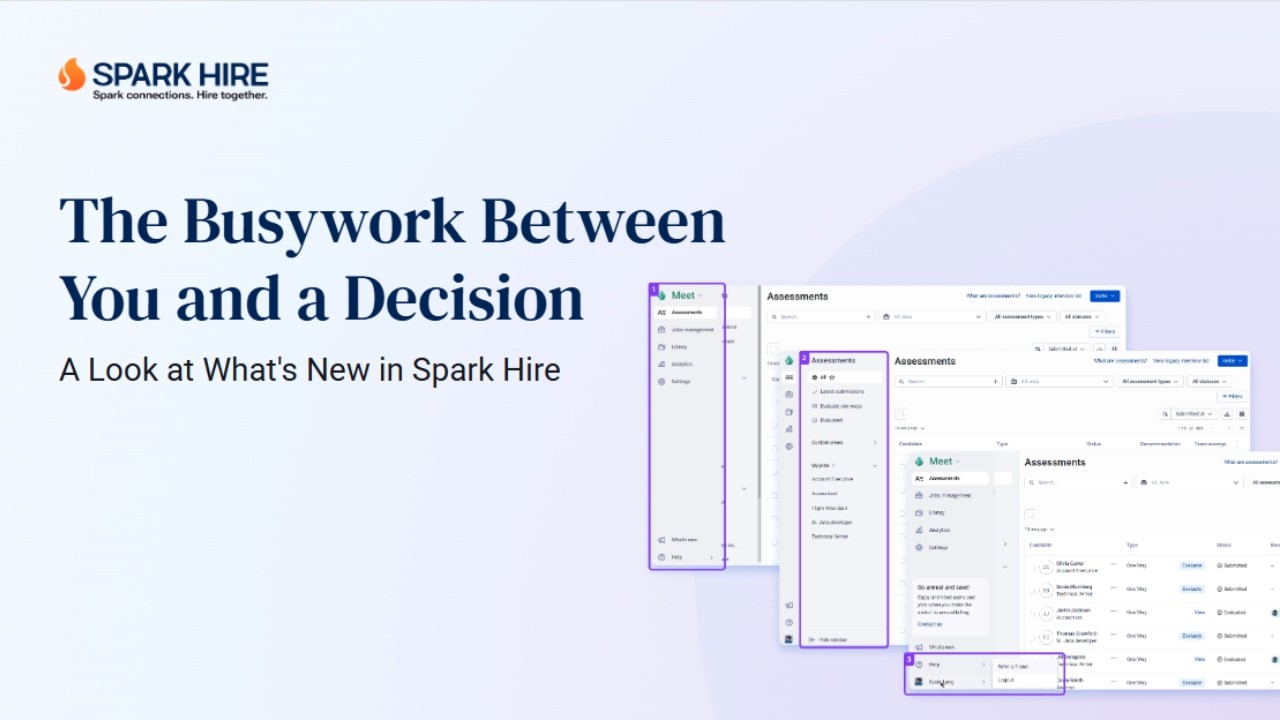
What’s New In Spark Hire: Less Busywork, Better Hiring Decisions
Spark Hire's Alisha Garlow and Ori Horvitz cover new updates for less manual work: smarter resume ranking, automated references, and AI interview sets.
Hiring in the AI Era: How to Embrace and Evaluate the AI-Enabled Candidate
AI-drafted resumes and coached interview answers make candidates harder to read. Hear a panel on evaluating AI-enabled candidates fairly and at scale.
Candidate Screening and Selection
Spark Hire's Let's Talk Hiring dives into candidate screening and selection, building a structured process for confident, informed hiring decisions.