
Getting to Know Your Candidates Authentically in the AI Enabled Hiring Land
November 13, 2025
A polished AI-written resume doesn't tell you who can actually do the job. Hear a recruiting expert on assessing real competence without adding more work.
Are you hiring a person or a perfectly polished AI response? Stop wasting time on résumés and applications full of keywords and start assessing for real competence…without breaking the bank or adding more work to your already busy schedule.
In this month’s installment of Let’s Talk Hiring, hear from recruiting expert McKenzie Walker, who shares how she has overcome the paradox of modern HR: the need to hire faster to combat labor market competition, without sacrificing quality, culture fit, or candidate experience.
During the session, we walk through how to:
- Ask authentic questions AI can’t answer
- Use a variety of assessment types to validate soft skills
- Keep humans in control of every decision, even with AI-assistance
Hello. Welcome to another session of let’s talk hiring. We’re really excited to jump in today. A topic that is, has been buzzing around probably for the last year, and continues to evolve in the world of AI is how do we assess candidates authentically in this AI enabled hiring landscape, AI on both sides.
So we’re very excited to jump in. Also excited to have with us today Mackenzie Walker, and I’m gonna leave it to her to provide some background because we’ve got a unique twist on it. But, Mackenzie has a long experience in recruiting and has seen some unique insights that we’re gonna dive into here. But just before we do that, if you are joining us here live today, let us know in the chat, which you can see there that we are gonna be monitoring that.
So if you have any questions throughout, feel free to drop them in there. Let us know from what part of the world you are joining today.
In the meantime, Mackenzie, I’ll turn it over to you. Welcome.
Awesome. Thank you, guys.
As you mentioned, there is a little unique twist.
I have been recruiting for six plus years in multiple different industries.
I’ve recently come on to SparkHire as an AE and I’m super excited.
Into my recruiting experience, I’ve been in mortgage, I’ve been in insurance, I’ve been in pharmaceutical software companies, most recently in home inspection.
A little bit of everything and been able to see the landscape really change over the last six plus years. I think it’s really been sped up in the last probably two-three, but just overall, when I got into the recruiting industry, it’s a very different world than it is today.
I’m super excited to be here.
And, she was kind enough to do a little bit of work with us in advance. I’m like, you know what? She would be really great as a member of this team, and somehow we convinced her to join us. So very excited to have her a member of the team.
Okay. Well, let’s, let’s jump in. So I think that’s probably one of the things. We we hear a lot throughout the recruiting experience.
There is, understandably a huge bias towards we we wanna keep it authentic. We wanna keep it human involved. Right? But at the same time, in this in this new world, if you will, we have candidates that are using AI to their benefit, which we all would say is a good thing to do.
Right? Let’s it’s a tool that’s out there. Let’s be thoughtful about it, and, let’s use the tools that help us prepare, that help us, you know, put best position us.
But the result has been a lot of me too looking candidates, a lot of similarities, a lot of homogeneity. And so how do we how do we think through that and and think about this? How do we get to an authentic place between candidate and, the requirements?
Yeah. I think that’s a really great question. And to be honest, I’ve been on both sides of it. I have applied for jobs in the last six years, and I’ve been recruiting in for jobs in the last six years and have used AI on both sides. I do think you find a really thin line of overusing it or using it wrong, both as an applicant and as a recruiter.
I’ve been fortunate enough that I have used tools like SparkHire, so I’ve been able to use that to help navigate it. But I think when every resume looks the same, is really hard to differentiate it, especially certain industries, the experience is going to be the same. Their tenure might be different, but on resume, it’s going to look the exact same, especially in regulated industries or things like that.
Think that’s where things like video interviews easily can be used to see their personality and see how they can answer questions and how they communicate.
Think everyone also looks for a culture fit, I think that’s a big thing too of being able to see a lot more than just what’s on paper. I do think that, to your point, AI has made every resume look even more the same, the same formatting.
You see a lot of people say, This is how you format a resume for AI to read it. I think that that has been a big detriment because now every resume looks identical.
Yeah. And I think, you know, a few and I’m curious what you’ve seen over the last few years. But a few years ago, the challenge was easy apply, and it became so easy to submit your resume for jobs. So volume went like this.
And our only saving grace was that as a recruiter, still people were submitting unique resumes, and things looked a little bit different. So it was a little bit easier to shortlist from there when you had that volume. But now with that volume continuing and also the use of AI where everything starts to look the same and everybody’s optimizing their resume before the specific job, it becomes really, really hard at the front end of the process to determine who you’re gonna speak with. And it’s not like you’re faced with five candidates whose resumes all look very similar on paper.
This might be 50 or in some cases 500.
Exactly. You know, depending on the position to your point where, you know, previous experience is is all relatively, equivalent.
Yeah. And, you know, I’ve been in roles where the requirements are very strict, so it’s easy to filter through those. You can use knockout questions, things like that. But there’s also a lot of scenarios where four fifty out of that 500 might meet those requirements.
Being able to really dig into those and see who might be a better fit, especially for lower level roles where, again, easy apply. You put it out there maybe at 3PM on a Monday and Tuesday, you come in as a recruiter and you have six How 32 does a team of one or two recruiters go through that? You physically, you can’t do it.
Then you turn to recency bias of probably who last applied, the last 50 are gonna be the ones that you get through for that day or whatever. It’s not necessarily a fair process when you go through that.
Might find your one candidate within those 50, but those other 400 were great as well. So it’s really kind of how do you manage that? How do you truly pick the better person or the more qualified fit without screening four fifty people individually in that time? Or even just reading that resume, who then again looks the same when you just keep clicking to the next.
Yeah. And there’s there’s really two sides of that challenge too. There’s the fairness side to candidates. Right? 400 people applied. They’re all relatively in the same ballpark in terms of qualifications.
Why should one get more of an opportunity than another candidate? And then on the flip side, there’s a consideration of the hiring manager.
As a recruiter, your goal is to serve up the most qualified candidates and give the hiring manager the best opportunity to hire the best person for their team. And if you’re not able to do that because you’re only able to get through a certain number of people, it’s a disservice to the hiring manager and them not having, you know, the right shortlist for them to evaluate for the position.
Yeah. Definitely.
So, Mackenzie, as you go back to and as as Josh pointed out, it it’s kind of a tsunami of converging forces. Right? It’s the easy apply, and then AI comes in.
At what point did you, or I guess go back, at what point were you like, okay, this is literally untenable. I can’t do this. What was the moment that that kind of happened? What was going on there? And then how did you go about evaluating, okay, what are my options?
How do I solve Yeah, that’s a great question.
I honestly think back to early twenty twenty one, I was in mortgage and the mortgage industry boomed. Overnight, people were leaving all their other industries to come into mortgage.
There’s a lot of shuffle within mortgage companies.
I worked at the branch level where I was hiring loan officer assistants and loan processors, even some front desk people.
I was one of the only recruiters who handled the branch side and it just wasn’t attainable. I remember looking over at my team and on the corporate side, they weren’t as swamped. Was like, Am I doing something wrong? What resources do I have? What do I need to change?
One of the girls on my team who also did branch recruiting, she had previously used Spark Hire. She’s like, We pitch need this to our HR team. I was like, Let’s do it.
We sat through a demo and we ultimately used the tool. Back then, it was just a one way video interview tool, so we were able to use it in different points of the process. I really truly used it as a second step.
I would review resumes and then I would do phone screens for maybe the top 25% of the people that I looked at, and then the next 25% that I didn’t think maybe were perfect on paper, but I didn’t want to disqualify them, I would then send them to Spark Hire.
Then from there, reenter them back into the process for those top performers.
It really cut my recruiting efforts in half per se, because I always really liked to at least talk to the top 50% of the talent that came in. Obviously, you’re going have people that aren’t worth that conversation, but people are a lot more than what they are putting on paper. I think Spark Hire really does a great job of enabling candidates to tell you a little bit more about their experience, more about their life, more about why they are where they are that an initial resume doesn’t do. Sometimes even a phone screen doesn’t get to that detail or people don’t feel as comfortable.
That’s where I used it. I think that with the high volume, it really helped me just tailor to who I needed to prioritize at that time. It made me feel a lot less underwater than I had initially been when that boom hit.
It’s curious. That’s interesting. Sorry, Gary. I just want to get to one point, and maybe we’re going to the same place.
Probably. We’re good. But you so in that situation, you were using it to expand your capacity to consider more candidates. Right?
So you had this top tier of of talent that was coming through based on their resume, and then you had this next year where it was a maybe and you didn’t wanna necessarily disqualify them. So you expanded your capacity. You gave them an opportunity. I’d be curious to know how many of that pool ended up making it through where it kind of opened your eyes and said, you know, we should consider them for the next round.
So that’s one thing I’d be curious about. So we’ll plant that.
But then the other thing I’m I wonder is is that kind of what we’ve seen in the shift of the current dynamic of that was 2021. You have a lot of people applying. You have your top pool, but you still have a lot of more people that you’d ideally like to talk to, but volume was prohibiting you from doing that. But now do we have the challenge of you still have all that volume, but then that second tier of people start to look like the first tier of people because AI is helping them optimize their qualifications and for the role. And so it all starts to blend together.
Before you answer that before you answer that, I’m gonna a slight twist on that because I before we jump ahead, going back to where you were. So you started with top 25 get a phone screen, and then the next 25% are one way video interview. Curious as you went through that, how your perception of the value of a phone screen over a one way video interview may have changed because of presumably your ability to actually get through them faster and the asynchronous ability to do that versus now having to schedule a phone screen. So curious if that evolved.
Yeah. So I’ll answer both of your guys’ first questions first. I think they kind of mix in.
Of the next 25% of candidates that did the Spark hire, I’d say at least 40% of them, would at least show to the hiring manager, which leads me to Gary, your point of the value behind the one way video interview, my hiring managers then asked me to send everybody to Spark Hire because they would rather watch the videos than read my notes, which maybe my notes were great, but I think it also speaks a lot to being able to sit there and then watch a candidate answer those questions. I ended up sometimes having to send people that I phone screened through the Spark Hire in order to send that video to the hiring managers. I think I’ve never had a hiring manager not like the video option or say, No, we don’t want to do that. I’d rather read it.
And so I think that that really showed the the value there. As far as time, I if I did a one way video interview first, oftentimes, I’d at least do a quick phone screen with them before an official interview with the hiring manager, even though the hiring manager maybe knew they wanted to speak with them. Mainly just to talk over compensation and more of those private things that I don’t personally do on the one way video interviews. I think they are a little bit more intimate conversations.
Depending on your workflow and your recruiting structure, the hiring manager might not also be the best person to ask those questions. That was my experience. I always did both, but very often did I do a phone screen first with maybe our favorite candidate on paper, realized that I should also send them to Spark Hire or vice versa.
Does that answer both of your first questions? Yes. Or do want to tag people? Okay.
Because and then and then on the second one, I think we can park this as well because I do think as well the part of weaved into this and before we get on to some other ways to get through all of that is, there’s also a perception of and I think a lot of times the the the idea is in we we joked about this the other day. Right? In a perfect world, we would bring every candidate in, sit them down on our couch, and have a lengthy conversation and get to know them. But there are constraints.
Right? When you have 500 people apply for the same role and you legitimately want to give those 500 a shot at the role and make sure that we are surfacing the best candidates for that, how do we actually do that? And so there there is this idea of, well, how do we keep it how do we keep the human in this? Like, how do we keep it authentic?
And, you know, I think your experience, we can come to this a little bit later. But but as you started to use it versus as you think about that that both the phone screen and the ability to speak to someone, but at the same time, able to put the person in front of the hiring manager and not just one hiring manager, but multiple of them at the same time.
It like, what is that human interaction as well? So we can come back to that.
Perfect. Yeah. No.
I I think that those are great questions, and I think they’re constantly evolving too. I think one of the things is as AI takes over, and and not I don’t mean take over as in, like, replacing recruiters, but it it takes over a lot of our workflow and changes the process in which we do things or even when we think about things. I think those are definitely valid questions.
One of my favorite things is an intro video and an outro video. As simple as that is, I think it gives them a little bit of comfort in seeing someone else do what they’re being asked to do.
No one likes being in front of a camera one on one or feel not likes, but feels uncomfortable, right, especially the first time that you do it. Seeing a familiar face or a familiar name give that video to you knowing that they also sat there and recorded a one way video interview for you, makes it feel a lot more personable.
It was one of my favorite things. Also, with the outro video, being able to thank them for their time and maybe give them a little insight of kind of what next steps look like so they’re not just like, okay. I completed it. Now what? They feel like they’ve been kind of updated in the process without having to manually do it.
Yep. Okay. So, Josh, back to your question about the you know, now we have volume plus homogenous volume.
Right. So just, yeah, setting the stage. You, you know, previously would have a lot of applicants apply, and you could clearly identify this tier one. This is tier two. Tier one, we’re gonna fast track here. Tier two, we’re gonna do a one way video interview.
Now it seems like the thing that we’re hearing, and, you know, you’ve you’ve been recently in a talent acquisition seat, you could speak to it, better than I can.
But is are we now faced where tier two and tier one start to blend together? And it’s like you still have volume, but now it’s just like a wall of identical looking resumes.
Yes. Because I think everything is so much more polished.
I think everyone who is applying for jobs is probably guilty of throwing their resume in some kind of AI service and probably not even rereading what it spits back, but just relying on it for grammar issues or things like that.
Two, three, four years ago, grammar issues on a resume were an automatic, not disqualification, but depending on the role, it might not have even made it through that first initial screen. Whereas now, there’s a lot less of that being disqualified just because every resume most likely is relatively written well and polished. I think that’s probably the biggest difference is being able to look at a resume and being like, Okay, they know what they’re talking about. They can articulate sentences.
You can’t rely on that anymore, which brings back that one way video interview. You ask them a question, they’re either going to be able to articulate their answer or they’re not. You can very quickly see that without having to do a full screen or watch it fully. I think that that’s probably the biggest difference I saw was, yes, every resume looks the same, more so on the polished level than anything else.
I also think that AI has a very common communication style that isn’t natural for most people. I think the more and more that I saw AI generated resumes, I did notice more of who heavily relied on it versus didn’t. I think that that is slowly going to be a differentiator as well, is how personal It’s almost like we used to think a resume was over personalized and it was a bad thing, whereas now I think it’s going to slowly change to a more personalized resume or one that maybe has color or things like that do truly stand out more than a perfectly designed resume.
I was going to ask you that both polish is one thing, but also just actual formatting where you’re starting to see everybody’s got their little introductory paragraph and then the the even the structure layout of all of you seeing that The fonts are the same.
Yeah.
Yeah. And I think look. I think, as we said in the beginning, it is a good thing for candidates because even in the case of if we go back to those tier two versus tier one candidates, some of those tier twos, you discovered through the one way video interview process, they’re actually tier one. Right?
It was just they might have been at a disadvantage because of their resume formatting or the structure. They just didn’t do a great job of adding context or the right story behind their experience in their resume. And now some of those candidates have the ability to do that and bring more context to their resume through the use of AI. And so it blends them together.
So it’s not always the case of, like, you’re blending together this group of unqualified candidates and qualified candidates. It’s in some cases, the candidates that were previously qualified but didn’t do the best job of representing themselves are now in that qualified bucket, and you have some of the unqualified that are mixing their way in there too.
And to be honest, some of my most qualified people probably did come from that kind of tier two on paper because they just didn’t communicate their experience. They didn’t wanna boast about it. Right? Like, it there’s a fine line between what you’ve actually done on your resume and not fluffing it up, but making it more exciting. A lot of people either don’t feel comfortable with that or don’t know how to do it, and so you do find that too of if your experience is really good, you should highlight that, and not everyone does. I think that that also levels the playing field there as well.
As much as you can even put in what company you work for into AI and it’ll tell you what your role was supposed to do, and you can amp it up from there.
So Yep.
So we’ve talked a lot about, video interview as a as a way to get the authentic candidate in front of as many people as quickly as possible.
You also had a chance to experiment with the predictive talent assessment, the behavioral assessment. Can you tell us a little bit about that? First, any previous experience with behavioral assessments? And then what was the problem that you were thinking that this behavioral assessment could solve?
Yeah. Most recently, I used it when I was in a home inspections industry.
I don’t know if you know much about home inspections, but they all come from a similar background. Again, they don’t really have resumes per se, and if they do, it’s home inspections. Across the board, every resume looks the same. Now, the amount of inspections they’ve done in the ten year is different. But really when you look at a resume, most of them worked for themselves previously. They’ve owned their own companies, they’ve been construction, things of that nature.
When I first jumped into it, I didn’t come from that background. I wasn’t really fully sure of what quality should we be looking for and things of that nature. When I came over, we also implemented SparkHire at that most recent company. We used the predictive talent assessment initially as a individual contributor.
In full transparency, it wasn’t necessarily a match for what we were needing for the home inspection role, but we knew that going in.
What I did was I sent that assessment to about 20 internal employees, all different ranges of types of employees from high performers to middle tier to lower performers, team leads, things of that nature, and collected that data. Through those twenty twenty five inspectors, I was able to take their top 25 can’t think of the word. There you go, competencies and be able to narrow that down to six to eight that actually met that and weighted it based on what we saw a lot with high performers, but maybe we didn’t see a lot with low performers, or we saw something a lot with low performers, but not high performers, so we rearranged them to come up with it.
We were able to create our own profile. From there, it really gave me an insight, especially from someone who wasn’t a home inspector previously, what that profile would look like, because it does vary compared to the other profiles that were available.
That was my experience with it. We used it really only for that one particular role. We used a couple of the sales profiles for a few of our sales team, but I didn’t hire a ton on our sales team. It truly was our home inspectors that are the bread and the butter of the business. Are who make us our money, they’re performing that service, they are the people of the business. That is really where I used the predictive talent assessment to really narrow what we were looking for exactly in that candidate.
Where in the process did you find it helpful?
Yeah. I typically did it towards the end.
We usually sent it around the same time as they completed their final interview. We didn’t really use it as a decision maker. We used it more so as a confidence booster or used it as if we knew going in this is a person we wanted to hire, but maybe they didn’t fit the profile so well, we used and looked at the coaching report more so to be able to continue to develop them in the areas that maybe they weren’t as strong or look at them to Maybe they were really good at something that had to do with training or something that had to do with that where we knew in the future they might be a great team lead or a trainer, things of that nature.
We typically used it after the final interview.
I would say, thank you so much for your time. Look out for the predictive talent assessment, complete it. Then from there, we would move into reference check, background offer, things of that nature.
Got it.
But we didn’t use it as a decision maker.
That’s interesting, though, because and and you tell me, but it sounds like when what we hear often from a lot of hiring managers and and recruiters is at the end of the hiring process, hiring managers are faced with making a decision and they want to make the right decision they don’t want to make the wrong decision and they almost need that little reassurance of this person is the right fit because they’re the ones ultimately making the decision and there’s been the recruiter and whoever else involved in the hiring process. But at the of the day, everybody’s looking at the hiring manager to make the decision.
Was that like the catalyst? Like, mentioned it as a confidence booster. Was that ultimately a catalyst for using this data backed assessment to help them feel confident in their decision?
Definitely. I think that especially hiring managers, they feel the pressure of, like, well, if I have high turnover or things of this nature, it comes back at me. Right?
And as a recruiter, you feel that way too. If you’re having to refill the same role a bunch of times, you have to come back to the hiring manager and be like, Okay, it’s both of us. We need to figure this out. What are we doing wrong? Where can we fix this? You are always looking for that extra boost of confidence, that little validation of, Okay, I knew this person was going to be great.
I think the flip side of that is you have to train both yourself and your hiring managers to not rely on it, and again, not use it as a reason to get rid of somebody from the process. If they had a great final interview, they did a great infield, and their results come back maybe not a fit, that doesn’t necessarily mean they’re not a fit. It just means that they need maybe some additional training in certain areas or you change their role to match where their strengths are. Maybe they, again, go down into training and leadership. Maybe they aren’t super comfortable people facing. Maybe in a year or two, we work on that with internal and then you move them into a different role that is just as beneficial. I think that as long as you don’t use it as a true, this person’s out, I think it is really helpful for a hiring manager to feel confident.
Yeah. Go ahead, Josh. No, go ahead.
I was going to say that just the point that you made, which is, when you go through a hiring process, rarely do you end up with two or three candidates that all look the same and you just flip a coin and right? It’s like they all have 80% of what you need, 85 of what your ideal candidate profile looks like. But the 85% is all a little bit different. And so there’s pros and cons to every choice that you have.
And I can see then the way you describe it with the predictive talent assessment is it helps you assess, if there are there will be areas where everybody needs to develop, right? We all have them, forever. And, But it’ll help the hiring manager understand which talent that needs developed or which behavior or trait that needs developed are we best to help with and which ones aren’t we? And that that becomes then a fit relationship, which is best for both.
Right? If if if there’s something that you need to develop in the role and we’re just not equipped as a company or even me as a hiring manager to help deliver that, that’s really important to know for everybody because we don’t wanna get neither side wants to get six, nine, twelve months in and realize, like, what part of that critical competency is just not here, and I can’t give it to you.
Yeah. Or or even seeing what competencies can be taught and which ones are natural. I think that that was a big one too of like, if the competency came back of not a natural fit, but it’s something that isn’t easily taught, then maybe another candidate who has the same FIT score, but the things that they need development on are things that are easy fixes like one on one trainings or things like that, then it definitely gives a better view into the long term growth of both people.
Yeah. And it’s more a fit question than it is, like, an absolute on the candidate themselves. Right?
Yeah. Definitely. Yeah.
And I I think that’s and that’s where I was going was I think that’s the perfect example for showing the balance of the human intervention in the hiring process versus data back insights versus AI versus a one way video interview. All those things give you insights, they give you information, and they give you context about a candidate. But when it comes to making that decision, you know, there’s a lot of detail. There’s a lot of nuance to making that decision and thinking through is this person a fit, and how might we be able to use this person to be successful within our organization. And I think that’s really where there’s the balance of whether it’s whether it’s automation, whether it’s AI, whether it’s insights from a behavioral assessment.
That’s where like talent acquisition, that’s where hiring managers, that’s where people really need to step into that void. And they have all these insights at their disposal, but it’s like, now what do we what do we make of all these insights? And to Gary’s point, it’s not an absolute decision. It’s not black and white. It’s not yes, no. There’s a lot of nuance to it, and I think that’s the blend that people have to find in this, like, era that we’re living in right now.
And the other piece that you hit on that that I can see being valuable is the the coaching aspect as well. Right? Having actually before the person even starts an idea of where we need to set that is we all start with a thirty, sixty, ninety day plan as people come into a role. And a lot of times, it’s us predefining what that looks like with, frankly, not a lot of understanding about where the candidate’s strengths and weaknesses are. And now the ability to proactively plan some of that in just gives you an ability to ramp up your new hire faster to make them more productive, to improve fit.
You think about all the benefits of that as well.
Yeah. And I think from a candidate perspective, when they get hired and come in and they see the development is personalized to them, I think it makes them also feel a lot more seen too. I think it helps build that rapport and that connection between that new candidate and a company that they hopefully stay with for a long time. I think that first thirty to sixty days is really important. I think if you can use it for that launch pad or talent development, I think that it is a great tool, especially when you have hiring managers who are trained to really develop, not just take someone as they are and throw them out there.
Yeah. Yeah. Absolutely.
Okay. So one of the things we’ve talked about an authentic process, keeping it humanizing. And I think the typical thought around humanizing a process is that a human being needs to touch every single candidate. Right?
That back to the idea of, come on into my office, have a seat. Let’s have a cup of coffee and and talk through this. But, so as we think about the realities of the market in which we sit today and some of the tools that we talked about, like, what what is that as you’ve because you’re this is something that’s near and dear to your heart as well, like candidate experience and and making sure that they’re seen, heard, and valued is really important to you personally. Like, talk through some of that a little bit for us in terms of what that that that with these tools, the authentic process that you were able to create and develop.
Yeah. I think, first of all, it gives an even playing field to everybody.
Think even I am guilty, and I think a lot of hiring managers are guilty. You don’t always ask the same questions in the interviews. You’re not always giving an even chance to all of your candidates. Think that right there is one of the most human things you can do, is set everyone up for that same level of success or at least the same level of prep as everybody else had.
That was one of the big things for me was when I did these interviews, being able to use those same questions for every single candidate who went through that process.
I think that’s important, but I also think adding that human element of, again, that intro and outro video, I think that speaks volumes. I personally always did a recorded of me asking the questions for our one way video interviews. I think that makes a big difference.
When it comes down to the decision making, I think you can use all these tools to help you make a decision, but it should never make the decision. I think that’s where a lot of recruiting industry is changing. I think people are quick to, well, AI said it’s bad, then it’s bad. I don’t think that that should be a good rule of thumb because it, again, can’t see everything. It can’t understand everything.
Doing those one way video interviews gives more people a shot to explain why they are where they are. Maybe they had a three year gap.
I’m guilty of that. I took two years off to raise my two kids, and when I came back in, I got auto rejected from a lot of roles because I wasn’t working for the last two years.
Where I think that if I would have had the option to do a video interview, which they can’t do for every candidate, and if I would have given just that next 25% of sending that video interview, I could have explained why I wasn’t working for the last two years and why I decided to make that change, but also explain why I’m ready to move back into the workforce. I think that there is that stigma of if they’re not perfect on paper or they don’t match it, then it’s not worth it. I think that there’s a lot of gray area in recruiting, and I don’t think that we are in a place where AI can make that decision.
I think they can help and I think they can analyze and help you prioritize and speed up the efficiency of being able to see more people and hear more people versus relying on it to completely make that decision.
Yeah. It’s such a great point. I know personally having many, many years of hiring people that you’ve come to learn it, oftentimes, the best people on the team started a little rough around the edges, so to speak. Right? There was something atypical or what have you. And for whatever reason, you kind of look past that because you see this sparkle, and that’s what we’re ultimately trying to do with these tools is everybody’s got that little sparkle and finding it, especially if it’s a fit with the organization.
It’s like there’s there’s really just a few key points that actually really contribute to success. And if you’ve got those core three things, then almost regardless of everything else, you’ve got a really good chance to to to be a contributor, and that’s the trick is finding that.
Yeah. And I think, you know, what I heard from you is, you know, a human process is one that’s fair, one that’s fast, you know, and it it respects a candidate’s time. I think the big thing is giving candidates an opportunity.
I think that’s been a big challenge is because of, you know, the capacity constraints that recruiting teams have faced. There’s a lot of candidates to the point we’ve we’ve talked about over and over on this session that just didn’t get an opportunity to get in front of the recruiter or get in front of the hiring manager.
And so these asynchronous options give people that opportunity that they may not have otherwise had. And then I think the, you know, other part that we haven’t touched on yet, but this is where I wanna pivot to to hear from your experience, you know, the best practices that you implemented is on the communication and transparency side. Right? For a lot of candidates, some form of an asynchronous assessment or or anything new, you know, candidates are gonna have some type of response to or maybe make their own assumptions about. And so being in talent acquisition, you control the candidate communication. You control the transparency about the process. So how did you navigate that?
You know, maybe thinking back to when you rolled it out first at the at the mortgage company, it was your first time implementing it. How did you navigate Canada communication and making sure they knew what to expect and how it fit into your process?
Yeah. I think that’s probably the best example just because it was so new. I think back then, I hadn’t, as a recruiter, heard of one way video interviews. So At that time, it was not just educating us on how to communicate, but also educating your candidates on what the process looks like. I think even still to this day, I explain what it is in a personal email. I don’t just send them the assessment or send them the link.
I always rewrite the templated emails or send an email in addition to the templated email so that they, one, know it’s real and not a bot. I think that’s also important.
In today’s day and age, you don’t really know what emails are correct or what aren’t. I’d always give them a heads up that it was coming, which is a manual step, but it’s that personal touch that I think makes a big difference in making them feel comfortable and wanting to do the assessment. Another thing is if they hadn’t completed it with a day left, I would reach out and say, Hey, just wanted to make sure that you received it. It is legit. Let me know if you have questions.
Especially back then back then, it makes it seem like it was so long ago, but it feels like it is in today’s recruiting. Yeah.
We’re definitely in dog years.
Let’s let’s like Yeah.
Definitely.
Ten years ago.
Definitely. There was technical issues or they were nervous. They wouldn’t even start it because they’re like, Oh, I’m not tech savvy. I don’t want to do this.
I think that when you have that conversation of you don’t need an application, you just go in and do it. You can do it on a mobile device. You can do it on a laptop. You can do it at whatever time that works for you before the deadline.
I think if you have those conversations with them and really just prep them on what to expect, they’re a lot more open to it.
Now, fast forward to today, I think it’s such a common thing that it’s expected. It’s not a shock or something that you’ve never done before at some point.
I think that it’s a little bit easier to communicate that and set them up to understand what the process is.
But again, I’m going to lean on that intro and outro video. I think that those are such great ways to set the stage for the candidate to know what’s coming and what to expect after.
Ahead, Miguel.
Go ahead. No. Go ahead.
I was just gonna say a a little bit of a tangent, but with that, the the video can be really powerful. But I think in some cases, there are some that get stuck with, should it be me? Should it be the hiring manager? If it’s the hiring manager, how do I go get the video?
Like, what what what worked for you? Was it predominantly you? Did you introduce hiring managers? If so, how did you get them to actually get in front of a camera and record that video?
Yeah. Yeah. I think it’s just as awkward for hiring managers, especially in the very beginning. Right?
For the most part, depending on the role, if they were applying to a generic role that didn’t have a specific manager, so maybe it was a role that I had multiple branches in a certain area for, I wouldn’t have it be a hiring manager just in case that wasn’t the hiring manager that they reported to. In those cases, I would do myself.
If they were a specific role with a specific hiring manager, I would ask the hiring manager to do it. Oftentimes, I’d even script them like, Hey, just say these things.
At that time, we had a video, an about us, like a careers video, so sometimes I’d throw that in there too. If I didn’t do that on the intro, maybe I’d throw that in the outro.
A mix of everything. Some of it was a dedicated culture video. Sometimes it was me, sometimes it was a hiring manager.
Most recently, it was me just because I needed to implement it fast and I knew I could depend on myself getting it done fast, I went in and did them.
Especially because I was the only recruiter, I was a team of one, so I knew that everybody would know who my name was in the application process.
They got an email from me, they did a call with me, or what have you. I think having the person that they are going to be mainly contacting with is important to have at least maybe in that intro video or have the email come from such like that.
Yep.
Yeah. That’s great. I think so I’ve got a statement and then a question to, not totally change the subject, but, go in a little bit deeper on candidate experience. So what I’m hearing from you is and we just talked specifically about one way video interviews and, you know, maybe there needed to be more education a few years ago in terms of just candidate familiarity with them versus now.
But I think regardless, it doesn’t really matter. Right? Because whether it’s one way video interviews or it’s some use of an AI solution, anything, that’s asynchronous in the process requires some sort of explanation of what it is, why you’re using it, where it fits into the process just to give the candidate context. So that’s, like, the transparency side of it.
But then the other thing I heard you say, again, specifically for one way video interviews, but I think it’s applicable to all these different scenarios as you picture moments to insert a human touch into the process. So even though an invite was sent to them or a reminder was sent to them from the system, there was something that you could do. Even if it was in bulk from an ATS, you could send to the candidates from you very personal, light touch, just to remind them about the deadline or tell them to keep an eye out for this. And it almost in, you know, a process where maybe there’s a lot more asynchronous things, than there used to be, it’s like a reminder that hey we’re here there’s still humans involved in this process we’re reviewing your stuff we’re looking forward to hearing from you and those little moments and where you pick your spots are often overlooked, I think, because they’re it’s such a small touch point.
Like, it’s such a short, easy email that people are like, like, we can live without it. But those moments, I think, matter in terms of the candidate’s journey, throughout this process that’s very different than it was three, four, five years ago.
Yeah. And I think also it’s so important to not get ghosted. I think because so many companies are using similar tools, and, again, that mass apply. People are applying to 50 jobs in an hour, and they might get interviews for three or four of them. And if you don’t continue to keep that personal touch, you’re gonna kind of fall in with that kind of robotic sequence that every recruiting company might have. Yeah. So really finding ways to use that human element to differentiate yourself from from the pack.
You just gotta show up. That’s Yeah. What it is. Now okay. So now my question where I wanted to go, just continuing on the candidate experience journey.
We’ve talked about trying to learn and get to know candidates more authentically through the process, and we focused a lot on the application part of the process. But now let’s let’s talk about even in a one way video interview. You know, a lot of people might have questions of, well, is a candidate gonna use AI in every step of the process? And how do I know, you know, that it’s, really a good answer or it’s really their experience? So I guess if we just use one way video interviews as an example, what’s, like, a good way in terms of structuring that candidate experience or the things you ask to really extract the information you need authentically and not just end up with a bunch of, like, short yes or no or generic scripted responses?
Yeah. In my past, I’ve always relied on situational questions or even just pulling back from their experience.
Most of the time, I’m hiring for roles where they had to have experience in a similar role. You would ask about questions that has to do with, have you ever had a time when and explain a time when, which I guess in a way you probably could use AI. I think that that’s where with SparkHire having the limited amount of takes comes into play. If you truly want to have that true authentic interview style, then you are able to limit those to you get one option to answer it, and what you answer is what you would have done on a phone call or in person.
Again, staying away from those yesno questions and really trying to I think if you get them to feel comfortable through the process, they are going to talk a lot more, so I think that that comes into it as well.
Again, I think situational and past experience questions have always done better for me because you’re able to, even if not exactly the same industry or same role that you were in previously, you can usually relate something to the question that you’re being asked.
And I don’t think that, yes, AI could give you a generic answer, but very quickly be able to pick that up.
Yeah. Because the lack of specific examples and references and yeah. Right. I think that’s a really good point I also think you bring up a good point of making a candidate feel comfortable in the process I think sometimes people become reliant on tools just because they’re scared or, you know, there’s some fear of, like, you know, I’m gonna get the question wrong when really the company just wants to hear your response and your authentic self.
Because ultimately, it’s gonna benefit both if we make a decision that it’s the right decision, that it was based on, like, an authentic version of of who that person is. So I think that’s a good point of doing whatever you can to make them feel comfortable in the process. And some of that goes back to your communication because it gets them to open up, and then they realize, I could just talk about myself and talk about my experience, and I don’t need these things. I don’t need to polish the answers.
They just wanna hear from me. That’s really what matters. The content, you know, of my experience is really what matters.
Yeah. I was gonna pick up on that exact thing, Josh, which is you you that that level of comfort so that you get the best version of the candidate.
And curious how you felt you found it best to prepare them because human nature is we fear the unknown. Right? In the in in the unknown, we fear the worst. And so how do we, like, set those expectations and tamp that down before I even get into the video interview or in the predictive talent assessment? Whatever asynchronous assessment I may be doing that’s like, okay. I know what to expect here before I even begin. But what did you find that worked best for you?
Yeah. I think SparkHire also does a really good job with resources. I think having those resources available and letting them know if you have any technical difficulties, if you have questions, it’s right there. So, like, it’s not like you have to then shut it down or call me or text me.
Yes, I am here. If you need me, I am happy to support you. But knowing that there is also a live support that is able to help you through those issues so that maybe you feel embarrassed if you had to ask me, I can’t get my camera to work, or things of that nature. I think really letting them know that there’s resources outside of just me that they don’t have to feel embarrassed to come to the recruiter about or things like that.
I think that that is a big part of it. As far as getting them prepped, I remember I had one candidate who’s very nervous about talking on camera.
I told her, I said, put up your phone. Don’t even log in to SparkHire yet. Just put up your phone and just talk. The only way you are going to feel more comfortable is practicing.
You want to try and help humanize them as well. Give them an example. I’ve done a video interview and I felt nervous as well, or in the intro video, you might see me stutter on my words because I also was nervous filming the intro video. Think if you just level with them and give them the, Don’t worry, no one likes interviewing regardless. Whether it’s on the phone, whether it’s in video, in person, no one likes it. As long as you level with them of like, Look, this is also not the end all, be all. It’s not like it’s a make or break it.
Some of them, I would even say after, I’ll set up a phone call with you and we can ask the same questions. There was times where I had to double my efforts just to really make them feel heard or seen, which some recruiters might say is taboo and not to do, but you really want to make sure they feel comfortable. To be honest, a lot of those times they did the video interview, they felt more comfortable, and they’re like, Hey, I don’t need a phone screen after. I think I did okay.
Those are always the fun ones where they’re like, I actually really enjoyed it. I had someone say that to me too of like, Hey, I’ve never done that before. That was really cool. Was able to do it after I picked up my kids from school when they went to bed and have quiet time. I think that even when there’s reluctancy on the candidate’s part, as long as you really make them feel heard, seen, value, they come out on the other end happy that they did it that way.
Yeah. Great insight. Okay. We are, this time flies when you’re having fun. Here we go.
Could talk this stuff all day.
It’s into the discussion here. So, and I think that was that was helpful. We’ve I think we’ve covered everything from a human standpoint. But, I guess so now that you’ve been through it a couple of times now, you know, what what would you say is the thing that you you went into both with with any asynchronous assessment, but in this case, video interviews and the behavioral assessment, went in with a set of expectations. And then once you’d been through it, how what changed for you or what observations? So what did you learn from it? And one thing I do wanna plant a seed a little bit in that is, I can see how through the behavioral assessment, once you got through that and got answers and started to identify the candidate and see some of the strengths, how did that then go back and inform what you ask, how you ask, or how you structure the interview experience?
Yeah. Great question. I think being able to use the insights from any level of the interview they’ve previously done and being able to use what they’ve given you in that next round of questions or things, even if it’s just development. Like I said, we use the predictive talent assessment later on in stages.
We might not have used some of the coaching report questions in the actual interview because there wasn’t a next interview, but we were able to use them throughout maybe their training or things of that nature. I think that really it comes back to just understanding the person more than just what’s on their resume and training other people to do that too. I think hiring managers have the hardest time with that because they want what is perfect on paper. I think us as talent acquisition professionals are trained to think a little bit more outside of the box.
Some hiring managers hate us for it because we’re like, No, you want this, but really you don’t. You want this.
I promise.
We haven’t really talked on it, but I know it’s a big part of the downside of hiring the wrong person is expensive, not just in dollars, but in culture.
I think that using these tools have really helped me in multiple industries and roles avoid that. Now there’s always going to be a hire that gets through that isn’t the best fit or maybe they had a whole facade through the interview process. But I think when you have multiple steps where you get insights, whether it’s the predictive talent assessment or the one way video interview, it’s a lot harder for them to keep that facade through all of it.
I think you’re able to really get a better insight that way moving forward and really demonstrate that and build the hiring manager confidence that, hey, I know that this might not be ideal to you, but based on what we know, here’s why I think this might be a best fit, or this is why I think your favorite person might be a culture risk and be gone in three, six months.
I don’t know if that answers your question quite No.
It does. Yeah.
Right way, but that’s a lot of kinda how I’ve I’ve used it in receivers.
Well, you make you make such a great point, which is that I think that is a challenge is that everybody intuitively knows that, the wrong hire is unbelievably expensive, not just in dollars, but just in disruption and culture and and, you know, the ability for a department or team to accomplish their goals or but it’s also very, very hard to quantify. Right? It’s like we capture it kind of a high level as attrition, but, you know, we can do some math on that in terms of how long people are in the seat and how much it costs to hire and things like that. But I think that that it’s much deeper than that. And so you you made such a great point where if you can get to that that even that last ounce of of confidence that we’re making the right decision, that it’s the right fit, and not not only that it’s the right fit, but we actually have an idea of how we can accelerate their onboarding and their fit inside the team, why wouldn’t you do that? So Yeah. I think it’s a great point.
Okay.
Well, because stuff. This was awesome. Yeah. We’ll we’ll spend many more hours talking about this, but really appreciate your time today. Thank you for jumping in, throwing you right on the hot seat.
And All good.
But I did put What I’m here for.
Mackenzie’s LinkedIn profile in the comments. We encourage you to connect with her. And, obviously, you can find Josh and I as well. So please do that.
But I thank all of you for your time today. Really appreciate it. And we’ll stay tuned. We’ll be sending you out the the highlights here shortly, but really appreciate your time today.
Have a great week.
Thanks, everyone.
Bye, everybody. Bye. Thank you, everybody.
More Webinars
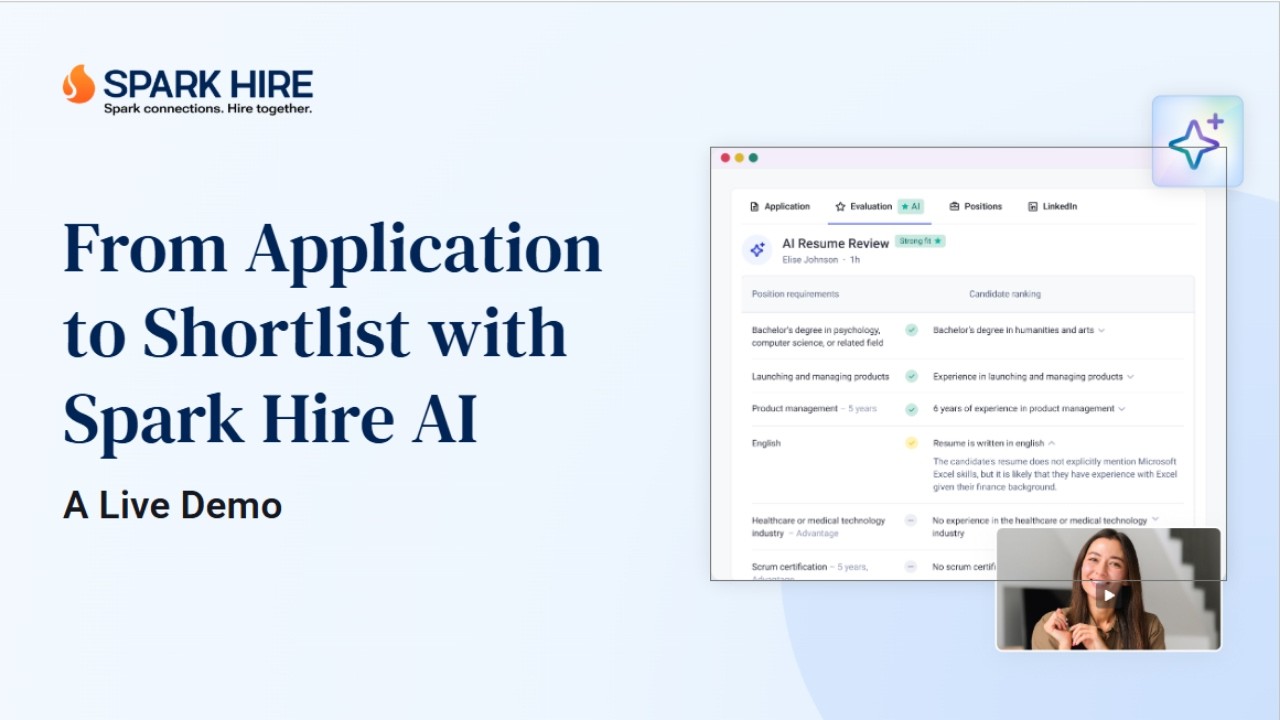
What’s New in Spark Hire: From Application to Shortlist with Spark Hire AI
Sorting applications takes time lean HR and TA teams don't have. Watch Spark Hire AI narrow a stack to a shortlist, while humans still make the call.
Pulling Back the Curtain on Modern SMB Hiring
More applications, more AI resumes, leaner teams. See how Spark Hire's video interviews, AI insights, and ATS work together to help you hire faster.
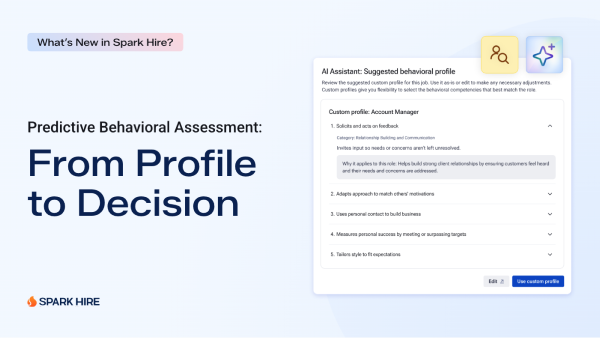
What’s New in Spark Hire: Assess the Behaviors That Predict Success
See Spark Hire’s Predictive Behavioral Assessment in action including the creation of a behavioral profile using AI based on the job description.