
What’s New in Spark Hire: Assess the Behaviors That Predict Success
September 23, 2026
See Spark Hire’s Predictive Behavioral Assessment in action including the creation of a behavioral profile using AI based on the job description.
In this session, Spark Hire leaders walk through Spark Hire’s Predictive Behavioral Assessment from start to finish. See in action how to:
- Build a behavioral profile for the role, including a new AI option that suggests competencies from your job description
- Invite candidates with an email or a shareable link
- Read fit for the role and competency results
- Use results to ask better interview questions (not as a pass/fail score)
- Share the right report with recruiters, hiring managers, and candidates
- View results inside Spark Hire’s applicant tracking system
Learn more with these resources:
I think introductions are warranted first. So I’m Adam Kazansky. I’m the senior director of commercial revenue at Spark Hire. So I primarily work with our enterprise customer success and account management team and a few other team members as well. I’ve been with the organization about three and a half years, and I’m really excited for today’s webinar. But I’ll turn it over to Jeremy to introduce himself.
Thanks, Adam. Yeah. My name is Jeremy Tolan. I’m the partnerships manager at Spark Hire, which means I’m responsible for cultivating relationships among Spark Hire strategic partners. I’ve served in a variety of roles throughout my time at the organization where I’ve helped hundreds of leading organizations successfully implement our hiring software, and I’m looking forward to kicking off the session for today.
Excellent. Now before we get started, two housekeeping items. First is if you have questions during the webinar, please put them into the chat. We have two moderators, here. We have Vince and Sue who both work with Spark Hire and know the predictive behavioral assessment, top to bottom. So they are the right moderators to have if you have questions, so please throw them in. If we don’t get to your questions or if it’s something that we have to look into, we’ll let you know or you can please feel free to reach out to your customer success manager after today’s session.
Second, we are recording this session and it will be sent afterwards. So by all means, please feel free to share this with team members after the session is completed. Alright. So before we take a full dive in, let’s go over the agenda for today. So what we’re going to be doing is following, this session, following the PBA end to end. We’re gonna talk about the candidate experience.
We’re gonna talk about building or finding the right behavioral profile, especially our new feature, the AI suggested behavioral profiles, Jeremy will be showcasing for everyone. Deploying that assessment from Meet and then ultimately from Recruit, which I’ll get into Meet and Recruit in a moment on the next slide. We’ll also take a deep dive into our assessment reports, and then finally, we do on this webinar series, pull the curtain back on an upcoming feature that we’re really excited about, and today that’s going to be automated follow-up with AI suggestions. And good morning to you too, Lamisha. Okay.
So let’s go to our next slide. And what I wanna do is I wanna talk about meet and recruit because you’ve already heard me say meet and recruit. Now, Spark Hire Meet and Spark Hire Recruit are different product areas. Now depending on your package, your configuration, or your role, you may not have access to both or to every capability that we show.
If we cover anything that you don’t currently have and want to explore, respond to the poll when it appears, which will be towards the end of the webinar today, and a Spark Hire team member can absolutely follow-up. Now, what are the differences? Spark Hire Recruit is our applicant tracking system and Spark Hire Meet is where you have our one way video interview solution as well as our behavioral assessment, which is what we are diving into deep today. Okay.
So with that said, let me get rid of this screen, and I’m gonna now talk and then turn it over to Jeremy. So look. Here here we go. So we we all know a resume can tell us about someone’s experience.
An interview can help us understand how they communicate, how they carry themselves, and give us examples of what they’ve done at prior jobs, but neither necessarily tells us how someone is naturally wired to approach their work. That’s where the predictive behavioral assessment comes in. So what is a behavioral assessment? It’s a tool to evaluate a candidate’s potential for success in specific job roles.
Our predictive behavioral assessment, and every now and again, me and Jeremy may slip and you may hear us call it our PBA. We’ll try not to. But it provides deeper insights into candidates’ behavioral competencies, skills, and motivations, helping you make the right hiring decision.
So the beauty of the predictive behavioral assessment is you can use it at the beginning or at the end of a recruiting workflow. Once I in a recent hire that I had, I had it at the end of a workflow, and I was down to two candidates, and I really couldn’t decide on each. So I deployed the predictive behavioral assessment to provide me insights that the interviews, the phone screens, and the resumes couldn’t give me, and it really helped in the decision making, which also leads to another important thing about the predictive behavioral assessment. It is not a pass fail assessment. It does not make the decisions for us. We’re using it to give recruiters and hiring managers more context and a more consistent evaluation process.
Okay. Now what I’m going to do is I’m sure you are all like, alright. Enough talking. Show the predictive behavioral assessment.
So I’m going to turn it over to Jeremy to focus on what I want us to demystify first, which is the candidate experience. That’s always what, the recruiters that we speak to have questions about. So we’re gonna go into the candidate experience first, and Jeremy, over to you. Oh, I’m sorry.
Before we do yes. Thank you for that poll. Are you currently using a behavioral assessment in your recruiting process? I totally forgot to ask that.
Really important question.
Alright. I see a few answers coming in. Alright. I see we’ve got oh, some people using it. A lot of people considering it. Yeah. This is great.
Amazing. Alright. So what we are seeing is, the majority of people are not using it in their process right now, which is great that we’re getting a lot of that curiosity here on the webinar. Okay. I’ll try not to forget the next poll, but that’s not for a while anyway. So Jeremy, over to you.
Thanks, Adam. And yes, the perfect place to start learning more about it and thanks for propping up the conversation for today. And before we dive more deeply into what this looks like for candidates, I was just gonna give a little bit more context on what the assessment is specifically evaluating. So Spark Hire’s predictive behavioral assessment evaluates 138 key competencies that are tied to real job behaviors.
And basically, you would first create a behavioral profile within the platform. And that’s essentially a set of six to nine competencies that you determine are gonna be most important for the particular job you’re hiring for. So just as a quick example, right now, I’m on the Spark Hire Meet platform. I’m on our jobs page, and I’m just going to look at the sales job just for our example.
And if I go to this assessment section and I scroll down to the predictive behavioral assessment, we’ll see that I’ve configured this inbound inside sales behavioral profile for this role.
And as an example, I can see a preview. These are the competencies that I determined that were gonna be the most important ones for this particular job. And if I click on the details of them, I could see a little bit more context about what a candidate that’s a strong fit will be able to demonstrate for these particular competencies. And we’re going to come back to this in a moment and see a really clear example of how you can actually build these out. And before we do that, like we mentioned a moment ago, we’re going to show what it’s like for candidates first. But just wanted to give you a little bit more context on what those profiles are and what exactly is being evaluated by the assessment.
So here, I’m going go ahead and share my screen and show you more of what that looks like for candidates now here.
Okay. So you should be able to see my screen again. But basically, you’re going to send an email invitation to candidates. And you can also send an SMS message to candidates as well when you invite them to complete the assessment. In that email, they’re going to see a little bit more about what to expect for what that experience will be like. And they’ll see that it’s only going to take them twenty minutes or less to complete that assessment.
Are you able to still see my screen, Adam?
Adam, are you able to see my screen?
Adam, I think you’re on mute.
Yeah. I can see your screen. I was able to see your screen. You just stopped sharing.
If you want to Sorry.
Take another Okay. Thought there might have been an issue with the screen sharing. I’ll get that going.
No. No. You’re all good. You’re all good.
We can see it.
All right. Back to what the experience is like for the candidate. So basically, they’ll go through that email. After seeing the email, they’ll go through a landing page that provides some more tips and instructions and how they can even receive technical support if they need any assistance when they’re doing the assessment. And then when they get started, they’re gonna be prompted to answer a series of 118 multiple choice questions, and they’ll be able to choose the option that they feel best describes themselves. So there’s not necessarily right or wrong answers like Adam was explaining. And the questions are intentionally varied to encourage genuine responses while also dissuading candidates from trying to choose answers that maybe present them in a more favorable light.
If a candidate doesn’t complete their assessment on one sitting, the progress is automatically saved so they can go back to the link they got invited from and pick up from where they left off. And what’s so convenient is that candidates don’t need to download an app. They can complete these from mobile or any device, and there’s there’s no app required to download. And when they finish, they’ll see a thank you screen. They’ll also receive a confirmation email.
Alright. This is not going well for Jeremy’s Internet connection today. So what I’m going to do is I’ll I’m gonna take over and at least show you how we deploy the assessment from Recruit. So Jeremy did show you how we deploy that assessment or from from Meet. So I’m gonna share my screen. We’ll show you how we deploy it from me from Recruit. So let me go in and share my screen.
Alright. So now I’m in Recruit, and what I wanna do for the Recruit users here or for anyone here that is interested in exploring Recruit, which we’ll talk about later on, what you’ll see here is I’m in my workflow for one of the jobs that I’m currently hiring for, and I wanna add a behavioral assessment step to that workflow. So all I’m going to do is add that step, and you’ll see right here, it’s adding the predictive behavioral assessment. And right from here, I can select the assessment, and this is going to select any assessment that was already built in Meet.
So it could be one of our standard profiles or one that I’ve added all or one that I’ve custom built already. I can select it. And then after I select it, I could select the expiration of that assessment. So if I want it to not expire at all or set it on a tight deadline because we have a tight hiring deadline, and I can even auto start.
Now auto start means that when a candidate completes a step and we move them to the predictive behavioral step, you don’t have to do a thing. The invite automatically goes out directly to that candidate, making it incredibly easy.
Now it looks like Jeremy’s back in the mix. So I’m gonna go I’m gonna stop sharing my screen again, and I’m gonna let Jeremy continue on his journey, and then we’ll go to the next section. Alright, Jeremy. Fingers crossed. Up to back to you.
Yeah. Here. So I’m gonna share and show you what it’s like to actually create those behavioral profiles.
So now I’m just in the same place where we started where I’m looking at a sales job on Spark Hire Meet. And if I go to the assessment section, I can see where I’m configuring the predictive behavioral assessment. And there’s a couple of different ways that we can create these behavioral profiles. We can either create new and create them from scratch. And if we do that, we’ll be able to pick from our list of 138 competencies.
On the other hand, we offer a number of standardized profiles that likely already align really well with the roles that you’re hiring for. So you could either you could also pick from those standardized profiles and use them as is or modify them by removing or adding competencies to them.
However, what we hear is that sometimes one of the hardest parts of getting started with a behavioral assessment when it’s new is knowing which profile to use. And no one wants to spend precious time combing through profiles just to find one that aligns really well with the requirements of your job or trying to figure out creating one from scratch. So Spark Hire now offers new AI generated profiles that Adam mentioned a moment ago where you don’t have to worry about any of these potential challenges. So instead, if I choose create with AI, now it’s just going to take a moment to review our job description.
And now it’s going to go ahead and recommend competencies for that role. And each of these competencies will even include an explanation of why it’s relevant based on the job description analysis that it did. And what’s really helpful is that it’s going to know if there’s a matching standardized profile available, then the AI assistant’s going to recommend an existing standardized profile that aligns well with the job. However, if there’s not a matching standardized profile available, then the AI assistant will just create a custom behavioral profile based on your job description and the behavioral profile best practices that we’ve put together.
And the goal here isn’t for AI just to decide what success means for your organization. It’s really giving your team a thoughtful starting point to then review and refine rather than requiring every single profile to be built from scratch. So from here, although it assigned this outbound inside sales profile, I can now go ahead and start removing certain competencies that maybe I don’t wanna include and adding other ones from our full list of a 138 competencies that I do wanna make sure that we’re focusing on.
Yeah. What But what Yeah. Go ahead. Continue. What I love about this is when we talk to recruiters that are interested in leveraging the predictive behavioral assessment, the thing that intimidates them the most from when I talk to them is knowing what profile.
We have over a 100 standardized profiles that you can choose from. What competencies do you want? How how is it gonna relate to the job? So there’s this, bit of, like, intimidation in using the predictive behavioral assessment because you don’t know how to find profile which will give you some of the right signals on a candidate’s motivation and engagement.
The beauty here with the AI generated profiles is it’s doing that for you. It’s saying, look, don’t you worry about it. I’ll either find that standardized profile for you or I’ll build one for you that you could then customize any way you see fit. So you sit back, relax, and we’ll do the scary part.
So I love that here. And Jeremy, back over to you.
Yeah. No. I think that’s that’s a really valid point where it’s making the setup so easy where you don’t have to have a lot of technical know how about assessments to get started really quickly. And then when we go over the results in a moment, we’ll show you how to. It’s really e the platform just makes it so easy to be able to interpret and take action on the results. But now that we’ve defined what we’re actually evaluating for, the next step’s gonna be getting that assessment in front of your candidates without adding any unnecessary coordination for the recruiting team.
So I’ll let Adam help set us up for that conversation too.
Absolutely.
So, you know, when we think about using any type of assessment or anything that the candidate experiences, we really want it to fit seamlessly in the recruiting motion. We don’t want it to feel for the candidate and especially for us, like it’s creating a separate administrative process where we’re jumping in and out of systems and slowing ourselves down.
I already showed how we can deploy that assessment from Recruit quite simply, but let’s see how we can deploy it directly in Meet. So if you’re working in Meet, there’s actually a few different ways to get that assessment in front of the candidates depending on how your team already communicates with those candidates. So I’ll turn it back over to Jeremy, to show you how that’s done.
Yeah. So just on the sales job within Meet, I’m on the assessment section. And one way that you’re gonna be able to invite candidates to take this assessment is from the top right hand corner. I’m just gonna invite to a predictive behavioral assessment, and then it’ll prompt me to enter the candidate’s name, email address.
I could even put in their phone number so that it sends that SMS, that text message as well to the candidates. And you could even bulk invite up to a thousand candidates by just uploading a CSV file that includes that information about your candidates too. And when I do that, it’s gonna go ahead and just send an email invitation to the candidate where they could follow the link in the email to complete the assessment just like what we saw with that candidate experience a moment ago. So that’s one way you can easily invite candidates right from within Spark Hire Meet.
Another way is by creating this invitation link. So when I go down to configure the predictive behavioral assessment, I can create this invitation link. And this gives you a lot of flexibility where you can now copy and paste this link to distribute to candidates however you prefer, however you choose. So maybe as an example, you might be leveraging a separate applicant tracking system.
Maybe you wanna set up an automated email template within that applicant tracking system. You could easily copy and paste this link into that email template so that you can easily invite candidates to complete the assessment using an email template from, your separate applicant tracking system. Or as another example, perhaps maybe when candidates first apply to your roles, maybe you wanna set up, like, an autoresponder email to candidates so that it will include this link in there. You can just copy and paste it right into that autoresponder email so that all of your candidates that are applying to that role will be instructed to go ahead and follow that link to complete that predictive behavioral assessment as an initial step of the process.
So those are the two different ways, basically. You can either send out the email invitation from within Spark Hire Meet or create this link that you have some more flexibility to use however you prefer. And regardless of how you’re inviting your candidates, communication matters. It’s so important. And we really want your candidates to understand why they’re being asked to complete the assessment, generally how long it will take and when it’s going to be due.
And once they complete the assessment, that’s where this becomes much more than just a step in the process. Now we can use that behavioral signal to make the next hiring conversation better, And we’ll take a look at what it looks like to to actually look at the results now.
Yeah. Absolutely. So Jeremy’s gonna keep going, but we’re doing a lot of talking about sending it out to candidates, the candidate experience, how it fits into your workflow, how you build it. But now what we wanna do is take a look at the results that actually come in, and we’re gonna be able to look at those in Meet, and Jeremy’s gonna show that, and also in Recruit, which I’ll show a little bit after. So excited to highlight that for you as well. So Jeremy, let’s show what some of those results look like.
And again, too, if you’re thinking of any questions, thoughts, comments, don’t hesitate to use the chat to put those in there so that we can address those live during the session too.
But here’s what it’s going to look like when you start getting the completed assessments back. Here’s an example of a comparison of my candidate’s evaluations.
So now when I start reviewing these two columns, fit for role and workplace motivation, Those are gonna be based on insights from the assessment results, and I can start easily making decisions on which candidates I wanna spend more time and effort on based on these two columns.
And if I go to this candidate’s profile an example as an example, I’m gonna scroll past their video interview straight to their predictive behavioral assessment results. And one of the first things that I’m gonna see is their overall fit score. I could see if this candidate was a good fit for that inbound inside sales behavioral profile, And I can see the different competencies that were being evaluated for this profile. And I can also see this match indicator score too. And those are basically just being categorized by being a clear strength, an emerging strength, an area for development, or not a natural strength. And if I click into any of the details for these competencies, I can see some really helpful context that makes it really easy to interpret action on and really understand what these evaluations actually mean. So it provides more intel on this behavioral competency at work, what does the rating actually mean, as well as guidelines for coaching.
And one distinction here that’s really important is that this is helping predict someone’s natural potential for the role based on this behavioral profile we selected. So it isn’t necessarily telling us whether they’ve demonstrated that competency in a previous job. And it isn’t saying whether someone can or can’t be successful. It’s just adding another signal that helps inform our evaluation.
And outside of these competencies for the behavioral profile, we could also see some additional insights related to workplace motivation. And, again, if I click into any of these, I can see those same details with the behavioral competency at work, what does this rating actually mean, as well as the guidelines for coaching.
And just below this section, we can also see the candidate’s top behavioral competencies that aren’t necessarily included with the behavioral profile.
And rather than treating any of these things as reasons to automatically move someone forward or eliminate them, we can start thinking them as more as like prompts for our next conversation with the candidate. So if we see something that’s a natural strength, we might wanna explore where that candidate’s demonstrated that behavior before. Something that’s maybe not a natural strength, we might want to ask more about what support, experience, or strategies they view successfully in that area. And that’s where this assessment starts helping us ask better follow-up questions in later stage interviews and not merely just giving us a score.
And one thing to remember with these top behavioral competencies is that, someone’s top competencies aren’t automatically the ones that matter most for the particular job. And that’s why we had defined that behavioral profile closer to the top here up front so we know what’s important.
But here, I’ll go ahead and turn it over to Adam so he can show what those results are.
Before you do that, you know, one of the things that really stands out here as well is you see that yellow box, accuracy concerns. So one of the things that we one of the mechanisms that has been built into the assessment is basically sensing and alerting whether the responses may have been answered in a socially desirable way. Now, when you see the questions, the questions aren’t, are you good at sales and things straightforward like that, but it’s really behavioral skill based questions. And if we believe, not we believe, but if the predictive behavioral assessment believes that a candidate may not be answering in a realistic way, then it just alerts you.
And it doesn’t mean, oh, that candidate is lying or anything like that. And it doesn’t mean you even have to do anything about it. It’s up to you. But we just want to alert you as to what the system might have or what the predictive behavioral assessment might have picked up on.
So thank you so much for that, Jeremy. So I’m gonna take over and I’m gonna show you how that looks in Recruit as well. So if you are a Recruit user or you’re considering exploring Recruit, the beauty is is everything Jeremy showed you transitions flawlessly over to Recruit, which again, as a reminder to some of you is our applicant tracking system. So I’m gonna go back and I’m gonna share my screen.
Okay. So I am looking at this candidate, Adam Kazanski. And when I scroll down and I look at the evaluation tab, what I’m going to see here as I scroll down further is the predictive behavioral assessment. And again, it’s going to look very similar to what Jeremy showed, highlighting, the different competencies, whether they are what level of strength they are, their percentile, the workplace motivation, and then their overall top behavioral competencies and some personal characteristics.
You will have the ability to expand these as well and learn what the rating means, the competency at work, and guidelines for coaching. And the beauty here is with the guidelines for coaching, you don’t have to look at someone that doesn’t have a natural strength in an area and say, oh, we can’t hire them because they have an area that isn’t a natural strength. No. It’s not a blocker.
We provide you with the guidelines for coaching because it also is important to know that there there is no perfect candidate. Every candidate’s gonna have an opportunity to get better at something.
And what you’ll notice here, no pass fail information. The low result does not mean somebody can’t succeed. So you’re seeing a candidate with a really strong result. I do wanna go into a candidate that hasn’t had a strong result so you can see what that looks like in recruit as well. So we’re gonna go over to Andy Green. We are going to go again to evaluation, and you’ll see here where we have maintains active pace, not a natural strength, makes persuasive presentations, area for development, motivation, contribution, low, but still finding the top behavioral competencies outside of the profile. So really provides you with incredible insight into these candidates and the complexity of these candidates, their engagement, their motivation.
So with that done oh, wait. Before I turn it over to Jeremy to show the reports and what those look like, you do have the ability to download the report directly from Recruit or launch this assessment and analysis in Meet as well if you wanna go back into Meet. So with that, I will now turn it back over to Jeremy to highlight those reports, which I love. They are fancy looking, and they’re they’re great. So, Jeremy, back, back over to you.
Yeah. Here. Let me share my screen again, and, hopefully, you’re getting a really good idea of how simple and easy it is to interpret these results, and it’s it’s way more than just providing you with the score, but it is so simple to really start taking action on the results. So now I’m in the same section that I was looking at before. I’m just looking at the the results of the predictive behavioral assessment on a candidate’s profile within Spark, Higher, Meet.
And at the bottom here, there’s this download report, and that’s gonna give me an opportunity to download three different reports. The one that I’m gonna show you is the hiring report, and this mirrors what we saw within the platform really well. And this is a really great way to share that intel with any other key hiring stakeholders that are gonna be involved throughout the hiring process. And this is gonna recruit this is gonna include a really nice visual representation of their behavioral competencies, the candidate’s strengths, their potential role fit, their percentile scores, as well as that coaching guidance.
So it’s going to include all of that analysis that we just saw within the platform all on a PDF that you could share with anyone that’s going to be involved with this.
Now there is also a coaching report that we saw too. The coaching report is going to mirror this hiring report, but it won’t include percentile scores. So it’s a better fit for development or coaching conversations. That coaching report would be a really good one to share with the member that’s going to end up being the manager of that new employee so they know how to best work with them and to best coach them.
And then there’s also an individual report. The individual report’s intended to be shared with your candidates, if you’d like to provide that to them too.
And with that candidate facing report, it’s going to include the candidate’s motivations, their habits, their personal characteristics, as well as growth recommendations. But it won’t label the results as positive or negative. But that’s something that you could even provide to candidates just for their own development to have that as well.
Yeah. And before you continue, what’s amazing about that is if you think about the candidate experience, very rarely do we give the candidate anything coming out of that recruiting experience where they feel like they have an opportunity to improve. And I know when I’ve interviewed for jobs before and I haven’t gotten a job, what what I’ve always wanted is that recruiter to say, oh, here’s where you kind of fell short. Here’s what we were actually looking for and things of that nature. And what we’re doing here is we’re really giving the candidate something tangible where they can learn about their own strengths that they may not even know they had and learn about areas where they could get better. So it’s if we think about the candidate experience, something that we always want to improve because the better the experience, the more candidates want to apply to your to to work at your company.
This report, not the hiring report, but the, individual report really, gives you that ability to enhance that candidate experience. So sorry about that. And, Jeremy, back over to you.
Yeah. Absolutely. I think that’s a great point, and I think this is just a really great way to close the loop with candidates and really offer them up something. You know, they already invested fifteen or so minutes to complete this assessment, they’re not being considered further in the process. This is a really nice piece that you could share with them to help close that loop.
Now, I know we’ve covered a lot for today, but if you’d like to learn more about how the predictive behavioral assessment was developed and tested for validity and fairness, we’re going to drop a link to a help center article in the chat that I encourage you to check out.
And at this point, I’ll turn it back over to Adam who’s got, some exciting updates that he’s able to share with us about AI suggested follow-up.
Absolutely. And before I do, you’ll see that another poll has popped up on your screen. If you wanna learn more about Recruit, which is what I was webinar ing, showcasing, demo ing during my portion, then obviously, please feel free to answer yes and a a member of our team will reach out to you. If if not, all good. And if you just wanna learn more later on, then you can always have that conversation with your customer success manager. Alright.
Now let’s go into that sneak peek. So, let me go back to our presentation.
And what I’m going to talk about now is automated follow-up with AI suggestions. So this is a feature that does exist in Recruit. So when you think about the candidate experience, which is something that we actually just talked about with giving the candidate the individual report, you know, we’ve when candidates don’t respond to a request to schedule an interview, you know, we risk losing them.
And we want them to also know that we’re not forgetting about them either. So with the automated follow ups, it helps you keep candidates engaged without manually tracking unanswered invites. So if you think about, like, where our time is invested, tracking candidates, tracking if they’ve responded, if we need to do a follow-up with them, like, you all have much more significant work to be doing. So that’s where we wanna come in and help out. So what you’ll see here is our follow-up email.
Now when you invite a candidate to select a time for their interview, Spark Hire AI will suggest a follow-up message that you can enable with a click. So you’ll see here that you can enable a follow-up email when sending a self scheduling invite for the candidate.
You’ll start with text suggested by Spark Hire AI, and then you could go in and you can make any edits that you need. On the upper left hand side, what you’ll see is that you could choose when that follow-up should be sent if the candidate doesn’t respond.
And then the beauty is that if the candidate responds, if you don’t need that follow-up any longer, if the candidate schedules an interview or if they’re no longer in the process, Spark Hire will cancel the follow-up emails for you.
Sometimes what we do is we we invite somebody or email somebody and then we set a reminder, a timed email to go out a few days later and then something happens and we don’t need that timed email but we forget to stop it.
The beauty here is with the AI suggested follow-up email is that it’ll stop it if the candidate pulls themselves out of the workflow or if they’ve accepted the interview. Right now, it’s solely being used for scheduling the interview, but I’m sure we’re gonna be deploying this in a lot of other areas as well. So stay tuned. This is gonna be entering rollout very, very soon. So, obviously, if you have questions about this as well, please reach out to your customer success manager.
Okay. So last but not least, finally, a poll I remember to ask. Do you wanna learn more about Spark Hire’s predictive behavioral assessment? Vince, can you throw that one up on the screen?
Let’s see what answers are coming. Loving this. This is why we do these webinars because we’re getting a lot of yeses, which is which is really wonderful to see. So keep those answers coming while we while we close out a little bit.
So thanks so much for joining us. And the larger story here isn’t that Spark Hire offers another assessment. It’s that the predictive behavioral assessment can help a hiring team define job relevant success, surface clear behavioral signals that resumes and interviews won’t uncover, and then carry that signal into the conversations where human judgment matters. If you’d like to learn more, we did add that help center article, so please feel free to use that.
If you forget to check it and you need it later, you can always reach out to us or your customer success manager, and we will happily share it. But thank you again for joining us. We really appreciate your attendance and your your your just just being here with us and you have a wonderful rest of the day. And again, members of our team will reach out if you showed interest in anything through the Pulse or if you show interest afterwards, just reach out to your customer success manager and we will be more than happy to help.
Thank you so much.
Jeremy? Thanks, everyone. Yeah. I really appreciate it and look forward to connecting with you following the session today.
Excellent. Thank you all so much. Have a great rest of the day.
Thanks.
More Webinars
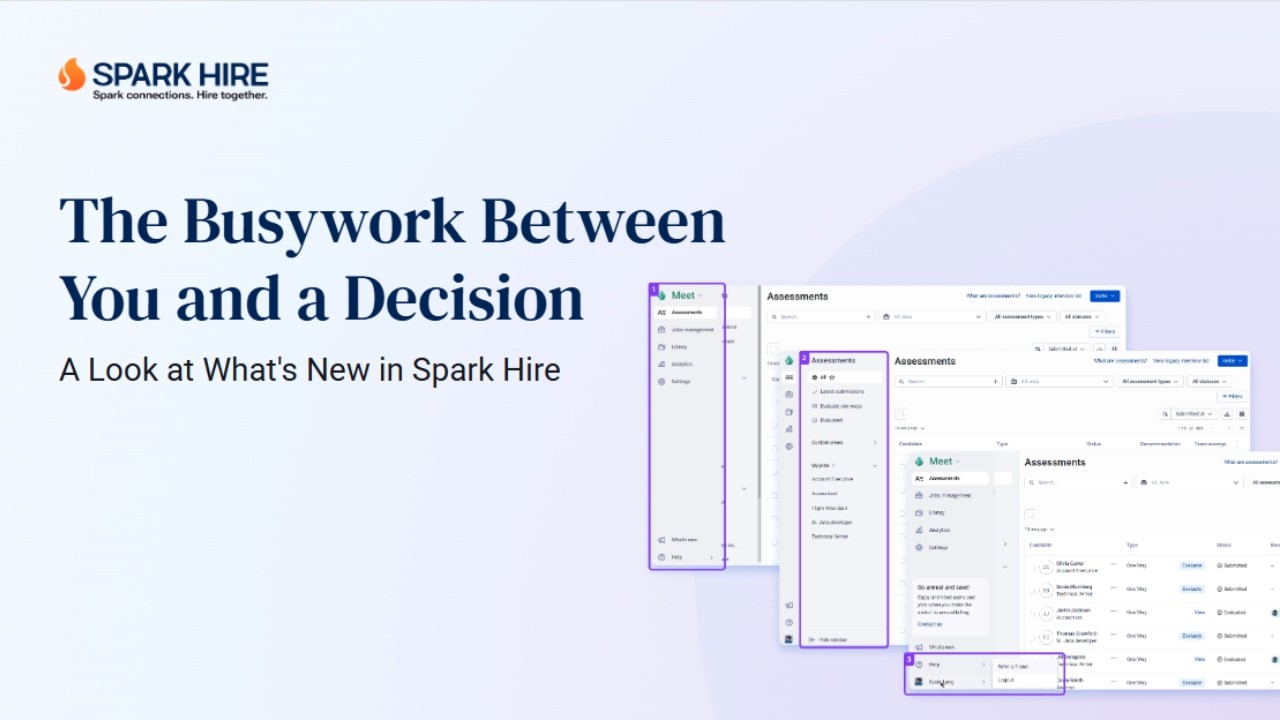
What’s New In Spark Hire: Less Busywork, Better Hiring Decisions
Spark Hire's Alisha Garlow and Ori Horvitz cover new updates for less manual work: smarter resume ranking, automated references, and AI interview sets.
How SMBs Build an Intentional Hiring Process that Protects Trust, Clarity, and Team Capacity
As SMBs grow, hiring often turns reactive and inconsistent. Watch two hiring leaders share how to build a process that protects trust and team capacity.
Pulling Back the Curtain on Modern SMB Hiring
More applications, more AI resumes, leaner teams. See how Spark Hire's video interviews, AI insights, and ATS work together to help you hire faster.