
How SMBs Build an Intentional Hiring Process that Protects Trust, Clarity, and Team Capacity
May 31, 2026
As SMBs grow, hiring often turns reactive and inconsistent. Watch two hiring leaders share how to build a process that protects trust and team capacity.
How can small and mid-sized businesses build a hiring process that protects trust, clarity, and team capacity without creating unnecessary complexity?
In this webinar, Jennifer Howell (American Marketing Association) and Victoria Manley (Reliable Medical) join Spark Hire to discuss how growing organizations can design a more intentional hiring process that supports hiring managers, improves candidate experience, and keeps teams aligned.
Many SMBs struggle with hiring processes that become reactive, inconsistent, or overwhelming as companies grow. This conversation explores practical strategies for building structured, human-centered hiring workflows that help teams make better hiring decisions while maintaining transparency and trust. In this session, you’ll learn:
- Why many SMB hiring processes break down as companies grow
- How to build clear hiring workflows and expectations for hiring managers
- Ways to protect team capacity while evaluating candidates effectively
- How structured interviews and thoughtful screening improve hiring decisions
- Practical strategies to improve the candidate experience and hiring transparency
- How to create a repeatable hiring process that scales with your team
Whether you’re an HR leader, recruiter, hiring manager, or business leader, this discussion will help you build a hiring process that is intentional, scalable, and human-centered.
Watch to learn how SMBs can create a better hiring experience for both candidates and internal teams while making stronger hiring decisions.
Great. Well, let’s dive in. Welcome to Human by Design. This title is a mouthful. How SMBs build an intentional hiring process that protects trust, clarity, and team capacity.
We’ll get into this because even earlier in our discussions, what do we mean exactly by human by design? So we’re glad you’re here. Glad you, wanna know. So we’re gonna dive in.
First, my name is Gary Schwalke. I’ll be, emceeing us here today and and, look looking forward to diving into this conversation.
But before we dive in, let’s talk a little bit about SparkHire just to give you an idea who we are. So, SparkHire has been around for over thirteen years, and we are a provider of modular hiring software that provides one connected experience for hiring teams, really built for lean teams, that provides the ability for you to connect video interviews, in order to do asynchronous screening, behavioral assessment to really get additional signal from your candidates, and then combined with an applicant tracking system. And what’s unique is that it is modular in nature and that you can get one or all of these. And so, we’re very excited to be here today hosting today’s webinar. Without further ado, let me dive into, the speakers today. So, I’m gonna punt it over here very quickly to Josh, who is the founder and CEO of SparkHire. You’ve already heard from me, and then he’ll introduce our speakers today.
Hey, everyone. Josh To land, CEO of SparkHire. Gary did a great job of introducing the company, so I won’t, be duplicative in the messaging here. But really excited to be here today. As he said, SparkHire has been in business for over thirteen years, so I’ve been doing this quite a while, have worked with thousands of customers and their hiring processes and really excited to be here talking to all these, great speakers we’ve got on the panel today. And with that, I will kick it to Jennifer who is directly below me in the video.
Hello. My name is Jennifer Howell, and I have the absolute pleasure of serving as the director of people and culture at the American Marketing Association. So I guide people and culture strategy, talent acquisition, compensation, benefits, engagement, and I serve on our leadership team.
Great. Thank you, Jennifer. Victoria.
Hello, I’m Victoria Manley, and I’m the talent acquisition coordinator for Reliable Medical.
I have the privilege of really supporting my managers and our organization and building great teams. And I have a passion for recruiting and talent acquisition and excited to be here with you today.
Well, thank you both for joining us. We’re really excited. This should be a fun conversation. It’s two very different experiences, an unbelievable amount of experience, and so I think we’re gonna learn a lot today.
So let’s talk about what we’re gonna cover. So the first is really the capacity challenge. I think this is we’ll talk about this from a small to medium business perspective, SMB. But I think those of you in large companies would say that you also feel this capacity challenge.
So it’s very relevant regardless of the size of the company.
Then we’re gonna take some opportunity to dive into automating the observation to elevation so we can elevate decision making. So, you know, we wanna maintain a human experience, but the, at many times, the constraint makes that very difficult to do. And so where are the places that we can employ automation in order to, have those moments when we do have the opportunity to connect as humans that much better? And then really, the agility advantage.
So here with an SMB perspective, one of the advantages that you have to counter some of the size and resources of the larger companies is this agility and how do we put that to work? And then we’ll, of course, provide some Q and A at the end. So, I will, with that, let’s before we, dive into to directly, I think what would be really helpful is, tell us a little bit about just to set the stage and provide some context context for the listeners. Jennifer, we’ll start with you.
Just little bit about the company, number of employees, locations, hybrid, remote, you know, number of roles and types of roles you’re looking for. I think that’ll just help everybody queue in on, you know, your experience.
Sure. So the American Marketing Association, we are a nonprofit community for marketers, whether they are students or practitioners or executives or academics.
We aim to elevate the profession and deepen their knowledge.
We have five scholarly journals and then we have industry leading training events and conferences that define future focused practice. So that’s what we do. We’re an organization of 67 team members across 22 states. So we have been fully remote for six years, which provides its own wonderful privileges and some very unique challenges as well.
Yeah, that’s great context. Victoria, how about you?
I work with Reliable Medical and we supply medical equipment. We are now a nationwide organization.
We have branches in probably 15 different states. Some of those are on-site positions, but I also have a lot of remote positions.
So having the ability to learn more about candidates quickly is really a great plus for us because we are also really expanding and growing quickly. So that agility you talk about is really important.
Yeah. Excellent. Well, and all that in the confines of, you know, the practical realities of the day to day. So, Josh, why don’t you kick us off with the capacity component here? Because, actually, several last several LinkedIn posts that you had have really, I think, hit the nail on the head.
Just some of the conversations we’ve had recently, as the Yeah. Market rapidly evolves.
So Sure.
Yeah. I think we’re all dealing with volume constraints, sameness with people using AI in their applications, which is a good thing on its own. Right? Like the ability to personalize an application to the job, but it creates all these challenge down funnel both from a volume standpoint and also from a sameness standpoint of us being able to get to know our candidates and really determine who’s qualified to get to the next step of the hiring process.
And especially for SMBs, which I guess context setting for everybody here, when we define SMB, a small or medium sized business, we’re referring to organizations with 500 or fewer employees. But as Gary said in the beginning, even if your organization is larger than that, it’s all relative. I think the other converging force that we’re all seeing is that we’re all being asked to do more with less.
So no matter how big your organization is there are very real constraints on your bandwidth and the other forces in the market that we’re facing of volume because of easy apply or remote positions and all those things that create that alongside, you know, AI optimized applications. It creates this real pressure for lean teams that are trying to to get to know their candidates. So that’s kind of like, I guess, setting the stage of what the market’s dealing with. Curious. Jennifer, Victoria, is that what you guys are seeing at the top of your hiring process?
Victoria, I’ll let you take this one first if you’d like.
Yeah, absolutely. Seeing that as we continue to grow and being able to meet with candidates quicker, response time is really important and being able to have more bandwidth.
I think it has really made the difference for me of spending as much time as I used to on the phone in the old fashioned way of phone screening my candidates, which I liked that, but it made my response time much slower. And it also made it harder on the candidates because they couldn’t even book with me for two to three weeks. And that just is not a good candidate experience. And it really isn’t getting my hiring managers or the organization what they need and getting candidates quicker. So we become a funnel, right? Where I was the one that was kind of holding it up, but I didn’t have any more time in my day.
Needing to go to technology to be able to free up that time and to get that candidates into the interview process quicker was really my objective and what I needed to do.
For us, I’m the only person in my team that does talent acquisition. So I work directly with hiring managers and then I’m the one person along with the hiring manager going through candidates. So as volume ticked up, and my work continues in other areas, what I really found to be helpful is making sure that I have a very solidly designed thoughtful process that I can rely on, that my hiring managers and my interview teams can rely on, that utilizes technology in a way as an enabler but then also still make sure that there is kind of the human touch throughout and that’s kind of threading the needle of like how do I avoid scope creep and I need it yesterday and there’s only so much hours in the day and wanting to ensure that we get the right person for the right role at the right time.
And so it can be really tricky and if you’re under the kind of under time constraints, you know, there can sometimes be challenges with wanting to cut corners or wanting to amend a process to get a quicker outcome.
But what we find is that when we do that, those are the folks that don’t stay. And so like ultimately what’s your return on investment for your interview process and your recruiting process? Retention.
So I think having a really well designed process that is equal parts optimizing the tools that we have and also making sure that there’s a personal touch that can hopefully work in your favor. And calibrate expectations like some things can’t happen tomorrow.
Like if you want this done thoughtfully then you have to build that into your plan.
Yeah. And you bring up a great point. I think that’s something that everybody needs to anchor on is the outcome you’re after isn’t a hire. It’s a productive, long standing employee that’s gonna add a lot of value for the organization and be aligned where the organization’s also a good fit for them so that they are there, for the long haul.
I think, you know, what both of you hit on, and what we’re talking about here are these capacity constraints that are very, very real. And oftentimes, Jennifer, in the example that you gave teams confront those by cutting corners so in the instance of let’s say phone screens like Victoria was saying you know gets to a point where you’re booked two to three weeks out and so what type of experience is that for a candidate when they have to book that far on the process? A lot of them probably might just end up dropping off because it’s too too far in the future for them to schedule and other hiring processes are moving just faster.
So it’s it’s not a great experience from that regard, but the other thing and this is you know where I think we get into kind of the title of this webinar here when we talk about human by design is is that really a human first or human by design type of hiring process? And I think that’s the thing that we’re all trying to balance is we have these very real constraints on our capacity. And so if we don’t do anything about it, the candidate ultimately is the one that feels a lot of the pain. And that’s not because the recruiter doesn’t care about delivering a good experience, but it’s these constraints that they’re under that lead to that experience for the candidate if nothing is done.
And so when I think about it, I’m curious how you all think about just defining human by design. I think it’s important for us to level set on that here for the audience. To me it’s about designing a hiring process where all candidates that are qualified can be considered for the role. All of them get a fair shot to present themselves for the opportunity.
And as a business, that’s what you want as well to Jennifer’s point if we ultimately wanna bring the person in that’s going to be the fit and if we cut those corners, we kind of sell ourselves short of giving ourselves an opportunity to find that person as well. So when I think about human by design, it’s not about the personal touch points, right, that everybody thinks it is. Now that’s that’s certainly important, and ideally, we could insert ourselves at so many steps of the process to have that personal touch. But to me, it starts with really the first step, which is ensuring that all candidates can be considered and have an equal and fair shot for the opportunity.
But curious how you guys think about that.
I mean, for American Marketing Association, it means that there’s real intent through the entire process. How is this role gonna impact the business? How is this person gonna interact with other teams and external stakeholders? How can we cut through the AI slot? How can we make this challenging process underpinned by the people at AMA and what’s important to us?
We also think about our core competencies and interview based on those core competencies because who you are happens well before what you do. And so these are things that if there’s no intent other than a body in a seat, that’s not intent. That’s reactivity. And so human by design for us means a very clear intent of what we need, who we need in this role ideally, what questions can we ask to make sure that we’re determining whether or not that this is the right person, that we’re clear and concise about it in the job posting so they know what to expect too. And those kind of little things when you build them into a process and you design it into a process, it actually eliminates a lot of the grunt work because it’s just stuff that you do instead of things that you have to add.
Well, I know Josh, me, one of the things that you talked about, human by design and really how to define that. I think one of the things that we wrestled with was with the technology piece, are we not having that touch point? One of our people first and being respectful of people and certainly engaging and building relationships is really important to our company culture. So we kind of wrestled to say, would this be a deterrent or would this not be a good representation of our company by utilizing technology in this way? And really had to look at it and define it, as you said, as I looked at really the reality of a candidate experience and not being able to be engaged quickly and really finding out what did that mean? And I think it was really redefining that.
And I think that this has really been the right solution. It has been lovely to find that some of these candidates, I mean, I’m being able to reach out and get them started in the process the same day that they apply. And what’s exciting about that is they remember who we are because like you said, with Indeed, with some of these one click or what this and that, if it’s a couple of weeks down the line, they forgot what they read about. But usually that first day when they’re applying, they’re engaged in the position, they’re excited about the opportunity.
And so you don’t lose that momentum with a candidate as well. So I think it’s been much more respecting of their time of putting in an application with us. And the other aspect to it that I thought has been really a good contrast for me, even though is when my phone screens, I would try to be very descriptive and I would try and give as much of a great summary of what they were providing. It’s really one dimensional compared to what a video will provide or having that because they have the opportunity to fully express themselves and present themselves.
And I just found that it’s like three d in comparison and it’s just so much richer. And again, I think that allows for more candidates, like you said, to be considered that all qualified candidates and you’re able then that in that grouping, be able as you’re going through your interview process to find the one that’s going to be the best fit. And it’s not restricting or leaving others out. So I think it really does include more people to be considered.
Yeah.
That’s such a great point. It sparked a, I remember Alex Mosman from Knox County Schools conversation we had a month or so ago said, look, at the end of the day, everyone, every human being wants to be seen, heard, and respected, right? And and if you, if we think about that as the human aspect of it and it sounds like, you know, you both have decided to part of the way that you’ll create capacity for your organization is by utilizing asynchronous video interviews in order to help make that possible just as you described, Victoria and, if you, if we, if we take it from that perspective, to your point, it’s like, okay, now, what are the actual advantages with those goals in mind that this additional capacity creates, right? For we’re we’re more quick to respond to everyone regardless if you’re a fit or not a fit, right? And that’s respecting them, right?
Mm By doing so, we’re showing them that they’re both seen and heard and they get an opportunity to your point to tell the depth of their story that that probably doesn’t come across in a in a two d, two dimensional as you describe.
So, that’s a way that that probably a good segway then to the the next piece which is okay, we’ve we’ve put in place some of these tools that have created this opportunity for asynchronous communication between a candidate and a recruiter as well as hiring managers because to your point, not only can you, respond quickly back but can you put them in front of a hiring manager or hiring managers, plural at the same time, right? And they can see them asynchronously. So, I’m sure that’s been a boon for creating capacity. How is that then helped you where those human touch points do then come in to amplify the quality of those or you know, how we how we think about where the the human judgment comes into that process.
I mean, I think one of the things, there are a couple of things. One of the things that I realized is when somebody submits an asynchronous interview, I get a notification and I started noticing that we were getting them at eight, 09:00 at night or like midnight 01:00 or six, seven in the morning or during the lunch hour. And so like when I started identifying these trends, I realized this is when it’s best for them, not when it’s best for me. And so it was allowing candidates to not have to constrain themselves into a stressful situation.
The other thing that I did which was pretty intentional and what we’re able to do is say how much think time do you have? How many retakes do you have? Like those kinds of like components that you can build in. And one of the things that I realized was that nothing in the jobs that we do at the American Marketing Association, we’re not saving lives, we’re not curing cancer, we don’t work in an ER.
So like a thoughtful response is more helpful for us than a really quick, oh my gosh, I have thirty seconds to think of this answer and then I can’t retake. And so we gave unlimited think time. And I’ll say in the intro, I want you to give me thoughtful responses and like really give some thought. That’s why you have unlimited think time and give them that opportunity to show up as the very best versions of themselves, whether they choose to or not, that’s them. But if we give them the space to do that, they show up and they show up in really magnificent ways.
Great point.
Well, think Go ahead.
Oh, go ahead.
Oh, no, I was gonna say that has really been our experience as well, Jennifer.
I think you articulated that beautifully in what we’re seeing and to the quality. I mean, the people that are responding and taking the time to do the videos are usually the stronger candidates, and then they’re able to represent themselves in a way that you know, it’s so much richer for us to get to know them so much quicker. And like you said, they can do it on their own schedule, which, you know, really does allow for a quicker turnaround time to present them in front of the hiring managers.
And just doubling back real quick. So, Jennifer, one of the things that you described was, the opportunity to create a thoughtful process. And I think that’s one of the other major benefits of this capacity creation is. Mm It’s not only that you can process more and do more volume but it actually gives you the opportunity to work on the process instead of being drowning in it. Yeah. And then, you can really think about, okay, what is that balance of, you know, us getting more signal while at the same time, really getting the best out of the candidate like giving them an opportunity to shine and you know, maybe if if you can talk a little bit about some of the things that as you had that opportunity to go back and think about that thoughtful process, what were some opportunities that were created by virtue of, you know, having some additional capacity?
I think one of the benefits of that was, so like most people who are in talent acquisition, we do an intake meeting with the hiring manager and we say, what would be really helpful for you to know about this candidate that can be more observational and build that in. There’s so many observational aspects of a role. Like, how do they show up? How do they communicate? How do they explain a situation that they’ve been in? How do they take themselves through a behavioral interview question?
We also find that people are a very authentic version of themselves and they’ll share things that they loved about previous jobs and things that they really struggled with in previous jobs. And that’s informing why this job, why us? And so we’re finding out like this more robust story of them that helps us to also sort of say, this fits. Or it could be, gosh, we might not be what they’re looking for at all.
And so that’s a thoughtful way to enter into the process. And then it also allows us to say, Oh, these are the things they chose to speak to us, tell us about. I then during a phone screen after we put them further down in the funnel, I bring it up. And then they’re just like, Hey, wait, your voice sounds familiar.
And I’m like, Yeah, it was me asking the questions.
So it’s sort of like, it’s reiterating, no, we’re a human process and we’re a small organization. Like there’s only so many people that do this. So yes, I’m gonna be holding your hand through the whole process and this is all really meaningful to me. And if I’m showing you that it’s meaningful to me, then you’re gonna feel valued as a candidate.
Yeah.
And that is ultimately like what we want.
Great example.
Well, I like the idea of the, again, more of the thoughtful questions. I think one of the things that I’m able to do now, I always had individual phone screen templates and ones that were position specific, but it was kind of always just that first layer, if you will. And I think here that I’m able to design questions that are a little bit more specific and richer for each position so that the candidate can then speak to those things as to why their experience, their skills, their passions are such a great fit for the opportunity. And they have more opportunity to really express that.
And the hiring manager is able to find those candidates easier as well. And that’s already been discussed before they even get into the interview so they can dive deeper. So I think it helps to kind of look at being able to have a richer interview experience through the process because so much of the original went deeper to begin with. So I think it’s beneficial for both.
When you work at a small or medium sized company, you’re competing with massive organizations for candidates, right? So it’s how can we, we can’t give them all the bells and whistles that a Google could or an Amazon could, but what we can do is we can treat them like a person and not a cog in a wheel.
And like, if you design a thoughtful enough process, they’re gonna remember that and they’re gonna say, Yeah, Google’s cool, but man, I felt And that is like the feedback that I hear because we have candidates that come from all kinds of backgrounds and they remember our process. And then once they’re here, we do interview training with them and they’re doing interview teams and then they see behind the stage and they say this is thoughtful all the way around. I’m like you bet it is.
Because we have to compete with other organizations for talent and so how best do that than have us show up in the same way that we are asking them to show up.
Totally. And I think candidates can definitely feel when a process is really thoughtful, and a lot of effort has been put into design of the interview questions and the interview team and everything that goes into it. So, of course, when you get capacity and you can invest it into those areas, candidates will feel that. I also think that maybe the biggest thing that is maybe unsaid but does happen is when you get this extra capacity, it really allows you to invest in the moments that really, really matter to the candidate.
And those are the things that aren’t necessarily a stage in your hiring process workflow. It’s really those moments in between stages. So for example, if you are doing phone screens just back to back to back for weeks on end, how are you able to show up when you’re on those phone screens and give a proper evaluation of candidates when it’s just like back to back to back, one blends into the next. I don’t have time to even write notes down in between them.
So one, like, how are you showing up in those moments? That really matters. Two, how are you getting back to those candidates? Right?
Like, by creating the capacity that you now have, you can actually invest in those touch points to make sure we are getting back to candidates in a respectful, thoughtful way. We might even be able to provide feedback to some candidates who ask for it. And then you think even downstage, like, later in the process when we have to get back to candidates and tell them they didn’t move forward. Like, those are the moments that a candidate is going to remember about your organization.
And in some cases, those candidates might also be future candidates. But even if they’re not, right, you wanna treat them with respect and dignity. And it’s like when you create the capacity because of things you do, whether it’s tools or things you do through process, you can reinvest in those moments and that is ultimately I feel like what the candidate is gonna most remember about the process. Like they’ll remember it went fast, they’ll remember you asked good questions, but they will really remember the recruiter who reached out with really thoughtful feedback even if they didn’t get the role.
And so I think if you can free up the capacity, it allows you to invest in those things, which just reinforces this like human first, human by design type of process everybody’s trying to run.
I think and we both hit on the other benefit of, you know, the the process that you’ve designed is, especially in this environment is the richness of the signal that you get about the candidate, right? Back to Josh’s point about when you’re just flowing through the process, it’s really easy to just check the box versus actually giving them an opportunity to convey the the best version of themselves and get to some level of depth and then, when you’ve done that and you use, as you mentioned, they they respond to a question a certain way and then later down in the process like, hey, I was really intrigued by that. Can we unpack that a little bit? I mean, how much more powerful to be able to seen and heard than that?
Right. Right and it’s also, you know, for for us, an async interview is the first step And then after that, it’s a phone screen with me if they’ve made it through.
And so what I’ll always do is I’ll schedule my day. I mean, is also like time management and trying to mitigate stress when you’re in HR in a small and medium sized business, you have a lot to do. And setting that time aside at the start of my day to say, Here are the people I’m phone screening today. I’m gonna set aside a half hour, thirty five minutes to rewatch their async.
And then I have my scorecard and I type in my notes in advance and say, really loved this, really loved this, would love more information on this. And so I’m taking notes as we are speaking, I’m encouraging them to be as open as they can be with me. And it’s a pretty robust conversation almost every time. But it’s, again, you have to The design moments of the process can be very small.
So it can be quite literally blocking your calendar off for like ten minutes before an interview, blocking your calendar off for an hour in the morning and getting yourself prepped because candidates feel it. If they think that the first time that you’re seeing their resume is when you are talking to them and hesitating, that is the worst, worst thing. And so it’s my job to make sure that they feel seen and heard by showing up as my most prepared version of myself as a representative of the American Marketing Association. So building those micro moments into your process, That’s the time savings that you’re getting.
That’s where you can utilize it in a really thoughtful way that is evident to your candidates.
And Victoria mentioned this earlier. She brought up the term momentum, and I think it’s a really important term to reference here.
Recruiting is all about positive momentum with the candidate as you work through your process, not just from step to step, but, Jennifer, as you just pointed out in those moments because you know what crushes momentum is when a candidate did some type of interview and they show up for the next type of interview and they’re being asked the same questions over again and it seems like nobody read the notes or nobody watched the videos or whatever you’re actually doing in the process. Like, anytime a candidate feels like you didn’t put the time in or it wasn’t thoughtful, or they’re being asked to repeat themselves, like, that just totally crushes momentum.
And so when you can create the capacity, to go back into your process and examine these steps, these momentum opportunities, that’s where you can really, invest a lot of time again into the way that you communicate with your candidates, into the way that you review their interviews or the review the notes so you can show up as your best self from an interview perspective, for the next round. Whatever those moments are, like, think about those things that would actually matter as a candidate. Or if you were a candidate, what would actually matter to you? What would be the things you would really remember about the process, and that’s where you can go back and really invest that extra capacity.
And then the outcome of that is not only a fast hiring process, which is obviously good for the candidate, but a process that feels fluid. And I think that’s the thing is candidates don’t like the gaps because it feels like unknowns and black holes. Did they really look at this? Did they really talk to this person?
Did they even watch my video interview or whatever it is? But when you can show up because you’ve created the capacity to show up, it makes it a lot more fluid for the candidate, and that continuity gets them, like, really bought in, like, nodding their head. Yes. Yes.
Yes. I want to work for this organization, and that’s really what you’re after throughout the process.
I mean, people’s time is valuable.
It’s basically it. Like, my time is valuable because I am a team member who is on a salary.
Our candidate’s time is valuable because they’re investing time in this process. So understanding, accepting and pointing out rightly your time is valuable.
So that there’s not a lack of understanding of what our process is. Here’s the timeframe. Here’s when to expect to hear back from us. Here’s when, like, and as close to that as I possibly can get of, I’m doing phone screens this weekend next. I would say expect to hear back from me by these two or three days about your candidacy moving forward. If you have questions, drop me an email.
They know every step of the process that it is not just dropping into a dark hole.
And so those are also things that from freeing up space, I’m able to intentionally provide more transparency about our process.
And that’s really important because if I’m answering emails of, Hey, I interviewed with you. Hey, I interviewed you with you. Hey, what timeline are we looking at? Hey, I’m still really interested. Hey, I now have a job offer somewhere else. If I’m spending all of my time responding to those emails, that could have all been avoided had I simply been transparent about the timeline at the front end. And so that’s been a real time saver for me and our candidates appreciate it too.
Yeah. That’s such a good point. The transparency is huge. And I think also, Josh, the point that you brought up about killing momentum by going back and asking some of the same questions, Not only is that killing momentum with a candidate but it’s also very inefficient for us because we’re asking the same questions and not getting any new signal, right? That’s the point is I wanna get to some level of depth and so, now, as you think about that some of the changes and process that you’ve put in place, where have you seen that show up for your hiring managers as an example to just that point, what they feel like, you know what? I actually know a lot more about this candidate at this point And now I can go deeper on the areas where I need to explore, fill gaps or things like that.
Well, this is really, you know, when you talked about having some extra capacity, this is really where I have found that I can be a better support to the hiring managers and helping them with their interview process. I mean, a lot of us that are in HR and in talent acquisition, we know how to do it. But not all hiring managers, even though we have training and things like that, but they need more support many times. What’s important for them to be asking and what are the things that are important to be reviewing with candidates and having that layering.
Many of my managers, maybe the next step would be a virtual with maybe a manager. And then from there, it’s going to be an area director. So helping them coordinate between that where they’re not just asking the same questions over and over, but really have something that is going deeper to each layer. And so I’m able to really be that subject matter expert that’s coming in and helping them build their processes in order to have a better interview.
And that’s where my capacity has opened up so that in the long run, that does give the candidate a better experience, right? Because they’re not just being asked the same things. And it also is better for the hiring managers because at the end of the day, as they go through the process, which is really what a well built interview process should be, where at the end of the day, you know who your top candidate is. And I feel that that’s where I’ve been able to really use my time to help with building our processes better.
Jennifer, I know from a previous conversation you used a term that really resonates with me and what exactly what Victoria is saying, which is you’re a steward of the hiring process and it’s not just with your candidates but it is also with your hiring managers. So we’ve talked a lot about right now reinvesting time back into the process that impacts candidates, but I think Victoria brings up a great point which is you are a steward of all stakeholders in the process. Candidates are one and hiring managers and other stakeholders are other, you know, people that you need to be a steward for in the process. So really when you can create that capacity you can become more of an enabler, and help not only you know you and the candidates but also your hiring managers and downstream what their influence is on the process.
It’s true. And one of the things that, you know, when I do an intake meeting with with a hiring manager, I’ll say, I’m Tell me what you’re looking for outside of the job description. Like, what are you really looking for? What qualities, where is there a gap on your team? Like, what quality would be really helpful to round it out?
What are the three to five things that I can brag about what your team has done?
Who is this person gonna be working with? Like, let’s make sure to include them in the interview team. Like, what competency do you want to assign this person on this other team? And so having them have a very firm say of, yeah, we’ve really struggled with candidate or people in this position previously, there tends to be a little bit of a challenge with this other team.
So I absolutely wanna bring somebody from that team into the interview process so that we can say, all right, so what’s important to you? Well, I really need somebody who can clearly and quickly communicate, Great. And so then it’s sort of like, we’re trying to resolve issues, not just for the hiring manager, but how this person is gonna interact with stakeholders internally. And then I can then say to candidates, you’re gonna be working really cross functionally here and here’s how that shows up.
And when they’re doing a virtual interview, I prep them. And I say, here’s who you’re meeting with, here’s how you’ll work with them.
Here is kind of what they’re like and how they interface and what they do here at the AMA. And so it’s also providing them context as a candidate of like, why am I meeting people from this team?
But again, it’s like, and then building those interviews so that they’re meeting with me first, I’m giving them as much information as I can, as much knowledge, as much cheerleading as I can. They’re meeting with people from other teams and then they meet with the hiring manager.
And I tell them at the start, you’re gonna get a lot of context that a job description is not going to give you. You’re gonna hear from these people why this role is important.
And so you’re gonna bring all of that knowledge into your interview with the hiring manager and you will be your very best self.
And so it’s like having a process that considers the candidate’s experience when it matters at the end, that is worth more than gold.
It’s so valuable. And so if you have extra time to spend thinking about what your process looks like and where it matters, you can build these moments and that are a little bit more micro.
That is such a a great point, Jennifer because Josh has heard me say a thousand times, slow is smooth and smooth is fast and you described exactly that which is the capacity gives you the opportunity to to not just have an intake meeting but really help the hiring manager through that intake meeting get to what is exactly what does success look like? And let’s actually go to all of those areas of nuance that don’t often get described that are that actually end up being the arbiters of success or failure and then, you can determine, great, now, how do we look for that? What are the questions we need to ask?
Who needs to be involved so that we can get to those those attributes that are like, hey, we feel really confident in that success. So. Mm Such a great example which quick plug, we actually put together a custom GPTs to help hiring managers do just that. They’re entirely free.
We’ll include a link here somewhere but we’re we’re pretty excited about it because that’s I know Josh has been very adamant about that. That it’s like anything even as we think about what we do day to day selling software is, you know, really taking the time upfront to plan. What is the objective and and where do we lean in and spend our time that gets us to the output that we want?
Yeah and I think both of you throughout this webinar have made me actually rethink. I think I wanna redo on my definition of human by design hiring. I I still firmly believe in the fact that, you know, candidates deserve an opportunity to be considered. Like, that is a no brainer.
But what this conversation has led me to is we also have to factor in the other humans on the other side of the process, which are the hiring managers.
And those the candidate and the hiring manager, those are the two stakeholders that really hiring is stressful because it’s such an emotional time.
Right? On the one side, you have candidates that are they they need a job. They want a job. They also want people to like them.
Right? They want to to feel valued and feel like they have the skills to get the opportunity that they’re trying to get. On the other side, you have hiring managers who have a target to hit or have goals to hit as a team, have this anxiety about this open role, whether it’s a backfill or growth position, ultimately not having that position filled is impacting them and their team performance in some kind of way. So there’s, like, this anxiety on both sides of the hiring process.
And while the recruiter in the middle might own the KPIs around time to hire or future retention or whatever that may be, like, the candidates and hiring managers have the most, like, emotional weight at stake in the process. And so as I think about, like, a human by design process, it’s it’s one where, you know, we can, you know, make sure that we’re not only giving candidates an opportunity to be considered, but we’re also, you know, helping hiring managers run the best process they can possibly run to ensure they get the person that’s gonna help the success of their team. So it’s like the balance of those things.
And then what I think I wanna transition to here just as a quick pivot off of that is like, you now are faced with the constraints of what we talked about in the beginning of the market today. So it’s like, how do we how do we build a human by design type of process? How do we create the capacity? What are the trade offs we have to think about as we try to build that process?
That’s really like the challenge that people have to solve for. You know, somebody and I won’t take credit for this, but somebody shared with me recently, there’s a Reddit post, and the post was a letter from, like, I don’t know, nineteen fifties, really long time ago. And it was from the director of some department at an organization. It was to a candidate that had interviewed for the organization, and it was like a handwritten letter that says something along the lines of, sorry.
The position is no longer available, but we appreciate your time. As a thank you, we’ve enclosed a $75 check for your time and whatever else the rest of the letter says. But I thought that was a really interesting example of investing in the moments that matter. The challenge, though, is, like, today is not the nineteen fifties, and we have very different constraints.
So, yes, in an ideal world, we’ll able to write that handwritten letter. We’ll able to bring everybody in for coffee and talk to every candidate in person for ninety minutes as we interview them. But there are very real constraints in our time and our bandwidth just based on how fast everything moves. So with all that, and maybe this is a good segue as we kind of, like, outro from this webinar.
I’m just curious how you thought about the balance of that. Right? Like, you realized, hey. We have this capacity constraint.
We have to do something about it. And, Victoria, you alluded to this earlier as you were considering using a one way video interview solution. So maybe we’ll start with you as, like, what were the things you were thinking about? And, ultimately, how did you come to the decision that going in this direction was better than going in the other direction or just sticking with the status quo?
And before you answer that, I wanna add to that because I was on heading down the thing, actually, not surprisingly, is as you were thinking about ways to solve it, to Josh’s point, there are other stakeholders involved and and both of you, like, it’s one thing to implement new solutions that make the current process you know, maybe it’s an applicant tracking system or something like that. That’s like, hey, this just has more bells and whistles and allows us to do these things but we’re fundamentally peel back the technology and the process doesn’t really change.
The introduction of asynchronous interviews is fundamentally different, right? And in the in without having previous experience, there are probably lots of stakeholders in the room that are like, I don’t know about that. Like, you’ve you’ve even mentioned that Victoria. So, as you are evaluating these things and where you’re plugging in, how did you then also think about, you know, those conversations and and getting people comfortable with that with those changes?
Well, a lot of it that were conversations that I was having with our hiring managers is they themselves were feeling the constraints of time and not getting the candidates quick enough and things like that. So as I was doing my investigation of how best to solve those questions. So it was something that we were engaged in conversation with the hiring managers as we went. And then as we were finding some solutions, I was sharing what I was finding with them as I went to.
And of course, they would hear my excitement about, Hey, I think we found some good ideas. And so engaging them in advance too, with letting them know that we are looking at and addressing these situations. I think one of the things that is wonderfully surprising is, again, we talked about it earlier, the agility, right? It allows me to have that because it really can change on the type of position I’m recruiting for, how that is.
We also are in major growth in our organization. I’ve got new launches and de novos and things like that that are happening simultaneously with the regular type of recruiting that’s going on. So it’s allowing me that being able to be agile in building some processes and new that are going to be more timely for our situation. We can’t remain stagnant.
We can’t remain doing all what we used to do when you’re in that, nor should we. Mean, that is one of the things that’s wonderful about having all these wonderful tools is that it does allow us to do things better and to be more mindful and thoughtful about how to utilize them and be agile in how to adapt them to the different positions or situations that we’re in. And I can pivot quickly, which is really what I needed.
Yep.
I mean, same for us. I think the problem that we were trying to solve for was we had been using asynchronous interviewing for a while, but the constraints were that didn’t have a mobile function. And so that was something that we were really trying to solve for because it made it, it didn’t lend itself to being an inclusive option for people. And so that was the main problem that we were trying to solve for. And how do we show up as an employer in this platform in a way that’s authentic, true, and not just here’s the question on the screen, now answer it. It’s can I record the questions?
Can I control how much time they have to answer? How many retakes they have? How much think time they have? Like, can I build this in a way that’s better suited for them?
Can I do an intro to tell them what to expect and then an outro thanking them for their time? Does it trigger emails to me when it’s finished so that I can move and trigger an email to them saying, Thank you so much. We received it. You’ll expect to hear from us in this period of time.
Those were the big problems that we were trying to solve for. And for our hiring managers, it also removed the, I have a good feeling about this. It’s when you have a video interview, hiring managers are asked to submit like a scorecard on it. Like, what did you like?
What did you hear? What were your thoughts? And it removes the gut check because we’re asking for specifics. What did you hear and why did you like it?
And so affinity bias can be really, really real and it’s one of the biases that is the hardest to check for because it’s like it’s something that makes you comfortable.
And when you remove that and ask for specifics, get different kinds of candidates that rise to the top. And so having this be part of our process, solve for problems that we weren’t even really aware of until we realized that, the people that are moving forward are a far different caliber and have different backgrounds and have different skill sets and different work experiences than we ever had before. That’s fascinating. And we’re better because of it.
Yeah, back to that, the richness of the signal. Well, you both provided great advice because I can tell you as we work with hundreds of people every month that are evaluating alternatives and a lot of times, they don’t start the way you started which is what is the problem that we are seeking to solve and what are all of the ways that we can do that and then, Jennifer, you also hit on and what are the non negotiables in solving it? Like, I need to be able to, you know, do these things. I I don’t doesn’t matter what tool I use. I need to be able to have these capabilities so that I can deliver the experience that I wanna deliver. So that was just really solid advice.
And and Gary, I wanna bring up one thing, and then I think we should transition to a final question as we wrap up here. But I think it’s it’s about both of what you all said, and I think it’s also about, you know, weighing things against the status status quo and what we’re doing today. And so I think like as you evaluate whether it’s one way video interviews or any type of solution AI, some automated tool, whatever it is, you’re you’re you first start with the problem that you’re trying to solve and you know what your status quo is.
There’s not gonna be any solution that there’s not gonna be some type of trade off to consider when you when you think about implementing it. But that’s where I think it goes back to the beginning and when we talk about human by design and this definition. I think it’s what you need to start with internally is be very clear on what type of process, what type of experience are you trying to deliver to candidates and hiring managers and start there because that’s a really good anchor point as you think about some type of solution to implement that has trade offs. It’s ultimately, well, we know what the status quo is.
We know what this new solution will help us do. We also know the trade offs with that new solution, but which of these paths is going to lead us to the process and the experience that we ultimately want to deliver. And so I think that’s like a really good north star as you think through the decision making process and think through getting stakeholders bought internally, and that’s a good lens to look at things through. So I know we’re short on time.
I wanna just wrap up with one question, then Gary will go to next steps, outro, and all that. You know, we talked in the beginning about the sizes of your organizations. We defined SMB as, you know, 500 or fewer employees, give or take.
You guys are both in those types of organizations.
For an SMB, Jennifer, you alluded to competing with larger organizations for talent.
What are, like, the biggest wins when you create this capacity and you can really invest in the process and experience that you want to deliver? How does that help you outmaneuver, you know, the bigger employers that you mentioned when you might be disadvantage in other ways just because of the size of the organization?
And as you answer that, I’m just gonna put this up so people can have it.
I mean, I’m what I hear from our candidates and from the people that we hire and the people that we don’t move forward with is that they felt seen, they felt taken care of, they felt prepared, they knew what to expect, and that was rare.
And so I think the fact that it’s rare is telling you that human by design isn’t something that is common as you would think. And so when you treat candidates well, even if you don’t move forward with them in the process, if they still follow you on LinkedIn, they still apply for another role down the the line, that’s telling you that you’re doing something right. I think one of the other signals of success in this is turnover. Like our average tenure, depending upon the team is three to eight years. Like it’s wild. You know, we generally don’t, the average jump is maybe two to three years I keep seeing in reports everywhere, our people stay.
And when they go, we’re never mad about it. We’re so excited that we got to be part of their journey, but they remember how they were treated at AMA from the very start. And sometimes they come back because they know that they’ll be treated well. And so I think those things matter.
I think it matters. And so those are the big wins. And our former, we had a former executive who was with our organization for almost a decade and then went on to a larger organization. And he said to me last year, Gosh, I forgot how thoughtful we were.
A whole different world when you work at XYZ Corporation. It’s like, man, they don’t care at all. Like, it’s the job. And it’s like, that’s okay.
That’s okay for some. It’s just not okay for us.
Yeah.
Well, I would just say that the same thing, being seen and being heard. I found for most people these days, that means much more to them. They’re much more invested in companies that want to be invested in them, right? And not just being a number, not just being a cog in the wheel.
And I think when you are a company like ours who wants to be people first that really care about that relationship building with our organization, with our clients, with our coworkers, it’s really holistic with what we’re wanting to accomplish. And so having it in our system as part of our interview process and allowing for that gives them that touch already of how important it is. I’m just finding that, well, they’re the right fit for our kind of company because that’s what’s going to work. They’re gonna be happier here, you know?
So to Jennifer’s point about longevity, right? They know that it’s rare. And I’ve I think that more and more people are really wanting that, you know? And we aren’t really wanting people who just want a job.
I mean, it is a mission. We have something that we’re trying to accomplish and we want to have people that are invested in the mission that we’re trying to accomplish.
And so I think it allows them to be able to express too how they’re in alignment with our mission.
And that’s exciting. I love when I get that kind of response from candidates and learn about their passions and how that means something to them, because that’s really a good fit for us and and and know it’ll be a good fit for them. It’s a win win. It has to be both ways.
Yep. Yep. Well, that was awesome. Jennifer, Victoria, as we expected, such a good conversation, and, I mean every time we learn something from you both.
So, thank you for for taking the time and for sharing your wisdom and expertise and just being candid about it all for everybody. I think that’s what we all learn the most. It’s just you know, we’re all we’re all trying to figure it out and, doing it together makes it a lot more fun. So thank you for your time.
Thank you for having me.
And Thank you both.
Those that, for those that have, we just have the next steps. If you are interested in learning more, go to go.sparkhire.comsherm.
You certainly would encourage you to reach out to us on LinkedIn as well. Josh in particular is easy to find, a man in demand, and Jennifer and Victoria as well. So thank you all for spending some time with us. Thank you for your time today, and, we hope you found it very helpful. Have a great day.
Thanks, everyone.
More Webinars
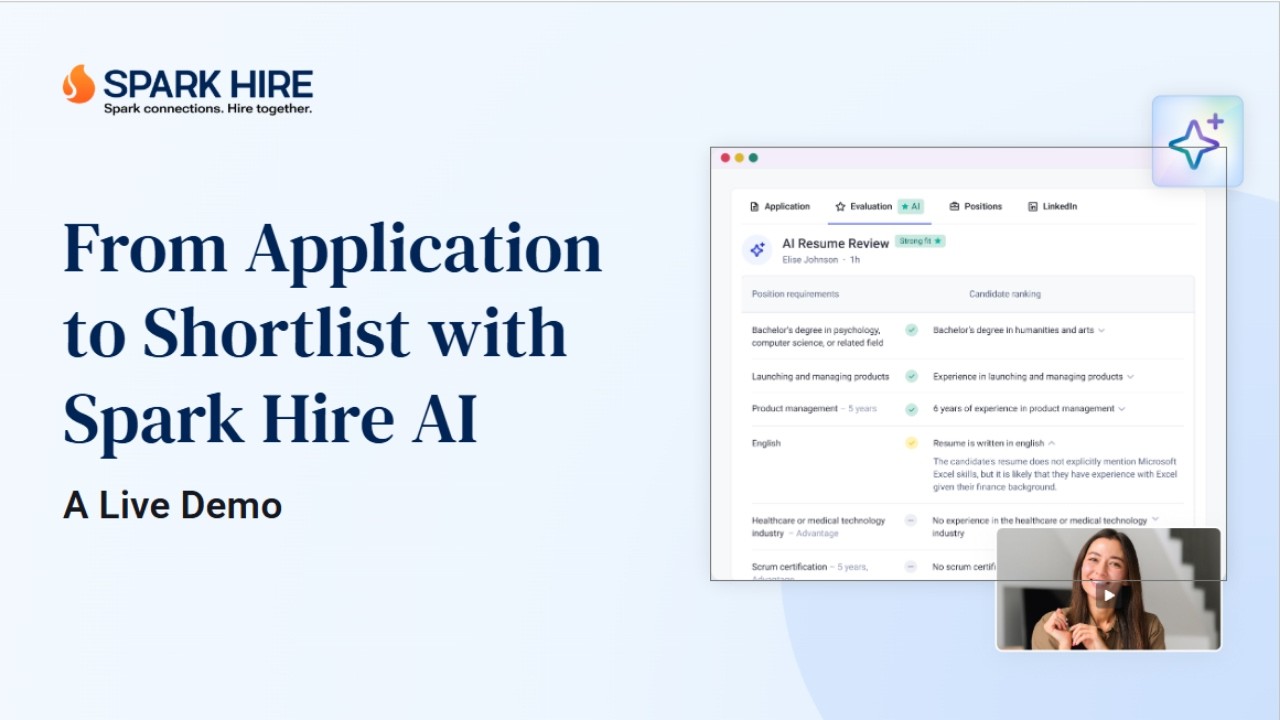
What’s New in Spark Hire: From Application to Shortlist with Spark Hire AI
Sorting applications takes time lean HR and TA teams don't have. Watch Spark Hire AI narrow a stack to a shortlist, while humans still make the call.
Pulling Back the Curtain on Modern SMB Hiring
More applications, more AI resumes, leaner teams. See how Spark Hire's video interviews, AI insights, and ATS work together to help you hire faster.
Make Hiring Easier for Everyone Webinar: How HR and Hiring Managers Can Work Better Together
When feedback sits in an inbox instead of the system, candidates disappear. Watch HR and hiring managers share how to close that gap.