
Make Hiring Easier for Everyone Webinar: How HR and Hiring Managers Can Work Better Together
August 28, 2026
When feedback sits in an inbox instead of the system, candidates disappear. Watch HR and hiring managers share how to close that gap.
Hiring shouldn’t feel like a tug-of-war between HR and hiring managers. But it can, unfortunately, regularly include:
- Chasing hiring managers for feedback that’s sitting in their inbox instead of the system
- Re-explaining what “good” looks like for a role because no one ever wrote it down
- Losing strong candidates to another offer while feedback is pending
- Getting asked to fill a role no one flagged until the team was already underwater
Sound familiar? If this is the pain you’re experiencing while trying to hire, this webinar is for you.
Watch to learn more about where communication and coordination break down between hiring managers and HR, and what you can do to alleviate the friction.
For years, Kate Michael, Recruiter at Holganix, and Megyn Rushton, TA Coordinator at Cyprus Credit Union, have seen the toll this friction takes firsthand. Kate, Megyn, Josh Tolan (CEO, Spark Hire), and Gary Schwake (CRO, Spark Hire) share how to build a hiring experience that works for you (the recruiter), the candidate, and your hiring managers.
Get practical strategies for reducing friction, building collaboration, and creating a system that works for hiring managers, recruiters, and candidates alike.
Hello, and thank you for joining us for this presentation. Make hiring easier for everyone, how HR and hiring managers can work better together. This program is part of the SHRM webinar series. You can learn about upcoming and on demand events from our newsletters and the SHRM webinar homepage at shroom.org/webinars. SHRM thanks SparkHire for sponsoring this program and our series of free webinars for the HR community.
Before you hear from today’s speakers, we want to provide you with guidance on using the SHRM webinar interface.
To the right of your screen is where you’ll be able to submit questions to the speakers.
Under the video window, you can find the program resources for this presentation.
Closed captions are available. You click on the CC button at the bottom of your video window to enable captions.
A quick reminder for all SHRM credential holders. By attending and listening to the session, you can earn professional development credits, PDCs, towards recertification.
Remember, you only need 60 PDCs to recertify your SHRM CP or SHRM SCP, so every credit counts. Visit your SHRM certification portal today to track your progress and stay certification ready.
Viewing this whole program qualifies for one PDC towards SHRM CP and SHRM SCP recertification. If you’re watching this webinar live, after this program, you’ll receive an email with the SHRM recertification code.
Now about today’s program.
You’ll learn about where communication and coordination breakdown between hiring managers and HR and what you can do to alleviate the friction. To lead our presentation, we’re pleased to welcome Josh Tollin and Gary Schwalke with SparkHire, Kate Michael with Hulginix, and Megan Rushton with Cypress Credit Union.
I’m now pleased to turn over the webinar microphone to Gary Shwaki.
Thank you, Connor. Glad everybody’s here today. So before we dive in, we’ll do this in a minute. People are still coming in.
Would love for you to put the location from where you’re joining us. That’s always interesting to see, around the The States where people are joining. I’m in Charlotte, North Carolina. Megan’s in Salt Lake City.
Kate’s in Missouri, and Josh is in Chicago. So I think we have all but one of the time zones represented here. But, yeah, go ahead and take a second and and drop that in there.
Great. Okay. So first, everyone, thank you for joining us for today’s webinar on how hire excuse me, HR and hiring managers can work better together. We know a lot of you are living this topic on a daily basis and are looking forward to diving into a great discussion here with Megan and Kate.
I know our panel has some solid takeaways from today’s session and actionable tips that you can use today to help make hiring easier. Alright. So let me, without further ado, jump in and provide a quick introduction.
So the stars of the show are gonna be Kate and Megan. We’re we’re gonna dive into their background here in a little bit. Also joining us is Josh, founder and CEO of SparkHire, and myself, Gary Schwalke, chief revenue officer at SparkHire.
And let’s do a quick so SparkHire is, of course, the the sponsor of this webinar, and we’re very grateful that you took time out of your day to join us here.
SparkHire helps HR and talent acquisition teams close the gap between recruiters and hiring managers with multiple solutions, including an applicant tracking system, one way video interviews, and a predictive behavioral assessment, all of which can be used together or separately for ultimate flexibility. We’ve been around since 2012 and have helped more than 10,000 customers. So with that, let’s jump in and talk about, the topics that we’ll cover today. So first, this is our an agenda. We’ll go through this. It’ll be very conversational so that we can dive into some real world situations. We’re gonna start with where collaboration breaks down, really understanding where the problems begin.
And then how do we make the right thing easier for hiring managers? How do we make it easier for them to collaborate? And then, obviously, the results of collaboration are better hiring decisions and a better candidate experience.
And then let’s talk about the distributed hiring manager problem. Even if hiring managers are in the same building, I think we all feel as if we’re distributed. It’s amazing how we can be in the same footprint and still be on Zoom. So, that’s a a a modern day reality. And then we’ll talk about next steps.
So, Conor, if you can stop the screen share and we’ll dive right in. So let’s start with Megan. I I think it would really helpful to provide some context. Like, give us a little bit of your background, but also, the Cypress Credit Union, like the types of roles you’re hiring for, size of the company, things like that, just to kinda paint a mental picture for the audience.
K. So I, myself, have been with Cypress Credit Union for a little bit over eleven years. And I would tell you, Utah is like credit union capital of the world. There’s so many credit unions here.
Right? So Cypress Credit Union, the one that I work with, we are the oldest credit union in the state of Utah. We’re almost about ready to celebrate our two hundredth anniversary. Oh, no.
Sorry. That’s a lie. Our one hundredth anniversary. I got overexcited. And we are the sixth largest in the whole state.
So we, go anywhere from St. George, Utah to Tooele, Utah. We currently have 25 branches, and we have about 450 employees that we work with all across the board. I myself have been doing recruiting with Cypress for, almost eight years now.
When I started, it was just entry level positions, and now I’ve worked with the CEO to hire new vice presidents for him. And so every day is different for me. One day, I’m in a CEO interview, right, talking about vice presidents and and things like that. And then five minutes later, I’m talking to a teller, and we’re just joking and laughing about life.
So I get to cover the whole spectrum of things here.
That is that’s great. And, Kate, how about you?
Yeah. So I work for Holganix, which is a soil health company. We have a proprietary biological that we have on the market today that is called Bio 800, And Bio 800 helps growers have stronger farms. It sequesters carbon, and it just helps us with soil health and and soil quality.
So I work in the agriculture industry. I’ve been in agriculture for about fifteen years. I’ve been with Holganix for one, and it’s kind of a a joke around Holganix. But Holganix years, I think one equals, like, maybe seven.
We’re in, like, dog years at this point. So, I was hire thirty five, and I think I have about a 140, team members today. So I’ve hired, quite a few, team members in the last twelve months, and, we’re just we’re in kind of a cool growth stage. To give you perspective on the the size of the team, So about a 140 teammates.
We’re in 10 to to 15 states, throughout the Midwest, and we’re on about 5,000,000 acres.
Wow. That’s incredible.
And, Gary, I’ll just give some context here on SparkHire. We’re just a little under a 100 people, so just a little bit smaller than Organics. And I’ve been obviously with the company since I founded it for about fifteen years. I’ve been heavily involved in recruiting, and a lot of our hiring is actually hiring manager led.
But I think the thing that’s you know, while we are a different company sizes and, you know, very different industries between all of us that are on this call, the thing that’s similar is we’re lean teams that are supporting a lot of different managers. Like, Megan, you just mentioned, you’re supporting a hiring manager, the CEO, and then you’re supporting, you know, maybe a branch manager who’s trying to hire a teller five minutes later. So the context switching is crazy on a day to day basis. And just, like, the different types of hiring processes and personalities and leadership levels that you have to work with, is certainly a challenge. And so we’ll definitely talk a lot about that today.
Absolutely. With that in mind too, so we are gonna be talking about this, and, I think there’s, just based on, some of the comments in the chat, there’s a lot of, shared experience as it relates to this. But let’s, throw up the first poll here to get a better understanding of where does hiring manager collaboration break down most often for you.
Is it defining what we’re looking for?
So kind of at the beginning, is it reviewing and screening candidates?
Is it getting timely feedback or getting to the final decision?
And we intentionally did not put all of the above.
Yes. It is not a trick question. I guess while people are are answering it, I’ve certainly myself experienced all of the above, but I think, for me now at Spark Hire, probably the biggest challenge is honestly the final decision. I think we do a really good job upfront of gathering requirements and, you know, getting really clear about what we’re looking for. But I think there’s still just this challenge downstream with hiring managers who are infrequent hires themselves. I think the term hiring manager is kind of funny because it’s like they hire once a year, a lot of them.
And so a lot of times, it comes down to that final decision where they’re like, oh, maybe we should speak to more people, or maybe we need more people to compare it to, or can you, Josh, get on a call and talk to this person?
So a lot of that confidence can be built up earlier in the process by just creating more clarity about the role, but, that’s certainly, you know, something I feel like we deal with, pretty frequently. I’m curious. Kate, Megan, how about you guys?
I think for us, it’s just the screening of candidates. For example, we have I think when you think of credit unions, you don’t think of IT. Right? But we definitely rely on our IT department.
And so I posted an IT position maybe six months ago, and within a twenty four hour period, we had 246 applicants. Right? And so and I had a time frame. As a recruiter, I’m always like, I wanna be back to them within a week.
Right? And then the managers have a time frame of, like, when it’s convenient. And so I feel like that’s kind of our biggest hurdle here is just the screening and going through candidates and who does that and Yeah.
I think with my hiring managers being in the field and field based, you know, their first job is to to work with our customers and to coach their teams. And so, I think sometimes getting that feedback loop tightened is is a situation that we noticed, like, we really start to slow down. Josh, one of the things we implemented on, like, getting to that decision faster, we call it team sync, but it’s like after all of the interviews, we get on a fifteen minute call. And if you’re not super confident about, you know, the decision you’re making, maybe you can borrow confidence from someone who hires quite a bit and or you can share with the team kind of where your, like, reservations lie so that we can, like, discuss those and have that conversation.
We can talk about, you know, the assessment results and how they maybe support your, like, feelings or maybe conversations that we had that you didn’t have and, you know, maybe that contradicts what you’re feeling. And so that’s really been a a big unlocking move for us to just have a lot of confidence, and everybody goes into that, like, offer then really excited. And and we’re all on the same page. We all shared our, you know, our view, and we get to, like, move forward in the same direction.
So that’s really sped up the process for us.
Yep. Makes sense.
Yeah. And it’s interesting. I guess not surprising that there’s actually uniformity in in where probably because it is there’s a little bit of all of this to be true. Right?
Getting timely feedback. And and as Josh pointed out, there’s like we’ve got a reasonably good process upfront, but all that comes together to to make the final decision kinda looking back to the root cause. So, it is interesting throughout that process.
Okay. So maybe we go into a little bit more like, okay. We talk about now the collaboration process. Right? Which is okay. We we we we it hiring is a team sport. Right?
And everybody comes with different experiences. Josh pointed out, some hiring managers, have maybe never hired before or hire so infrequently, and there are others that, you know, know the drill. They know the role.
And you have to context context switch back and forth between them. So, typically, where do you see it break down the most? Where do you see you know? And and then we’ll get into kinda how do we how do we work to resolve that?
Maybe, Kate, let’s start with you.
Yeah. So I think, like, we just talked about that feedback loop and just tightening that feedback loop and making sure that we’re keeping things moving rather quickly. I think it’s the piece for us that we really like or or the piece for me that I really, like, hyper focus on. And it’s making sure that, that context is there, so we’re not starting every interview from scratch.
You know, the the hiring team knows what the conversation previously was. They understand where there were, like, you know, really great alignment that we maybe don’t need to touch on again, but where were there some areas where we really can, like, go back in and dig in? And so I think that that’s really a big piece for us is just keeping that feed loop feedback loop tight and making sure that it’s happening in a a timely manner so that we can keep the hiring process moving. My goal is generally to have most hires and not all of them.
There are exceptions to this rule, but I like to have a decision within ten days on, you know, are we moving forward? Are we exiting someone from the process? And what does that really look like?
And so in order for me to do that, I’ve gotta really hold my hiring managers to a super high standard to give me back that information so that we can keep things, you know, kind of front of mind and fresh for the the candidates and make sure that that candidate experience is really positive.
Right. And, Megan, how about you?
I would say it depends on the role that we’re hiring for. For example, our entry level teller positions, we hire for those frequently. Right? We’re hiring, like, maybe 10, a month.
And so that that is really processed out and ready to go. I recently just hired our, vice president of mortgages, and the chief lending officer reached out to me. And he’s like, okay. What’s our process here?
And I’m like, it’s it’s actually kind of whatever you want it to be. Right? And so flexibility was really important there.
And so but we always make sure that HR is involved in every single step of the organization. I have a recruiting team of about three of us. And so HR sits in on the interviews, and then HR reaches out to them to get their feedback. And so what we have found successful for us in keeping in with line with managers is the HR is just involved in every single step of the process, not overtaking it.
It’s the hiring manager’s decision. Right? But that we just let them know, like, these are the next steps. These are the next steps and staying involved that way as well.
Yep. Makes sense. I think for us, it’s less like, where it breaks down is less about a particular step or thing that has to happen in the process. And often, it’s that we have to re anchor the hiring manager on, like, the objective of the hiring process and what we’re trying to deliver as a candidate experience.
I think a lot of times, a hiring manager goes into a process, and they’re so caught up with everything in their world. One, they have this urgency because they’ve got this opening on their team, so they want to rush to get the job posted and get it live. When in reality, they would save more time if we slowed it down at the beginning at the front end of the and really got clear about what we’re looking for so we could develop the process around that. You know, same thing goes later in the process when they are, like, swamped with all of, the meetings and things that they have going on in their regular day to day job.
They might not see it as a big deal to push an interview to the following week or not make a decision about a candidate this week because we’ll just get back to them next week. No big deal. And the perception is that it’s no big deal, but they don’t see, like, the downstream impact of that and how that impacts the candidate experience. So a lot of times, it’s less for us about, like, hey.
We have to do this step better, and it’s more about, hey. Let’s re anchor you to the type of process that we’re trying to deliver and what really matters here to get them in the right mindset for hiring. And that’s challenging when they don’t do it that frequently. Like, when they’re hiring every six months, you gotta train them up again on, like, what we’re trying to deliver on, through the hiring process.
So Yeah.
With that in mind, so, Kate and and Megan, curious your thoughts on that. So that that’s, that understanding of how important that process is both for the hiring both for them as the hiring manager as well as for the candidate experience.
What are some things that you have done to help articulate that so there’s understanding of that? And then, you know, process or procedurally how you have put things in place to actually support that so that they it makes it easier for them to do that.
I’ll pick Megan.
You can start. I’m thinking of our teller position because that’s the one that we hire for the most frequently, and that’s the one that we utilize SparkHire on the the heaviest. Right? And so we mainly work with the vice presidents over branches, and then we let them know, like, okay.
HR is gonna go through all of the new teller applicants that come in. Our rule is that they need to have a response from us within three days of applying for the position. And so we will do the screening for the tellers, and we will send them the video interview. And plug here for SparkHire, what I love about it is that now we send out a job, and we have all of the managers that watch all of the video interviews, and they can go in and comment.
And we tell the managers we’re on that three day time period again. After we set out a video interview, we would like to have a response back to the applicant within three days. And so, they’ll go in, and they’ll watch the videos, and they’ll score them how they like them. And then we will go back and then bring them in for an in person interview and then offer the job from there.
And so then we’ll we’ll we’re making sure that we’re checking in with our managers at throughout the year. Like, what are you thinking of these hires, and how are you liking the process? And and are you liking those that we’ve hired? And if they come back with complaints, we we’ll just let them know, like, we’re flexible and we’re open, but just know that you’re the one picking the candidates.
And if you’re not watching those video interviews within three days, then it falls to the recruiting team to pick the candidate. So if you wanna say, this is where you’re most valuable and where you’re gonna what what we need you to do in the process. And so just being very clear and open about that from the beginning.
Great feedback. Kate, how about you?
Yeah. So our team has grown so fast. I feel like we still have a very, maybe guided experience for our hiring managers. There’s a lot of, okay.
Kate called, and she said, you know, this is what’s going on. And, you know, there’s a lot of conversations around, like, hey. Here’s, you know, the four people that I think I’m gonna bring forward. I’m scheduling them with you.
Here’s, you know, you can go into SparkHire. Here’s the link. Here’s all of their, resumes and information, and you can see my feedback. And so, there’s a lot of collaboration when it comes to kind of getting process moving.
There’s also a lot of conversations upfront about this is how we hire. This is what the structure looks like. This is what the cadence looks like. This is how we’re doing things.
And so, I think, honestly, from a hiring manager perspective and then also from a candidate perspective, when we can go into that first interview and we can say, look. This is what the hiring process looks like for us, and this is kind of the timeline that you can expect. And this is a cadence of, you know, who you’re gonna speak with and and what that looks like and how those conversations go. We just set a lot of those expectations up front, and then I can use SparkHire behind the scenes to set up that whole process.
I can automate quite a bit of it, and I can make sure that the the process just continues to move forward in the way that it needs to.
And I think for for us, everyone knows what to expect, and then it happens that way. And I think that that builds a lot of trust with our hiring managers, and I think that that builds a lot of trust with our candidates as well to make sure that things just keep moving the direction we told them to expect it.
You I think Go ahead.
Sorry. Here. I just wanna say, I think you nailed it when you talk about how you define all this stuff up front with the hiring manager. And not only does that help you run a better process, but now you can communicate that process to the candidate so they know exactly where they stand and what’s next and they can prepare.
And I think that’s a really good point because a lot of times, like, in recruiting, you’re sitting in the middle of hiring managers and candidates, and you have to manage both stakeholders. And I saw Jennifer Howell on here in the chat, so I’ll give her a shout out. Hi, Jennifer. And she I’m gonna steal her quote.
She said before that you are a steward of the hiring process. And I really like that term because I think it factors in that you really have to be balancing both sides of the hiring process. How can you inspire confidence in both sides? For hiring managers, it’s about delivering a really good process and ultimately really good candidates.
And for candidates, it’s about communicating effectively, setting the right expectations, making sure they’re prepared for the next step of the process. But you can only do that if you communicate and set those expectations with your hiring managers up front. So I appreciate you bringing that up, Kate.
Yeah. It’s actually a a great segue to the next section here. So so Theresa asked a question in the chat. How have you been successful in training hiring managers to interview without getting personal with the candidate? So that’s part of this expectation setting at the front end. So, Connor, if you would, let’s launch our next poll here.
So and this goes back to setting those expectations. So when a new role opens, how clear is the division of responsibility between HR talent acquisition and the hiring manager for you personally today? Very clear. Everyone knows their not only knows their role, but what they need to do in that role.
Mostly clear, some gray areas. It depends on the individual hiring manager, and then we figure it out as we go.
And it’s okay. This is a safe space. Be honest.
Megan, how about you?
I think ours is mostly clear. We do a really good job at staying in keeping our hiring managers in the loop. Now at our company, because we sit in on the interviews and we schedule the interviews, may. We HR may be more involved than most companies are realistically able to do. But because we’re so involved, I think it’s it’s mostly clear of kind of what the process will look like.
Kate?
Yeah. I would say ours is extremely clear, and I probably have the benefit of that of of not necessarily scaling a team yet. So I’m a hiring department of one, and so I can I have a lot of control over, you know, how this all happens? I can see that probably that dynamic will get more, involved or or, probably there will be more struggle as we, like, expand the hiring team.
And and now it’s different recruiters, you know, with different expectations working with, you know, the different hiring manager personalities. But today, we’re pretty laser focused on exactly what this process is gonna look like. This is what I need from you. I’m gonna drive the things behind the scenes and make things happen.
And I feel like our our hiring managers are getting kind of that, like, white glove experience of, like, you’re my customer, and I’ve gotta bring you really great candidates. And then, you know, you in turn have to pick the right people for your team. And so, we do a pretty good job right now, not to pat myself on the back too hard, but I know that that’ll that dynamic will change.
Well, you’re both on this for a reason, so let’s go.
Josh, how about you?
I would say mostly clear.
I would say probably the challenge we have and and what we we try to do a better job at is oftentimes when we’re hiring, especially if it’s a backfill or an existing position that we’re just open have a new opening for, is the hiring manager will come with just the job that we’ve used previously without taking a step back and looking holistically at the team and looking at the performance and looking at what’s really required in the role because we had this job description however long ago. But now knowing what we know, how might we change it? And so oftentimes, again, the hiring manager has this position.
They wanna urgently fill it. So it’s like, let’s go. Let’s go. Let’s go. We’ve got the job description.
Let’s post it. Let’s get it out there. And sometimes it’s about getting getting them to take a step back and and say, do you really need this, or do you really need that, or is this missing from the job description? Because what we don’t wanna have is get later in the process and a new requirement pops up, or something that they’re looking for that wasn’t defined in the beginning.
Yep. Yeah. And it it’s I guess it’s not surprising that the second vote here is it depends on the hiring manager because we’ve all been there. It’s like you can’t compel the unwilling. Right?
But a good process but a good process really helps with that. And and I think we we covered the expectation setting really well. And I’ve I’ve used this, like, four times in the last two days and a wise man, Josh, has heard this a thousand times.
A wise person once told me that all frustration is the result of an unmet expectations. So if we have unclear expectations, what do we expect? Frustration. So that expectation setting that both of you hit on right up front is so important as we go into that, and that’s including how do we assess talent.
Right? It’s not just throw it over the hiring manager. Let’s actually provide you some structure to do that. But with that in mind, kind of covering back on Theresa’s question, what information and it’s I’m sure it’s different at every step of the process.
What information does a hiring manager actually need to be able to evaluate well? And and I’m sure that’s different by role as well. But how do you how do you go about creating that baseline for them to be able to know how to assess good? Kate, let’s start with you.
Yeah. So for us, in our hiring process, we really baseline our core values.
And so, we’re putting a lot of the conversations up against core values. There’s obviously a component of hiring that’s you know, can you do the job? Like, do you have the ability to do the job? That’s pretty easy to screen.
It’s the ability to, you know, to come in and make a impact on the core values. It’s the ability to come in and make an impact on the team and and our customers, that’s really important to us. And so we use, core values in in a lot of the kind of that baseline of of how we’re evaluating candidates. We’ve actually created, the the evaluation at the bottom is based on core values.
So how does this candidate relate to, you know, our core value of gratitude? And then there’s a a blurb about what gratitude means and how that’s lived out in our daily life. And so we’re really bringing that back to the forefront and thinking about that, and I think that’s really important.
We also use assessments, and then we, like, filter those assessment results by the core values.
So, you know, how does the results that we’re seeing and and that we’re, you know, that we’re kind of marrying together, how does that play into the core values, and what does that look like? And how does that manifest in your daily life? And so, it gives our our hiring managers a really great, like, baseline to hire from.
It’s super important in keeping our culture intact as we continue to grow and expand and scale as quickly as we are. And it also gives us a really great, like, kind of group look, I guess, at how these values are man manifesting and what’s important to us as a collective. And I think that rooting rooting those decisions and those core values make a huge impact, and it also it makes sure that everyone’s being evaluated, you know, fairly and and, from the same lens.
That’s such a good point that that’s one thing to have core values, but if you walk around to everybody and ask them what that means and you get five different answers, like, then then then you’re not gonna hire well for that role. Right?
Right.
So that’s that’s great to hear. Megan, how about you?
We are very, very similar.
Our mission statement at the credit union is that we wanna be the most loved credit union, which is so cheesy and so Utah, but we really love it. And so when I, am working with managers of what to ask in interviews, we wanna focus on that. Right? How are you gonna help us be the most loved credit union? And you ask that to an accountant, and they’ll be like, I I have nothing to do with this. Right? And so we make sure we hit on that in interviews.
Because I’m the one setting up the interviews, our process is is that I will reach out to candidates, get the interview set up. And then a day or two before the interviews come, we have presaved questions, but we have been in the process of redoing that and making scorecards. So I’ve been utilize utilizing AI where I will take the job description that we’ve just updated because we have to update it before we post. I’ll take the job description and what those current employees are being, valued on in their Performance Pro and put that into AI and say, can you give me 10 questions that are related to these?
And then I will send those over to the hiring manager before the interview. They’ll be go through them. They’ll add in a questions questions that that they they wanna wanna ask or change. So when we go into those interviews together, we already know what we’re gonna ask and and what direction we’re we’re looking for.
And then we’ve with the video interviews and our teller positions, we’ve really been utilizing that scorecard there at the bottom because if you’re hiring a teller for a financial institution, they need to be professional. Right? We also are very focused on sales. So we ask a lot of experience based questions about sales, and we will utilize that scorecard and those video interviews, and managers can kind of also go and see how other managers are scoring them to make sure that our goals are in line with who we’re hiring.
Got it. Josh, anything to add to that?
Yeah. I mean, I think for us, we use a very similar approach to honestly, you know, at least once a year, we’re looking at our current team and running what we call a people analyzer, and this is from the book traction, the EOS system.
And, basically, what we’re looking at is do they get the job? Like, do they understand the job? Do they want the job? Do they have the capacity to do the job?
And then how well do they align or demonstrate core values? That’s what we look at with our internal team. We do the same thing then with potential new hires. So we try and map interview questions that are obviously specific to the job to do they get it?
Do they really understand it? Do they want it? Do they have the capacity to do it? And then core values, we look at behavioral questions that are more specific to their role that would demonstrate those values in the workplace for that role.
And that’s how we, like, build out the interview questions and build out the the relevant scorecards.
Yeah. And then and if you think about the the downstream impact of that, when you start getting feedback and those evaluation methods are all clear and consistent, the quality of the feedback that you get back is that much better. Right? So that’s an important point, which is actually a good segue to our next poll, which covers the implications when hiring is not easy for managers. So when internal hiring decisions slow down, what is most likely to suffer? Is it candidate communication, speed to hire, quality of the decision? And this time, we gave you a bailout option, all of the above.
Kate. I sorry, Gary.
Yep.
Josh, go ahead.
Comment because I saw there was a good question here. Now I’m scrolling through the chat to find it. But I think yeah. Laurie Miller here.
She brought up a question about, you know, setting deadlines with hiring managers and but hiring managers say they’re too busy to make decisions. And so how do we encourage them to not sit on these decisions? Because, ultimately, the manager wants the position built ASAP, but they create the bottleneck when they delay the actual decision. So, of course, it’s one thing to say this is the deadline.
But in the moment, when they ask about it, how do we help, you know, them progress and make a decision? And I bring that question up now because I think it’s related to the poll. Like, for me, obviously, it’d be easy to click and say all of the above, but I think, ultimately, it’s gonna impact candidate communication the most, which then downstream is gonna ultimately impact all those other things. Right?
Like, if you’re unclear with the candidate or if you’re not getting back to them or if you’re adding interview rounds or if you can’t make a decision, the candidates are gonna walk away with drop of the process. They’re gonna think that you’re not interested. They’re gonna think this is a bad experience, and they won’t wanna join you anyway. So, ultimately, it’s gonna impact the quality of the hire and the timeliness of that hire, but I think it starts with the candidate communication.
So we’re cure we’d be curious to get your guys’ takes, then, you know, maybe we could talk about Laurie’s question for how we can we can help, nudge those hiring managers to, to make a decision and get back to us.
All of the above.
No surprise. Not a surprise.
But but candidate communication probably is baked into a lot of that, so perfect timing. Megan, what’s your perspective on this?
I I put candidate communication for us as well. We recently just hired a vice president over one of our regionals for branches, and that process took months and months and months and months longer than we wanted. Right? And we were interviewing both external and internal candidates for this position.
And because it was such a brighter a bigger scope, we had two recruiters working on it, and we both had a list of externals and internals that we were communicating with than the chief officer that we were working with. And, he’s busy. He’s a chief over all of our branches. Right?
He doesn’t have time for interview process, but he was incredible about it. And so we just took that communication into HR’s hand. Right? Like, that we would reach out to him, and we wanted to make sure that they that every candidate had some kind of communication from us every single week.
Right? Now, luckily, we do a lot of texting, and so we were able to text them. We called a couple of times. And then when we got down to the end, we had four or five externals that we were looking at.
And, we had told everybody else no, but these four or were still, like, holding on. Right? And it had been months and months and months. And then we got down to our our final.
And so we realized that, like, while this relationship was ended, then they weren’t getting the position at this time. We didn’t want this relationship to to be sour. Right? And especially because they had been working on it for so long.
And so we we went above and beyond in our opinion, and we sent them all flowers and crumble cookies and also sent texts and and made sure that those rejection calls didn’t come through an email, right, that myself and the other, recruiter called them and talks to them. And so it was hard because I couldn’t do anything to make this chief make a faster decision, and rightfully so. We had a lot going on, and we needed a a a good decision made.
So we just did our best as HR to make sure that that we weren’t the holdup and that we were communicating with candidates Yep.
As much as we could.
That’s a great example. Kate, how about you?
Yeah. We do a lot of gut checks. So it’s, it’s a lot of conversations that sound a lot like me saying, if you’re not an excited yes, then you’re a no. Right?
You don’t get to, like, sit in the middle. So you’re either you’re all in, you’re here for it, they’re gonna be great, you’re going into this enthusiastic, or we’re not moving forward. And I think that when you start to make it that black and white, the hiring managers realize, like, I don’t get to sit on the fence. I have to decide.
And when you tell someone, like, you’re either a thousand percent enthusiastic about this or you’re not, it’s it you start to kind of frame the the conversations and the questions in that way. And, like, it’s really easy to know when you when you sit with yourself and you get checked. Like, am I really super excited about this? Am I an enthusiastic yes, or am I a, okay. And so I think that that’s really how we’ve driven the process of making decisions and getting into a decision faster.
Now that’s not always the fastest option in terms of filling the role, but I don’t wanna put people in positions where we’re not super excited and super, know, passionate about the fact that they can come in and make a huge impact and be really successful with our brand. And so I think it matters.
Absolutely.
And, point one thing out here. So Chris Chris in the chat asked a question about, you know, a lot of process communication coordination, but really also about culture, company culture. I think, in my humble opinion, a lot of what is a lot of culture is reflected in the process. Right?
To your point, I love the fact that you point out it’s either a really strong yes or a quick no. There is no, like, let’s swim in the middle and maybe let’s see what happens more often. And a lot of that comes from, I think, the fact that you’re holding so high and firm to your core values and you’re holding yourselves to those core values as well, not just the candidate. And that is reflected then in your process.
I think that’s a really important point and you you kinda hit on that.
Let’s, let’s take a quick pivot. We talked a little bit about unless there’s anything, Josh, or anybody you wanna cover more on, like, candidate experience.
No. I mean, I think, again, just to to reiterate that point that Kate made and then, you know, Chris in the chat here, I think, ultimately, that’s the right decision making framework.
Because if you’re not a strong yes in the hiring process, it’s probably unlikely to work out. I think a lot of hiring managers wanna keep people, like, warm in the process that they’re kind of lukewarm on, and they’re like, well, maybe this could be a backup. And it’s like but if they don’t meet what you’re looking for, it’s best to just let them know and move on to other candidates. If the process takes a little bit longer to get you the right candidate, that’s ultimately what matters because you’re interested in the long term success. I think too often, we’re like, oh, well, let’s just hold on to these people just in case we don’t find, somebody better, and then we’ll settle. And it’s like, well, you either have the requirements and the criteria for the position or you don’t.
And I think just making it very binary, is a really good way to to kinda force that decision. And to Chris’s point, it’s really indicative of the decision making process of the organization. Like, that’s the downstream impact on the candidate. If you’re taking too long after they’ve already gone through the interviews, they start to wonder, like, why can’t they why can’t this team just make a decision?
Yes or no? And so, ultimately, you wait two weeks, and then you wanna make an offer, and the candidate like, no. I’m good. I I don’t feel comfortable moving forward because you didn’t inspire confidence through the process that you executed.
Yep. Or the best candidates have other alternatives. Right?
That too.
Yeah. Well, I love this question from Damian on and this is a great, you know, in the trenches question, which is, the thoughts on selling slash marketing the role or sharing the challenging parts of the role with candidates. So and when in the process do you do that? Right?
So there’s this idea of, like, we wanna create, like, some excitement about the role or what have you. But at the same time, if if we’re not careful, we end up hiring candidates who don’t really know what they’re getting into, and now we’re now we’ve created a bigger problem. So what are your thoughts on those roles? And maybe it’s there’s you’ve seen in the past, like, takes a certain, you know, personality type, a certain level of fortitude that they really need to know what they’re getting into.
And when in the process do you think about introducing that as we think about candidate experience?
If I can with our our teller position, so credit unions are always cross selling products. Right? It’s just credit union wide. And we used to be, like, in their interview, be like, I’m so sorry.
I have to cross sell 10 products a month, and it’s gonna be fine. And do you want the job? Right? We’d, like, kind of, like, sneak it in there at the bottom.
But we know that if you’re going to be successful in this job, you have to cross sell. Right? It requires a certain kind of candidate, a certain kind of person to be successful. So we’ve weaved it in throughout the entire process.
It is the job description is very heavily based off of what we need here. And then, all of the interview questions in our video interview screening, all of those are focused on selling and member building experiences. And then when they get to the interview, we make sure that we hit it really hard right there, right, and go over that with them. So when they come to the interview, it’s not a surprise that, like, this is the part of the job that you have to be successful at.
And then other things that might deter them from the position, like, if the pay is not in line or the hours are not in line or the education is not in line, we will discuss that in the in the screening process before they even move forward because I don’t wanna waste their time or the hiring manager’s time.
Yeah. You don’t wanna get somebody really excited about it. You get three, four steps into a seven step process only to realize they’re like, oh, wait. I didn’t realize that.
Kate, how about you?
Yeah. So we are pretty upfront about it. I always kind of, I go into that that initial conversation, and and our first conversation is is really focused on, like, what does it take to be super successful here? Where are the, you know, the times of the year where you’re making great commission and the times of the year that where you’re not making great commission? And what does that look like for you, and how do you balance that?
We try to be very forthcoming about that. And then I send them to one of my hiring managers. He’s kind of usually the last conversation. His name is Rob, and I think Rob is, like, the antisales department. So he’s here’s all the reasons you’re gonna hate this.
Based on your DISC assessment and based on your profile and based on the work that you’ve done, here’s why this is gonna challenge you and be really hard. Are you sure that this is what you really want? And nine times out of 10, the people that are like, yeah. I’m sold.
I love what you’re doing. I love the mission. I love the culture. I love the team.
They’re like they’re having that conversation with them, and they’re like, yeah. I love it. I love all of the hard things that you just described that I’m gonna have to overcome. That sounds like a good time.
Let’s do it. And then I think there’s, like, you know, the maybe, like, 10% or less of candidates who hit that point, and they’re like, oh, that was, like, more intense than what I was expecting. Can you give me, like, the you know, talk to me about these three things that maybe didn’t align with exactly what my expectations were or the story I was telling myself, and I wanna know more. And I think that opening that conversation back up even at the end of a process to really dig into it before we get to an offer stage.
Like, it’s valuable at either time. But I think just having those, like, super, straightforward conversations and and sometimes kind of the hard questions.
And it’s not a tell me a time where you had to overcome adversity. It’s like, here’s the three things based on your personality type that are gonna be really hard about this job. What are you gonna do about it? How do you take ownership of that? What do you do proactively to get out and get in front of that stuff? And I think that it puts a lot of power back into the hands of the candidates, but it’s also eye opening in some situations.
Yeah. Well, I would suspect that that level of transparency for to your point, it it back to the culture thing. Right? It’s like, we know that it’s hard, and we’re being transparent about it, and we’re here to support you. But at the same time, there’s joint accountability. Yeah. Like, success happens if you’re willing to pick up a shovel and dig.
Yeah. Yeah.
And I think our culture is so heavily tied around, like, that self awareness piece.
Like, you don’t have to be good at everything. I don’t want you to be good at everything. I want you to be really good at the things that you’re really naturally good at, and I want you to highlight those natural talents. I But also want you to be aware of the things that you’re going to have to, like, struggle with and develop, and I want you to have the self fortitude to, like, lean into those things. And so I think that it does pair really closely with our culture and who we are as a team.
Yeah. Yep. Go ahead, Nadia.
Okay.
Go ahead. Oh, I say if, I was doing an interview one time this is gonna sound so narcissistic. I was doing an interview one time with an entry level position, and and on paper, their application wasn’t great, but we brought them in. And I remember thinking, like, you are charming.
I don’t know what I was worried about. And then I stopped talking, and I was like, you’re not charming. I’m charming. Like, I’m carrying this whole interview, and I’m, like, putting everything on a pedestal.
And so when I go into interviews now, I’m like, my job is to represent Cyprus, and I want Cyprus to look amazing because I truly think that it is. But I used to find myself trying to compensate for manager struggles in the interviews. Right? I mean, like, if they’re not bubbly and over the top, then I need to be.
If they seem harsh, then I need to to bring the love. Right? But that’s not gonna be indicative of what they’re getting if they get the role. Right?
So I’ve learned to take a step back in interviews and let the manager show who they are. And then if they’re not getting the response or the candidates that they want, that’s because of what they were represented in the interview. Right? And then it’s time for that kind of a delicate conversation.
Yeah. Yep. Yeah. And I think a lot of this comes back to what we talked about a little bit earlier, which is being the steward of the process.
And I think a lot of times we confuse recruiting with sales, and I gotta sell them on the role, and I gotta sell them on the company, and I gotta sell them on the manager. But the reality is the the objective is to find a good long term fit, both in helping the hiring manager and both for the candidate because you want that person, if you end up hiring them, to be there for a long time. And so the best thing you can do is give them the information and be an adviser throughout the process and empower them to make a decision. And when you do that for both your hiring manager and your candidate, you give them the information.
You empower them to make a decision. Ultimately, hopefully, they come to a good right decision, which results in a long term fit. But if you’re constantly selling, like, if you’re trying to sell the manager on the candidate or you’re trying to sell the candidate on the company, the odds are it’s probably not gonna work out long term. So it’s more about just giving them the information so they can feel confident in their decision that they need to make in the process.
Yep. And that’s, that’s a great pivot to the distributed hiring manager problem. So we all deal with this. Like I said, even if everybody’s in the same city, you can live on the same block and still be on Zoom. Right? There’s a there’s a distribute, there’s different schedules, different experiences, different time zones. So let’s talk a little bit about, you know, the the situations there.
And in in those situations, where do you see information most typically getting lost as opposed to literally being in the same building, same floor, what have you, or even in the same city? Kate, let’s start with you because I know you deal with this a lot.
Yeah. So I think sometimes what gets lost for us is the the details. Right? Like, the things that don’t get necessarily said, but it’s like, how did you feel in that process?
So one of the questions I ask my hiring managers, and a lot of times I’m working in sales roles. There are times where I’m working in, you know, product roles or or other roles as well. But, you know, in the sales roles, it’s like, would you buy from them? And that’s not maybe something that necessarily is like, you know, they said this right or they said that right, but it’s the feeling.
Like, what were the vibes of the conversation, and did you trust them? Would you buy from them? I think that that matters a lot. I think that’s something that gets lost in translation, so we have that conversation quite a bit.
You know? And then I think that it’s you know, when we’re when we’re filling out the, you know, the, interview evaluation and we’re, like, putting it in details, we try to be really factual. Right? Like, they said this.
They’ve done this. They’ve I can see their resume. I know what they’ve done. Tell me the things that, you know, you discussed or the questions that they asked or the areas, you know, that made their eyes light up or areas where they kinda sat back in their chair and you could tell that they weren’t really buying it.
Let’s dig into those areas. Let’s have those conversations. And so I think that I challenge my hiring managers quite a bit to, like, give me the, like, the, you know, the next level deeper of the conversation. I love the high points and, like, what you actually talked about, but but tell me how it felt.
Tell me, you know, what the trust equation looked like at the end of this conversation, and and that gives me a really good look at, like, how we move forward.
Yeah. That’s a the the emotion, the feeling, the, you know, inspiration side of it, that’s such a good point. Like, it’s that communicating that in person is easy. You can see it, right, all the body language, but very hard to do remotely.
Megan, how about you?
I would say one of my my least favorite reasons that a manager will give for not wanting to hire somebody is when they say, like, it’s just not a culture fit. I’m like, I agree with you. But I was trained to think if you’re standing in front of a judge and you tell them, this is why we didn’t hire them, who’s going to win that case? Right?
And so I need I was like, I always tell managers that I’m not making this decision. You are, but I need a really, really good reason why you’re not going with this person. And and it can’t be they’re not a culture fit. Like, that is true, but we need to find something else reliable, a protective class, something like that.
And so just making sure that we’re also looking at the legal side of things, but communicating that with our managers. Right? That, like, I always tell them, pretend you’re standing in front of a judge with this person, and they’re suing you for not hiring them, and who’s gonna win this case? Right?
Yeah. Yeah. Well, I think that goes back to the sorry, Josh. That goes back to the we we talk about culture fit. Well, we’ve got four, five, six attributes of our culture. Which one of these specifically, and what was it what did you believe was identified in your conversation? That makes it that to your point, that that now I’m making it specific.
Josh.
What were you gonna say?
No. I was it was that was a question that was actually brought up by Tina in the chat. She said, how do you suggest navigating conflict when HR and the hiring panel HR is interested and the hiring panel isn’t interested in a candidate, but they can’t provide constructive feedback on why they want to reject that person from the process. So I think, Megan, what you said is is a great step, and I think a lot of times it just comes back to, like, the go going back to the criteria with the team, and it’s like, do they meet this criteria?
And if they meet all the requirements and are aligned on that, it’s like, okay. Well, there’s something else. So, like, what’s holding you back and really challenging? Kate, as you said, you need to challenge a hiring manager sometimes because, ultimately, you can’t force them to make a decision.
It’s their hire. They’re responsible for their success. It’s gonna be on their team. It’s gonna be factoring into their team’s success.
So you’re not gonna force them to move forward or not move forward with the candidate, but I think it’s okay to challenge them and really ask those important questions. So it’s like, hey. Let’s just get very clear on why we’re not moving forward. So, also, if we need to update our requirements or if that becomes a factor for other candidates We’re interviewing.
Now we know. Now we’re all on the same page. Okay. In my recruiter screens, I’m gonna look for that now or whatever it may be.
This is great. Alright. So let’s, we’re gonna land this plane, as I like to say.
And I I really like this question because we focused on, a a lot as it relates to process hiring managers, how we how we think about creating a a structure that has them be successful in the candidates.
What is one thing that TA teams, hiring teams, should stop asking hiring managers to do?
Give you a second to think about it.
And either one of you, any one of you jump in when you’re ready.
Anything jump off the page for you?
I think that’s a great question. I think one of the things that I notice or, like, that becomes, I think, a bit of a pattern is feeling like they have to run the process themselves or feeling like they’re they have to they’re unilaterally making that decision. Right? So I think so often, it’s it’s really the easy answer is to say, like, well, they’re your hire.
You know? You’re the one that has to work with them. You are the one that’s going to manage this person, so you have to make the decision. You have to be the person.
I don’t want my hiring managers to be, like, the stand up one loan decision on all of these, you know, hiring choices.
But I also think we have to remove our egos in in, you know, being able to say, like, I’m just one opinion. And so being able to kind of balance that, you know, making them not feel like they’re on an island, but also, like, feeling that support, I think, is is really impactful.
I think asking the right questions and digging into, you know, some of those motivators or, you know, some of the feelings or or fears around, you know, what we’re getting into is is really impactful. But, I think when you put a lot of pressure or a lot of stress around that hiring manager, like, being your hire and this is your decision, You have to own this. You know? The the success or failure starts and ends with you.
I think that’s where we start to maybe unravel a little bit and slow down the process. I think we also, we just put so much pressure on that one person, that we we’re not getting a really good diverse look, and I think that that’s important. So Yep. That’s, I think, where where my head goes.
Yeah. Thank you, Kate. Megan, how about you?
I I would say probably when we ask managers, like, tell me what your perfect ideal hire looks like because I I don’t think that there is such a thing. And if we go and asking managers that, then we have one department specifically that builds with deals with building relationships in the community and getting the name of the credit union out there. And so there’s a lot of responsibility on this role. Right?
But we’ll post a position, and it takes six to seven months to fill because they need the perfect candidate. Right? They have to look right. They have to act right.
And so I think instead saying, what are your nonnegotiables? What do they have to have to be successful in this role? And then build from there. Because all interview candidates feel like, I think they’d be great.
And they’re like, they just they just don’t have it. You know? And so I think starting with instead of the perfect candidate, focusing on nonnegotiables that they have to have that are in the job description and then going from there.
Really, really good advice.
Gary, I’ll wrap up one point, and then we can wrap this up and go to the final poll, I think. Yep. Don’t don’t confuse this word here, everybody, but you don’t want a compliant hiring manager. You want an empowered hiring manager. I think so often when we’re frustrated with hiring managers engagement in the process, we’re like, why won’t they just follow the process? But if you can flip it and think about what’s getting in the way of them following the process, now you can be a partner in figuring that out with them versus just forcing them to try and run the process that you want to run.
Yes. Great. Great advice. That’s a great way to wrap up. Well done, guys. Awesome. Okay.
Well, let’s, let’s pull up our last slide here, Connor, then we’ll go to the poll. One thing, I this is a total audible. I would ask if anybody is here, we would love your feedback. Jump over to LinkedIn, tell us what you like, tag us in it, and let’s start a conversation.
We’d love to you know, we’re gonna actually be hosting webinars over the course with Sherm over the course of the next several months. So we’d love your feedback. What did you like about this? What did you learn?
That would really be great. Hugely hugely helpful for us, and it’s a great way to continue the conversation. With that, so if you are interested in getting a sneak peek under the hood on how Megan and Kate actually make this happen, please respond in the poll if you’d like to get a demo. And and and as a reward for your time, we are gonna provide a $50 prezi offer, which gives you access to just about everything.
Just a a couple of disclaimers, the the fine print, it’s one person per company. It needs to be a completed demo, and you can read the rest of the t’s and c’s there. But, really, it’s just an offer to really reward you for your time. Thank you for your time. You’ve already invested a lot with us today. We really appreciate that. I think you’ll find it a very informative conversation because a a lot of those are around understanding the challenges you seek to solve and then showing you how you can actually use these tools to build the process we just described.
So we can jump in there.
And, that’s great. We see a lot of people jumping in. So appreciate that. A lot of we’re gonna be we’re gonna have a busy team. A lot of people wanna know. So appreciate that.
Okay. With that, we’ve got some, Connor’s gonna wrap us up with some, continuing education process from here. So, Connor, if you can jump in there, let people know what they need to do.
Thanks, Gary.
If you’re an HR and not a SHR member yet, you’re leaving tools, answers, and support on the table. Access 3,500 plus expert templates, talk to certified HR pros, not bots, and get ahead with insider research and compliance tools, all designed to make your job easier and your impact bigger. Please visit shirm.org/edge to see what you’re missing.
This program is sponsored by SparkHire.
SparkHire is an applicant tracking system built for organizations with 50 to 500 employees where hiring must be treated as a repeatable operation. Many teams rely on spreadsheets, email, or rigid HR software that make hiring manual, fragmented, and hard to coordinate. Spark Hire brings everything into one place with flexible workflows, automation, and AI so your team stays accountable, move moves faster, and hires better together. Want to see it in action? Visit sparkhire.com.
Alright.
Thank you, Connor. Megan, Kate, I can’t thank you enough. Such a great conversation. Thank you for being so willing to just open up and share your experiences.
I think everybody learns when they see you under the hood. First of all, we’re all dealing with these challenges. Like, there’s there there’s no silver bullets, but you guys have both done a wonderful job, and we appreciate you sharing your experiences. So thank you for that.
Thank you both.
Yeah. Thank you for your time.
It’s good to see you both.
Yeah. It’s good to see you. Thank you.
I’m gonna close the poll so you can see our PDC now. There we go.
Alright. Here’s the information on the PDC earned today towards your MCP and SEP recertification. You can claim your credit by using the number 27BMN3V. Again, that number 27BMN3V. SHRM credential holders, don’t forget to claim your PDCs recertifying on time before your cycle ends as easy.
So we’re coming to the end of this program.
We’ve got less than a minute before the program window closes. In a post webinar email, you’ll receive the post webinar survey as well as the SHRM recertification code. We hope you’ll take a few moments to fill out the survey. It helps us assess this program and plan for future events.
Before we sign off, we want to thank our presenters Josh Tollen and Gary Schwalke with Spark Hire, Kate Michael with HolgenNix, and Megan Rushton with Cypress Credit Union for the information they provided us today. And we also want to thank everyone tuning in for being with us and for choosing SHRM for HR webinars. That concludes this program.
Thank you, everyone.
Thank you.
More Webinars
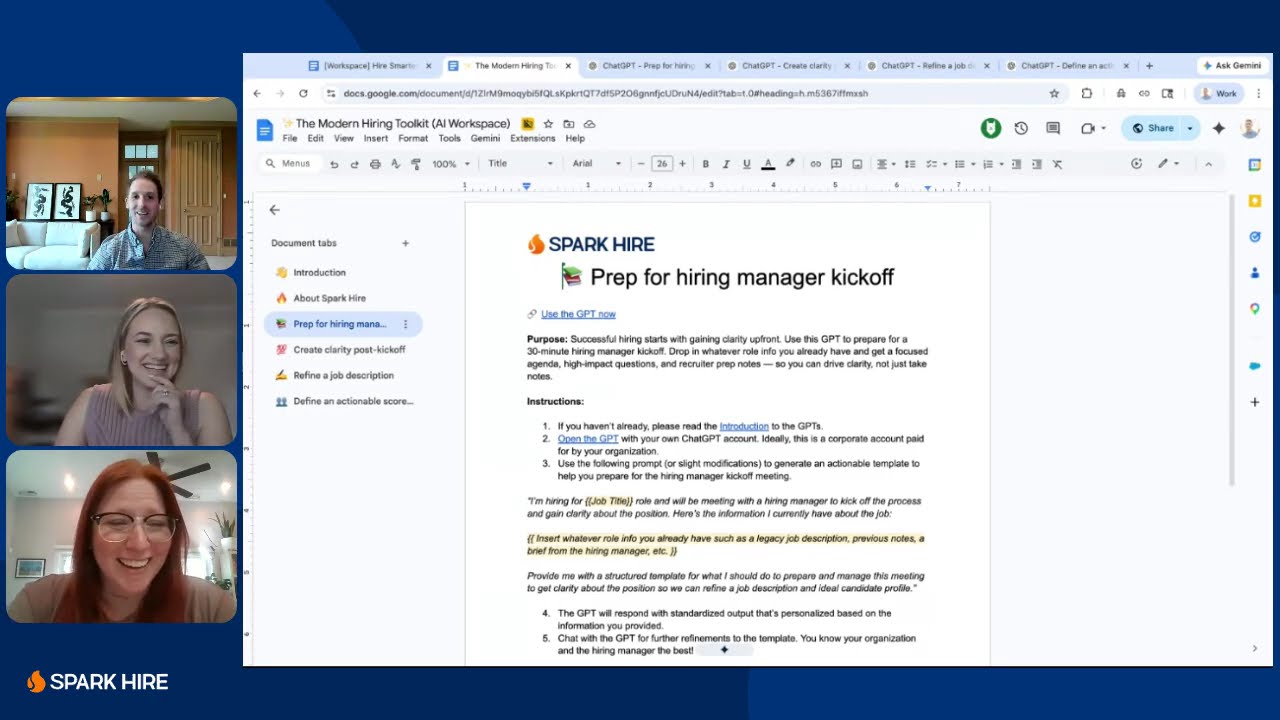
Hire Smarter in 30: A Live Hiring Sprint with Custom GPTs
Vague job descriptions and rushed kickoffs cause most of your hiring headaches. Watch a live, 30-minute demo of custom GPTs built for hiring teams.
Hiring in the Age of AI: Ethics, Authenticity, and Tech
AI makes hiring faster, but it also makes a polished answer easier to fake. Watch hiring experts on using AI for scale without losing human judgment.
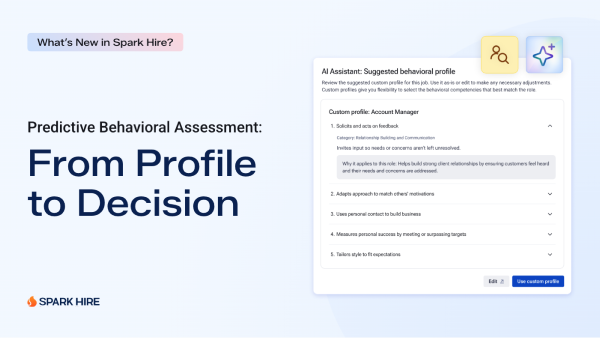
What’s New in Spark Hire: Assess the Behaviors That Predict Success
See Spark Hire’s Predictive Behavioral Assessment in action including the creation of a behavioral profile using AI based on the job description.