
Your Blueprint for Innovative SMB Recruiting Success
September 9, 2025
Recruiting stretches thin SMB teams without a big budget or headcount. Hear hiring leaders on building a better process by starting with the problem.
Are you an HR professional at an SMB? Feeling stretched thin, particularly when it comes to your recruiting bandwidth and tools?
Check out our recorded session from Hacking HR’s 2025 Talent Strategy and Acquisition Summit as we break down a strategic framework for recruitment process innovation that doesn’t rely on a massive budget or a huge team.
Hear from people leaders at Spark Hire, the American Marketing Association (AMA), and Laird Norton Wetherby as we dig into a “People, Process, Technology” mindset for building a streamlined and collaborative hiring process.
You’ll learn how to:
- Honestly assess the biggest challenges in your current hiring process.
- Build a unified and consistent process that frees up your team’s time.
- Identify the right technology for your needs, using a “problem-first, not feature-first” approach.
- Foster critical collaboration with hiring managers to ensure successful hires.
A must-watch for any HR or TA professional looking to innovate their hiring process and drive real results, we’re exploring how to do more with less by focusing on the fundamentals and getting the right people within your organization on board.
Welcome, everyone. My name is Adam Kaczanski. I am the senior director of commercial revenue at SparkHire.
Welcome to today’s session on recruiting innovation, well, recruiting process innovation for SMBs. You know, I encourage everyone to let us know where you’re dialing in from or where you’re logging in from. It’s always great to see where people are streaming these sessions.
So please put that in the chat right now. It’d be great. And while you’re doing that, I think it’s safe to bring our entire panel on stage right now. Let’s get the gang all here.
Gang’s here. Here we go. One.
An absolute powerhouse panel in the world of talent acquisition. And I’m not just talking about myself.
Well, I really am excited. Thank you so much.
Well, I mean, I’ll just do some intros and while we’re doing that, some people can, some extra people can log in or people had stepped away from the last session, which was absolutely fantastic.
But thank you all for joining us. Again, my name is Adam Kaczanski. I’m gonna be the host of today’s session. I’m here on behalf of SparkHire, who is a sponsor for the event. And I just want to quickly orient our audience to who SparkHire is. We are a hiring software that drives collective people driven approach to hiring, helping overburden teams, which is something we will definitely be talking about today, make successful hires.
We help you go beyond revenues and help you manage every aspect of hiring to create a positive impact on the candidates, on your talent acquisition team if you have one and on those pesky hiring managers, how we always try to get involved in the process.
Our solution involves SparkHire Recruit, which is our applicant tracking system and SparkHireMeet, which is our talent assessment solution, which consists of automated reference checks, behavioral assessment, and of course, video interviews. Okay, now that that’s done, let’s dive into the panel. First, I guess it’s a nice segue when we’re talking about SparkHire to introduce SparkHire CEO, Josh To land. Josh, thanks for joining us here today.
Thanks. Pleasure And to be Adam, you’re you’re a great host, great hype man. I gotta take you around everywhere.
I I do parties as well.
So please feel free.
We also have Doctor. Roz Cohen, who is the Chief People Officer at Laird Nortenthalerby. Welcome, Roz.
Love, thanks for having me.
And thank you, because I was thinking, do I go Roz, Rosalyn, and the name right there has it perfect. So thank you so much. And then, of course, finally, last but not least, is Jennifer Howell, Director of People and Culture at the American Marketing Association. Welcome, Jennifer.
Thank you so much for having me. I’m really excited to talk about this. My very favorite thing in the whole world.
Well, then you’re in the right place at the right time. Okay, great. So why don’t we dive in? So obviously, we’re talking about recruiting process innovation for SMBs.
And I think anyone here who’s listening who is part of a small to medium business or has been one, know that in the world of talent acquisition for these types of organizations, in many instances, you are a jack of all trades. You’re not just doing talent acquisition, doing a lot of other stuff for the company as well. I guess, Roz, we will start with you.
You know, what are some of the biggest challenges that are unique to recruiting? Now let’s say these enterprise organizations don’t really understand when you are a small to medium sized business.
What we think about in my company when we’re looking at recruiting is what are the characteristics of the individual that we need to have that are successful characteristics? We call them these threshold attributes that make people successful in our organization. And how do we create a process that helps us match the skills and these attributes together so we hire the right people? So for us, it’s really learning about what are the things that make us successful? What are the things that make our people successful?
And sometimes that takes a little bit of time to figure out. And then how do we create the process that allows us to see those things, ask the right questions, and then hire the right people to be able to do that work.
Excellent. Thank you for that. Anybody else wanna wanna jump in and, build on that?
Sure. Yeah. I think Roz nailed it, the keyword there is process. I think at a lot of small and medium sized employers, as Adam, you said, you know, oftentimes hiring sits in HR.
There isn’t a dedicated talent acquisition team. So the HR team, you know, they’re they’re all a jack of all trades or doing so many different things. And so hiring is just squeezed in amongst all these other things. So to me, it’s the biggest challenge is exactly what Raj said.
It’s like, yes. We need to identify who our ideal candidate profile is, and how do we map a process, to attract and find and screen and identify those people.
But doing that within the constraints of being the HR team running the process and trying to orchestrate a process when you have hiring managers who want everything done now, and you’ve got all these other priorities within the business pulling you away from that. So to me, that’s what jumps out, you know, is one of the biggest challenges for any small or medium sized employer.
I would also say, you know, to kind of put a fine point on it, Josh, is that it’s not just that we’re doing a lot of things if we’re the only person handling HR strategy, if we’re handling benefits with somebody else, if we’re working on payroll, we’re doing onboarding, we’re doing off boarding, you know, employee relations, coaching. I mean, this is stuff that fills your brain and takes up a lot of your mental energy. And so having to move from one thing to another with the same kind of thoughtfulness to the candidate experience and to the hiring manager experience, it requires a lot.
So I think there is something very special about people that do recruiting in a small and medium kind of environment, because it requires you to use every skill in your toolbox to be present in the moment when you’re needed to.
It’s a great point.
So, what’s really interesting, I think in the world of small to medium sized businesses, I’m just gonna say SMBs going forward. But what’s really unique in that world, say, I feel like there’s been a shift over the past few years where, you used to post one of those evergreen roles as a small to medium sized business and you get 150 applicants because you’re not one of the big name organizations. You didn’t see that massive influx.
But something has shifted in the market. And what I hear all the time is a year ago I posted this role, I had 150 applicants. Now I post this role, I get 500 applicants. So we know that there’s, that may sound good at first when you first hear it. Well, so many applicants, what a wonderful thing to have, but it definitely creates its own challenges.
Jennifer, what’s the risk now for small to medium businesses for not having a system in place to adapt to this change that we’re now seeing in the market?
I mean, I have big feelings about this. If you have a position that’s always open, my first question is to interrogate why. Is it due to high turnover? Is the business growing?
If it’s the former, then you have to do some work with the hiring manager and get information from exit interviews, like what didn’t hit right, what didn’t work the last time. If it’s the latter, it’s a great way to reframe a job posting that says, you know, we’re having amazing growth and we want you to be part of it. And shifting the mindset from the candidate finalist the first time around to candidate bench. Like, till I encourage everybody that interviews with me, connect with me on LinkedIn.
You’ll see a job as soon as it’s posted. Let’s keep in touch. And so I think things like that can foster better relationships with candidates that can go further in a role.
That’s kind of something that’s worked for me.
Yeah, and I guess when you think about that influx, there is a needle in the haystack situation that you’re in. And Roz, where are you finding the process to find that needle?
It’s a great question because with the 500 candidates, and we know the market is what the market is, right? There are a lot of people who have lost their jobs. And so folks are struggling and really wanting to get new employment.
That’s where doing a little pre work before the positions ever opened is critical. Right? So one of the things that I talk about here at my organization and when I was doing consulting is the interview and the conversation before the job is ever needed. Right?
So, okay, we have this position. Usually, the process is, okay, so and so quits. You end up taking the job description. Look good.
Looks good. We post it out, and we just go forward.
We never really ask the question or take the pause to be like, do we need this role in the way in which it has been listed? Is this role really that important? Not that we don’t need the body different. Right? But are the responsibilities the same?
And do we ask the person leaving if we have that opportunity? Do we ask the people on the team? Do we ask with those in the organization that interact with that position to say, what is it that you do? How do how do you work with this person? And then say, okay.
This is the job description we had. This is the job description we may need. How do we merge those things? And use that as the catalyst really to figure out who is the right person or what are the right skills, cultural fit, and leadership responsibilities for this role.
And being able to do that in advance. It takes time. Nobody knows. But it’s critical.
Yeah. That intake meeting, Roz, is key.
It’s like we have to be as fluent in this role as our hiring managers. And we will only be as fluent as the information that they tell us. So having a really intentional intake meeting questionnaire that you’re going through so that they can rely on you to partner with them to find the right person and to suss out what are the things that are different.
That’s right.
And what I’m looking for now than what I had in the incumbent before. That’s right. You know, so I am so with you on this one.
Absolutely. And those are great points. And I think, you know, to tie it all together here, without these processes and things in place, with all this prep work we do before the hiring process, without thinking about how we’re going to run a process to deal with this influx or this larger volume of applicants, we, as an SMB, run the risk of losing the advantage that we have as an SMB, which is speed and agility in the hiring process. The reality is as an SMB, you’re not gonna be able to pay as much as the big company that’s out there.
You’re not gonna offer the same benefits. You’re not gonna have the employer brand that, you know, people have heard about and can look up a million reviews of people working at that organization. And bigger organizations have those advantages over you in terms of attracting and essentially bringing on employees to their organization. And so as a small organization, your advantage is speed and the candidate experience.
And those two things give you the opportunity to impress candidates along the way where you’re actually able to overcome some of those shortfalls when in terms of, like, the offer that you’re actually able to make at the end of the process by being able to show you’re an employer of choice through the hiring process that you run. So that’s, to me, like, the big risk with this influx of applicants and not being able not being prepared to deal with it, through process that you run as an SMB.
Yeah. So, I mean, the theme that I’m definitely hearing from everything that you all said and Josh kind of summed up for me was, it’s have the process before you publish that role, like have a very thorough and thoughtful process, make sure common phrase, all your ducks are in a row here, ensure that when that role is posted, you are ready so that you’re not wasting the candidate’s time, you’re not wasting your time or the rest of the team’s time. Jennifer, you did bring up two words that I think a lot of recruiters are scared of. That’s hiring manager.
So I do want to talk a little bit about collaboration with hiring managers. We know how critical it is, but it’s not easy. And for one of the most important pieces, collaboration in the recruiting process, it’s some of the most difficult problems that we can resolve. So I’d love for somebody to go off you to jump in and talk a little bit about, how do we go about solving it?
What is standing in the way of collaboration with some of the most critical people that we work with?
I mean, as a small to medium sized business, so the American Marketing Association, there’s 65 of us, right? So I know everybody at the organization. And I have relationships with everyone at the organization.
I heard a, in the, there was a session earlier on the tech and tools session, earlier with Felicia Blasberg that the recruiter has to be fluent in the job.
And the only way that that can happen is collaboration with the hiring manager. If the hiring manager needs somebody in the role, the only way that that can happen is with my help. And so it’s a relationship that matters quite a lot. So if somebody’s left the organization, I wouldn’t want processing your exit.
If somebody’s coming on board, like we’re the first people that they see. So I think if the hiring manager can understand that you’re there to help them, then it’s going to be fine. And we have a benefit of that in a small and medium sized business, because our relationships are different where things aren’t quite so, oh, that’s not my job or, oh, that’s not your job. In a small and medium sized business, it’s usually a more collaborative space.
I I would agree a 100.
One of the things that I try to do with our hiring managers here is be curious.
HR walks into the room and sometimes we have this like, oh, we know what we’re doing. We got you.
Good. We got you. We’re going to hire that person for you.
That can be really off putting. But if we’re curious as HR people and tell us what this role does, tell us why this role is critical, tell us how this fits in with the bigger part of the organization, give us some understanding of why this position is so important in the process of whatever it is your department does. When we get curious, there becomes this people like to share what’s going on. And so you end up with this natural collaboration and conversation versus this one way dialogue.
So I’ve always found that to be really critical for me in working with hiring managers. I know nothing. Pretend I know nothing. Tell me a little bit about this role and why it’s important.
Spot on. And you have the opportunity as an SMB, like Jennifer just said. If you’re 65 employees or a 100 employees, whatever it is, you have the opportunity to start developing those relationships and having those conversations early. I think the challenge in collaborating with hiring managers is a role pops up.
The hiring manager’s antsy to fill it. They wanna rush the process along because they need somebody in that seat. And so oftentimes, there’s the urge to skip steps or speed up the process on the front end to just get to hiring. But the reality is the relationship and those conversations and the seeking to understand has to start much earlier.
And, again, going back to SMB versus big business, this is your advantage. You have the opportunity to develop those relationships and get to know everybody in the organization. So when the position does come up, you’re ready to dive right in with that hiring manager. I think the other thing too, is with hiring managers, is really getting them to understand why it’s so important to work on the process together.
Number one, at the end of the day, this hire is going to impact them and impact their team more than anybody else in the organization. So it should matter to them a lot. And in terms of getting their participation, it’s about reframing it from, I need you to do this so we can do x, and more from in from the perspective of you’re the expert. Like, we need you.
Your team needs you. You need you, your own input into the hiring process so we can find the best person for this position. And I think once people understand that why and you’ve also done the upfront work to build a relationship with them, it makes it a lot easier to then hop onto that kickoff, and get things moving. So even if there is an urgent need, you can work a lot faster because you have developed that rapport and mutual understanding of, you know, expectations for the hiring process.
And to build on that a little bit, Josh, I think in a smaller business, your hiring managers are player coaches. Right? Like, there’s very few people in a smaller organization who don’t work.
Like, they all have work. So how am I helping them? Because they still have a ton of work to do. So the way that I can help is I can, if you give me all of the information that I need, then the basic questions that you need answered in order to determine whether or not to even send them to the first, like what questions are we asking?
They know that if I’m asking those questions straight away, either in a one way video interview or in a phone interview, the people that they’re going to see at the very end, they don’t have to worry about the basics because I’ve already got I’ve already covered it.
That is so Oh, sorry, Jennifer.
That is, like, so spot on and so critical. Sorry, Adam.
I’m sure you No.
No. No. This is keep going, please.
It it is so critical for us to be able to ask the right questions so that they know when would they’re walking through the door that they’ve got the right candidate. And so here’s something else that I will also say that I know is a little controversial.
Your senior leaders, your hiring managers, the people who are looking for this role should be the next interview that happens. It is not easy for that to be the case.
But if you have an HR person and then you have the most junior person by the time you get to the senior person who’s the actual hiring manager, you may or may not have the right people in. But if you can, and I think it’s true with small to medium businesses, you can have the more senior people, the hiring managers involved earlier in the process which allows them to really like these are the people I have vetted and so by the time you see them, they are the right folks. I believe that they are the right folks for the role. So it all is about this process and this structure. I think in an SMB, have the opportunity to create that as long as you have buy in at all levels of the organization.
Excellent.
And we switch off. I’m so sorry. So, Rod, I’m like, this is my favorite thing to talk about. I stuck with this all day.
One of the things that we do is sort of switch off. So, like, I will do the first pass. So, like, I’ll make sure that the hiring manager sees 30 to 50 out of the hundreds that come through. I’m eyes on all of them.
And then from what they told me, I know what they’re looking for, I think. So then I tell them, go through this 50. Am I on track? And then they’ll move them to SparkHire, which is the one way video interview.
They’re responsible for it. So I’m not judging the candidates at all. So they are making the determination at the first step, who’s gonna move forward? Who am I gonna speak to?
And then during that phone interview, then I will say, based on the things that you’re looking for, if you’re the questions that I’m asking, I’m asking the same questions of every candidate. I’m sending my scorecards to the hiring manager. And then they decide, yep, these are my three, these are my four. And then it goes to the interview team of which they’re a part.
So I think you can have both. I think you can have both.
Yeah. And, Roz, I love that you talk about bringing hiring managers up earlier in the process.
I think, you know, there’s a number of benefits to this. Number one, as you just mentioned, by bringing them closer to the process, closer to the candidate earlier in the process, you can calibrate a lot quicker on iterations that need to be made to the criteria that you’re looking for, the questions that you’re asking, the steps in the process, whatever changes or modifications may need to be made versus getting to the end of the process and realizing, okay. We’re off market, and we now need to start over, and you waste a whole ton of time doing that. Number two is you need them earlier in the process.
As we just talked about, there’s an influx of applicants. There’s more work to just be done in the front end of the process. And if you are running, hiring in HR alongside all the other things that you’re doing within the business, you need their involvement earlier in the process just from a capacity standpoint. And then number three, I would say the big intangible benefit of moving the hiring manager up in the process is really from a candidate experience standpoint.
When candidates know that hiring managers are engaged and involved earlier in the process, whether they see or hear from them or not, but at least if you’re communicating that they are, to candidates, it feels like they’re being heard and they’re being seen more instead of, like, I gotta go through these five steps before I even get in front of the person that’s gonna ultimately end up being my manager. So I think there’s just so many reasons that you should constantly be pushing the hiring manager up in the process. Now that doesn’t mean you should be putting them in a step where they’re vetting through a ton of people and spending a whole lot of time on the wrong set of people.
But that’s why you have to address the front end of the process. So as you move them up, the candidates that get to them early in the process are the right candidates.
And you can be transparent about that in the job posting. I see it more and more of, like, you know, what to expect from this process. And then it it very clearly lays out. And so then they know before they even apply.
And that kind of thing can really make a difference.
And I think, thank you all so much. And I think, you know, for hiring managers that haven’t experienced both ends of the spectrum, being a hiring manager and the small, like it may sound like, oh, this small company I’m working for is asking so much of me. Better to be on that end of the spectrum than I’ve been at the large organization where it’s one of my salespeople left, I need to replace them and the cogs just start moving. And it’s all right, we have the job description, we will post the role and we’re gonna send you the 200 best applicants that we see come in, and then it lands on your desk.
So you lose that aspect of collaboration and then ultimately lose hiring manager buy in early in that process. But thank you all. Some great, great insights there.
But I now want to move to that first, let’s say that first pillar of recruiting and innovation for SMBs, and that is creating capacity, right? So we talked earlier on about you’re wearing a lot of hats and there’s no way of getting around it. You can’t be like, well, I’m just gonna take that one hat off and I won’t do HR for the next few weeks while I’m recruiting. So there’s a need to invent capacity.
So part one of this question is, I guess, doing some kind of assessment of where the biggest challenges are. It looks like Jennifer’s having a bit of a login internet issue. So Roz, we’ll definitely start with you on this one. But how do you take that step back and look and say, all right, I need to create capacity.
This is how I’m gonna start my analysis.
You’re on mute Roz.
Oh, sorry.
And of course, had to sneeze at that exact Oh, bless you.
When you say create capacity, do you mean capacity within the HR department?
You Capacity for yourself managing recruiting while you’re wearing so many different hats.
Yep. I think that there is technology that you can use. I but I’m not we don’t use SparkHire, so let me just say that I’m I’m I’m I’m not I’m not pitching them. I know the product. But what I do say is that there is technology that can be used that I think we can’t rely on it 100%, but we can use it as a tool by which to hire the people that we need to hire. If we’re thinking about all of these different resumes that we’re receiving and keywords, how does all of that fit so that I can get the right folks or the folks that I’m looking to hire in a in a smaller package so I have the ability to look through them versus trying to go through 500 or 600 resumes.
Yeah. Totally. And, you know, I’ll reference, somebody gave me this great quote, and I use it all the time now, Alex Moseman. Shout out to Alex from Knox County Schools in Tennessee. So school district, not necessarily an SMB, but an under resourced organization, nonetheless.
And the phrase that he used was you need to find or invent new capacity. And I like that because there’s really two sides of that. Of course, if you’re running hiring within the HR department, there’s the pitch to the organization of at a certain point, it makes sense to build out a talent acquisition team or bring in a dedicated recruiter. So that might be finding capacity.
But then there’s, okay. You’re not gonna get approval to do that. So what are you gonna do? And that’s where you have to invent new capacity.
So as Roz said, of course, there’s the technology route that you could go. But I think oftentimes, you know, people jump to technology as the solution, and I’m saying that as a technology vendor. And a lot of times, I think the first place you should start is really examining your process. Like, what are the bottlenecks in the process that are causing friction and slowing us down and creating drag?
And let’s smooth those out before we necessarily, you know, go and start adding tools to the mix. Eventually, I think you’ll find yourself in a position where you have to do a little bit of both.
But to me, it starts with, like, let’s let’s analyze the process. Where are we spending or where are candidates spending the most time in the hiring funnel at what particular stage? And let’s start unpacking why and start to figure out if we can just invent new capacity by modifying our process. And then, you know, we can we can get into the tools from there.
And that’s where your ATS system is critical. Right? Because they should be able to look at your process and see where are the bottlenecks. Is it happening at the first stage where you’re sort of reviewing resumes? Is it happening when it goes up to a particular manager? Where is that happening? And so that’s where it’s using the data to be able to make the informed decisions is is a key piece of this.
100% agree, Josh.
I I agree as well. And I I I think that there are certain thing there’s an urgency, to create inventing capacity because you if you are a talent acquisition person who cares about your candidates, like you care about what their experience is like as a part of their journey as a potential employee, team member, and then alum once they’re once they’re they’ve moved on, That entire journey has to matter. And so for me, it’s making sure that there are automatic touch points. They apply, there’s an automatically triggered personalized email that goes to them.
When they are moved into, you know, the first step of the process, they are informed. If we’re not moving forward with their candidate, candidacy, they are informed within twenty four hours. If they’re a specific, stakeholder, so if they’re an AMA member and they’re applying for a job, I have different communications for that too. So that, and we use, you know, their preferred name, their preferred pronouns, because we ask for it in the application, and it’s letting them know where they stand.
I don’t have to do that every single time because I’ve built it into the ATS that I use. And so it’s sometimes, like Ro said, you’re doing a lot of work on the kind of on the back end to set the stage so that things can move smoother once you’re in it. My my my one of my mentors, the wonderful Kelly Scullen, she’s she said, hire hire, pants on fire. And it’s sort of like, do all of the pre work so that you can move real fast.
And that’s something that I try to do with intention.
Great, thank you for that as well. And when we decide to take that leap, let’s say we’ve worked on our process, Josh, like you said, again, we are the vendors here, but focus on process first. Is hands down the most important thing that you do. And when you’ve done that and you decide to take on a technology in any aspect of recruiting, whether it’s technical testing or behavioral evaluations, whatever it may be.
I think that there are recruiters out there or people out there that bring it on and say, once we picked our technology, it’s problem solved. And we know that picking the technology is just step one in a new set of challenges that have now opened up for us. So I think my next question will start with you on this one, Jennifer, is.
How do you what is your method of figuring out, let’s say, an easy user friendly technology to bring on board? First one, that’s just going to create more challenges and headaches. Like are you prioritizing as you evaluate different technologies for that purpose?
It’s a great question. And I think when you work in a small to mid sized company, finding more bandwidth for yourself is the number one thing, because all of your team members rely on you for the hard moments, really, really hard moments.
And so I need to create more mental bandwidth. So one of the things that I will do is go to my network in HR, of, like, who is in the same rough, same size, same revenue that I that my organization has. Crowdsourcing can be a little bit exhausting and a little bit confusing, but if you know people that are in your same space, you can get ideas.
See what works for them. For the AMA, I needed a I need tools that can integrate everywhere.
So I need to remove as much manual work as I possibly can. So our ATS integrates with DocuSign, with our payroll system, with everything. That was, like, the number one thing. And so that was that was the key for me. And that was the thing that I was looking for. It’s only gonna be as successful as the time that I can spend to put in it.
Great. So we have about nine minutes left. And while I do wanna stay on this topic, I do want us to move over to that next topic and that second pillar of innovation, which ultimately is collaboration.
So, Roz, question here for you. Have you seen a change, whether it’s recent or over the past few years in the collaboration between hiring managers and recruiters being more proactive than reactive? Like has that thought started to shift a little bit?
I I I don’t know if it has as of yet. I think what you have now is the advent of AI. You have all of the different products that are out there.
And I think we as HR people need to be more intentional about talking with our hiring managers about how to use these technologies, how to use these products to help them get the people that they want in faster. I’m not sure that the conversation is happening yet.
I think there’s still a lot of hesitancy around utilizing AI in the process because of other risks or other biases that it can create. So there’s a lot of conversation that needs to happen.
I’m gonna take it on myself as the HR person to initiate those conversations. Hiring managers are not gonna do that. They don’t have the time. They don’t have the bandwidth.
I mean, they just don’t. They want that person in that seat. So it’s my responsibility to have that conversation in advance or if not in advance, immediately upon the the time that we know that the position needs to be filled. So I’m not sure it’s happening yet.
I’d be curious to hear Jennifer’s perspective.
But I think we are responsible for changing that conversation.
I mean, I will say from the AMA side of things when it comes to recruiting, I don’t utilize AI.
So I believe very, very strongly in the people in people and culture.
I believe that candidates, I know that candidates utilize AI in their resumes. I know they utilize them in crafting their responses to interview questions. I get it, and that’s okay. So it’s, you know, it’s how can we know what it is that we’re looking for?
How can we make it happen? Sometimes it’s gonna mean having more knock on questions that literally call back to the job posting. So it’s reiterating, we need three years experience in HubSpot. How many years of experience in HubSpot do you have?
Less than six months, six months to a year, one year to two years, three years to four, more than five. And then it’s like if it’s under the threshold, they get an email the next day that says we’re so sorry. I’m not even seeing candidates that are self identifying as not having the skills they need for this job.
So, but those are questions that I have entered in.
It still means that I’m still going through hundreds of resumes, but that’s okay.
Great, thank you for that. So, you know, thinking about, you know, Roz, you said bringing in technology to help with collaboration. Again, I open this up to the crowd here. How can technology help streamline collaboration between recruiters and hiring managers or other stakeholders when hiring a role? If anyone wants to jump in on that.
I’ll defer to these two experts on their experience with that.
But I will say, and even going back to the the conversation, just a second ago about AI, I think the most important thing is you’re looking at technology, especially as it relates to working with hiring managers and expectations for hiring managers to use that technology is you have to take this approach of, like, problem first, not feature first. And what I mean by that is if you’re asking the team to use something, you need to be very clear about what problem that you’re hoping to solve with that tool. And we’re not just using it because it’s this great tool or we’re excited about the feature or we’re using AI for AI’s sake.
So I think as you think about collaboration with hiring managers and ultimately getting their buy in to use whatever you’re asking them to use or even do whatever you’re asking them to do in terms of the hiring process, it always starts with problem first. So I’ll defer to these two and their, you know, real world experience in terms of implementing technology and maybe some examples of how it’s helping, you know, them better collaborate with hiring managers. But that’s, you know, from a 30,000 foot view, I would say that’s my advice to anyone out there.
I’ll I’ll just say I am six months into this role, so stay tuned. We are we’re still out here, But I’m excited because there are options out there. And being in an SMB, you get the chance, as Jennifer said earlier, to know the people that you’re working with and know what the So needs I’ll let Jennifer answer that question.
So, again, I think that technology has its place. I think that technology can aid. It can help. The tools that I use are my assistant as it pertains to talent acquisition.
But some of the most impactful tools that you can use with hiring managers and interview teams is having a recruitment and selection selection process map. I go through it with our hiring managers during intake. This is what you’re responsible for. This is what I’m responsible for. This is what the flow looks like. If you are not sure what comes next, this is your map.
And I refer to it constantly. And it also changes sometimes because, you know, our platforms change and the way that we handle candidates changes. But when you have that set, that can really help. Having interviewing one zero one training with all team members, all of them, interns, c suite, vice presidents, individual contributors, they know exactly what’s expected of them when they are part of an interview team.
Hiring managers’ expectations. This is what I need from you in order for this process to work. Because we are so small, these visit like, these one to one touch points are going to matter because we’re building the teams that they need.
And so I cannot rely on technology to make that happen.
So like, I need the hiring manager to see their fingerprints on the success of their team, because they worked with me to help them get the right person for the right role at the right time. And there is no technology in the world that can make that happen. So that’s that’s my take.
I love it. I have big feelings.
I love it.
Look, I I love here that I know this session is talking about recruitment process innovation, and I know oftentimes innovation is associated with technology and shiny new objects. But I think, you know, here, what we’re the key takeaway here is innovation is improvement. And so the way I would look at it is it’s really three things with technology at the end. It’s people.
It’s process. It’s technology in that order. Jennifer hit on it earlier. It’s people. It’s developing those relationships, having those conversations, having empathy for your hiring managers, building that trust to establish a strong foundation.
It’s process, so you have something to use that foundation to run. Slow is smooth. Smooth is fast. So you don’t have the which I love this phrase, hire to hire pants on fire situation.
And then technology is last. I think sometimes, you know, people think innovation, and it’s like they start at the the end. They look for technology to solve all their upstream problems. But I really think it’s in that order.
It’s people process technology, and they all play a role in better hiring at SMBs. But I think, you know, you gotta follow that order of operations to ultimately get to the best outcome.
And one last thing, and I know we’re out of time, but we’re in a workforce that has four to five generations in it.
And all of those generations have different needs. They have different ways that they communicate, different ways that they want to move throughout the process. And being able to effectively communicate and problem solve is evergreen.
And so whether you can do that one on one or whether you can do that through a shared document, through a Zoom chat, through a process, through notes in an ATS, all of those things are valid. But this is a it’s a skill. It’s very much a skill.
Great. Well, I want to thank everyone so much. We are at time. I we’re going to spend one last minute. I think it would be great, you know, for everyone listening here who learned a ton.
But for all of our SMB recruiters that are dealing with tight budgets, if we could give them in one sentence, one actionable piece of advice, if each of you could throw out one specific sentence, one thing that they could do to jumpstart to an easier path forward. What’s that one sentence? I know it’s the hardest question I’ve asked so far, but what is that one question? What is that one sentence?
Create a framework for what success looks like.
Great.
I would say build trust.
Excellent. I don’t know if it’s cheating to go back to the last thing I just said, but I would just say people process technology in that order.
Excellent. Excellent. All right. Well, thank you everyone for joining.
Roz, Jennifer, Josh, thank you so much for, as I expected, a fantastic panel.
Please connect with us on LinkedIn, everyone who’s listening. We love to build our recruiting network. So don’t hesitate to reach out, find us on LinkedIn, but I hope everyone has a great rest of the day and enjoys the rest of the sessions. Thank you all very much. Have a good one.
More Webinars
What’s New in Spark Hire: From First Look to Final Notes with Spark Hire AI
Spark Hire leaders introduce Role-Aligned AI Video Review and AI Notetaker, two new features connecting screening and evaluation in one process.
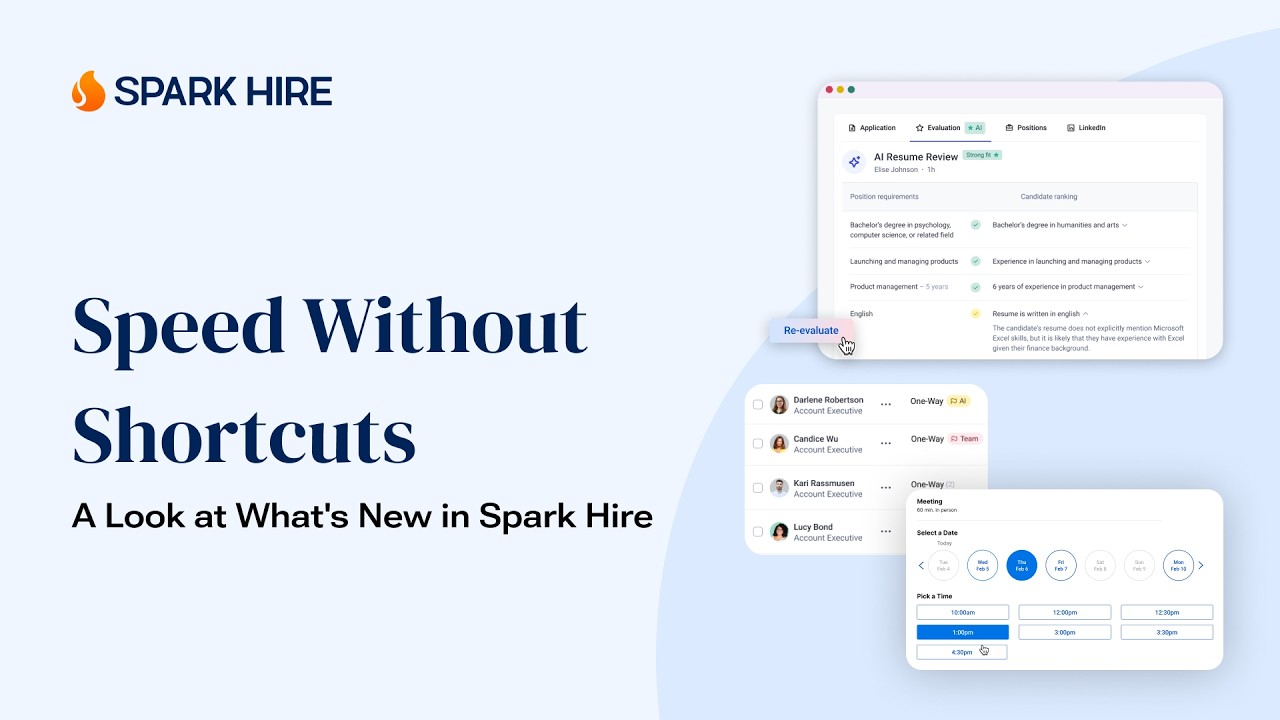
Speed Without Shortcuts: A Look at What’s New in Spark Hire
See what's new in Spark Hire: smarter AI resume ratings, less scheduling overhead, and clearer assessment review, all in one live walkthrough.
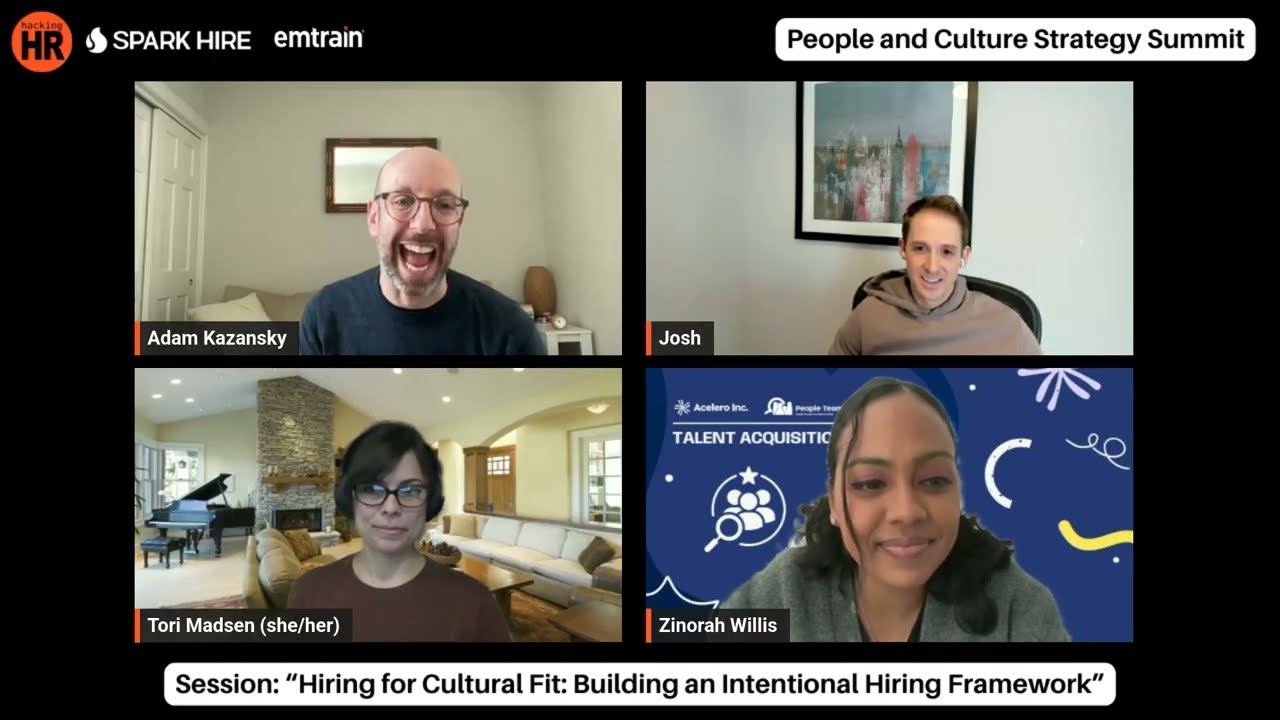
Hiring for Cultural Fit (Not Vibes): Building an Intentional Hiring Framework
When culture fit becomes a stand-in for vibes, bias and inconsistency follow. Hear talent leaders on building a structured, repeatable way to evaluate it.