
Upgrading Your HR Tech: How to Make the Business Case for Change
October 24, 2025
Learn how Holganix redefined its hiring strategy, strengthened communication, and accelerated hiring through better process design and thoughtful technology adoption.
In this live workshop, Spark Hire sits down with Kate Michael from Holganix to explore how organizations can successfully upgrade their HR technology and modernize their hiring process.
Kate shares firsthand insights on:
- Evaluating your existing HR systems and identifying gaps
- Building a business case for new HR tech that resonates with leadership
- Gaining buy-in from hiring managers and executive teams
- Streamlining hiring workflows to improve candidate and manager experiences
- Balancing automation, AI, and the human touch in recruitment
Whether you’re planning your 2026 HR tech roadmap or preparing to pitch an ATS or process overhaul, this conversation will help you connect efficiency improvements to real business outcomes.
Welcome to another edition of Let’s Talk Hiring. We’re excited to be here with Kate Michael of Holganix, and, we’ll turn it over to her for a second because you will do a far better job of giving your background, although we were having a lot of fun backstage, if you will.
But as we, get prepared to do that one thing, if you just drop in the chat, if you can. First of all, this will be very interactive. So if you have questions, we encourage you to drop them into the chat. We often will reference those and pivot our discussion on the basis of what you wanna see.
But let’s start with from where you are joining. So what part of the world are you joining from? I know we have, the Midwest well represented between, Josh and Kate, and I’m in Charlotte, North Carolina.
But if you can just drop that in there. And while that’s happening, Kate, thank you. Again, we’ve we’ve had the luxury of being able to spend some time with, Kate over the last month or so. She’s been very generous with her time and sharing her expertise and experience with us. And so we couldn’t help but ask her back to to talk about this as especially now as we sit here firmly in the fourth quarter as a lot of people are looking ahead to 2026 and planning, that that her experience here in the last couple of organizations would really be insightful for for people to to learn from. So, Kate, without further ado, provide us a quick background for the team. The sixty seconds on you and then a little bit about organic so they’ve got some context.
Yes, absolutely. Well, thank you for having me. And I really appreciate the time and opportunity to speak with both of you.
So I think that for me, my background, I grew up in Central Iowa in the seed industry and my mom has been in the seed industry for her entire career and so, I kind of got to see, you know, what the seed industry was all about and grew up in in kind of farmland and and had kind of an interesting perspective. I wanted to go to law school and I I thought, you know, maybe that was my path and then I kind of got pulled into some seed industry work and I loved it and it just felt like home And so for my entire career, the past almost, I guess, fifteen years, I’ve been in seed and agriculture. My most recent role was with an ag tech company, and so we did drone scouting.
And then I joined Holganx, and Holganx is a soil health company. We help growers improve the soil and improve the revenue and thrivability of their business.
And we do it by creating like a stronger soil structure, putting biology back into the soil, and creating healthier, stronger plants and so, my job here is to hire really great people, put them in jobs that they can be really successful in, and let them make a big impact. And so I use SparkHire to do that every day. And I’ve had the opportunity to build out a lot of processes and plans that have helped put Holganix in a good position to succeed in the future.
And a lot of that has been due to the fact that I have the time and ability to focus on some things by utilizing the SparkHire platform.
That’s all. And one thing that we’ve I know you’ve shared with us in the past that I think is really good context for folks is, just the the niche nature of the industry, right? And what is that? What does that therefore mean in terms of looking for talent and where that talent may live and, you know, the to to I guess, share with us a little bit about that because I think that’s important context for as we think about process and technology and things like that.
Yeah. So the beautiful thing about farming is that it happens in the flyover states, right? So we’re not really central to just one location. I have reps throughout the Midwest. I have locations throughout the Midwest. I’m located in the Midwest.
And so we’re able to really build out teams here locally.
And and I think that, you know, utilizing the the ability to build out our locations or build out the wrecks in, you know, our remote locations has been a really huge plus for us.
Yep. Josh, I think you’re muted.
Sorry. I muted myself for the intro and it never came on me. Well, hi, everybody.
Well, Kate, yeah, I think it’d be really helpful. First of all, thank you for the support. But second, it’d be really helpful just to frame up the context around Holganix.
How big is the company in terms of employees, maybe different types of positions that you guys generally recruit for, and then just the makeup of the HR slash recruiting function, like who’s all involved.
Yeah. Absolutely. So Holganix is an independently client business.
And we have, I would say, between 75 to 80 employees today. My estimate and plans put us over 100 employees probably by the end of the first quarter of twenty sixth. So rapidly growing. And I think for us, we’re hiring sales folks in the field. We’re hiring middle kind of people managers in the field. We have some operations roles.
We have roles that are on-site. So people who are in the warehouses, shipping product or logistics folks who are in the office and kind of handling some details there.
We’re hiring roles up into upper management. And so just a wide variety of the type of roles that we’re hiring and the locations. We’re not all in a physical location.
And so there’s just there’s a lot of moving pieces and a lot of different places where we’re looking.
And when you joined the business, what was the catalyst for that? Because I believe you’re the company’s first full time Yeah.
Person in talent So, you’re right.
So the team, for us, we have one full time employee, who’s handling the HR function. We have two consultants who are working with us on some HR functions. And then, previously, before I joined the company, the hiring process was really handled by the hiring managers, our chief of operations, our chief of revenue, and then also the HR function. And so everyone was kind of coming together to really try to make hiring a success.
And they all had a lot of success. They brought in some really great people, but they all also had really core business functions that they needed to focus more time on. And so when I was able to have a conversation with the company, I think for me, it was just about how do we build a better process? How do we streamline this so that it works more effectively and efficiently?
You have these huge goals for growth. And what an exciting place to be in the industry today, right? There’s not a lot of companies in agriculture that are growing this rapidly. And so how do we make that more effective and efficient for you?
How do we bring in really, really great talent?
But how do we give you the time back to focus on your core business objectives and let me focus on hiring and building this team out for you? Let me take some of that off of your plate. And ultimately, I think that plea was successful. And so I got to join the team. And I’ve had the amazing opportunity to really help them build out the team and bring in some phenomenal people. And we’ll continue to do that.
That’s great.
Yeah. And so this actually is a great segue for as we think about this. So the, you know, a lot of organizations here that we brought at the beginning here, we said at 2025 and looking ahead to ’26, and it’s a natural time to kind of reflect you know, what works, what maybe doesn’t work so well. But I think in a lot of cases, it’s it’s, well, everybody would deem it necessary.
It gets really easy to push that off, and then all of a sudden, you wake up and it’s Christmas morning and you haven’t done it and you gotta come right back and fire off on twenty sixth. So you were were, you know, fortunate enough to have the opportunity to be dropped into that situation and now have to really assess because that’s why you’re brought in. So when you did that, like, how did you actually go about assessing, okay, where are we? Like, where where do we stand from a from a process perspective and all the different stakeholders involved, including candidates, and then, obviously, technology being part of of that process.
How did you go about doing that?
Yes. So when I started with Holganix, we had an HIRS system that had a sort of a platform for hiring. It was maybe a little adaptive, you know, and lacked some function functionality. And so that process or that platform had been kind of being built. And so there was some things that were glaringly missing from it. But then there was also just some functionality that I wasn’t quite sure if we would ever get to the point where it would do the things I needed it to do.
And I had the the ability to really come in and luckily be able to say, okay, you know, we’re gonna build some processes around, you know, these certain areas. And I really, there were processes that were working, but there were processes that were maybe a little clunky or maybe a little slow or maybe a little manual that I had the good fortune to kind of feel fast on. And so I’m not a very patient person. That’s probably my fatal flaw.
And so I was able to really identify areas where in order to be successful, I needed to get extremely efficient in a few areas. In order to improve our candidate experience, I needed to get really efficient in a few areas. And I was able to communicate those and kind of have some conversations around, this is what I need, this is where we’re at today, but I’m not sure what we have today can get there. And I’ve probably told this story 60 times and I’m sure everyone’s tired of hearing it, but I had the good fortune of having a CEO who’s incredibly intelligent, but he’s also really empowering and he gives us the autonomy to be successful and to make the decisions that we need to make.
And so I said, I’m just not sure that this platform can get me where I wanna go. I know of a platform that can do all of the things that I need.
Is there a way? And he said, do it. And I was like, but I have this whole list of reasons. Like, all of the numbers together.
And like, you don’t wanna know any of my rationale? He said, no, just take care of it. Just do it. Do what you need to do to be successful.
And so I was actually able to reach out to SparkHire and say, you know, this is something that we’re really interested in.
Within like, I think a day I had a meeting. The meeting was phenomenal. Within like another day, I had Sonia who’s been my implementation lead and someone I’ve worked really, really closely with. And I would say by the end of that week, I was actively building out requisitions on SparkHire and pulling candidates in, and we made that transition. We were able to build things very, very quickly. We made that transition very, very quickly.
In my previous role, SparkHire was something that they were using. So I was able to learn the system, but I didn’t necessarily get to build it. And, I had the good fortune here to be able to actually take the blank canvas and say, okay, this is how I want this to look, and this is how I want this to read. This is the workflow I want here. I could really customize everything to exactly how I wanted it to be built out. And so I really enjoyed that and the process happened very, very quickly.
Yeah. And so you actually referenced that. So you had the benefit of having previous experience with it and then having exposure to, in the in this case, specifically, SparkHire recruit the applicant tracking system. So that when you came into Holganics, you already knew what where you wanted to be, like, what good looked like. I think a lot of organizations may not have that that background, right, that they don’t have the luxury of either having previous experience with an applicant tracking system or the one with which they have experience was, as you pointed out earlier, some that are a part of the HRAS system are fine to kinda get started, but they lack a lot of the the horsepower necessary to really drive an efficient process, and amplify your capabilities.
So in that situation, as you think about you know, I don’t because in your head, you’d already kinda mapped out, like, okay. I see where the where the bottlenecks are.
For those that don’t have that, how how would you recommend okay. Here’s just break down the process, and here’s the places where it can most often go awry as we think about the candidate experience or hiring manager capabilities or, you know, effectively screening 100 resumes for a role? Where are the kind of the hotspots for you?
Yeah. So for me, one of the biggest pieces was the communication and just how that impacts the candidate experience and how I knew that I could do a better job with communication.
But my prior system didn’t necessarily have the capabilities to make that very streamlined or very effective or efficient. And so I was having to pull a email address out of the system and put it into my Outlook and then compose the email and then send the email. But then no one who is within that system could see what I had sent or when I had sent it or what the response was. And so then if I wanted to make sure that, you know, the whole group was aware because we hire as a team.
It’s not just my opinion. Right? I’m bringing people in and I’m screening them and I’m having really good conversations and I’m kind of setting the stage, but then I need this entire group of super intelligent people to also buy in. And for us, it was how do we communicate more effectively, improve the customer experience, and then how do we improve our internal communication?
How do we make sure that we’re not all having the same conversation six times and wasting our time? How do we make sure that we’re all aware of our thoughts on this candidate or I always joke with the team but like, if you want to know how I really feel, look at that further review box because I’m going to give you all of the context and I want you to be able to read through my notes and know when you start that next conversation, it’s not a, like, repeat of the conversation that we had previously. Let’s build off of that and let’s take our time and be intentional about being able to dig deeper with each interview as we move through the process.
Yeah. And so for me, those were two areas that were really time consuming and they were really important and they were really clunky. And so I knew that making those processes a little bit more streamlined but also just improving the communication internally among our team. We were going to feel so much more confident in making those decisions.
We’re going to feel so much more confident in those hires.
We were able to you know, if my CEO wants to know what’s going on in hiring, he doesn’t have to call me and say, hey, Kate. You know, where are we at? We’ve got all of these roles open. He can just click in and see what’s going on.
He can see my comments. He can see, you know, the chief chief revenue’s comments. He can see all of the things that have kind of told the story of this hiring process so that he can feel really confident when we’re making these hires as well. And so that’s been such a big piece for us is improving the efficiency, but improving that internal communication has been absolutely key.
Yeah. So it’s interesting. You bring up a lot of points there. It’s like the the communication piece of it.
Right? But but it’s not it’s external to the candidate. It’s internal with each other, and then it’s making it all visible because it as you suggested, and this is what we see in especially small to medium sized companies is is it’s almost always a team sport. Absolutely.
Right? Because there’s a lot of other subject matter experts that need to be involved in in addition to the hiring manager. But then you also brought up the visibility and and and communication at an executive level, right, for people who aren’t even in the process is that the ability to make that more transparent so that they have the confidence and they can weigh in and see that. So really interesting dynamic and and helpful, I think, for people as we think about, okay, how where do we even begin to evaluate my process?
It’s almost like, we’ll go through these places and start to map out what has to happen and the systems that are involved and the time it takes. And it’s, to your point, just as much about the the the time efficacy. But if it takes a lot of time, imagine what that’s doing to the candidate.
And where does the candidate fit in all that? And they end up going someplace else because we just couldn’t get all the dots to connect fast enough.
I think there’s a point that I missed on that as well that I think is worth discussing, and it’s just the reporting externally piece too. So, my team works really, really closely on bringing in really good people, but the executive team has a a huge, you know, vested interest in ensuring that we’re being effective and efficient and bringing in really good people and having the reporting piece of of, you know, the tool, right? All of my candidates are in this tool. I don’t have candidates sitting in 16 different platforms or, you know, some in my inbox and some in a job board and some in LinkedIn. Everything is connected. It’s integrated. They’re all sitting in one spot.
I’m moving them through the process. All of that is being tracked, measured, you know, accounted for and I can take all of that information. I can send that externally to make sure that, you know, the the people who have a vested interest in what we’re doing understand and have the visibility to see how the process is working. And so that reporting piece was huge for me as well.
Yeah. And I one thing I wanna go back to, and I think this ties into it perfectly, is that’s really the shift from recruiting being something that everybody owns that’s hiring manager led to being an actual strategic function of the business where executives care about it and they want to see reporting and all that kind of stuff. But if we go back to you thinking about making a change in the hiring software that you’re using and the processes that you’re running, it all goes back to the hiring managers that were mostly leading their own processes to begin with and oftentimes can be resistant to change because why try and fix something that in their minds maybe is not broken? And they know what they know, and it’s been working well for the most part for the organization, you know, up to that time when you came in. And, obviously, the business was making a shift in where you guys wanted to go.
So you know or you knew where you wanted to get the organization to. You knew what tech could help you do it. And you could, of course, show them once you got there.
But that’s you know once you get there. So how do you like bringing it back to the start of the process? How do you start that journey with your hiring managers when it’s this transition from you used to own the process meaning hiring managers and now that ownership is on your plate, and you want to make these changes, and you need to get them bought in to work with you on implementing those changes, whether it be process or tech.
Yeah. So I think I maybe was in a little bit of a unique experience in the fact that our company was growing so very quickly that the hiring managers were like, take it.
Take it and run with it. Right? Like, have so many things to do and we have so many places to go. And like, this is just one big thing that sits on our plate every week, but we don’t maybe have the capacity to really do it justice.
And so I was able to kind of come in and say, okay, I see where you’re spending a lot of time. I want to own this process for you. I want to make this more effective and free you up to take care of things that are really important to your core business. Right?
And then let this be my problem. I still want you involved in the process, but I don’t want it to be overwhelming or, extremely manual. You know, I want you to just be able to, you know, kind of play your part, give me the feedback, and then I’ll run with it. And I think that that was a relief, honestly.
But there was also just I went through a process of explaining the the expectations and how the system worked and the where they could find information and all of the benefits of having you know, the recruit tool to really like utilize effectively for them and it was, you know, like two minutes into the me showing them around and kind of giving them a demo. They’re like, this is great. This is wonderful. We love it.
And I was like, yeah, you know, there’s just, there’s so many pieces of this where, you know, my expectations of you are to have this interview. I’ll schedule the interview. I’ll take care of the, you know, the logistics of the interview. I need you to attend the interview.
I need you to have some conversations. I can give you, you know, some options for questions or direction on, you know, how this interview needs to go. You can read my feedback to understand, you know, the context of, you know, what that first conversation looked like. You have the resume right here for the context of who this person is and what they’ve done.
You’ve got all of this information in one screen and then, I just need you to click the button and evaluate the candidate and tell me what you think so that I can handle the next step for you. And it was like, that’s all you want. I’m great. Yeah, let’s do it.
This is super effective. And then we get to the end of the process and we do what we call a team sync. And it’s something that we’ve implemented that just says, okay, all of the stakeholders need to come back together for fifteen minutes. We have all of the feedback and we need to make a plan on the direction that we’re headed that everybody’s really bought into and we can keep moving.
And prior to having all of the information in the Recruit tool, that was like a thirty to forty five minute meeting because you had to kind of still collect all the feedback and everybody was trying to like remember who this candidate was and how that conversation went and what their thoughts were. It was a little bit jumbled, and it took some time to unpack. Now that’s a fifteen minute conversation. It’s really just us all clapping for each other and telling, this is so exciting.
We can’t wait for this person to come onto the team. Like, this is gonna be so wonderful. Sometimes there’s some contract discussion in that meeting, but it’s fifteen minutes where we’re like, this is so great. Congratulations to the hiring manager.
We’re so excited to have this person on the team. Let’s go make the offer and close the deal. And so because we have all of that information pulled together, we are so confident about the decision that we’re making. It’s timely information.
So we’re not trying to remember back a week ago or ten days ago.
And we can speed the process up so much because we are really confident in the decisions that we’re making because we’re making those decisions based on all of this information that we’ve gathered and pulled together in one place.
Yeah.
So I think the hiring managers love it.
I think that, you know, they’re looking at this as a tool for effectiveness and efficiency for them. And I think that, it has made them so much more confident, which is really a huge deal for them.
Yep. And I think the thing that stands out to me from one of our previous conversations is you mentioned the culture at the organization around domain expertise and really owning your domain. And that was obviously a big reason why you were brought into the business as somebody needed to own recruiting as a domain of the business rather as then like a side project for a hiring manager to do. And so what I’m hearing from you is the big way to get hiring managers on board is to emphasize just that that, hey, in recruiting, like, this is my domain expertise. I’m here to build a process and make things more efficient for you as a hiring manager so you can focus on your domain expertise, which is your day to day job.
But I need to put processes and tools in place that allow us to leverage your domain expertise as part of hiring as a team to ultimately get to the best outcome. And so I think that’s at least, you know, that’s what I’m hearing is how you kind of connected everything for hiring managers and made it all click. And that’s why they’re so, you know, active and engaged in the hiring process.
I think that’s true. We call them guardrails a lot. Right? Like, the process and the workflow and the way that everything’s laid out in the Recruit tool gives you a very visual look at what absolutely has to happen before we get to the hiring or like offer stage, right? And all of these things can happen very, very quickly if they need to they can happen in like a normal cadence if they need to but all of the things have to happen and so, I kind of think about this as like the guardrails, right? We know what has to happen. We can we can move fast through it if we need to.
But we’re all bought into that process because it is so, you know, intuitive and it’s laid out clearly and the expectations are managed and so, I think that we’re really setting the hiring manager managers up to succeed And ultimately, that’s all they really want. Right? They just wanna be really good at the job. They just wanna have a really good team that’s, you know, blowing it out of the water in sales.
And by hiring effectively, they can get there. They can do all of those things. My ops guys, they just wanna be really operationally efficient. They can do that when they bring really good people into the business who add value immediately and know what they’re doing and can, you know, take pieces of this and run with it.
And in order to do that, they have to hire really effectively. They have to bring in really good people. So if we make them more effective upfront, they’re more effective down the road. And who doesn’t want that? They all wanna succeed.
Yep. And we’ve heard you talk about a few different stakeholders in this decision to move to recruit, upgrade HR tech, implement new processes. We’ve heard exec leadership, which sounds great and we’ve heard we just talked about hiring managers. The third stakeholder which you’ve also touched on is the candidates. Now they’re not a stakeholder in the sense of they have a decision in the tools you use or the process that you run But it’s a major consideration in those things that you select and design. And it’d be helpful just for the group here to just frame up why that matters so much, especially as it relates to organics from our previous conversations about just agriculture community and how it’s so important to really deliver a good candidate experience and why that’s got to be a big consideration as you think about what tech you’re using and processes you’re running?
Yeah. So I think when we think about candidates as a stakeholder, it’s an obligation. I have an obligation to our candidates to put them through a process that’s fair, that’s straightforward, that’s honest, that provides feedback, you know, that even if they’re no longer being considered for the role, that they’re aware of that and that they have that clarity so that they can continue to move on and and focus on other roles and so, you know, for us, it’s about our culture and how we go to market and how we interact with the industry. It’s about a creator mindset and owning this space and also owning the decisions that we’re making, but being loving and kind and fair to our candidates and so that they’re aware of where they stand today and and what the next steps look like.
I think for us, it’s about being able to have those guardrails in place to speed up the process when we need to or continue with a normal cadence when it’s necessary, but not dragging out the process over three months or six weeks or whatever the timeline needs to look like. And so we’re fair to candidates, and we’re fair to the people who are kind of putting their trust in us to build a great work environment. And so I see that as an obligation. It’s a huge piece of what our core values look like and being very transparent in that process.
And then I think that there’s also you’ve kind of touched on agriculture as a market.
2%, it’s less than 2% now, of people in The United States are actively farming. It’s less than 5% who work in agriculture. So the market of folks that I really want to hire that are really great people who really fit our culture, it’s kind of a small you know, subset of of, you know, what industry looks like in The US and in order for me to be really successful, we have to have a great reputation as a company that you want to work for, as, you know, someone who has a fair hiring process, who, you know, is aware of the biases and does everything that they can to ensure that those biases aren’t, you know, a consideration or that they’re addressed and and handled appropriately and just that we do a great job to make sure that people feel heard and valued and seen whether we hire them or not.
So I think that that we’re starting to, like, see this rubric come together. So we’ve talked a little bit about the business case that you prepared but never had to share, which was a great That’s it. Whoo. That’s.
Yeah. Was so disappointed. Yeah. Yeah.
It’s like, it’s probably still sitting in the shelf right now. A preformal shelf. But but I think it would be helpful to kinda walk through that a little bit because, you know, we have the benefit of working with a lot of different companies who are evaluating technology in this case, which which as a result brings process change. Right?
That’s why we buy technology, right, is to to for those improvements and those enhancements for all those various stakeholders. And what we find is that a lot of times, people come into the equation with a recognition that there are things that need improving, but they haven’t done a great job of defining the actual problem and then actually connecting it to business impact. So we hear a lot about time savings and efficiency, but you start to draw some of this out in terms of, well, what does that mean in terms of implications for the candidate? What are the implications of that for the hiring manager?
What are the implications of that for the executive team?
And how does that then result in we’re missing good candidates. We’re tarnishing our brand. Like, we’re taking up hiring managers’ time.
So maybe maybe unveil the covers a little bit on your on your, you know, that that business case as you were thinking about how did you structure it in a way that says, here’s what’s happening, here’s the possibility, and here’s the impact of that. Because I think that’s connecting those dots is oftentimes the hardest part for a lot of folks.
Absolutely. So, I think I still thought about benefits in the sense of time as well because it was like, we can make more money. You know, we can we can change our circumstances and a lot of things but we can’t make more time, right? And so we have to be really effective with the time that we have. I want to make sure that we’re really effective in the sense of the work life balance for our team and our hiring managers and our leaders as well. We want to make sure that they’re really efficient with the time that they have during the day so that they can get back home and spend some time with their kids or go to a sporting event or do the things that are important to them as well.
But then there’s also the financial piece of this. And so I laid out in three arguments. One was my time. If I could be more effective and efficient in scheduling, in collecting feedback, in knowing what the next steps look like, I could spend more time looking for really good candidates and contacting really good candidates and reaching out to really good candidates. And we could be less reliant on external headhunters and more reliant on our now our internal recruiter, right? And so that was a money saving piece of the puzzle. Then, there was the reputation piece.
We can be so much more effective telling our own story in handling the conversation or handling the dialogue that’s happening around our hiring process, around our business, around our culture, around what’s important to us. And so hearing that from someone who’s living it every day, right, we’re a Holganx customer. My husband farms. He uses Holganx.
So I understand what that customer experience looks like. I’m sitting in the chair as part of the team. I’m having the conversations. I’m hearing the decisions that are being made.
I’m watching how the core values impact the decisions that we’re making. And so I can have that conversation in a different way. I can control that narrative in a different way than if we’re relying on someone externally to tell that story for us. And so that was important to me.
And then it truly does boil down to the sales team can go focus on meeting with growers and telling the story and doing soil testing and mapping and all of the things that are important to commercialization and revenue versus trying to figure out where we’re at with this candidate or making sure that nobody slipped through the cracks or making sure that they emailed or sent the right candidate over. And so it was just that return to revenue generating practices or processes or tasks was so important to me because I do work with the commercial team quite a bit. That’s really, you know, this team is growing so quickly that we’re spending a lot of time and energy building out that that commercial team.
And for us, it was really important to, you know, let them be out in the field doing the things that they’re really good at And so I think there’s a time saving piece of that. I think that there’s a just like job satisfaction piece of that. They’re doing the thing that they really love to do and that they’re really good at doing.
And then I think for us, bottom line revenue, they’re more effective in front of customers than they are in front of candidates. And so how do we put them in front of customers to people that they’re really effective and let them own that space and take some pressure off and let me own this space and how do I do this effectively? So those were kind of my three pieces that I really considered.
And ultimately, that conversation was just Way easier than you thought it was gonna be.
Way easier than it should have been. Yeah.
Yeah. Well, I think I think the key there is, like, it yes. It’s time savings, but the key is it’s the reallocation of that time. It’s how are you you you go to your CFO or your CEO whoever it is and you say we’re gonna save time we’re gonna be more efficient and they’re gonna say so what like what does that mean for the organization right how are we reallocating that time how is that allowing people to do their jobs better make more money for the business, have more work life balance, allow us to be more proactive so we can bring in better talent, all those type of things.
I think it’s about the reallocation is really where people miss the mark, then they go for approval or try to pitch something to leadership. They stop at time savings. And it’s like Yeah. That’s the surface layer.
And I think there’s two two things that jump out to me in that, and and you’ve kinda hinted at them. One is is, I’ll call it death by a thousand cuts.
And then the other is the degree of confidence and the willingness to act act with conviction. So the first one is I think the biggest challenge in, frankly, a lot of workflow type settings, but in recruiting is that it it’s not like there’s any one thing that you can look at and say, oh, that’s the thing we need to go fix. It’s all of these little things that come together because it’s distributed. Right? Because we have different people at different times and different channels.
And so it’s this compounding effect of of that time that is really the issue. And I I think you hit on that. It’s like, it’s this collection of, like, the communication flow and things like that that happen. And so articulating that as it’s this this compounding thing, this death by a thousand cuts that actually collectively has a really big business impact if not done well.
Then the other that you really hit on when you talked about the the the joy in the fifteen minute meeting is that as you think about business impact, getting to the right candidate and knowing it quickly. Right? When you have that that ability to make that communication efficient and transparent, you can almost see the confidence start to amp up. Like, everybody starts to feed on each other.
I’m like, oh, we got we got one. And then then you’re like, bang. Let’s move. Let’s move now before we lose this candidate because those candidates always have the best options.
They’re always the ones that have, you know, the the most number of of possibilities. And so the sooner we act with conviction on that, that to me is a is a real game changer in terms of of ultimate impact.
I agree.
I agree.
Especially in an organization and this is true of every organization but, you know, we work a lot with organizations where the the people are a big part of what’s being bought and sold, right? The the the service that’s delivered or the product, it’s their expertise that is part of that and so, that that it just amplifies. It’s not just somebody doing not shouldn’t say just but the the you know, the the it’s amplified. The person that’s in that seat that has that subject matter expertise, especially if they’re in front of the customer. It it it they they have an outsized impact on the organization.
Absolutely.
And Gary mentioned this about confidence, and I think that’s something we should come back to in terms of just confidence in selecting the tech that you’re going to use. So we’ve already covered here as you anchor in on some problems that needed to be solved.
You were anchored in on the ATS that comes with our HRIS is not the solution. So we anchored in on a category of solutions in ATS.
What’s the process by which you evaluate multiple companies within one category? Because it’s so easy to get lost in the lost in the sauce, if you will, of, you know, features and functionality. And the but the reality is, you know, a lot of ATSs are gonna do 90% of the things as the other ATSs. And so how do you find the nuance and the solution, ultimately the vendor that you’re selecting to ensure that they’re gonna be the right one to help you solve those problems you’re hoping to solve?
Yeah.
So I think for me, I had worked with a few different applicant tracking systems in my past, roles.
And, I had worked with some that were connected to an HRIS system, some that were just the applicant tracking system. And I had a preference on working with a applicant tracking system that was maybe a little bit more stand alone, but it had to integrate. And so that was one of my criteria, right, was, I I want this to stand alone because I want it to have the functionality that I need. And sometimes I think the functionality gets missed when we’re really focused on like the HR functions versus the actual hiring functions and so I knew that that was a piece that was very important to me, right?
It needed to have the functionality. It also needed to integrate And so I don’t want to have to manually move information from six different locations or six different software programs and pull it into this for this and that for that. And so knowing that Spark Hire and Recruit could actually integrate into all of my systems, I could put information where I needed them, I could get all of the things that I needed happening behind the scenes and without a lot of manual intervention was a big piece for me. I had used SparkHire in the past.
I knew how the processes flowed. I knew the automation that was available.
You know, one of the tools that I think gets a lot of, talk right now is, like, the AI tools, and people get really excited about AI or people get really frustrated about AI and there’s a lot of big feelings around how AI can be helpful in business cases like recruiting or interviewing and it’s just that. It’s a tool, right? And so, I can use an AI resume review within the Spark Hire recruit platform that allows me to kind of summarize the information that are that’s in the application or the the resume, but I’m still the one me, a human, is still the one making the decision, and that was important to me. I didn’t want to be only fed a pool of candidates that was deemed acceptable by the AI resume review. I wanted to still have the ability to go through and look at the pool and feel very confident in that decision. So I think that was a big piece.
For me, it was having the stakeholders be able to have visibility and knowing that I could build out the admin functions or the functions of my team in a way that gave them access to the information in a succinct manner, but that they didn’t have so much information that it was overwhelming, or they didn’t have access in a view of information that they shouldn’t have. And so I can be very understanding of the confidentiality, but also give it where it’s needed.
So there was just so many pieces that I think I was kind of looking at and pulling together, and I knew SparkHire recruit could do all of those things.
I’ll be completely honest with you. There were pieces of SparkHire that I wasn’t using in my previous employer. And when I went through the process of actually building out SparkHire, and I got to work with Sonia, she was like, have you ever used this? And I was like, no. That’s a great piece that I never really even considered because it wasn’t part of my workflow before. And so I had the opportunity to even, like, learn new pieces that I I didn’t even take into consideration that are helping me be really effective and efficient.
So for me, it was really about the tools. It was about, working with a great company that I trusted, and then the integration was a big piece.
Got it. So it seems like it was a criteria of there are a few technical requirements, feature functionality requirements, like the integration with your HRIS, maybe things around how AI does or doesn’t work within the platform. Like you said, it’s really important for you to be making final decisions. You don’t want AI acting autonomously, so maybe that’s a technical technical requirement.
But it sounds like everything else was less around this feature or that feature and more around what you were actually trying to solve for within the business, whether it was giving people the visibility that they needed to run the process you were aiming to run. So it was less about check the box of, can you do this? Or can you do that? It’s show me how you help me solve this problem.
And I think that’s really where, you know, people when they’re looking at software miss is they go in looking for specific features instead of looking to solve the problems that they need to solve and how the software which software solves it best for them is really what they need to get after.
Yeah. Which, you know, full side coming back to the beginning of our discussion is that, well, I’m gonna start by let’s just map out the process and all the the who does what, when, and what system do they do it. And you start to see, like, man, this is really clunky. I and now I know what I’m solving for.
I don’t know. There’s a there’s a combination of features that can do that, but it really is. I just need to synthesize communication, make it transparent, and, you know, have it, you know, have it be easy for the hiring manager. Great.
You just framed up a set of requirements. Now you’ve got a foundation by which to go look at other things.
And and we’re as we kinda wind down the discussion here, I think it’s actually a great segue to the other thing that we often see as well is that, as we get into tech, especially for those you you mentioned, like, you had you had used systems in the past, but this was really the first opportunity to be implementing.
And in many cases, that’s a that’s a that’s a big unknown. Like, you haven’t been through it before, and sometimes that actually causes paralysis. It’s like, I know we need to do this, but, man, I’m really about that, especially when you’re moving from one system to another and you’re the one saying, this is my project. You know, we need to do this.
Like, what am I getting myself into? So as you as you got down that path, you didn’t have the benefit of, having done that before. What were some of the things that you thought about? Now that you’ve been through it, what would you recommend to your past self that your future self now knows in terms of, you know, as I think about integration, what are the things I should prioritize?
And what are the factors that that we need to consider in terms of of of the partner that we choose?
Yes. So I think the support piece, is a huge a huge consideration. Having that, I keep referring back to Sonya, but having Sonya as, you know, kind of my point person, she was it. It wasn’t like, if you run into problems, call someone on the team and a customer service rep will be with you to help you shortly.
It was like, Sonia was emailing me and she was like, hey, Kate. We need to get in touch about these six things, and then we’ll schedule our next time to talk. And if I said, you know what, Sonia, I see point one and point three are things that I’m really comfortable with. I understand that.
I’m good there. She would be like, great. Have you considered XYZ? And we could go through the entire system.
We could build the system. We were like screen sharing and actually building it out together. If I got to a point where I was stuck, I knew there was just one person that I could call and have that conversation with and she’d walk me through.
But then, like I said earlier, there was also pieces that I didn’t really know or like I hadn’t used before and so, her being able to walk me through, it wasn’t a demo. It wasn’t like, you know, this is how process works. It was actually, these are options you have and you can kind of self serve, pick what works for your business and how you want things to, you know, kind of workflow out, how you want that communication to look, and then build it how it works best for you. But here are some options you may not have considered.
And she had the benefit of building this out with other companies. And so she could say, I see what you’re doing and I want to tell you, I’ve seen that work, but I’ve seen also, like, there’s some pitfalls here or I’ve never considered this. Have you looked at X, Y, or Z? And so, just having that, you know, person who really understood the process and understood our needs, be able to kind of bounce ideas off of me and be able to kind of give me some different options I hadn’t thought of was such a huge support.
It is a kind of daunting task to move to a new applicant tracking system.
But at the same time, as I’ve already self confessed, I’m not a very patient person. And so I had told Sonya, like, listen, we’re gonna pedal to the metal of this baby. Like, I would like to have it up and moving very, very quickly. And I could schedule those meetings out in a way that actually worked really well for me. And so I was having, like, two meetings a week with her so that we could really get everything moved through and we can move very, very quickly and bringing candidates over.
That process can be very simple as well. We can actually do like a mass download of candidates. And so everything’s there. We can kind of have that integration piece to pull candidates over.
So there was just a lot of pieces that were moving very, very quickly, but having that one point person versus go figure it out yourself and then call me if you have issues. This was a very proactive approach to onboarding and to building out the system and to making that change, and it was very guided. And so I felt like that made the entire process significantly less concerning because I didn’t have to spend the time and energy to try to figure out what I didn’t know. I had someone telling me, you haven’t thought about this or you haven’t looked at this or have you seen x, y, or z? And that guided approach just made all the difference.
Yep. Great to hear.
Yeah. Yeah. No surprise.
No surprise. Yes.
Shout out to Sonia.
Yes. And the team in that matter because she’s got a lot of support too.
For sure.
So related to that, though, I think, you know, I would say, yes. You obviously had a lot of guidance and support, but you also came to the table with a plan. Right? And and I know that our team loves that.
Right? They they really Sonia thrives in that environment because she’s able to amplify what you’re doing. So, you know, as as you think about it, as you were preparing for implementation, what are some of the things that you did to prepare so that when you were interfacing with with Sonia, your CSM, that you were like, okay. This is these are my questions.
This is what’s important to me so that she had context to know where to focus.
Yeah. So I will say the best thing about it, right, is that it’s not a blank page. So you don’t get that, like, paralysis of, like, where do we go? There’s there’s templates built out.
There’s processes built out. There’s pieces that you kind of pick and choose and pull from. So, I knew going into it, who the stakeholders were for the role. I knew how they needed to fit into the interview process in a way that would make it flow intelligently and that made sense and that would keep the the information being passed in a way that was effective.
I knew going into it that I wanted the communication to be very personalized and that I would have the opportunity to build out some templates that I could add to or take away from but have a starting point. So when I email a candidate and let them know that we’re moving to the next stage, I can kind of pull that template in. I can add my, you know, comments or notes or, you know, just little things here and there, and I can send it off and be really effective. So I knew that when I started building out those templates that I had an idea of framework of what I wanted them to say, how I wanted them to what the voice needed to be and how I wanted them to read.
So I came to Sonia with some of those kind of pieces pulled together already. But she did such a phenomenal job of sending information in the pre onboarding stage. So I’ve talked about communication between, you know, myself and our candidates and myself and my team and our team internally. But communication, like, from SparkHire to, you know, the client or the client back to SparkHire.
When I before I even planned the implementation meeting, Sony was sending me emails on, you know, this is kind of the step by step process. These are some of the things you need to start thinking about. Here’s some examples of what has worked well. Sonya had dummy accounts that she could, like, pull me into and show me exactly how she had set things up in the past.
So I wasn’t I didn’t have that paralysis of starting with a blank page and being like, I don’t know all no. I have all of the things in the world. Right? How do I pull them in?
There was kind of that, you know, starting point that made things really succinct and easy. And we were able to make a lot of good information come together fairly quickly because we kind of had that pre conversation and then also just a good place within the system.
Yep. And what I think, you know, one of the challenges, like Gary said, a lot of people get paralysis when they’re getting started because they don’t they just don’t know that initial milestone they’re trying to get to. So they look at everything that they can do or everything that they wanna do. And it’s like, my gosh, this is so much.
I’m either not gonna move forward with the software at all, or I’m completely overwhelmed as we get to onboarding. I think it’s easier when it’s an organization, like, we’re talking about ATS implementation. It’s easier for organization that’s coming with no ATS because it’s like, okay, our milestone, our objective is that we gotta get out of spreadsheets and we gotta start hiring in the system. You were coming from a situation in which you had a platform.
You were hiring out of software. You were working with hiring managers in there. So as you thought about your implementation of a new ATS, what was like what was the first objective or milestone or thing that you’re like, we have to get this done so we can maintain hiring continuity, and we can kinda think about everything else later.
Yeah, it was just feedback. It was, well, I, you know, I I kind of had my three goals, right? Or I had my three, like, situations that I needed to solve but for me, the, like, first order of business was collecting feedback in a way that was visible to everyone in the group, was, standard in the sense that we were comparing each candidate against a set idea of, you know, what our expectations were or what the needs of the role were, and that we’re collecting feedback in one place. It wasn’t a text message.
It wasn’t a phone call. It wasn’t an Email. It was in the system. It was in one spot that we could all go back to and so for me, that was like the, this is the absolute must.
First thing. Gotta do it. We’ve gotta handle this. And then all of the other things we could build out and build onto.
But I think when you start with the end in mind of how can I make this process what are the, you know, what are the pieces that would make this process really successful and then, you can start building in the how you make those pieces really successful?
I think when you start with the end in mind, you it gives you the tools to actually build backwards and say, okay, these are the pieces that I can pull from the system that would help me be effective and help me be more successful. And so there’s just a lot of opportunity. For us, it was about ensuring that we could all be really confident and share that information. So that was where I was hammering them on.
That’s such a great I mean, that’s such a great example of that because to your point, Josh’s point, that was the milestone that you had. And not only that, it was a milestone that everybody could feel immediately.
Right.
And and profound impact on the organization. It seems like a relatively light lift, but we get everybody in there and like, wow. This is so much better.
And and boom. That’s, you know, value created for you as an for the organization. Right? It also helps focus where where you need to spend your time, energy, effort. To your point, it’s like, okay. I know that that’s important to me.
So now working with Sonia, what do we have to do to make sure that that’s the thing that we deliver on and and really focus that effort? And and to your point, it’s like and then once we have that, then we pick off what’s the next thing that that will really provide that impact and just keep marching in in that way. And I think, you know, that’s one of the things back to the process that that we pride ourselves on is that we look at it as actually, you know, yes, there’s onboarding to get you up and running, but it really is just phase one of an annual and and ongoing success plan. Absolutely. What are the steps, the evolution? Like, we continue to evolve as as your process evolves because as you get there, as I’m sure you did, you’re then all the the whole company lies, this is great. Can we do this?
Can we do that? I’m like, yes. We can.
So I will tell you, we we can call it onboarding.
It didn’t feel like onboarding. It felt like like I got to bring someone else onto my team, and they got to help me build this out in a way that made a lot of sense, right? And so, it wasn’t an onboarding as a check the box activity. It was onboarding as a dynamic activity.
I had this person who is incredibly intelligent and really good at what they did, but they got to kind of be on my team. She asked about what problems was I trying to solve? What was important to the business and how do we address those things? And then she brought in other ideas.
And so I almost think of when I work with Sonya, almost think of her as like a consultant. I almost think of her as someone that’s actually on my team that’s helping me do this and versus here’s all of the things you can do, go figure out what you want to do. Right? So I think that it’s it’s a very dynamic experience. It’s not a hypothetical. You know?
Yeah. Yeah. Start stop project. Here you go. You’re done. Yeah.
Yeah.
Well, that is a great way to end this conversation. This was so fantastic, Kate. We really appreciate you spending the time. Just wealth of knowledge.
You’ve been through a lot. So thankful and and great grateful for your willingness to share it with everybody. I think there’s a lot that we can learn. So thank you for that.
Thank you for having me.
Of course. Thank you. Alright. Well, stick around just for a minute, Kate. We’ll go backstage here in just a second.
But for everybody, thank you for carving time out of your day to join us here, and, we’ll provide you the, what do we call it? The the key plays, clips here shortly so you get you get the the highlights, but really appreciate you joining us on Let’s Talk Hiring with SparkHire. Thanks, everybody. Have a great day.
More Webinars
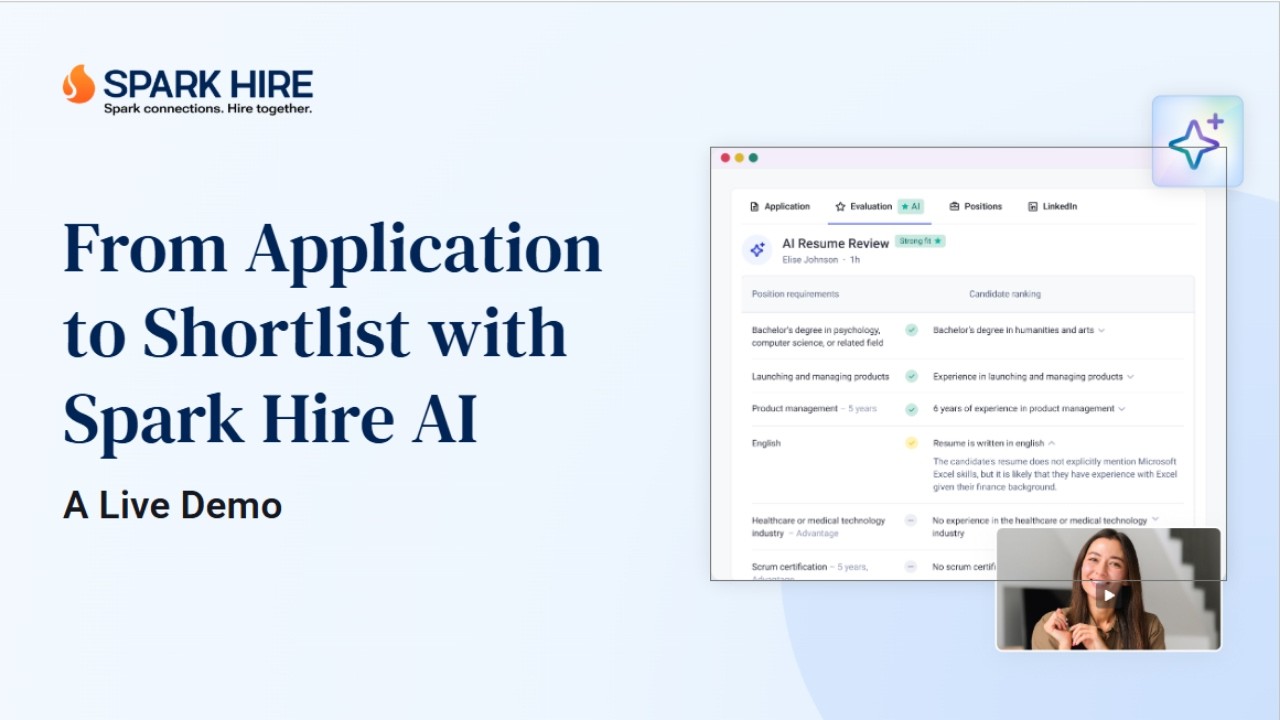
What’s New in Spark Hire: From Application to Shortlist with Spark Hire AI
Sorting applications takes time lean HR and TA teams don't have. Watch Spark Hire AI narrow a stack to a shortlist, while humans still make the call.
Pulling Back the Curtain on Modern SMB Hiring
More applications, more AI resumes, leaner teams. See how Spark Hire's video interviews, AI insights, and ATS work together to help you hire faster.
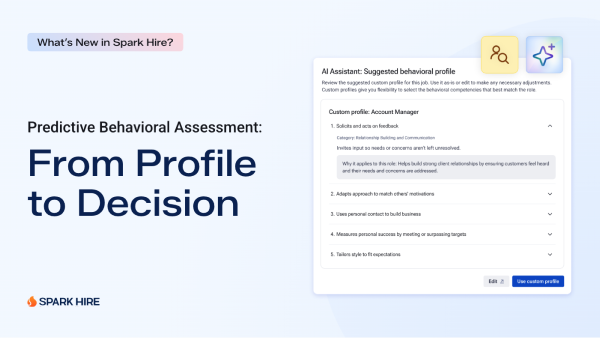
What’s New in Spark Hire: Assess the Behaviors That Predict Success
See Spark Hire’s Predictive Behavioral Assessment in action including the creation of a behavioral profile using AI based on the job description.