While a human resources information system (HRIS) powers the core of an organization’s HR department and people operations function, it’s not built for hiring and recruiting. That’s where an applicant tracking system (ATS) comes into play.
Keep reading to explore the differences between an ATS and HRIS, and why a dedicated applicant tracking system will enable your team to perform recruiting tasks more effectively than an HRIS with a recruiting module, ensuring you meet your recruitment goals and greater business objectives with ease.
Table of contents
Applicant Tracking System vs. HRIS
Key Takeaways
- ATS and HRIS serve different HR purposes. An Applicant Tracking System (ATS) manages the pre-hire process (recruiting, screening, interviews) while a Human Resources Information System (HRIS) handles the post-hire process (payroll, benefits, employee data).
- Making needs-based software selection. A dedicated ATS is often ideal for growing companies with high hiring volume. An HRIS with limited recruiting features might be sufficient for smaller teams that hire infrequently, but it will present challenges as you scale due to its limited recruitment capabilities.
- Seamless HR tech integration is key. To avoid manual work and bottlenecks, search for HR tools and systems that integrate seamlessly with your existing HR tech stack.
What is an ATS?
An ATS, or Applicant Tracking System, is a piece of HR tech used by talent acquisition professionals, recruiters, and those HR team members responsible for hiring within their organization. This type of HR software helps manage the end-to-end recruitment process from sourcing through to the job offer stage, and helps automate and simplify your organization’s recruitment and staffing operations.
With an ATS, busy recruiting and hiring teams can organize and manage candidate information and open positions. Beyond managing candidates and requisitions, applicant tracking systems offer numerous features that aim to accelerate the hiring process.
Some features you can expect in an ATS software include applicant screening and interviewing tools that help busy teams sort through high applicant volumes to more quickly surface the most qualified candidates. Many applicant tracking systems offer customizable workflows so that the system can be easily tailored to suit an organization’s particular hiring process.
Additionally, the top ATSs have robust communication tools and reporting capabilities so that recruiters can centralize all of their activity into one platform.
All of this powerful functionality and resulting automation not only saves time for the recruiter, but it also enhances the candidate experience, proactively providing the candidate with more information about what to expect during the hiring process.
What is an HRIS?
While an HRIS, or Human Resources Information System, is another piece of essential HR technology, the fundamental purpose is very different from that of an applicant tracking system.
HRIS systems are used to track information for current employees, rather than prospective ones. An HRIS system often needs to support the entire HR function, including functions such as employee record-keeping, payroll processing, benefits administration, time tracking, compliance tracking, and more, but its core function is to manage employee data long-term.
Where does an HRIS fit into the HR workflow?
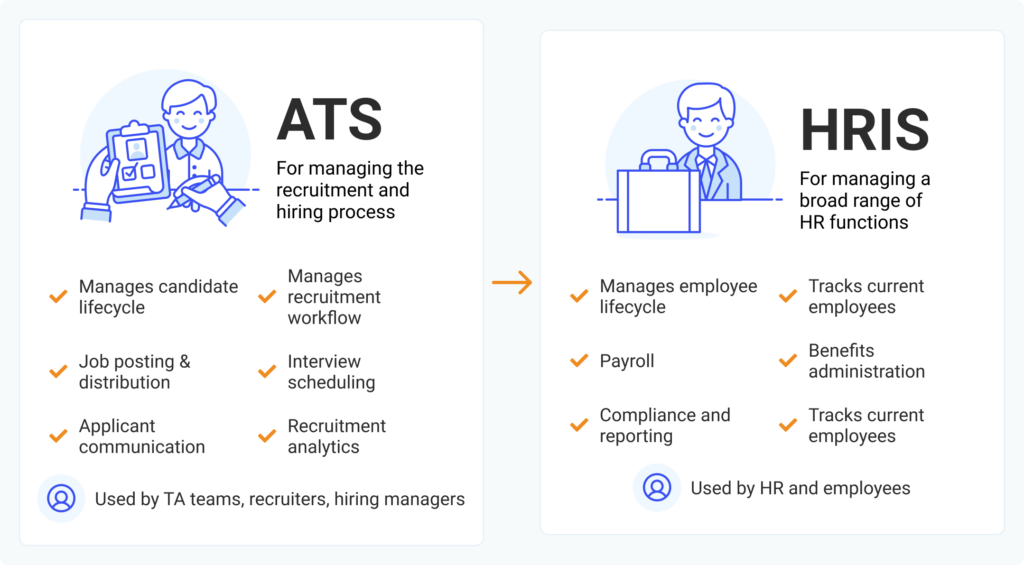
When considering the use cases for an ATS vs HRIS, most organizations find that they have a strong need for both platforms.
- An ATS is a key component of hiring and recruiting, used mainly by talent acquisition teams, recruiters, and hiring managers.
- An HRIS is used mainly by the HR department, but most employees will need to access the platform occasionally to download documentation or manage requests (like time off).
Again, an ATS manages the candidate lifecycle and an HRIS manages the employee lifecycle; the systems are built to serve different purposes (something that is often lost on organizations and the root of their recruitment challenges).
The two systems need to interact only when a candidate is making the transition from candidate to employee.
A Dedicated Applicant Tracking System vs. an HRIS Add-on
As we consider the depth of functionality offered by both applicant tracking systems and HRIS systems, it’s important to note that each piece of HR tech is tailored to different end-users and that tradeoffs inevitably occur when prioritizing an all-in-one system.
Recruiting modules that are added on to an HRIS solution often lack advanced, automated, and customizable functionality that is common in an ATS, including advanced candidate sourcing, applicant search and management, interview scheduling, assessments, and robust reporting for hiring process optimization.
Spark Hire’s ATS: Seamless Integration with HRIS Platforms
One of the key benefits of integrating Spark Hire’s ATS with your chosen HRIS platforms is the ability to seamlessly transfer candidate data from Spark Hire gathered during recruiting into the HRIS for onboarding. This means that when a candidate is hired through Spark Hire, their information is automatically synced with the HRIS, eliminating the need for manual data entry. This not only saves time but also ensures accuracy and reduces the risk of errors.

Learn more about Spark Hire’s partnerships and integrations here.
Implementing Spark Hire’s ATS to Boost Your HR Capabilities
If you’re still relying on a lightweight ATS module in your HRIS, or if you do not yet have any applicant tracking software, Spark Hire’s team of experts is here to help!
Learn how our highly collaborative ATS, Recruit, can help you scale your hiring and deliver powerful insights into your recruitment process. Not only will recruiters feel more empowered to source and organize top talent, but hiring managers will become more engaged in completing tasks and providing feedback that results in better quality hires.
With intuitive and customizable workflows, flexible enough to meet your ever-changing needs, Spark Hire’s ATS is powerful enough to help you grow your organization without overcomplicating hiring for those outside your talent acquisition or HR team.
Ready to Simplify Hiring?
See how Spark Hire’s applicant tracking system helps lean teams stay organized, move faster, and hire with confidence.