When was the last time you really looked under the hood of your hiring process?
If you’re like most HR teams, you’ve been running at full speed all year, filling roles, putting out fires, and trying to keep up with everything from “easy apply” and AI chaos to hiring manager requests that seem to change by the hour.
But what got you through this year might not cut it for next year.
Maybe your time-to-hire has been creeping up, or you’re seeing more candidates drop out mid-process. Perhaps your hiring managers are giving you feedback that something feels “off” about the candidates making it to the final rounds, or your budget is stretched thin from job board fees and recruiting tools that aren’t delivering the results you expected.
The solution? It starts with taking a step back to audit what’s actually happening in your hiring process, not what you think is happening.
An end-of-year hiring audit gives you the chance to look at real data, identify what’s working (and what’s definitely not), and make strategic changes that’ll set you up for success in 2026.

Table of contents
Key Takeaways
- The Problem Often Starts Upstream: Inefficiencies like poor quality of hire or high candidate drop-off often originate in the pre-screening or candidate sourcing stages, not the final interview. Audit your role definition and source ROI first.
- Team Alignment: Hiring is a team sport, but evaluation must be consistent. Assemble an audit team, use standardized scorecards, and ensure all stakeholders — from HR to hiring managers — use the same criteria to reduce bias.
- Quantify Your Pain: Don’t just identify problems; track the cost to make a quantifiable case for change. Use metrics like cost-per-hire by source, conversion rates between hiring stages, and the time from final interview to offer to turn qualitative frustrations into a compelling business case to your leadership team.
- Plan for Immediate and Long-Term Fixes: After the recruitment audit, divide your findings into quick 30-day wins (cleaner job descriptions, simple interview scorecards) and strategic long-term fixes (building talent pipelines, developing role-specific interview guides).
Pre-Audit To-Do List
Before you start diving into spreadsheets and pulling reports, you need to get clear on what you’re actually trying to accomplish with this audit.
Set Goals
Start by setting goals for this audit. It’s best to start with the hiring trends you’re noticing throughout your organization.
Perhaps you’re trying to speed things up because your time-to-hire is dragging and you’re losing good candidates to faster competitors.
Or maybe you’re seeing too many new hires struggle in their first 90 days, causing you to look at the quality of hires or the quality of the onboarding process (or both).
No matter what you notice, be specific about your goals. “Make hiring better” won’t be all that helpful for you (or your leadership). “Reduce time-to-hire by 25% while maintaining quality of hire scores above 4.0″ gives you something concrete to work toward.
Determine Your Baseline
Next, define your baseline.
What time period are you analyzing? We find it’s best to look at the last 12 months to get a full picture, but you might also want to break it down by quarters to spot trends. For example, did your process slow down during the busy season? Did quality dip when you were hiring for multiple roles at once?
If you made any major changes to your process this year — like implementing new hiring technology or changing your interview structure — note when those happened. You’ll want to see if they had the impact you expected.
Assemble Your Team
Finally, gather your audit team. As we’ve said before, hiring is a team sport, and to audit your process, you’ll need your A-team, including:
- Hiring managers who work with candidates you send their way
- Recent hires who can speak to the candidate experience
- Leadership who can share strategic priorities for next year
- Your HR team, who knows the day-to-day reality of managing the process
You don’t need everyone in every meeting, but make sure you’re getting diverse perspectives on what’s working and what’s not.
For a true hiring process audit, you need to actually walk through your entire hiring process step by step — that starts with finding your people.
Here’s a great example of how to do this well, courtesy of our recent interview with Fusion92 Associate Director of Talent and Experience, Justin Elliott:
How To Audit Your Pre-Hiring Process
Before you even think about posting a job or reaching out to candidates, there’s critical groundwork that determines whether your entire hiring effort will succeed or struggle. This pre-hiring phase is where many teams unknowingly set themselves up for frustration down the line.
What to Audit
Start by examining how you approach role development and budget alignment. When a hiring request comes in, do you have a clear process for defining what success looks like in the role, or are you jumping straight into writing job descriptions? Are hiring managers, HR, and leadership all aligned on the seniority level, compensation range, and strategic importance of the position before you start looking for candidates?
Look closely at how you identify and document core competencies for each role. Do you have a consistent way of determining which skills are must-haves versus nice-to-haves? Are you clear about the behavioral traits and cultural elements that predict success in your specific environment, or are you relying on generic job requirements that could apply to any company?
Examine your job descriptions and hiring trajectories. Are your job postings actually attracting the right candidates, or are they so vague (or so specific) that qualified people either don’t apply or get scared off? Do you have a standard interview and assessment process for different types of roles, or are you reinventing the wheel every time? For example, your approach to hiring senior leadership should look very different from filling evergreen roles, but many teams use the same process for everything.
🚩 Red Flags To Watch Out For:
- Frequent misalignment between what hiring managers expect and what candidates deliver, often indicating unclear role definition upfront
- Job descriptions that are either too generic (“dynamic team player wanted”) or too restrictive (15+ requirements that eliminate 95% of candidates)
- Inconsistent hiring processes where similar roles get completely different treatment depending on who’s managing the search
- Budget surprises or compensation discussions happening late in the process instead of being locked down before you start
Next Steps
After you’ve conducted your audit, prioritize foundational fixes that will improve everything downstream.
In the next 30 days, you might create simple templates for role planning conversations with hiring managers, develop a standard process for identifying and ranking core competencies for any position, and audit your current job descriptions to make sure they’re clear, specific, and actually reflect what success looks like.
Strategic long-term improvements could involve building hiring playbooks for different role types (leadership, evergreen positions, specialized roles) that standardize your approach while allowing for customization, developing better collaboration processes between HR and hiring managers for role definition, and creating systems to capture and reuse insights about what actually predicts success in different positions at your company.
How To Audit Your Sourcing Process
Your sourcing strategy is the foundation of everything that comes after. If you’re not attracting the right candidates in the first place, no amount of screening magic can fix that downstream.
What to Audit
Start by mapping out your actual sourcing process.
Do you have a consistent approach for different role types, or are you winging it every time? For example, your strategy for filling evergreen roles, such as nurses or consultants, should probably differ from how you approach senior leadership searches. Yet many teams use the same approach for everything, which explains why some hires feel like a perfect fit while others struggle from day one.
Next, dig into the numbers that actually matter. Look at your source breakdown to see where applications are really coming from, then calculate application-to-hire ratios by source. This is where things get interesting — you might discover that LinkedIn brings in 200 applications but only results in 2 hires, while your employee referral program generates 20 applications and 8 hires. Don’t forget to track quality by source, meaning which channels produce people who are still thriving in their roles a year later.
Finally, get honest about what you’re actually spending. Add up job board fees, recruiter costs, employee referral bonuses, and—this is the part most people miss—your team’s time. If your HR coordinator is spending 10 hours a week manually posting jobs to different boards, that’s a real cost that should factor into your ROI calculations.
🚩 Red Flags To Watch Out For:
- Watch out for over-reliance on one source — if 70% or more of your hires come from one channel, you’re vulnerable.
- High application volume with low conversion is another warning sign, often indicating your job descriptions aren’t clear enough or you’re posting on the wrong boards.
- And if your cost-per-hire keeps climbing while your hiring volume stays flat, something needs to change.
Next Steps
After you’ve conducted your audit, you’ll want to make a plan based on the findings. Try to split them up into short-term and long-term fixes.
For example, in the next 30 days, you might suggest cleaning up your job descriptions to be more specific about what you actually need, set up proper source tracking in your ATS if you’re not already doing it, and survey recent hires about how they found you.
The bigger strategic moves take more time but have a lasting impact, like building an employee referral program people actually want to participate in, developing relationships with relevant schools or certification programs, and creating talent pipelines for the roles you’re always hiring for.

How To Audit Your Screening Process
Screening is your chance to separate genuinely qualified candidates from the pile of applications that look good at first glance but don’t actually fit what you need.
What to Audit
Start by examining your actual screening process.
Do you have consistent criteria for what moves someone from “application received” to “phone screen” to “interview”? Or are different team members using different standards, creating an inconsistent experience that might let great candidates slip through while advancing people who aren’t actually qualified?
Look closely at your screening stages and conversion rates. How many applicants make it to phone screens, and how many of those advance to interviews? If you’re seeing huge drop-offs at certain stages, that’s telling you something important about either your process or your candidate pool. For instance, if 80% of candidates fail your initial screening questions, those questions might be too restrictive — or your job descriptions might be attracting the wrong people.
Don’t forget about the tools you’re using and who’s doing the work. Are you relying on manual resume reviews that eat up hours of your team’s time? Do you have screening questions that actually filter for what matters, or are you asking generic questions that don’t predict success?
And critically, who’s making these early screening decisions, and are they equipped with the right information to make good calls?
🚩 Red Flags To Watch Out For:
- If it takes your team more than a few minutes to review each application, your process is probably too manual
- Conversion rates that are way off industry benchmarks (either too high or too low) suggest your screening criteria need adjustment
- Hiring managers consistently saying “these candidates aren’t what I was looking for” means there’s a disconnect between your screening and their actual needs
- High candidate drop-off rates after initial screens often indicate unclear expectations or a frustrating process
Next Steps
After you’ve conducted your audit, split your findings into short-term and long-term fixes.
Quick 30-day improvements might include adding specific screening questions that actually predict success in the role, setting up one-way video interviews to better assess communication skills and cultural fit, and creating simple scorecards so everyone on your team is evaluating candidates consistently.
Longer-term strategic changes could involve implementing talent assessment tools to objectively measure job-relevant skills and behaviors, building structured interview guides for each role type, and training your team on how to spot the difference between someone who looks good on paper and someone who will actually thrive in your environment.
How To Audit Your Selection Process
Selection is your final chance to make sure you’re choosing candidates who won’t just do the job, but will excel in your specific environment.
What to Audit
Start by mapping out your actual selection process from first interview to offer.
How many interview rounds do you typically have, and what’s the purpose of each one? Are you asking different questions that build on each other, or are multiple people essentially conducting the same interview? Many teams accidentally create a repetitive process that frustrates candidates without gathering better information.
Look at your decision-making process and timelines. How long does it typically take to move from final interview to offer, and where do delays happen? Are you losing good candidates because your process drags on, or are you making rushed decisions because there’s pressure to fill roles quickly?
Track your offer acceptance rates, too — if candidates are frequently turning you down at the end, something in your selection process isn’t setting proper expectations.
Pay attention to who’s involved and how they’re evaluating candidates. Are hiring managers, team members, and HR all using the same criteria, or is everyone looking for different things? Do you have a way to gather and synthesize feedback from multiple interviewers, or does the decision come down to whoever spoke loudest in the debrief meeting?
🚩 Red Flags To Watch Out For:
- Decision timelines that stretch beyond a week after final interviews—top candidates won’t wait around
- Low offer acceptance rates (below 80-85%) suggest candidates are getting surprised by something at the offer stage
- Inconsistent feedback from interviewers often means you don’t have clear evaluation criteria
- New hires frequently struggling in their first 90 days indicates your selection process isn’t predicting actual job success
Next Steps
After you’ve conducted your audit, organize your improvements into immediate and strategic changes.
In the next 30 days, you might create standardized interview scorecards so everyone evaluates candidates on the same criteria, establish clear timelines for decision-making and stick to them, and set up a simple system for collecting and comparing feedback from all interviewers.
Strategic long-term improvements could include developing role-specific interview guides that actually test for success factors, implementing structured decision-making processes that prevent bias and groupthink, and creating better feedback loops with hiring managers to understand which selection criteria actually predict long-term success in each role.
How To Audit Your Onboarding Process
A strong onboarding process can turn a good hire into a great long-term employee, while a weak one can send even your best candidates looking for the exit.
What to Audit
Start by examining what actually happens in those crucial first 90 days. Do you have a structured onboarding plan, or are new hires basically figuring it out as they go?
Map out the experience from offer acceptance through their first few months—who do they meet, what training do they receive, and how are they being set up for success in their specific role?
Look at your early retention numbers and new hire feedback. How many people are leaving within their first year, and what reasons are they giving? Are new hires feeling overwhelmed, underprepared, or disconnected from the team?
Track time-to-productivity metrics as well. How long does it typically take for new employees to become fully effective in their roles, and does this vary significantly between hires?
Pay attention to who’s responsible for what during onboarding. Is it all on the hiring manager’s shoulders, or do you have HR support, peer mentors, and clear handoffs between different team members? Are new hires getting mixed messages about priorities, processes, or company culture because different people are telling them different things?
🚩 Red Flags To Watch Out For:
- Early employee turnover rates above 15-20% in the first year suggest onboarding issues, not just bad hiring decisions
- New hires taking significantly longer than expected to become productive often indicate insufficient support or unclear expectations
- Feedback about feeling “thrown into the deep end” or “not knowing what success looks like” points to gaps in your process
- High variation in onboarding experiences between different managers or departments creates inconsistent results
Next Steps
After you’ve conducted your audit, focus on changes that will have an immediate impact alongside longer-term culture shifts.
Quick 30-day improvements might include creating simple onboarding checklists for managers to ensure nothing falls through the cracks, scheduling regular check-ins at the 30, 60, and 90-day marks to catch issues early, and gathering feedback from recent hires about what would have made their transition smoother.
Strategic long-term changes could involve developing role-specific onboarding paths that align with how people actually learn and contribute in different positions, training managers on how to be effective onboarding partners rather than just delegating tasks, and creating systems to measure and improve time-to-productivity across different roles and departments.
From Audit To Optimization
You’ve done something most HR teams never do: taken an honest look at your hiring process.
Now prioritize changes by impact—start with quick wins you can implement in 30 days, then plan strategic improvements that transform how hiring works.
Remember, the right hiring technology can be instrumental in turning audit insights into lasting improvements. Tools like collaboration-enabled ATS platforms and video interview software don’t just automate tasks — they provide the data and efficiency you need to sustain better hiring practices long-term.
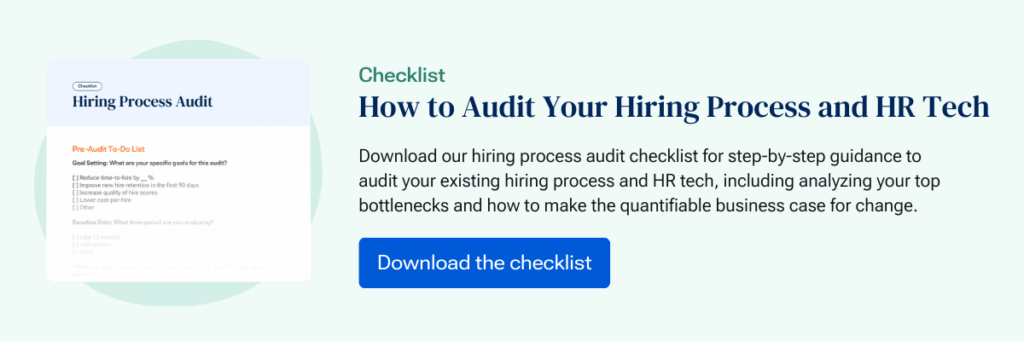
Download our free Hiring Process Audit Checklist to get started.