Your Guide to Reduce Candidate Cheating, Fraud, and Hiring Bias with HR Technology

Read the Guide

Introduction

The headlines aren’t pretty.

  • “How Leaders Are Getting Played by The ‘Dark Side’ of HR Tech”
  • “What HR Leaders Can Do About Candidates Using ChatGPT To Cheat “
  • “How Candidates Use AI To Cheat in Assessments”

Yikes.

With this rhetoric, it’s no wonder 65% of hiring managers are freaking out about candidates using AI to cheat their way onto their teams. 

But that same report found that only 15% of early-career professionals reported that they’d use AI tools in the assessment phase.

There’s an obvious disconnect at play. 

What can people teams do about it? 

A few things, really:

  • Implement strong internal controls (solid screening and selection process, actively mitigate hiring bias)
  • Adopt and administer specific AI usage policies 
  • Use the right HR technology that lets you truly assess a candidate’s strengths and weaknesses

Let’s get into it.

Key Takeaways

  • Focus on assessment philosophy, not just tools: The most cheat-resistant evaluations eliminate right/wrong answers in favor of behavioral assessments that reveal how candidates approach real workplace situations.
  • Structure reduces bias more than intuition: Standardized processes with consistent questions, clear evaluation criteria, and technology-assisted interviews create fairer outcomes than unstructured, gut-feeling-based decisions.
  • Transparency builds trust on both sides: Set clear AI usage guidelines for candidates while being open about your own AI applications — mutual honesty creates better engagement throughout the hiring process.
  • Audit and improve continuously: Regularly review your hiring technology for potential bias, track key metrics to measure effectiveness, and ensure your tools enhance human judgment rather than replace it.
Part 1:

How Candidates Can Cheat In The Job Search Process

We’re no longer in the ‘looking over someone’s shoulder’ or ‘sneaking notes via a waterbottle’ era of cheating.

We’re in the AI era of cheating. 

And this can manifest in several ways. 

Exaggerating Work Experience 

The most common form of candidate fraud happens before they even walk through your door — embellished resumes and fabricated cover letters (a big AI don’t for candidates

This might look like inflating job titles (e.g., turning “Marketing Assistant” into “Marketing Manager”), adding responsibilities they never had, or claiming experience with tools and technologies they’ve barely used.

With AI writing tools, candidates can now craft compelling narratives around experiences they never actually had, making these exaggerations harder to spot on paper.

To screen for exaggerated or falsified work experience, dig deeper during interviews with specific, situational questions such as:

  • “Walk me through how you used [specific software] to solve a problem.”
  • “Describe the team structure you managed and how you handled conflicts.”

Ask for concrete examples, timelines, and outcomes.

Vague responses, inability to provide specifics, or answers that sound overly polished compared to their conversational style are red flags. 🚩🚩🚩

Reference checks remain valuable for verification, but one-way video interviews can be particularly effective here, allowing you to assess communication skills while asking follow-up questions about claimed experiences. 

When candidates have to explain their background in their own words, on camera, inconsistencies become much more apparent than they would on a resume or within a standard application.

Gaming Skills Tests

Skills tests are tricky. 

Given the nature of the tests themselves — having a right and a wrong answer — it’s getting easier for people to game the system. 

(And that doesn’t just mean using AI.)

We were talking to a hiring expert about this, and she mentioned that she’d heard a story about a candidate pulling up the test, hopping on Zoom, sharing their screen, and having their friend in the other room text the answers.

This is just one example of a “creative” way candidates can be dishonest in skills tests. 

Now, does that mean skills tests are bad? No. 

Does it mean skills tests aren’t useful? Also no.

The two questions you need to ask yourself here are:

  • What are we trying to evaluate this candidate on with this experience?
  • What’s the best vehicle for getting the most accurate, helpful, and authentic outcome?

This is where your assessment philosophy matters. 

It’s not just about whether or not you use a skills test, but so much more about the philosophical engine that makes it run.

Falsifying Reference Checks

We’ve all heard the stories: roommates posing as ‘previous managers’, siblings claiming to be coworkers, or best friends verifying specific career experiences.

Reference checks are infamous for being faked in the past, giving them a sour reputation in the industry. 

But with today’s technology, high-quality reference checks are making a comeback. 

To help avoid this, you should:

  • Cross-reference information with LinkedIn profiles to verify employment history, reporting relationships, and timeline consistency. 
  • Ask specific, tailored questions that only a real supervisor would know: “What specific projects did [candidate] lead?” or “How did they handle tough market shifts like AI or budget cuts?” Generic responses or hesitation around details should raise immediate red flags.

Technology can also provide safeguards here. 

For instance, Spark Hire’s automated reference check system tracks and cross-references IP addresses between who requests the reference and who submits it. 

List of requested and completed references

If the same IP address is used for both the request and the response, that’s flagged as a potential inconsistency, indicating the candidate might be filling out their own references.

While these technical measures aren’t foolproof, they add an important layer of verification that helps maintain the integrity of your reference check process.

Friend That Cooks Case Study
Part 2:

Practical Ways Hiring Teams Can Reduce Candidate Cheating and Fraud

We’ve touched on this briefly, but there are a number of things employers can do to mitigate cheating and fraud from candidates throughout their hiring experience.

Establish AI Usage Guidelines

The key to managing AI in your hiring process isn’t to ban it outright — it’s to set clear, fair expectations for everyone involved.

Start by creating specific guidelines about what candidates can and can’t use AI for. For example, you might allow AI assistance for initial brainstorming or grammar checking in cover letters, but prohibit it for completing assessments or crafting answers to specific interview questions. The goal is transparency, not prohibition.

Consider implementing what some organizations call an “honesty contract.” It’s a simple acknowledgment where candidates confirm they understand your AI usage guidelines and agree to follow them.

While this won’t stop every instance of misuse, research shows that when people explicitly commit to honesty upfront, they’re more likely to follow through. One study found that when candidates had to sign a contract like this before an assessment, their likelihood of using assistance like AI or family/friends dropped from 28% to 13%.

But here’s the important part: if you’re setting AI rules for candidates, you need to be transparent about how you’re using AI too.

Fair is fair.

Let candidates know if you’re using AI for resume screening, assessment scoring, or other parts of your process. This transparency builds trust and shows you’re committed to an ethical approach on both sides.

The most effective AI policies establish mutual respect and clear expectations that help both parties engage authentically throughout the hiring process.

Use One-Way Video Interviews 

One-way video interviews naturally reduce the incentive to cheat because there’s no “right” answer. 

Unlike skills tests with clear correct responses, these interviews ask candidates to share insights, provide context, and draw from real-world experiences  —  things that can’t be easily faked or outsourced.

The reality is that nothing can completely prevent someone from lying. Someone could just as easily fabricate experiences in a face-to-face interview. But one-way video interviews actually make inconsistencies more apparent because candidates have to articulate their background and reasoning in their own words, on camera, without the benefit of real-time coaching.

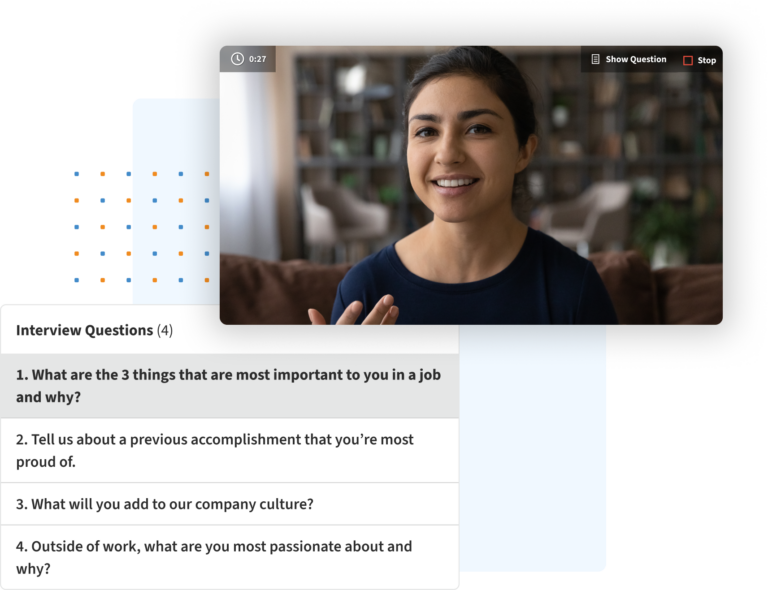
One-Way Interview Recording and Question Set

From the candidate’s perspective, this isn’t a test to pass. It’s an opportunity to expand on their real-world experience and showcase what they’d bring to your organization. 

When the focus shifts from testing knowledge to understanding experience and approach, cheating becomes less relevant, and authentic evaluation becomes much more valuable.

Implement Additional Talent Assessments

One thing we’ve found really helpful is to assess a candidate based on behavioral criteria that will set them up for success in a particular role, level, and organization. In other words, a talent assessment, such as Spark Hire’s Predictive Talent Assessment.

Talent assessments are vastly different from other skills or personality tests as they focus on how a candidate is likely to perform specific job tasks or competencies in a specific environment. 

And they’re a lot harder to “game”. 

By eliminating the right/wrong dichotomy, you don’t give people the option to cheat because there isn’t one gold-star response. 

Plus, with a behavioral talent assessment like ours, the candidates don’t know the yardstick they are being measured against. They don’t know what the employer has marked as a key skill or competency, further reducing the incentive to lie their way through it. 

This shift from testing arbitrary knowledge to understanding specific behavior as it relates to your job posting creates a more cheat-resistant and genuinely predictive evaluation method.

It’s also super important to take a step back here and remember that not all candidates use these sorts of methods in the screening and selection process. 

You don’t want to assume that people are or will cheat. Instead, you want to establish the right safeguards and guardrails that help you identify the best candidate for your open position. 

Explore Meet's Predictive Talent Assessment
Part 3:

How Employers Can Take Accountability and Reduce the Potential for Hiring Bias

The conversation we’re having isn’t just about how to prevent candidates from cheating — it’s also about how employers can establish fair, ethical, and unbiased hiring practices that help them get top talent faster.

Here are four steps you can take to build a fairer hiring process.

Build A Structured Hiring Process

A strong hiring process is a strategic, repeatable system that connects your hiring decisions directly to business outcomes.

At its core, an effective hiring process has three key phases: source, select, and onboard. But what makes it truly powerful is that each phase is built on a foundation of clear goals, defined priorities, measurable business impact, and specific culture needs.

This means starting every hire with fundamental questions: 

  • What problems will this role solve? 
  • What value will this person bring in their first 90 days and beyond? 
  • Which skills are absolutely essential versus nice-to-have? 

When you have concrete answers, every subsequent decision becomes more focused and objective.

Why does this structured approach matter so much?

First, it creates standardization that naturally reduces bias. When every candidate goes through the same evaluation process with the same criteria, personal preferences have less room to influence decisions. 

Second, it becomes data-driven rather than gut-feeling driven, giving you measurable insights into what’s working and what isn’t.

This systematic approach also improves collaboration across your hiring team. When everyone understands the goals and evaluation criteria upfront, feedback becomes more constructive and decisions happen faster. 

Most importantly, it creates efficiency without sacrificing quality — you’re not just moving quickly, you’re moving strategically toward the right candidates.

Ask Strategic Interview Questions

The questions you ask — and how you ask them — can make or break your ability to evaluate candidates fairly and effectively.

Structured interviews, where you ask every candidate the same core questions in the same order, are your best defense against bias creeping into the evaluation process. This consistency ensures you’re comparing apples to apples when making hiring decisions, rather than allowing personal chemistry or random conversation topics to influence your judgment.

Consider how traditional, unstructured interviews actually amplify bias. When conversations meander based on rapport or shared interests, you end up learning more about candidates who remind you of yourself while potentially overlooking qualified individuals who don’t immediately click with your personality. 

Research shows that unstructured interviews have lower predictive validity and higher susceptibility to confirmation bias — where interviewers unconsciously seek information that supports their initial impressions.

Technology-assisted processes solve this problem by providing structure without sacrificing insight. One-way video interviews, for example, ensure every candidate answers the same behavioral questions, giving you consistent data points to evaluate. You can still assess communication style and cultural fit, but within a framework that treats everyone equally.

Strategic Interview Questions to Ask CTA

Screen For The Right Candidate Qualities

Before you can find the right person, you need to know exactly what “right” looks like for your specific role and organization.

This goes beyond the typical job description checklist of skills and experience. You need to understand the behavioral competencies that actually predict success in your environment. 

  • Will this person need to influence without authority? 
  • Handle ambiguous situations with confidence? 
  • Collaborate across departments with different priorities? 

These nuanced traits often matter more than technical qualifications in determining long-term success and overall job fit.

Traditional screening methods struggle here because they focus on what candidates have done rather than how they’re likely to approach new challenges. A resume might show impressive accomplishments, but it won’t tell you if someone thrives under pressure or naturally builds consensus among team members.

This is where predictive talent assessments become invaluable. You’re not just screening for generic leadership or communication skills. You’re identifying candidates whose behavioral tendencies align with your specific role requirements and organizational culture. This targeted approach helps you move beyond gut feelings and surface-level qualifications to find people who will genuinely excel in your environment.

Use AI Ethically

If you’re setting AI guidelines for candidates, you need to hold yourself to the same standard. Start by auditing your current AI applications. Are you using it for resume screening? Assessment scoring? Candidate communication? Document each use case and evaluate whether it’s enhancing fairness or potentially introducing bias. AI tools trained on historical hiring data can perpetuate past discrimination patterns, so regular auditing isn’t just good practice — it’s essential.

  • Where AI works well: Automating administrative tasks like scheduling, sending follow-up communications, or parsing resume data for initial screening. These applications save time while maintaining consistency across all candidates.
  • Where to proceed with caution: Using AI for final hiring decisions or complex evaluations without human oversight. AI should augment human judgment, not replace it, especially when assessing cultural fit or leadership potential.

In a similar vein, you’ll also want to consider your AI boundaries for candidates in your hiring process.  We’d encourage you to have an open mind here.  

Take video interviews, for example.  

If a candidate uses AI to help organize their thoughts or make their responses more concise, does that fundamentally change your ability to evaluate them? You’re still: 

  • Seeing them speak
  • Hearing their explanations in real-time
  • Getting authentic insights into how they approach workplace situations.
Spark Hire AI CTA

The Right HR Technology Helps You Hire The Right Candidates, The Right Way

When implemented thoughtfully, HR technology doesn’t create bias or enable fraud — it solves these fundamental industry-wide challenges. 

By combining structured processes, transparent guidelines, and ethical AI usage, you can build a hiring system that’s both efficient and fair. The key is choosing hiring software that enhances human judgment rather than replacing it, creating better outcomes for candidates and employers alike.

Ready to hire the right people the right way? Book a demo to discover our approach to ethical, bias-reducing hiring technology.

Suggested Guides

ATS Guide

The Guide to Finding The Right Applicant Tracking System for Your Company

The Complete Guide to the Candidate Experience Featured Image

The Modern Guide To Building A Better Candidate Experience

AI in Hiring Guide

The Employer’s Go-To Guide to AI In Hiring

Get started with Spark Hire

Get Started with Spark Hire

Smarter Hiring Starts Here

No matter where you are on your journey to building a better hiring process, Spark Hire's team of experts is here to help!