
Compete for Talent by Focusing on What You Can Control
June 2, 2026
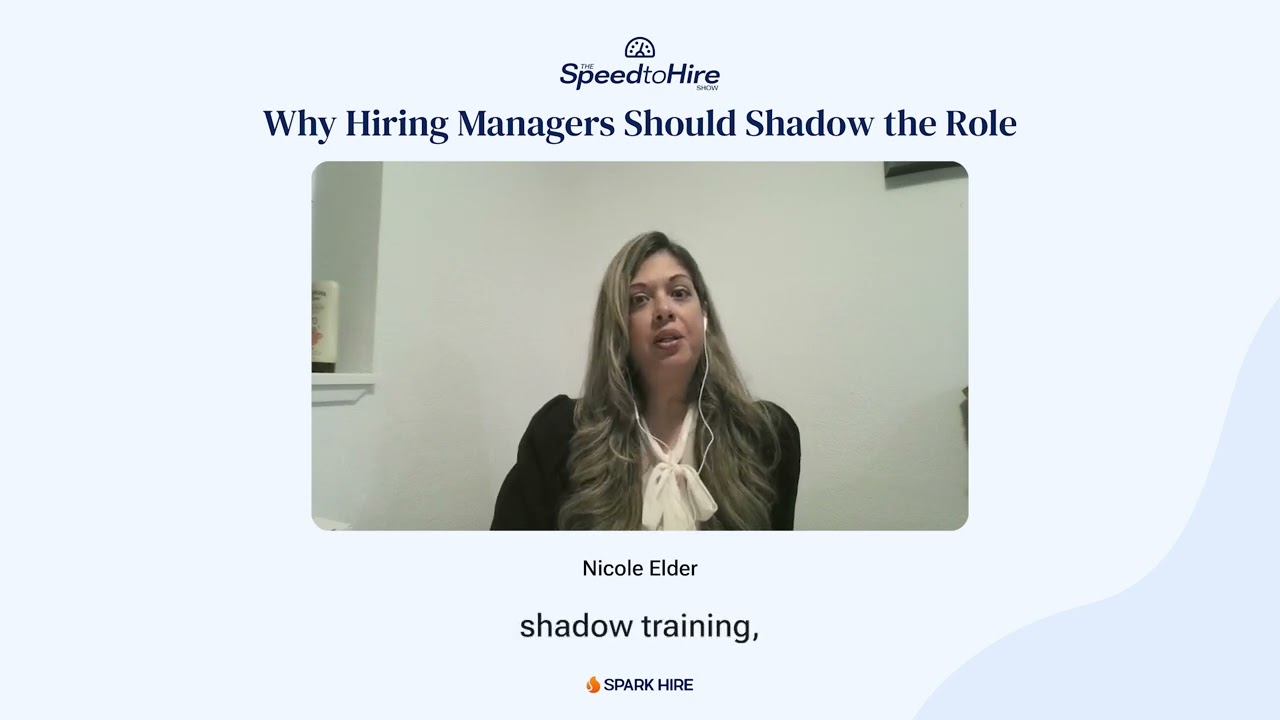
When pay can't be your edge, speed and structure have to be. Hear Nicole Elder of East Bay Innovations on improving hiring without a bigger budget.
Hiring doesn’t improve by doing more.
It improves by doing the right things — better.
When you can’t compete on compensation, every part of your hiring process matters more. Speed, structure, and transparency aren’t nice-to-haves — they’re how you compete.
In this episode, Josh Tolan (CEO of Spark Hire) sits down with Nicole Elder, Director of Human Resources at East Bay Innovations, to break down how her team improved hiring outcomes by focusing on what they could control.
From restructuring the process to rethinking outdated rules, Nicole shares how small, intentional changes created faster hiring, better candidate alignment, and stronger long-term retention.
They discuss:
• Why speed matters more when you can’t win on pay
• How “day in the life” videos help candidates self-select
• Where hiring processes slow down — and how to fix it
• Why outdated rules can eliminate great candidates
• How training hiring managers improves decision-making
• Why hiring for teachability leads to better long-term outcomes
• How to design hiring from the candidate’s perspective
You don’t need a bigger budget to improve hiring.
You need a better process.
Key Takeaways:
- [13:26] You Can’t Always Win on Pay — But You Can Win on Speed
- [14:58] Show Candidates the Job Before They Say Yes
- [15:50] The Real Bottleneck in Hiring
- [18:02] Rethinking Outdated Hiring Rules
- [20:10] Train Hiring Managers to Make Better Decisions
- [29:48] Hire for Teachability, Not Just Experience
- [32:00] Why Shadowing Improves Hiring Decisions
- [33:38] Hiring Is About Decision Confidence
- [36:05] Every Step of Hiring Is a First Impression
- [38:58] Design Hiring from the Candidate’s Perspective
JOSH TOLAN: Well, Nicole, welcome to the podcast. Super pumped to have you on after our conversation leading up to this. know all of our guests are going to learn a lot from you. To get things started, it’d be great if you just provide a little background about yourself and how you got into the role you’re in today.
NICOLE ELDER: Okay, I’m Nicole Elder. am the Director of Human Resources for East Bay Innovations. We are a nonprofit in the East Bay that supports adults with developmental disabilities to live independently. I honestly didn’t know organizations like ours existed. I was researching when I was looking for employment when I moved down to the East Bay. and found this wonderful organization. I’ve been with East Bay Innovations for going on five years now. So I’m quite pleased to have found such a wonderful place.
JOSH TOLAN: Yeah, that’s great. And how big is the organization from an employee standpoint?
NICOLE ELDER: 300 plus employees.
JOSH TOLAN: Wow, okay. And when you started, if I recall correctly from our initial conversation, you started in pretty much like a recruiter role and now you’re in a director of human resources position. So what has been that transition like for you?
NICOLE ELDER: It’s been a interesting transition. think it’s, I like that I’m able to have a perspective from all facets of human resources, starting with recruiting. It allows me to kind of identify the processes that were not working and what was working. And then once I, I think I was in, the role of hiring manager for the largest department for about a year. After that, I transitioned to the assistant director of recruiting and training. I think I was in that role for about seven months. And then I transitioned into my current role, which is the director of human resources.
JOSH TOLAN: Yeah, that’s a great career trajectory at one organization. What does the HR function look like today besides you, or are you the HR function of one?
NICOLE ELDER: No, so when I started, there was two hiring managers and assistant director of recruiting and training. So there was three. Currently, we have two hiring managers, assistant director of training and recruiting, director of human resources, and a compliance coordinator. So we are a team of five now.
JOSH TOLAN: Okay, great. And with all that team that you’ve got structured, it’s great that you’ve got several people dedicated to recruiting. What does recruiting look like at East Bay Innovations today in terms of types of positions you’re recruiting for, volume of positions, I guess just general lay of the land?
NICOLE ELDER: Yeah, so we have six different departments that we recruit for. are we have anything from supported living where we would have staff that come in and support clients with daily needs, anything from personal care to overnight staff. We have job coaches that go out to the client site and support them to be successful in their jobs. We have independent living instructors that help with different things like budgets. We also have a transition care and case management department that supports the unhealth population transition from skilled nursing facilities to their own homes.
JOSH TOLAN: All right, so lots of variety in the types of roles that you guys are hiring for. Being such a mission-driven organization, are there certain core principles or values that you instill in the hiring process? Is there specific things that you’re looking for across all of those roles that make somebody a good fit at the organization?
NICOLE ELDER: Yeah, I would say you definitely have to be passionate about humans and supporting people, right? Human services is not an easy role. It’s very taxing work. It’s a lot of empathy that you’re putting out. So I would say you have to be mission driven. You’re not going to take this role for a paycheck because nonprofits don’t pay the highest wages, but you really have to be passionate about. your community and supporting people.
JOSH TOLAN: Yep, that’s great. So tell me about when you first joined the organization, like what did you inherit? What did you come into? I know from our initial conversation, some discussion around staffing shortages. So just, you know, give me the lay of the land in terms of challenges that you were facing when you were brought on board.
NICOLE ELDER: Yeah, so we it was 2022. So we were coming out of the COVID crisis, you know, we were very short staffed, we were in a staffing shortage. The, you know, so we were not receiving quality candidates, but we also were paying a lot in recruiting costs. So we had high recruiting costs, and we did not have a significant amount of candidates coming through the pipeline. I think there are a couple reasons for that. One would be nonprofit wages are not the highest and we live in a really expensive area of California. The Bay Area’s cost of living is extremely high. So we were getting lower quality candidates because those were the candidates that were interested in pretty much any role. which, you know, like I said, this is not a job that you are going to come and work for just a paycheck. You really have to care about the services and what we do.
JOSH TOLAN: Yep. so overall in term, obviously maybe there was some compensation misalignment. I’m also assuming there was just more increased competition generally with the types of candidates and the positions that you were trying to fill and everything else that was going on in healthcare, healthcare adjacent spaces. So I imagine you were competing for a lot of talent there, which made things challenging as well from a process standpoint. I know you mentioned you guys were spending a lot and not receiving the quality of candidates or maybe even the volume of candidates you were hoping for. What were some of the things from a process standpoint that you saw that maybe weren’t working or needed to be addressed?
NICOLE ELDER: Yeah, I think that coming in, you know, we didn’t have a lot of structure in our processes. I think that we were doing things the same way for like decades. And so coming in with like a fresh set of eyes, I could see that, you know, there was a lot of inequities in our process from reference checks. The timeliness was not on our side, I think that’s one of the biggest things in any hiring process is having a timely process, but not for us working with, you know, vulnerable populations, are vetting process could not change, you know, we had to keep the integrity of the process, but make it more timely. So I would say, you know, the timeliness, the reference checks were taking a lot of time. So I think coming in, I knew we need to speed up our process without sacrificing the integrity of it as well.
JOSH TOLAN: Yeah, and that’s like the most common dilemma I feel like in talent acquisition is we need to move faster, but we don’t want to cut corners and we only have so much capacity. So what can we do about it? and that’s where process or tools or all these different tactics can come into play. but I think to your point, it really starts with, process. and, and so you mentioned speed being, you know, a big factor for you, not only because you felt like it was moving too slow.
NICOLE ELDER: Mm-hmm.
JOSH TOLAN: But how did that impact you in terms of when you were competing for talent with these other employers as we were just talking about a minute ago?
NICOLE ELDER: Yeah, I I noticed we would have people through the pipeline and we were losing them because they accepted other offers, right? And so I think, you know, the most important thing is timeliness and the person, I would say highest wage and then timeliness. You know, if you have the highest wage, that’s probably going to get more quality candidates. But if you’re more timely and you’re able to be transparent about the role in a way that they can make an informed decision is going to be on your side.
JOSH TOLAN: That makes a lot of sense. think especially in a nonprofit or just a smaller organization in general, and you’re competing with companies, especially, let’s say, in the Bay Area, like you mentioned, you’re not going to win on the compensation package. That’s not why somebody is going to join the company. But where you can win is if you can outmaneuver those other employers that would win from a compensation standpoint by, A, delivering a fast process. But in delivering that fast process, making sure it’s a good process for candidates where they can get to a confident decision about joining your organization and feel like they have all the information to make that decision. And I feel like when faced with two opportunities, even if comp isn’t equal, in a lot of cases, candidates will go with the thing that makes them feel more sure and more confident. And a lot of that comes from transparency and communication and the experience that you deliver. throughout the entire process? Is that what you were hoping to solve for? And I guess, like, what have you seen as a result of that?
NICOLE ELDER: Yeah, definitely. think, you know, having implementing some technology that would allow us to speed up the process, creating a day in the life video of the role to kind of showcase what it would the role would actually look like when you’re out there, you know, allows people to make informed decisions. And it also cuts, you know, turnover because people know exactly what they’re getting into before they sign up.
JOSH TOLAN: Great point. It’s not just about winning in terms of getting the candidate to accept an offer. Winning is really long term, right? It’s the employee being successful at the organization and driving value for the organization and the way that the organization had intended when it opened this position in the first place. When you were looking at the process, how did you go about identifying some of the biggest bottlenecks from a speed perspective?
NICOLE ELDER: Yeah.
NICOLE ELDER: Well, I had the opportunity to go, I was a hiring manager at a start. So like I understood exactly how long each step took, right? References were taking longer than every other process, right? Because we are fully vetting people. had some parameters around references that didn’t provide employment pathways or opportunities for more underserved populations because they work for their family and we wouldn’t allow a family member to be a reference check, right? So kind of finding other ways to provide opportunities for people that maybe went from school to help with their family business by allowing professors to be references and opening up more opportunities there. And then also allowing Also, the video screening really freed up a lot of time for us. So we were able to free up the manager’s time to perform more reference checks. And then it also allowed us to see a life video of the person and kind of how they present themselves, which gives you a better opportunity to understand the candidate a little bit better than just phone over the phone.
JOSH TOLAN: Totally, totally. ultimately, by giving the hiring manager that preview, they feel more confident in getting to that face-to-face interview versus just reviewing some notes from a phone screen or something that’s not really as tangible for the hiring manager. certainly, obviously, we’re big believers over here of that and a proponent of video screening in the hiring process. Talk to me a little about reference checks. you mentioned some of the inequities that were created by the process. It sounds like you had, or the organization had some like self-imposed rules about what types of relationships would suit as a viable reference for a candidate. So can you talk a little about, I guess, that in more detail and the challenges that presented with candidates that you were actively engaged with in the process?
NICOLE ELDER: Yeah, I think every process is put into place for a reason, right? And some may be just a little bit antiquated, and we’re not revisiting the process to see if we could improve upon it. So I think working with vulnerable populations, the vetting process is important. It’s a really independent-facing role. It’s just you and the client. So it’s easy to put people, maybe, are not a good fit for the role, right? And so we had a lot of turnover and I think implementing such really strong reference checks were a way to combat getting the right people in the role. But as time went on, there was a way to do it. I think that was a little bit more equitable and a little bit more timely. So being able to find other pathways to… get reference checks for quality candidates that still vetted them but didn’t have the stringent parameters that were currently in the process.
JOSH TOLAN: Yeah. And it makes sense. mean, if I was to think about the rules that sound like they were in place before, intuitively it makes sense to say like, well, we don’t want a family member to be their reference because we want it to be their manager at their previous company. But as you pointed out, well, their manager might have been a family member because they worked for a family business. So at that point, what is the candidate supposed to provide you with? And so if they can’t come up with those references and they therefore they, you know, fall out of the process. You’re potentially losing a great candidate just simply because of a self-imposed rule. And so I think it was wise to reopen that. And I imagine, did you guys have to change maybe the way you were running those reference checks or the types of questions that you would ask depending on the relationship? Or how did you still make sure that you were getting the value out of a reference check but still… like satisfying the organization’s concern of like, well, we don’t want it to be biased because it’s a family.
NICOLE ELDER: Yeah, good question. think, you know, I did a lot of training with the hiring managers. Like I created, I developed and implemented a supervisor interview training. So, you know, it covered bias in the hiring process. It covered, you know, legal things that you can say and you cannot say in an interview, right? All of these areas that I don’t think people really put a lot of thought into when they are hiring. So I felt that it would be really important to skill up my hiring managers so they could make informed decisions and hire more quality candidates. I think when you have a really good team, they’re going to be able to identify if someone’s not a real reference or not, right? I think they have the skill set to know if it’s fake or if it’s not. So I think, and even if they’re kind of on the fence, they would check in with the team. So we would kind of make a team informed decision. So I think it provided them the confidence to make more informed decisions.
JOSH TOLAN: Yeah, and I think a lot of that too just comes down to question design. you’re asking, look, no candidate’s going to give you a reference that they think is going to give them a bad reference. And I think that’s often why people are like, well, reference checks don’t add as much value as you think, because why would somebody say something bad about the person that, you know, believe them to be a good reference? But you’re not looking for somebody to say something good or bad about the person. It’s really about the question design. You want to learn. about how that person worked, what they accomplished. And so it’s about that, like those real world stories that you can draw out through those like behavioral based or situational based questions where you ask the person to draw on real world examples versus leading questions like, you you mentioned empathy being important. Like, would you describe this person as being empathetic? It’s like the reference is going to say, yes, totally. They’re so, they’re so empathetic.
NICOLE ELDER: Right.
JOSH TOLAN: But if you ask questions like, can we evaluate that based on something they did in the workplace, you can shift a question to focus on that. And therefore you’re not asking them that leading question. You’re asking them about a time or a story and they give it to you. And then you can make your evaluation of, did that demonstrate, you know, essentially what we were looking for? Really not that much different than how you would design interview questions when you’re asking a candidate is like avoiding the leading questions, asking open-ended behavioral stuff. to draw on real world experiences. You do the same thing for references and you’ll get a lot of good information. Like I said, you’re not looking for anything good or bad, or you’re not like trying for anything to disqualify a candidate. It’s just another data point that helps validate some of the things that you heard throughout the interview process. And you’re just asking a different point of reference, different perspective on those same things that you’re evaluating through the hiring process.
NICOLE ELDER: Yeah, that’s right. And I think being objective, you’re not going to ask subjective type questions, like the empathy question. And one really good one is, which location did you work at? And what were their job duties? And if the person can’t answer that, then that’s a little bit questionable. Maybe they’re not a reference. But I think one of the most important questions would be, would you rehire this person? I think that’s a telling way to know, you know, like if that employee did, you know, a good job at that workplace.
JOSH TOLAN: Yep, Yeah, I think those are great questions. And yeah, to your point, that’s a great way to validate if they’re a good reference is did they know what the candidate actually did on a day-to-day basis and can they speak to it in a way that aligns with what you heard in the interview process? Personally, I also like to ask things just about development. I think it’s not a way to try and get at like what are the candidate’s weaknesses.
NICOLE ELDER: Right.
JOSH TOLAN: It’s more about like, where do they still have room to grow? But without asking the reference, where do they still have room to grow? So I might ask something like, if you were still managing them, what would be the things you would focus on for their continued development in this position? And they give you a lot of insight there. And they’re not necessarily weaknesses. Like I said, you’re not looking for weaknesses, but it gives you some ideas of like, okay, well, maybe there’s some areas where they still need to grow. Do we have the environment that will support them in these areas? So I think, yeah, like, asking these types of questions can make references really valuable. If you were to think about like going back to the start of the process, so we’re talking about how to make references, you know, in the process more equitable by softening the rules for what a valid reference is. But let’s go back up to the front end of the process. Were you seeing any of that in terms of the requirements for the role? Like I know sometimes we’ll talk to organizations and they’ve got these really strict requirements or this long list of bullet points for a position and some of them when you When you truly ask the hiring manager, we, this really a requirement? Like if they wouldn’t, if they don’t have this, would you not hire them? And they say, no, like it’s okay. If they do this instead, that would be fine. It’s like, okay, well that’s not really a must have requirement. And similar to references that could be eliminating people from the process either because they don’t apply at all when they see the requirements or because as the recruiter, you’re evaluating people against that as strict criteria. When with the hiring manager, it might not be as strict.
JOSH TOLAN: Maybe that wasn’t a great question. guess I didn’t end with a question. I guess that was more of a statement. guess were you, were you, were you? All right, I’ll reset here. So were you seeing any of that in the process, like at the front end of the process that needed to be cleaned up with hiring managers in terms of how you define the position?
NICOLE ELDER: No.
NICOLE ELDER: Yeah, think, know, annually we go through our job descriptions and questions with the department directors to see if there’s anything that is changed or limiting, you know, the role. If there is a role that is a little bit more difficult to recruit for, we have one role that’s a 24 hour emergency cell phone responder and it’s a part time role. It’s it’s not a role that everybody’s gonna want because most people want full-time work. you know, we will work with recruiting platforms and just kind of ask them, you know, to look at our posting. Does it seem like there can be areas that, you know, can increase candidate flow? So we usually will try to work with, you know, wherever we’re posting it or like the department directors or brainstorm as a team. Is there any barriers to this role that can be approved upon?
JOSH TOLAN: Yeah, so it’s like a value. What are the trade-offs? Where do we have flexibility to make sure that we can get a viable candidate pool to make a hire for that position? That makes a lot of sense. It sounds like you’ve got great collaboration with the department managers, different hiring managers throughout the organization. You mentioned the supervisor interview training. What does your cadence look like with people throughout the company that aren’t part of the HR department in terms of whether it’s training them on interviews or updating job descriptions or just talking about best practices that relates to hiring. Like, do you do this just in kickoffs when there is an open position or do you have some cadence throughout the year where you’re continuing that relationship and that open dialogue to make sure when it is time for them to hire a position, like they, it’s not like they’re coming in completely fresh and haven’t talked about hiring in 18 months.
NICOLE ELDER: Yeah, no, I think, you know, I don’t know if it’s lucky or unlucky, but you know, there’s always hiring going on, you know, a department may not be hiring and then two weeks later, they’re hiring. So there’s always kind of a continuous flow of hiring, I would say. But we partner in the hiring interviews. So the hiring interviews will be like someone from recruiting and a supervisor from the department. Prior to that, have all new supervisors go through the supervisor interview training and then we will do a shadow interview and sign them off on it. you know, we implemented it and then now it is agency-wide where everyone’s part of that interview training before they even start interviewing. So we collaborate with the interviews and then at the end, the department directors ultimately make the decision. I think if there’s any concerns that we’re seeing, we’ll definitely talk about it. The concerns, maybe any red flags that we see as potential risks down the line and then they ultimately make the decisions with all the information provided to them.
JOSH TOLAN: Yep. And for the interview training that you do when a new supervisor starts and then you assess them on how well did they comprehend that training? What’s, what are the core focus areas? Like, what are you hoping that they leave that training having a better understanding of?
NICOLE ELDER: I, you know, checking their bias at the door, ensuring that, you know, they are making informed decisions based upon, you know, the job, the central functions of the role. Does this candidate seem teachable to perform the essential functions of the role? So that’s a big thing, right? If somebody teachable, someone may not have all of the experience that you’re looking for, but are they teachable? Can you teach them to learn some of the things that they’re lacking? I would say that is probably one of the biggest things for us.
JOSH TOLAN: Yeah, and I think again that goes back to the, you know, when you start a process with the manager, getting that clarity with them upfront on what are the true must have requirements versus what are the things that are nice to have or we can teach them. Because what I find a lot of times is again, hiring managers will give you this long list of requirements. That’s what then we go and aim to hire for and then throughout the process, they can’t find anybody that they like. They want to constantly see more candidates. And then they start saying things, well, maybe we don’t really need this or we should soften up on that. and so I think, you know, having that dialogue with the hiring manager to iron those things out before the process starts, but also training them on that before they even ever get into a process. So they don’t come in with like, okay, I’m to need all these things. They, when they’re thinking of the things that are needed for the position, they’re ready in the mindset of what’s teachable versus what’s a true requirement. and as a result of that, there’s a lot more clarity about the role. You can be, like you said, more transparent with candidates. So they feel, more bought in and just more in the know about what the role is and have more confidence in the organization. And then, you know, from a hiring process perspective, I imagine you, a get a lot better candidates, but B you also have a lot quicker and better decision-making because we know exactly what we’re looking for. So when it comes time to make a decision. There’s no waffling back and forth. They’re starting to make tradeoffs at that point.
NICOLE ELDER: That’s exactly right. think, you know, like, skilling them up with, you know, the confidence to go into those interviews and understand what they’re looking for did increase the timeliness, you know, like it made the process faster. provided better quality candidates because they knew what they were looking for. Something really cool that we do at our organization to give the managers an even better look into the roles as we do shadow. training where they can go into any role that we’re hiring for and shadow a staff person and the client in that role. So they really understand what they’re looking for when they go into those interviews, when they’re watching those video screens, all of that before they even get into the interview process.
JOSH TOLAN: Hmm, that’s really interesting. I haven’t heard of many organizations doing that. some that they knew that you started recently or after you joined or was it something that was already in place?
NICOLE ELDER: That was in place. I don’t think we utilized it as much as we could have. I really recommended to my hiring managers to utilize that so they can get a better understanding. What I put into place was the video screening and creating videos, the day in the life videos, to allow candidates to kind of see that. Instead of having them go into the role, it gave them a virtual. day in the life, but exactly what the role would be, you know, from caring for someone to going to their place of employment and supporting them there. I think when you can get a better understanding of a role, you’re going to be able to make a more informed decision what’s going to lead to quality candidates, which is going to lead to retention.
JOSH TOLAN: That’s right. mean, at the end of the day, HR, talent acquisition, you’re sitting at the center of multiple stakeholders in the process. And if we boil it down to the two on opposite sides of the process, there’s the hiring manager, the department manager, and there is the candidate. And as you just called out, in both cases, you’re trying to help both parties get to decision confidence, where it’s like, I saw hiring manager. I feel good about this candidate because they’re aligned with what we spent a lot of time defining on the front end of this process as what we’re looking for. And so I can make a quick decision because we’ve already done all the hard work. We’ve established how we’re evaluating candidates, what we’re evaluating them against. have structured criteria and ways to capture that evaluation. And therefore I can make quick decisions as a candidate. If I get all this information about the company, if I get day in the life videos, if I get just transparent communication, You know, good, good information when I’m in interviews, when I ask questions, people are knowledgeable, whether it’s somebody from HR, because they went in and shadowed now they know the role. And when they’re talking to a candidate, they can speak to it from, to a department manager can speak really well to it as a candidate that makes me feel really good. So if I’m choosing between a couple different positions, I’m probably going to gravitate towards the one where I feel most comfortable. because at the end of the day,
NICOLE ELDER: Mm-hmm.
JOSH TOLAN: If I’m going to be spending a lot of my time in this role, I want to make sure it’s a place I feel comfortable being. And I feel confident that what I hear during the hiring process is actually what it’s going to be like when I show up. in a lot of ways, while yes, HR is facilitating the actual nitty gritty of the process and the coordination of all the events that have to happen. The bigger role might be the empowerment in providing information and facilitating the transfer of this information to make sure that everybody at the end of the process can come to a swift decision because that’s a win-win for all parties.
NICOLE ELDER: Yeah, that’s right. think you have one chance to provide an impression of what your organization is going to be like, right? And so making sure those people that are the first people that the candidates meet are informed people, are kind people, are people that you would want to work with, right? Because you are representing the agency at that point.
JOSH TOLAN: Yeah. Yeah. And like you said, there’s one chance, but I think it’s really like there’s one chance. Every step gives you another chance. like every time the candidate steps forward, they’re having another interaction with the company and the interactions are separate. And, you know, it can be, it could be make or break on that particular, you know, chance to tell the candidate about the company or, you know, give the, him with an impression about the company in that step, but they also really compound.
NICOLE ELDER: Yeah.
JOSH TOLAN: Just like as we evaluate candidates through the hiring process, all of our evaluations from the resume review to the video screen to the department manager interview, whatever it is, at the end of the process, we’re making a decision based on the collective information references as well. The collective information that we’ve gathered throughout the process. So is the candidate. So it’s, it’s not only just important to like nail the first impression, but really every step is another first impression because then they’ll compound.
NICOLE ELDER: Mm-hmm.
JOSH TOLAN: And it’s like, if one thing along the way felt off, that’ll make the candidate wobble a little bit on their decision. But if everything feels connected and just as you want to hear in the interview process that, okay, the story tracks from interview to interview and to the reference, the candidate wants to get the same thing, right? Like that’s what we’re all after at the end of the day. We want to get to a confident decision about the right home for the candidate. when I say home, obviously work. And for the company, the right person to come join the team. and so I think like when you could really start to evaluate the process and all these moments throughout the process and focus on how do we make sure that at every step of the process, we’re delivering a candidate with an experience that makes them nod their head and say, okay, this connects to the, the, the previous step of the process and what I heard. and also gives me some foresight into the next step of the process or what it would even be like if I got an offer and the more you can keep like. adding those building blocks throughout the process for the candidate to the point we were talking about earlier in the conversation. If you’re a nonprofit competing with a company that’s got a huge budget for the position at the end of the process, yes, they might have a bigger offer somewhere else, but if they feel better about your organization, because it’s like that just, gave me, they were so transparent. They gave me all the information they need. They proactively answer my questions. I really know what it’s going to be like to show up for work here on my first day and beyond. And at the other company, it’s like, eh, it’s a little murky. know, people weren’t really prepared for the interviews. People were repeating questions across interviews. One person said this about the company. Another person said that. It’s like, yeah, the extra cash would be great, but like, I don’t know how long I’m going to stick around. And so when you can get the person to like, really buy in from just like communication and transparency standpoint. feel like that’s how ultimately in the long run your organization stands out.
NICOLE ELDER: Definitely, I think a lot of times recruiting, we think about it from our perspective only, right? But I think it’s really important to think about it from the candidate’s perspective. How would you feel if you went through that process, right? Does it seem efficient? Is it lengthy? Are we constantly following up and asking them different things? What does it look like for the candidate? I think that’s really important to assess when you’re… designing any recruiting process or hiring process.
JOSH TOLAN: Yeah, absolutely. One thing before we wrap up, what I want to touch on. you started in strictly hiring. You’ve grown into the director of HR roles. So now everything is falling under you. And I imagine your team has various responsibilities outside of hiring. I know there’s the two hiring managers that probably most of their time is spent on hiring. But generally, as a department, you’re focusing on all things with hiring just being. one of the many things that you’re responsible for, which is common in an organization, your size. So how do you balance all the competing priorities of everything else that comes with everything under the HR function, alongside all the things that we’re talking about that you need to implement and you need to execute on to deliver this type of experience to candidates and to hiring managers and department managers? to make good decisions. Like how do you find the time and how do you determine when to prioritize focusing on hiring strategy and process and design versus other things you’ve got to do.
NICOLE ELDER: Yeah, good question. I would say, you know, having a really strong team is probably the most important aspect of it. And, being able to delegate to my assistant director of recruiting tasks to oversee all of recruiting that allows me to focus on performance investigations, litigation, all of the other aspects of HR that are under my umbrella. I would say, you know, ensuring that your managers are informed, being transparent, clear with your expectations are really important. Being able to compartmentalize is helpful. Otherwise, it could be just really overwhelming, you know, making sure you’re prioritizing, you know, what needs to happen that day.
JOSH TOLAN: Yeah
NICOLE ELDER: And I think one of the most important things is ensuring that you’re giving back to yourself in some way throughout all of that, because you will just burn out if you don’t. The burnout for nonprofit is real. And I think whatever that looks like for you, amongst all of the chaos, ensuring that you are finding some time to give back to yourself so you can keep going. That is really important to make sure you don’t forget about yourself as well.
JOSH TOLAN: That’s great. Many of our listeners come from, you know, small and medium sized organizations. Many that are smaller than yours, some a little bigger, but generally in the same size range. So I know a lot of people will take that to heart and take a lot away there. And they’re always trying to figure out, okay, I’ve got open enrollment coming up. I’ve got, we’re onboarding 10 new people and we’ve got three open positions. And where do I ever find the time to actually design the process that we want to run versus being stuck in the process because I don’t have the time to work on it because of all these other things going on. a lot of good takeaways there from what you just said. So I appreciate it. Nicole, this has been great. Really great recording, great episode. Like I said, everybody’s going to take so much away from this. I really appreciate your time. It’s always great to hear how HR leaders like yourself are managing all of the various things that fall under HR and of course hiring and sounds like you guys are doing some great work. So thanks so much for coming on and sharing that with us today.
NICOLE ELDER: Yeah, thanks for having me, Josh. I was happy to be here and impart any wisdom that I’ve gained along the way. Thanks.
More Podcasts
Compete for Talent by Focusing on What You Can Control
When pay can't be your edge, speed and structure have to be. Hear Nicole Elder of East Bay Innovations on improving hiring without a bigger budget.
Scale + Soul: How to Grow While Preserving Your Culture
Scaling through acquisition can quietly erode culture. Hear Erin McAuley and Julie Spence of Springline Advisory on using hiring to keep it intact.
Recruiting Isn’t a Support Function It’s an Operational One
Rushed hiring rarely leads to good outcomes. Hear Sabrina Sanchez on why recruiting works best as an operational function, not an order-taking one.