
Recruiting Isn’t a Support Function It’s an Operational One
April 28, 2026
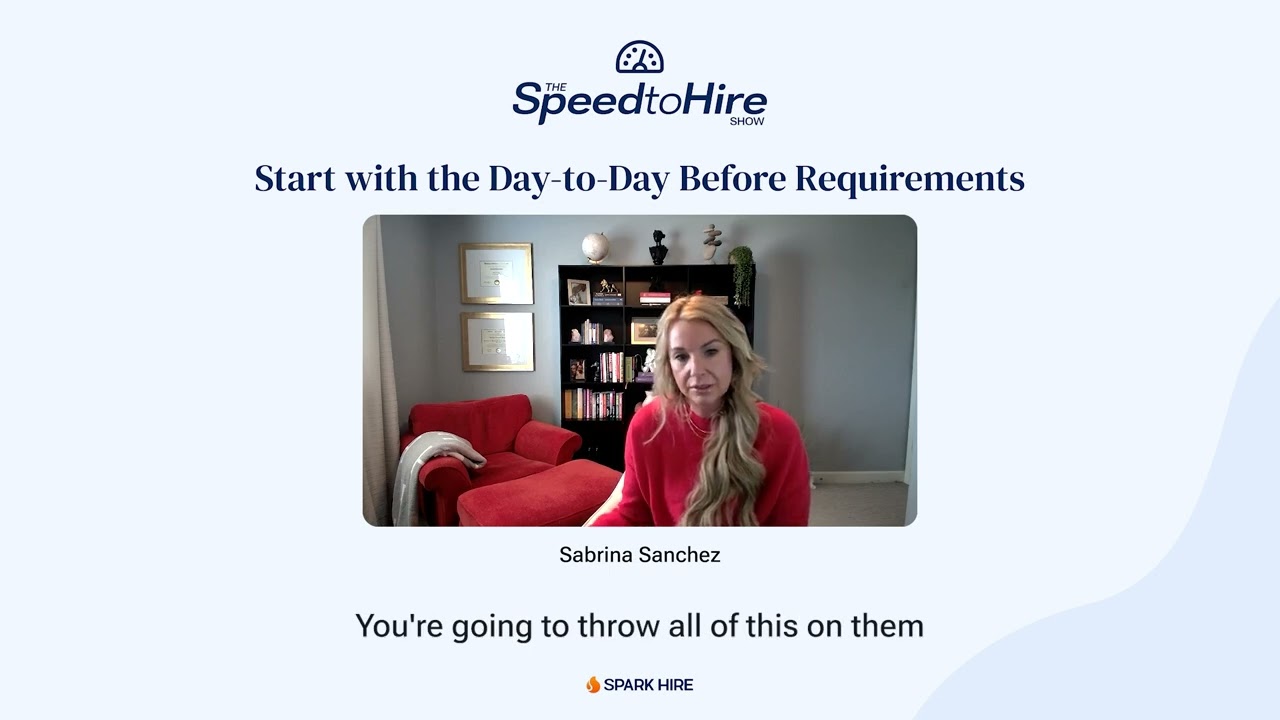
Rushed hiring rarely leads to good outcomes. Hear Sabrina Sanchez on why recruiting works best as an operational function, not an order-taking one.
Recruiting isn’t just about filling roles.
It’s about driving outcomes.
But too often, recruiting is treated like a support function — taking orders, moving candidates through a process, and reacting to urgency instead of shaping it.
In this episode, Josh Tolan (CEO of Spark Hire) sits down with Sabrina Sanchez to talk about what changes when recruiting is treated as an operational function — one that owns outcomes, influences decisions, and creates clarity before a search even begins.
They discuss:
- Why rushing hiring often leads to worse outcomes
- How intake conversations should challenge assumptions — not just gather requirements
- Why lack of clarity is one of the biggest drivers of hiring inefficiency
- How great recruiters shift from order takers to strategic partners
- Where AI can create capacity — and where it can’t replace human judgment
- Why recruiting problems often start outside of recruiting
Hiring outcomes improve when recruiting operates with ownership, structure, and clarity — not just speed.
Key Takeaways:
- [03:08] Recruiting Isn’t About Filling Seats
- [05:12] Why Slowing Down Leads to Better Hiring Decisions
- [06:18] Urgent Hiring Often Signals a Bigger Problem
- [09:02] Why Most Hiring Starts Without Enough Clarity
- [10:11] Start with the Day-to-Day Before Requirements
- [13:50] Intake Meetings Should Challenge, Not Just Capture
- [16:36] Why AI Can’t Replace Good Recruiting
- [20:52] How AI Creates Capacity for Recruiters
- [30:18] Most Hiring Problems Start Outside Recruiting
- [34:22] How Recruiters Earn a Seat at the Table
JOSH TOLAN: Well, Sabrina, thank you so much for joining me today. It’d be great to get started with a little bit of background information about yourself and your career and what’s really led you to where you are today.
SABRINA SANCHEZ: Yeah, so I started in talent acquisition full time in 2016. I didn’t really know what I was jumping into and the company had no recruiting and they were about to hit massive growth. So they asked me to come in, kind of build it out and fly the plane and learn it all at the same time. So I didn’t really realize when they asked me to come in that I was really creating this niche of recruiting is operationally driven. It was a manufacturing distribution company, so it really aligned with it to be hand in hand with operations. So that’s kind of how I created this niche lane that I see recruiting as operations, not HR.
JOSH TOLAN: Yep. That’s a great point. And I want to unpack that for sure. So tell me what you mean by that. Like a lot of people, you know, some companies, HR and recruiting are one function. Some companies, once you get to a certain size, it splits or if you’re anticipating a lot of growth, there’s different functions. But I guess regardless of where it actually sits within the company, when you think about recruiting as an operational function, more so than a supporting function, what does that mean to you?
SABRINA SANCHEZ: It means just not filling seats. It just doesn’t mean throwing bodies at problems like, we’ve got 20 recs, let’s get 20 people in here and let’s keep job security for recruiters and let’s just keep this high turnover. Like how do we actually look at it from a long standpoint of what is needed down the road? What is needed now and what is needed future to support the growth and not just throw bodies at a problem. Do we need 15 temps? Do we need five people to fully commit to this, train them, develop them career-wise. So let’s look at this long-term strategically, not just throw bodies out of problems.
JOSH TOLAN: Yeah, I think that’s a great point. One, there’s multiple ways to solve the problem within the business that is creating this perception that there’s a need for somebody in a position. But sometimes it might be, like you said, a different route, other attempts or contractors, or sometimes it’s really looking at why does this position keep opening up in the first place? And we shouldn’t necessarily just go rush, like you said, to go fill the seat because there’s obviously something going on here that keeps this need. coming up. So I think it’s a great way to look at it is rather than just being the intake person that everybody in the company comes to and says, we need to hire, let’s get this going. You actually help managers and the broader leadership team unpack what’s actually going on on the people side of the business. So you can have a more holistic approach to talent acquisition. and you had a LinkedIn post a while back that really resonated with me because I hear this, all the time when I’m talking to folks and recruiting specifically as it relates to working with their hiring managers. you had a quote that said, why I don’t rush hiring, even when leaders are panicking. and so it was all about my assumption is it’s all about like the time sensitivity and urgency that comes from hiring managers. when that position opens, what from your perspective when working with hiring managers have you seen is creating that like panic and need to just move as fast as possible?
SABRINA SANCHEZ: think we’ve all been there, right? Somebody puts in their two week notice and the hiring manager’s like, my God, I have to replace them right now. They’re panicked. They think they have two weeks to replace this person, but then you actually slow it down. Okay, what do you need from this person? Like what is the key three drivers that this person’s gonna accomplish? And really let’s look at the position. Great, it’s a field supervisor. If you rush and hire the first person you interview, how is that gonna affect your entire team? And then I do like to backstep it. Why don’t you have a field supervisor to put in this place? Like, why have we not trained this person up? So really asking a lot of hard questions that I don’t think most recruiters ask. Where’s the training? Where’s your pipeline? Where’s your bench? We can create this. I can throw somebody in here. How is that going to affect the team? So really coming from that calm place and then asking those sometimes hard questions. And then looking at the job description, making sure it aligns, making sure they’re interviewing correctly, asking the right questions, getting the right person in the right seat, and then setting expectations. This might not take two weeks. It might take four weeks, but let’s do it right the first time versus causing disrupt to the team and having to do it again in six months. It’s going to be harder in six months. So let’s get it right the first time. So really bringing that calm presence and kind of dialing their urgency back. and then meeting them at their expectations and getting clearly aligned.
JOSH TOLAN: Yeah. And I think, you know, the, like you said, the urgency is like, my gosh, somebody put their notice in, we need to backfill this. Their immediate thoughts are going to the productivity, the burnout of their existing team, their bandwidth, like all the things that they’re going to have to cover while this person or while this seat is open. But like you said, it’s really about the big picture and long-term success because they don’t want to be again in that position six months from now doing it all over again.
SABRINA SANCHEZ: Yes.
JOSH TOLAN: And so I think one of the challenges that happens though, when you’re working with hiring managers is there is this urgency and we understand that we can empathize with the urgency. And like you said, you want to get them to slow down and really think through, you know, what they actually need and how we set them up for long-term success. But how do you actually get them to do that? How do you get them to buy into like, Hey, we’re going to slow this down. We’re going to create clarity on what we’re actually looking for. We’re going to build a process together. Ultimately, that’s going to get you to the best big picture outcome, which I think they can appreciate. But it still doesn’t help them like while that seat is open and there’s like this, they feel like they’re just putting out fires constantly. So how do you like build that trust and get them to really buy in?
SABRINA SANCHEZ: Right, that’s always difficult when you’re first joining a new company. Once you come in, they’re like, you don’t know what you’re talking about. You haven’t done this. This is a different industry. It’s not the same. So you really have to sit down with the hiring managers and earn their trust. And it’s not from day one. It’s really that long-term relationship. And once they see that the recruiting process, even from their crew member, hey, I can give you 10 crew members, but let me phone screen them correctly. Let me have recruiting. do the process for you and that way when you’re interviewing, you can make better decisions. So once they kind of see that process unfold throughout, they really get the buy-in and they’re like, wait a second, recruiting is actually here to support me. It’s here to take the tediousness off of me. Those phone screens are valuable. So once they see that and it is slow, I wish it was quicker, but it’s really that relationship building and them seeing it come together. Once they see that, hiring managers have buy-in. It’s such a great feeling once they see it and they know that, we’re doing our due diligence, you’re getting the best candidates, now you can build your team.
JOSH TOLAN: Yeah, and I think you mentioned this in your post as well, is one of the things that this urgency and this rush to hire really exposes is a lack of clarity. Because often what happens is the hiring manager is like, well, let’s just go and hire somebody. Like, okay, what’s the job description? And it’s like this one from five years ago that really doesn’t match what they do now. And there’s also things that not only does it not match what they do now, but maybe there’s things.
SABRINA SANCHEZ: Yes.
JOSH TOLAN: hiring manager really should be looking for that they haven’t looked for in the past, but now with the benefit of hindsight of having somebody in the seat, they now know what to look for when they’re running the hiring process again. And I think that’s just like often a skip step because it’s just like, let’s rush to get the ad out there. Let’s rush to get applicants. We’ve done this before. Let’s just do it. From your perspective, like I guess, what are some of the signs when something is really unclear? Like what are the… the warning signs or the red flags of a hiring manager says they’re ready to go. They want to hire. But as you’re talking to them, it’s like, okay, we really need to tighten this thing up.
SABRINA SANCHEZ: When they give me like qualifications, when they start with, want this person to have this much experience and come from the industry and they can only have this, this and this. And I’m like, okay, this is the qualifications, but what does their day to day look like? What are they going to be doing? What does that look like? When they can’t answer that, then let’s dial it back. You’re gonna throw all of this on them, but want all of these qualifications. So.
JOSH TOLAN: Yeah.
SABRINA SANCHEZ: really dialing in what is that day to day look like versus those qualifications that they’re looking for. Because everybody will say, I want 10 years of experience. I want them to have done this before. And they can only come from this industry. OK, great. That doesn’t exist. If it did exist, they’d already be here. So kind of like dialing
JOSH TOLAN: Yep.
JOSH TOLAN: Yeah, there’s, totally. And it’s like also the balance of helping them realize what are the actual must have requirements versus the nice to have. Like, yes, it’s nice if they have some more experience or yes, it’s nice if they come from the industry. And I think sometimes hiring managers get that confused because it’s like they’re trying to, especially if it’s a backfill, they’re trying to replace somebody.
SABRINA SANCHEZ: Yes.
JOSH TOLAN: Who now they’ve built up in their mind is the person they’re trying to replace but they don’t really maybe think back to you Okay, what were the competencies and skills and experience that this person have when we brought them on? What do we train them on? They just go to like we need a one-for-one Match and like you said that like really really? Narrows not only the talent pool and who you can you know who you can get into the process but also like it just
SABRINA SANCHEZ: Yes.
JOSH TOLAN: makes it very murky in terms of how do we evaluate candidates when we have these strict ambiguous requirements, like 10 years of experience. It’s like, okay, is 10 years of experience over here the same as 10 years of experience over there? Like, why do we, why are we saying 10 years of experience? And it’s like, well, because this person has been at our company for 10 years, but there’s nothing that really like supports some of those bullet points. And so helping them unpack like what’s, what’s a hard requirement. what’s nice to have, what should just be removed altogether is really important from the start. Otherwise you run the risk of running the process, starting the process over. not being able to make decisions, hire a manager being too picky because they’re looking for something that just doesn’t exist. And those create, like you said, the hiring process already, everybody wishes it could be moving faster. And when you throw in this ambiguity into the process, it’s gonna move even slower. how do you get them to slow down? Like if they feel really set on, like you said, 10 years of experience and… They have to come from the industry and all these things and they feel these are hard requirements. How do you get them to like really evaluate if they actually are must have requirements?
SABRINA SANCHEZ: I think that hiring manager intake call really understanding the business, knowing your business, knowing what they’re looking for and then knowing their teams. do think that recruiting can be a very functionally remote position, but I do think you have to go and you have to learn your clients, right? They are your clients. You have to understand what they do. You have to see what they’re doing. You have to get a feel for that environment. And then once you know those hiring managers and you’re having that hiring manager intake call, of what’s nice to have, can kind of lead the conversation and say, you know what, with this industry, really knowing your market helps guide that as well. And being an expert in that field and kind of guiding that conversation. And again, I feel like if you’re a leader and you’re coming from a place of calm, knowing, hey, this is what I’m seeing, they do trust you.
JOSH TOLAN: Yeah. Yeah. And I, I think the word intake or the label for that type of meeting can sometimes be confusing to recruiters. I use all the time. know it’s like the common industry term. hear intake, you hear a kickoff meeting, you hear different variations. Some people do both. Um, I think sometimes that, that terminology can be confusing because sometimes recruiters will think it’s an intake. I’m just here to listen to what the hiring manager is telling me we need to do. And we’re going to go and do it. but it’s an intake similar in the way that, don’t know, maybe this isn’t the best analogy, but in a way, a doctor would do an intake where it’s like, okay, they need to learn about the situation and what’s going on. But ultimately they’re going to prescribe some type of treatment plan or give you some type of diagnosis. there’s some output there. And so I think that’s really what the intake is. It’s got to be like a collaborative thing where we work together. I’m not here to just. take orders from the hiring manager and we’re just gonna do whatever they say. And if they say this is the must have requirements, these are the must have requirements. So we just go off and running. It’s to your point. Sometimes we have to ask the hard questions and think about things from different angles to make sure that we get the clarity that we need to run a good process. And ultimately that’s all in service of the hiring manager and getting them the best person. But again, I think sometimes folks confuse intake with. I’m just here to intake information, but not have a little bit of that back and forth. And I think that’s where, you know, oftentimes hiring processes go off track. And I find that often most happened when talent acquisition lives within the HR function where the person that’s overseeing it also has everything HR related on their plate. And so it’s like, I’m going to rely on the hiring manager to give me all the information because I just got way too many other things going on.
SABRINA SANCHEZ: Yes.
JOSH TOLAN: to actually think through this with the hiring manager and be a true partner. And that’s just a natural challenge of being at a smaller organization. That comes with the territory when you’re managing both of those things. But I think it’s on that HR person to really think through. Okay, but how can I be a better partner? How can I create capacity to make sure I can do this well? Because what we do in the hiring process has all sorts of downstream effects in the employee life cycle, which also as an HR person will fall under my purview down the line. So, all right, I wanna pivot a little bit, because obviously we gotta talk, we’re on the podcast, we gotta talk about AI.
SABRINA SANCHEZ: Yes.
JOSH TOLAN: You had a post, by the way, love your LinkedIn, so for everybody to listen, definitely go give Sabrina a follow-up. But you had a post about your AI twin, and you said, AI can source faster, summarize better, but it can’t make trade-offs under pressure. Let’s unpack that. What do you mean by that?
SABRINA SANCHEZ: Okay, so we can go back to that hiring manager intake, right? If a hiring manager is gonna just give me an order, then why do I need to be here? I can give it to AI, right? He can go to AI, put it in there, he could do it himself. Why do you need a recruiter if you can just put this in AI? This is where you’re going to see the difference between recruiters and just AI driven processes, because you still have to understand the business. I could take that hiring manager intake call, not ask him any questions, not drive it down to what he’s actually looking for, throw it into AI, create a job description, post it, have AI screen and give you a candidate that you said you wanted. How long is that candidate really going to last? you account for any humanness in there? And that’s really when great recruiting comes in. AI is a tool that is valuable to our industry. It is going to take all the tediousness away.
JOSH TOLAN: Yeah.
SABRINA SANCHEZ: and let us really focus on the true work. And it is people, and people are people. So we have to train our people how to see what the hiring manager actually needs and how do we match that with the right candidate.
JOSH TOLAN: Yep. I couldn’t agree more. think, and I think, you know, there’s a ton of use cases for AI and we’ll get to that in a second and how, you’ve, you’ve seen it be effective in the hiring process that you’ve run. But I think really when we, when I think about AI, I think about using it to help me create capacity and do the things that matter better. And whether it’s creating capacity so I have the time to focus on the things that matter, such as collaborating with the hiring manager or thinking about how we’re going to communicate with candidates throughout our process. Like those are the moments that really, really matter in the hiring process, those people-oriented moments. So sometimes I think about AI in terms of just helping me to create the capacity to be able to focus on those things. But I think also AI can be a partner when you’re focusing on those things. It’s just a different approach. It’s just not put the thing in and expect the answers back. Because A, AI isn’t necessarily challenging and creating that back and forth with the hiring manager to really get to a good outcome. The outputs are only as good as the input. So if you’re just asking for the answers to the test, it’s going to give you the answers. But are they the right answers? Who knows? And that’s where I think like, the nuance and really where recruiters add a ton of value is in like the working in the ambiguity and figuring those things out and partnering with people throughout the organization to figure those things out. To use another analogy here and to use the answer example, it’s like, If you were in taking classes and you had an exam coming up and somebody just gave you answers to the test, you can go and submit the answers, but did you actually learn anything along the way? Did you actually absorb the subject matter? No, you didn’t. And so you’re not getting really better as a recruiter. The organization’s not really getting better at recruiting. You’re just following the outputs based on the inputs that you gave it. And so I think that’s where it’s so important.
JOSH TOLAN: to use AI in the process, but use it to enable you to do and focus on the things that matter.
SABRINA SANCHEZ: Yeah, no, couldn’t agree more. You have to understand it. We’ve all seen those emails. Your coworker sends a great email, but it doesn’t actually answer your question or have the context in there. And you’re like, thanks, I could have answered that with AI myself. So you really have to, and again, when Excel first came on, people were like, what is Excel? Now it’s a tool that you have to know in business. And I think AI is going the same way. If you do not learn how to use AI as a resource and a tool,
JOSH TOLAN: Yeah.
SABRINA SANCHEZ: but also your knowledge to go with it, then you are going to fail miserably. You have to use it to your advantage.
JOSH TOLAN: Yeah. And how are you or how have you embraced AI in different aspects of the hiring process, whether it’s in like the research phase, the kickoff before the hiring process starts, or even in the hiring process, just curious what you’ve seen to be effective so far for you and the teams you’ve worked with.
SABRINA SANCHEZ: I like it for streamlining those little tedious tasks that used to take us forever. Again, after the intake call, you drop the intake, you drop the job description. AI can tweak that in two seconds and it gets things that I didn’t get. I don’t have to spend hours doing a job description anymore. I can take things and tweak it very quickly. My job ads, how do you make this better? How do you make it more eye catching? Those like little things that AI can do in two seconds, hey, here’s my thoughts, organize them. Give me a phone screen template based off of all of this. So it can go down and give you quick templates that work with what the hiring manager just asked for. You can also drop a resume in it and say based on this job description, give me the red flag. So you can customize those phone screens that we used to have blanket templates for it to each candidate. So you’re getting better responses from the candidate and you’re seeing those red flags. So AI
JOSH TOLAN: Yeah.
JOSH TOLAN: Yeah.
SABRINA SANCHEZ: streamlines those nuances that use those tedious things.
JOSH TOLAN: Yeah, definitely. The tedious things, the staring at a blank page things and trying to figure out where to start. And like, yeah, I love that you brought up the intake example and using AI for it. We do that here internally and we encourage others to do it. We just did it for a role that we have open. But yeah, we’ve built things out to help us prepare for an intake or kickoff meeting with the hiring manager. So we go in and we ask the right questions. We use the transcript from that meeting along with what
SABRINA SANCHEZ: Yes.
JOSH TOLAN: we’ve got right now for a job description to then refine that, but also figure out what we try and use AI for. Don’t just give us the job description. Instead, come back to us on the things like, what is still unclear about this? Because we might have our own blind spots from reading it. like, yeah, that makes sense. But we have all the context of the organization. We know what’s going on within the business. Does the candidate? know the terminology you’re using? Does the candidate, can they read between the lines when they are reading your job description? Definitely not, right? Like they only know what’s put in front of them. They’re not within the organization. So I think we take a lot of those things for granted when we write them and we think it sounds great and it does match what’s going on internally, but you have to translate that for a candidate. So we’ll use AI to unpack the meeting and unpack the job description to figure out, okay, what’s still unclear? Then we go back. We answer those questions and then with those questions and with the help of AI, we can continue to refine the job description. And then I think it’s like a compounding effect, right? When you start to do that and when you can get to a better output in terms of a job description, well, if now you have a really good job description with really clear requirements, you’ve separated the must haves from the nice haves, you can now create a really good scorecard. Because now you know what you need to evaluate on and you can create a great scorecard And once you have a great scorecard now that you know what you’re trying to evaluate you can create good questions Obviously, you You have to know the best practices for certain types of interview questions and how you want to ask those but in terms of like Asking questions to evaluate against a scorecard your output could be a lot better Because you have this compounding effect of like if you keep making every step or all the assets of the hiring process better the next one can be even better because the hiring process is very fluid. It’s compounding. So it’s like from every stage, the next you’re learning more about a candidate. And as you think about like the assets that you develop that map to those stages of the process, you want those to compound off each other as well. So it really starts back in the beginning and like the better you can, the better foundation that you have as a starting place, the better everything else, you know, happens, happens downstream. And I think to your point, that’s why it’s so important.
JOSH TOLAN: when you’re connecting with the hiring manager in the beginning of the process, it’s like, let’s slow this thing down because if we can really nail this all the way up here, upstream, all this stuff gets way easier. But it’s still a challenge, you know, to get hiring manager on board to do that.
SABRINA SANCHEZ: together.
SABRINA SANCHEZ: And if you think about it, those steps that we just talked about, AI can do that in what, five, 10 minutes? If you give it the prompts and you go through it, back in the day, you’re talking, that would take me a day to write a job description, tweak it, human error goes into it, then you’ve got to create the hiring manager interview table. So you just took that urgency timeline, just accelerated because AI did a lot of the back-end work. Now I can focus on the candidates in the pipeline. So that just streamlined my process probably by a week.
JOSH TOLAN: Yeah, yeah. And with all the right inputs from the hiring manager, you’re able to do that. like, so in a lot of ways by moving slower at the front end of the process, and sometimes it’s not even necessarily moving slower, it’s just be more thoughtful at the front end of the process. You can move a lot faster through the process because you’re not scrambling mid process to figure out, what are we going to ask? Does anybody have a scorecard? Who’s like, how do we make sure these questions across interviews aren’t repetitive? Like all these.
SABRINA SANCHEZ: Yes. Yes.
JOSH TOLAN: things. And then the hiring manager is saying, can I talk to that person once more? I want to ask these additional questions. It’s like, well, if we can just iron all that out upfront, it’s going to eliminate a lot of that waste that happens in the process that slows the process down and causes candidates to drop out. And ultimately, it doesn’t get you to the outcome that you’re trying to get to. On the flip side, candidates are using AI in the hiring process as well, which I think is great. Have you, guess what’s your recommendation or do you communicate anything to candidates you speak with about how they should and shouldn’t use AI in the process?
SABRINA SANCHEZ: Yeah, there’s been a lot of coaching sessions, especially internally as tendon changes with employees coming to me saying, hey, how can I position myself? AI can learn you. Everybody’s AI is different. You can go in, you can customize it depending on what. I would suggest people start using it like they did Excel and really get to know it, use it to benefit you. Don’t just say, hey, agree with me on everything. Challenge me, make sure my ideas are good, make sure my resume is up to date. what some things it takes a little bit to learn you but once your AI is trained it can be your biggest asset. It’s personal it’s like a personal assistant. So really I would start using it I would start knowing it if you have a niche industry really hone in those skills where AI can benefit you. So what’s going to separate me from another candidate? Well I really know how to use AI. I know how to streamline it. I know how so everything could I shouldn’t see a resume nowadays that has mistakes on it.
JOSH TOLAN: Mm-hmm. Yep. That’s a great point. There’s really no, like you’ve got the tools in your arsenal to be able to, um, to be able to submit a quality resume. think, you know, the balance for candidates is they also need to be authentic. Right. Um, and, and that’s not, of course, you know, flubbing or lying on a resume is an absolute, absolute no-no, but I’m thinking like, not the fact that it’s a lie, but in a sense, it has to be authentic in the sense that you’ve actually given thought to the personalization. Similar to what we were talking about with AI giving you the answer.
SABRINA SANCHEZ: Yes.
JOSH TOLAN: If you just throw your resume into a chat GBT and you throw the job description you’re trying to apply for, but you didn’t actually read it, say personalized my resume, take the output and apply. It’s like, you don’t even know what you’re really submitting. And is that really an accurate, authentic representation of you as a candidate? Ultimately, at some point in the process, the company is going to find out like it’s best to portray yourself as authentically as you can. and use AI to polish it to make sure that it does align with like what the company’s looking for, but through the lens of what you’ve actually done and the skills that you have. And to me, that’s what’s going to lead to the best outcome for both parties. Like if you’re using it to try and embellish or just get through to the next stage, it doesn’t really help you. If you’re using it to better articulate what you’ve actually done so that it’s more clear and aligned with what they’ve put in the job description they’re looking for, like To me, that’s how you should use it. And to your point, there’s really no excuse to not do that. It’s the same thing on the candidate side as is on the hiring manager side. There’s this urgency to rush and apply and send out a bunch of resumes. But the people that are probably going to have more success are the ones that put a little bit more thought into the process and still use AI. but are actually thoughtful about how they’re using it to put their best foot forward. Because if they’re just copying and pasting, so are a hundred other candidates. And it’s very easy to see on the other side. When you start to get applications, it all looks the same and things are worded in the same way. It’s like, okay, now how much do I believe this candidate when they look like, you know, all the others that applied. So I think some good lessons there.
SABRINA SANCHEZ: Yes.
JOSH TOLAN: Definitely for candidates, definitely for hiring managers. As we look ahead, I know you do your own talent acquisition consulting, so I’m sure you work with a lot of leaders in talent acquisition and also just more general business leaders. What’s a big misunderstanding that people have about talent acquisition? And maybe this connects back to the beginning when we were talking about it as an operational function more than a support role, but what’s often where you see… like companies or somebody comes to you for consulting and talent acquisition, like what are the misunderstandings that they have that cause them to struggle or seek out consulting in the first place?
SABRINA SANCHEZ: think that they see it as the big picture. They just see it as one small little function and they’re like, we have high turnover. Okay, well, what’s leading to that high turn? It’s such a deep dive. And once you start asking the questions, it kind of is a map and it shows you the roadmap of how to fix it. But I really do think it starts with just not knowing what recruiting is. Or you have recruiters who are overworked, overwhelmed, who don’t have clear direction. They don’t have clear hiring manager intakes. They don’t have clear job descriptions. So they’re looking for somebody that’s not even aligned with the business. So I think it comes down to day one, how do you fix my recruiting function? Let me just talk to everyone. And then let me see where it’s breaking down from an operational side point, because recruiting could be, hey, I’m doing a fabulous job. My time to fill is 15 days and I’m doing great. And operations is over here. I’ve got 15 bad people. It’s where does the breakdown happen and it all aligns, right? Talent acquisition is your forefront to your customer. Who is that? What does the marketing look like? What is the job description? It kind of all piggybacks onto each other and it goes down to that retention. So I feel like the entire function sometimes can get siloed of just get me bodies in the door versus that big picture operational from day one to the end. What does it look like?
JOSH TOLAN: Yeah. Yeah. I think it’s such a good point in, I brought up how in the hiring process, things compound from one step to another assets that you develop for the hiring process compound. And I think, you know, what you just said is a great way to bring it full circle, which is really like the entire employee life cycle compounds on each other, but it’s also like a big circle, right? everything like informs something else. And as a result of that, there are so many variables at play. So a business leader might say, you know, we’re not happy with the people we have and it’s because we’re not getting good applicants and it’s because our recruiter is not good at finding people or something, right? And they’re like, oh, let’s go hire an agency to do it or let’s get a new recruiter or whatever it is. But there’s so much that influences that. And it can be everything from, well, we’re not really clear on what we’re looking for. The compensation doesn’t align. We’re not looking in the places, maybe we haven’t looked at current people and what makes them actually successful or unsuccessful in the role and bringing that back to the hiring process. So you really have to zoom out and look at everything holistically. You have to talk to people. Like I think that’s the biggest thing is like you got to get in there. You got to talk to people. You got to do listening tour. You got to talk to hiring managers. You got to talk to individual contributors. You got to really feel, get a feel for what’s going on in the business, what’s going on in the teams. Talk to people that are performing really well, get an understanding of what makes them tick, talk to managers about people that have exited the organization and what didn’t work out. And it’s the collection of all that knowledge that ultimately is going to inform things. And then even still, once you have that information, it’s still a very methodical process that you have to go through because as I mentioned, there’s so many different variables at play, you’re not going to get it all done in one. So it’s really like one building block at a time to develop
SABRINA SANCHEZ: Yes.
JOSH TOLAN: a good process, it starts with talking to people, it starts with building those relationships, it starts by learning what’s going on in the organization, and that’s going to inform everything else you do. So if you were giving advice to somebody that’s sitting in an HR or talent acquisition seat today, and they really wanted to get a bigger seat at the table, at the leadership table, what would you, like what direction would you point them in? What should they focus on to start opening up those conversations, to start getting leaders within the business, to start taking what they’re saying seriously and really buying into the change they’re trying to instill within the organization?
SABRINA SANCHEZ: If you really want a seat at the table, you have to operate like you’re responsible for the outcome, not just the process. So it’s not just filling seats. It is the big picture on how the business runs.
JOSH TOLAN: I love that. And I think that’s true for every function in the business. I think a lot of people get hung up on the processes or the checklists or the things to do and lose sight of what are we really after? What’s the real outcome? What’s the real objective that we’re trying to achieve? And people get so tied up in the minutia of all the things they need to do. They forget why they’re doing it in the first place. And so I think that’s a great point. Like if you’re going to go to executive leadership, you really have to start all the way at the top of like, what are we trying to achieve as a business? And then you have to connect all the things that you’re proposing or the things that you want to talk about to that objective, because that’s what leadership cares about. That’s why they’ve made it an objective for the business.
SABRINA SANCHEZ: Yes.
SABRINA SANCHEZ: Yeah, and the process is important. And each step of the process builds on each. And I think we’ve covered that several times today that the process is so important, but it has to be right from the very first or your process is broken. So it’s really understanding the business and what is the end here? What is the outcome? How do I own this? There’s been times where I’ve said, hey, I need to go to that P &L meeting. And they’re like, why would recruiting come to that P &L meeting? Because I need to understand the big picture. are we making budget? Where do we need people? Where is the breakdown coming from? So if you want to see it at that table, it’s really understanding and it’s kind of knocking doors down and saying, hey, I have to understand this. Hey, I have to go see how the CDL truck moves. I have to see how the forklift operates. So I know who to put in the right seat and the questions to ask. So it really is making it known that the outcome is just as important as the process.
JOSH TOLAN: Hmm. Yeah. And it’s, it’s, think a lot of times in recruiting, we look at the outcomes as the recruiting KPI, the hires made or the time to hire and all those things are, are, are definitely important to measure and to track, but that’s not the outcome for the business. We’re hiring this person for some specific business need. That’s the outcome we’re after. And so I think to your point,
SABRINA SANCHEZ: Yes.
JOSH TOLAN: recruiters need to you know kind of go that way a little bit or people in a leadership role need to go that way a little bit and think through What is the business really after and when you can really understand that you can bring all that knowledge upstream and it’s like, okay Now I really know what we’re trying to go or the types of people that we need in order to get there and now that’s gonna inform My process and I’ll measure how I run my process with these KPIs and early indicators that I ran a good process But a good process and a good outcome aren’t always the same. And I think that’s something that’s important to keep in mind is own the outcome, which is really the business outcome.
SABRINA SANCHEZ: Yeah, and I think that’s where recruiting partners with HR. Because once recruiting has that candidate and that candidate is signed on and they’re onboarded, recruiting’s done, right? Well, the recruiting has touch points with the hiring manager, HR takes over, but HR really needs to partner with recruiting on that 30, 60, 90. What is the candidate seeing at 30 days? What are they seeing at 60 days? What are they seeing at 90 days? Really partnering with HR on those. 30, 60, 90 reviews has been game changer when you’re trying to change your recruiting process, your turnover. Did the job description align? Were you told the right things? you, your training? So I think honestly getting that candidate’s input from that HR perspective and not just the hiring managers really gives you a full circle picture as well.
JOSH TOLAN: Yeah, and that will inform whether you’re still hiring for that role for other seats or you’re going to hire for that role in the future or even just broadly hiring in the company and informs changes that you might need to make to your process to create more clarity for candidates or update the onboarding process to make it smoother once you bring them on as employees. And you’re right. I think the reality is recruiting is so cross-functional and you really have to partner with every single leader within the business. And that’s what also makes it really challenging is you’re supporting so many different types of managers for a wide variety of roles across a wide range of candidates and then employees. And that’s what makes it challenging, but that’s also what makes it really special and such a critical function within the company. And so when we start looking at it in that way, it really allows you to do all the things that you’re talking about doing. When we stop looking at it as a support function, we start looking at it as like a driver of the business. It opens all sorts of doors whether it’s partnering with hiring managers whether it’s getting buy-in from leadership if you approach it that way You’re definitely setting yourself and whoever else is on your talent acquisition team up for success Well Sabrina
SABRINA SANCHEZ: Yes, agree completely.
JOSH TOLAN: This has been great. This has been so insightful. So many good nuggets here for our audience to take away and implement back at their respective organizations. If people wanted to connect with you, where should they find you?
SABRINA SANCHEZ: They can find me on LinkedIn. pretty active on there.
JOSH TOLAN: Great, great, yeah, everybody go give her a follow. Definitely some good posts as you heard us talk about today. And Sabrina, again, thank you so much for coming on. This was great, really appreciate it.
SABRINA SANCHEZ: All right, thanks, Josh.
More Podcasts
Compete for Talent by Focusing on What You Can Control
When pay can't be your edge, speed and structure have to be. Hear Nicole Elder of East Bay Innovations on improving hiring without a bigger budget.
Scale + Soul: How to Grow While Preserving Your Culture
Scaling through acquisition can quietly erode culture. Hear Erin McAuley and Julie Spence of Springline Advisory on using hiring to keep it intact.
Recruiting Isn’t a Support Function It’s an Operational One
Rushed hiring rarely leads to good outcomes. Hear Sabrina Sanchez on why recruiting works best as an operational function, not an order-taking one.