
Become an AI Powered Recruiter: Leveraging AI to Find Your Next Great Hire
August 21, 2025
Spark Hire's Josh Tolan and Adam Kazansky talk with 1Password's Amber White about adopting AI responsibly in recruiting, without losing the human touch.
In this episode of Let’s Talk Hiring, Spark Hire’s Josh Tolan and Adam Kazansky sit down with Amber White from 1Password to explore how recruiters can responsibly adopt AI to transform their hiring processes.
Amber shares insights from her years in recruiting—covering everything from AI resume review to interviewer training, candidate transparency, and ethical considerations. You’ll learn how AI can help remove friction (not people), elevate fairness, and free recruiters to focus on strategic, human-centered hiring.
What you’ll learn in this session:
- How to responsibly implement AI without losing the “human touch”
- Key opportunities and pitfalls in candidate AI usage (resumes, interviews, research)
- Why transparency and ethics matter in AI-driven recruiting
- Practical tips for small teams vs. large organizations adopting AI
- How recruiters can future-proof their careers by embracing AI
Whether you’re a solo HR professional or part of a large TA team, this conversation will give you actionable strategies to confidently integrate AI into your recruiting toolkit.
Welcome everyone to another edition of Let’s Talk Hiring.
Excited to start this session all about becoming an AI powered recruiter. Joining me here today is Josh and Amber, but before we go into the introductions, please let us know where you’re listening in from, put your location in the chat here, and if you are a SparkHire customer, we’d love to see that flame emoji there as well, but don’t be shy, let us know where you’re I almost said dialing in from as if it was the nineties and people are still using dial up. Let us know where you’re logging in from. It would be great to hear from everyone.
Excellent. All right. Great. Seeing some locations pop up. So really excited for today’s session. It’s about as topical as it gets, all about AI, using AI to find your next great hire.
Many of you already know Josh. I do wanna turn it over to Amber to introduce herself. Amber, over to you.
Yes, thank you, Adam. So I’m Amber White. I’ve been in recruiting for about fifteen years with the last several years being in tech, mostly as a team of one around very small lean teams, which means I wear a lot of hats and AI has come in very handy to support the kind of volume I’ve been supporting. But I have a background in IO psychology, and I really try to bring that lens into how we design hiring systems that are fair, structured, and actually give us really great signal.
But right now, I’m at 1Password where I’m focused on helping evolve how we hire, support hiring within the technology org, but really kind of support also how we evolve in an ever changing AI world to help candidates prepare and help our interviews interviewers prepare as well.
Great. Thank you. And, Josh, I don’t know if we do this normally, but introduce yourself.
Yeah. I’m Josh. You guys have probably seen me if you’ve been to some of these let’s talk hiring workshops. I’m the CEO of SparkHire. Happy to be here today. If you hear me mention things like you recently said this on a podcast, Amber, today. It’s because we’ve been on a podcast, together before, so I might draw on some things I heard in that conversation or discussion today.
And, Adam, you’re a new face to Let’s Let’s Talk Talk Hiring. Normally, we’ve got Gary here, who I will also say has also said, tell us where you’re dialing in from. So I think it’s, like, something about starting these livestreams that we all have this inclination to talk like we’re a radio host or something.
I, you know, I just wanna see if there’s anyone that lives anywhere near me and no one ever does. No one ever does.
But thank you all for joining.
And before we dive in, I think one thing I do have to tell everyone, if you are not following Amber on LinkedIn, you have to.
We decided that we were doing this Let’s Talk Hiring together, Amber and I connected and I’ve learned so much ever since Amber. Thank you so much. You provide, whether it’s anecdotes that provide legitimate insight or just your overall thoughts about leveraging AI in the workplace or other recruiting strategies, it’s really beneficial. So I really encourage everyone to find Amber on LinkedIn and follow her, please.
So let’s dive in. So the first thing, I believe we’re gonna, we’ll pop this big question up on the screen, And it’s what’s your biggest challenge or concern when it comes to using AI in hiring? And this could go in a million different directions, whether it’s about bias or integrating tools or about getting buy in. But obviously, Amber, first question goes directly to you. Would love to hear your thoughts here.
Yeah, absolutely. So I think one of the biggest concerns that I’ve especially heard across the market is AI is going to replace us, right? And I don’t think that’s necessarily the case. I really don’t. I think AI is ultimately going to bring us more consistency, bring us more fairness, but we also need to use it responsibly.
AI isn’t going to be about replacing people, but really partnering with the tool. And I always tell my teams and the people I’m working with, prompt AI with purpose, validate what you get, experiment thoughtfully. And I think the experimentation piece is going to be critical, right? But never stop applying that human judgment. So it’s using AI, but in a very human centric way, not letting it replace the human portion of things, but letting it really elevate what you’re able to accomplish by taking the busy work and letting you focus really on the stuff that’s gonna make an impact and make those experiences for people more human as it is.
Great point. Yeah. Think a lot of people probably have, you know, concerns about ethics and fairness and bias, like Adam mentioned. And I I look at those as, of course, we should all have those concerns.
That’s, like, the first thing we should be thinking about, when we’re evaluating using AI. But I think, Amber, to everybody that’s in TA, that’s definitely something top of mind and and and usually some fodder for LinkedIn content is around, is AI gonna replace recruiters? And we take a very similar mindset to what you were just saying, which is you’re using AI to hire. You’re not hiring with AI.
And I think there’s a key distinction there, and I’m sure we’ll get into a lot of that today. I think for me, personally, the way I look at AI and maybe it’s not necessarily a concern, but it’s always something that’s top of mind for me, in terms of how we implement AI in our software, but even how we implement AI throughout our business and through all the different functions is, are we using AI for AI’s sake, or are we actually using it to drive to some type of outcome? Because there’s so many different use cases. You can use it for pretty much everything.
So I think it’s really important that we use it and focus on really what matters.
And, you know, specifically, we’ll talk about the hiring process today.
Yeah. That’s great. And spinning off of Josh’s statement just now, Amber, you know, where, you know, where are you finding the most effective ways to use or let’s say, how do you determine the most effective ways to use AI in the organization versus just using AI to say that the organization uses AI?
Yeah. Yeah. Absolutely. I think the biggest thing and and similar to what Josh said is how is it gonna solve a problem? Like, how is AI gonna help solve this problem? And just because you can automate something doesn’t mean that you should or maybe, you know, should you? Right?
So I always ask, like, does this tool improve the quality, fairness, and experience for the candidate? And if not, it’s probably just adding noise to the process. So I think the best tools are the ones that quietly make things better without making the process feel less human.
Yep. That’s great. And then I also wanna connect to something you said originally, Amber, and it goes back to a quote that you actually said to Josh on the podcast together is that AI should remove friction, not people. And I think that’s a really powerful statement. And I hear, because I do talk to a fair amount of recruiters in the role that I have, is that there is a fear that the more we start leveraging AI, the more recruiters feel like their roles are being minimized. Can you talk a little bit about that concern and where people still become the absolute necessity, regardless of how advanced AI gets?
Yes. Gosh, Adam, I love this question. So I think that AI can help us remove the busy work, right? The tedious amounts of, I mean, in a world where there are so many resumes coming in, it’s an employer market.
I mean, we get thousands of applications per job. We can use AI to prioritize resume review. We can use AI to help with scheduling and reduce the Tetris, the puzzling that we have to do with scheduling. But using and leveraging AI on all those busy tasks really allows talent partners to focus on partnering with the business.
And so it’s freeing up the time for those really well guided conversations with hiring managers about what they’re looking for and how that connects to the broader business context. It allows us to be more strategic in developing structured interview plans and making sure that interviewers are calibrated. And so because AI takes a lot of the monotonous tasks of my role or evolves and expedites some of those more time consuming processes, I’ve been able to act as a stronger thought partner for my hiring teams, and bringing more hiring excellence through the talent side of the business.
And I think that’s really where that power is. So leveraging AI to give talent partners time to do the things that are more human.
And then I guess, Josh, for you, right? Because as the CEO of SparkHire, like a lot of those decisions fall to you. Like where do you see, as we launch, as SparkHire launches AI products, or as we use it as a company in the world of recruiting, like, what what are you looking for in deciding where does it make a difference worth where where are we just using it to use it?
Yeah. I think that goes back to, like, AI for AI’s sake. Like, every vendor, every can add AI features or every team can use AI for so many different things. And so for us, the philosophy has been problem first, not feature first.
And so that’s where we really try and listen to the market and understand our customers and what are the core challenges that is creating the most friction or the most trouble in their hiring process, and how do we use AI, to either improve that or to unlock, and unblock people to improve that in their own processes. So for us, the big focus has been around the themes of screening and selection and hiring collaboration because those are the two things, whether we’re talking to customers or I go to SHRM, those are the things that everybody’s talking about is the flood of applicants, and maybe we’ll get to that in this workshop as well as as one of the challenges that AI is presenting in the employment marketplace, and the challenges that that presents in the screening and selection process.
And then hiring collaboration is like the classic recruiter or hiring manager complaint of, you know, the hiring managers aren’t doing what I need them to do. They’re not writing good feedback, or they’re not writing feedback at all, or they’re asking me for updates 10 times a day or whatever it may be.
And so those are the things that we’re really focusing on versus going too broad and just trying to check boxes with AI features. So that’s that’s the approach that we’re taking.
Excellent. Thank you. So I’m gonna ask our audience a question, and then that question will relate to my next question ever. So everyone, on a scale from one to five, how are you feeling about this fast and furious emergence of AI in recruiting? One being immensely stressful and five being you’re excited and prepared to use it. So again, one, terrified, five, feeling good about it. You could throw those numbers into the comments and as you’re doing that, it does lead into the next question for you Amber, which is what is the mental shift that you think recruiters need to make in order to enter this world of using AI in recruiting?
It’s a great question. I would say being curious, but also still being skeptical. And I think if you go in fully ready to embrace AI and there is no skepticism, that is where the bias creeps in. And that is where AI starts to take over parts of the process that it probably shouldn’t, right?
Some of those decisions and in removing kind of the human elements of it. So I think I was just talking to one of my coworkers on our employer branding team, I was talking about how the experience people are experiencing with AI must be the same experience people had when the internet became a thing, right? And it’s a very scary thing and people were very skeptical, but then there is a very big curiosity of how much it can unlock and how much it can improve. And so I think we stay curious, but stay skeptical.
But also, you know, know that this is the future of our world. And if you don’t start embracing it, you’ll ultimately be left behind. And so be at the forefront of that, guide your hiring teams and how to use AI responsibly, and then be very transparent, right? And I think the transparency is key because it’s ultimately going to help us determine how people are using it, why they’re using it. And again, let that skepticism ask those harder questions of like, should we be using it here? Or is this the right, output that it’s giving? Or is this objective enough?
Yeah. That’s great. I I think you know? And we probably are seeing this for based on the responses.
Lots of, like, threes and fours, people right in the middle, which I think is a good place to be. I think it’s a very exciting time. Things are changing. It seems like every single day, you read something new that’s changed.
Just when you think you’re you’re caught up, something changes the very next day as it relates to AI.
And I think with regards to skepticism, I think what you’re alluding to is it’s really just being responsible in the way that you approach it. Right? And I think that’s the balance. That’s how you find the balance of, like, curiosity and skepticism. It is not skepticism for the sake of, like, resisting the use of AI. It’s leaning into it, but it’s being responsible in the way that you lean into it and just not trusting everything that’s out there, doing your own homework, doing your own research, trying things, versus just, you know, getting out there, copying and pasting, or listening to anything, that AI tells you. So, that’s how I interpret it at least.
Yeah. Absolutely. And I think the experimentation part is so important of it. Right? And doing some tasks and experimenting with different outputs and really trying to understand, like, if I used it for this, what would it give me? And I think that really shows where you have to start being responsible.
Thank you for that. So I wanna do a little bit of a switch here. So obviously recruiters are starting to adopt AI more and more, but there is a flip side of candidates also using AI more and more. And it’s funny that on the recruiter side of things, it’s getting more and more embraced, but we’re like, how dare those candidates use the same thing that we’re using?
So, I mean, Amber, it is a really tricky topic, and I do think it’s making recruiters have to think a little bit differently about how they’re changing their workflows. So what are you seeing from candidates in how they’re using AI? And has there been anything that you’ve seen as a trend or as surprising as you’re seeing those candidates starting to use AI more?
Yeah, absolutely. I think both trends and surprises for sure. So in terms of trends, like we’re seeing a lot of AI usage across, you know, resumes and application questions that require again, a little bit more effort in the process.
And while I think AI use in both of those cases, and I personally used AI as a job seeker, that you really still put your own human touch to it, right? And I say that because I have read the same application question across 400 resumes with the same exact output response. I can’t tell you how many candidates have built a chatbot, like every single one. I’m like, either this is real and people are really just building chatbots and that’s the most impressive thing they’ve done, or it’s just this output that people are not validating against.
The thing that has surprised me most is candidates using AI in interviews. And I think that that has been an interesting shift and something very tough to navigate is how do we get the signal that we need when AI is feeding them these very polished responses. And so I think the line with AI gets crossed when AI starts telling a story that isn’t true. And so it stops enhancing and actually starts inventing. And I think that’s where it really hurts people more than it helps. And and then, of course, we see the kind of AI bots that are applying and, the volume that that’s created. But I would say between trend and signal, those are the two on the candidate front I’ve really seen come through.
It’s been Adam mentioned your LinkedIn earlier, and I think it was yesterday or recently you put out a LinkedIn post.
And it it was actually on the use of AI in the recruiter side in a sourcing email that was sent to you. Yes. But I think the call out here as it relates to candidates, and you mentioned them answering and and so did Jolene here, the responses to questions and application questions and resumes, everything is, like, identical, is you might, as a candidate, go in and open ChatGPT and put this in and think you’ve come up with this amazingly personalized, customized answer. And in isolation, it’s great.
But on the flip side, you don’t realize that 400 other people did the exact same thing. And so it’s not really making you stand out because you’re not really making it authentic to you. And I think that’s the same thing in interviews, you know, to combat that use of AI. I don’t even know if combating is is the right word for it.
It’s more that how do we encourage candidates to be their their authentic selves in the interview? Like, I think the use of AI is fine, especially in terms of prep and thinking through your answers before you go into an interview. But to your point, if you’re just using it to, like, make up some story, it’s only gonna hurt you in the long run as a candidate. And so I think for recruiters, the lesson is to really start to think about your interview guides and the questions that you ask and to really make sure they are super behavioral based, rooted in real world experience where you’re really asking the candidate to draw on true stories from their past and pull in stories working with specific colleagues and things like that.
So it does require more work on the recruiter side to come up with really, really good thoughtful questions to get the signal that we’re looking for.
So that’s, you know, certainly a challenge for recruiters is it takes it takes more work, but that’s also something that AI can help you with as you think through it.
Yes. Absolutely. And on that front, I think even a step further is training interviewers has never been more important, right, because of AI. And if we are just going into these interviews kind of looking for this high level signal, you’re gonna find it. Where the art now is going to come in interviewing is digging deeper and doing the probing and really getting to the root of the context, action, and impact that these candidates had. So that’s gonna be a shift, I think we’ll see is just the importance of interviewer training and preparing hiring teams in a much more thoughtful way.
Yeah, I definitely wanna get to that. We should definitely touch on that, Adam. So I’m gonna write a note down that we come back to interviewer training and working with hiring managers. I did also wanna touch on, and maybe Tiffany can throw up this image on the screen, talk about one other thing related to candidates’ use of AI.
So this was actually something that I created using ChatGPT in, like, thirty seconds just as an example for this workshop. But I think it’s important to call out how the ability for candidates to do research and diligence on you as an employer at scale comparing you to other employers has significantly changed with AI. The ability to tap into all these sources throughout the Internet, create a quick comparison table, and summarize it has become so easy for candidates. So this was just an example.
I literally threw my LinkedIn profile into ChatGPT and said, find companies that would align well with my experience and compare what it’s like to work there. So super generic prompt, and it came out with this table. I blurred out the company names. But it came up with this table that I thought was really, really, insightful as a first step.
And if I was a job seeker and how I would consider whether I’m applying to these companies or whether I consider or continue in the hiring process with these companies downstream. So I think, you know, there’s a lot of focus right now on candidates using AI on the front end of the hiring process and coming up with the content they submit to you. But there’s also a lot of use in candidates using it to do way more in-depth research on you as an employer. And so what I wanna call it as important here is it’s really important for you to have a voice as an employer on the market because all this is pulling from is public information that’s out there on the Internet.
So whether it’s content you’re putting on your site or other sites that aren’t focused on employer branding around LinkedIn, it’s really important as you think about the future of your employer brand and your presence in the eyes of candidates to be optimizing for these generative engines to make sure that the right information shows up when candidates are doing their research.
Thank you for sharing that, Josh. And I guess my last I guess my last candidate question would be, Amber, are you getting questions from candidates about whether or not 1Password uses AI and how do you work with the team on setting expectations or making the candidates feel okay about it?
Yeah, great question. I think we’ve definitely established as an employer brand our position to candidates on AI use. So we include an AI piece in our job description. So shout out to our employer brand teams.
They were really on the forefront of that. So, yeah, I think in terms of being transparent, so we also use an AI notetaker in all of our interviews, and we’re very transparent about how we use it, why we use it, what it does support and what it doesn’t support. We don’t use it to make decisions on candidates, but we do use it for these reasons. And I think there’s still a huge opportunity transparently with candidates to ask more questions about it.
I do get some questions, but, it’s more your high level, like, does you know, is is 1Password embracing AI and and things like that. But, I’m still shocked about the amount of candidates that ask not to be have an AI notetaker in the interview. And I think that could be just a lack of understanding of why it’s there. Right?
And I think it really is an empowering tool for a candidate. And if it’s okay, I’d love to give an example of how I’ve I’ve used it recently to set a candidate up for support. Great. So, in in a previous role, I had a candidate that the hiring manager was really on the events with.
He’s gone through the whole interview panel.
And ultimately, the piece that the candidate or the hiring manager was really like on the fence about was their conflict resolution skill set. And in my interview, in my recruiter screen, I actually touched quite a bit on that and did some probing and dug deeper into that specific competency. And I was able to go back into the interviewing notetaker, use AI to say, hey. What did the candidate say about conflict resolution?
Spit me out an entire thing like a TLDR, but then also linked me to the specific clip that that candidate had talked about it. So I shared that clip with the hiring manager, ultimately, curbed his concerns, and we avoided not only did we avoid, like, another interview in the process, like a follow-up conversation to talk about conflict resolution. We ultimately ended up making an offer to that candidate. They did phenomenal.
Like, conflict resolution wasn’t even a concern. So it is super cool to see how AI can actually support the candidate experience in a way like that. But I also don’t know that candidates see the the behind the scenes, and they know that those types of things are happening. So they I I think sometimes the especially the notetaker specifically, can be like, oh, they’re recording this conversation to go back and find my faults kind of thing.
And actually, it’s completely opposite. And we’re leveraging it in a way to really empower the decisions we’re making and highlight those positive signals that came through the process.
That’s a great example. Two huge things there. One, I think there’s really a lot of power in the way that AI can connect the different stages of the hiring process together where so much context is missed in, like, the paper pushing of the traditional ways related to hiring.
But I think you also hit on the biggest challenge with candidates and employers’ use of AI is the fact that it is such a mystery to candidates. Really, the entire hiring process is a mystery to candidates. Before there was AI, it was all of the rumors about what an ATS does or doesn’t do with your resume. So I think the thing is when candidates don’t have the information, they’re left to make their own assumptions.
And in such like a high stress situation that a job search is, often people go to a dark place in terms of their assumptions. They’ll assume the worst. And so that’s the importance of communicating as much as you can and early and often how you’re using AI, but not just how you’re using AI in terms of, like, we’re gonna add an AI notetaker to the interview. It’s like Okay.
That’s the transactional version of how you’re using AI. But why and how does that benefit the candidate? And that’s the real challenge, I think, is how do you message that to the candidate when there’s already so much noise in the communication of the process. It’s like there’s a lot to say about that.
And so to me, it’s something like you should have some type of evergreen resource that’s front and center on your careers page, on your job descriptions that you can link to in every email or whatever it is about, like, how we run our hiring process and how we use AI and why and all that kind of stuff so candidates can ask or can can look into it whenever. Because it’s tough to, like, put that all in an email, and expect somebody to read that with everything else that’s going on.
Yeah. With all the prep they have to do and everything. Yeah. Absolutely.
Exactly. Like, we don’t wanna give them more work. That’s the thing. It’s, like, we’re always trying to, like, not give more steps, not give more work, like, make it as frictionless as possible.
But, also, if we want to run a really successful pause process, we need that, like, back and forth of making sure we give you the information that you need to be successful in this process.
Yeah, absolutely. And I think the mystery you touched on a really great point about AI being such a mystery. And I think a lot of that is the like, the content that’s put out there is like, yes, use AI, use AI, use AI. It’s important.
It’s important. But it’s not actually showing the day to day usage and how people are actually applying it. And so that’s one of the things that I’ve been trying to do with some of my content is just unveiling that mystery of like, this is how I actually applied AI in this specific role. We had 1,200 applications come through.
I leveraged AI job criteria to prioritize candidates that have X, Y, and Z background. And then ultimately, it generated this list. And so I think we need more people out there sharing these stories about the positive responsible uses of AI and also how they’re bridging that gap of that human judgment and bringing that human experience in.
And that’s ultimately that transparency, I think, going to go a long way of making people more comfortable with using AI and allowing it to be part of the process.
Speaking of making people more comfortable with using AI as part of the process, you know, I wanna go back to what Josh said, I’m taking a note of this, so we’re talking about it later.
Making our people, our hiring managers and our recruiters more comfortable using it and it’s about training and exposing them and to to the technology and working together. Talk a little bit about collaboration, AI and training those team members to use it and use it in a powerful way in a powerful way.
Yeah, absolutely. And it’s so nuanced, right? Because there are so many different ways you can use AI. And it’s about, again, opening the conversation and asking the questions.
Want to know, I asked that question to hiring teams. Well, how are you going to bring AI into this process? Or are you using AI to generate this feedback summary? And if so, where is your human judgment and where is the decisions that you’re making?
One of my biggest concerns, especially from an ethical perspective, is we’re feeding our AI notes from interviews and things like that and being like, Okay, tell me how they align. Are they a fit? Make the decision for me. And that is not what we should be doing at all.
The AI is a tool to help us summarize, to help us give stronger, better, more informative feedback. Because let’s be honest, writing feedback is an art. And especially when you’re in 10 back to back screens, it gets lost in the time. And so I think it’s about being transparent, opening those conversations, but then also training and showing this is what I do and this is how I do it and not create not creating the veil around AI.
I think we need to normalize talking about AI and how implementing it in the process and just having more resources around ethical and nonethical uses.
Yeah. Andrew brings up a great comment in the chatter on rose colored glasses. I think that’s kind of related to what I was gonna say about AI is if you use ChatGPT a lot, what you start to realize a lot about ChatGPT is it tends to agree with you a lot and tell you how great you are. And so I think if we have this, like, inclination to use ChatGPT to tell us what to think about this candidate, it’s like, it’s so dependent on the prompt and the mindset that it is in in terms of how it delivers us that feedback about this person. So in some cases, that could work out overly well for the candidate, and actually not great for the employer, and then it could also work out on the flip side. So I think that’s just the importance of being, you know, super responsible in the way that you’re using it and the tools that you’re using and, you know, not going rogue and trying to do your own thing without testing it on a substantial amount of data.
Yeah. I love that it always agrees with me. Finally, something, someone out there. This is true. Yeah. Right. It’s a good My wife, I’m like, well, chat GPT thought I was right.
It’s a good midday boost. You need a compliment or a little pick me up, just open that little chat GPT tab, and it’ll be sure to lift you up.
And I’ve tested this. Every single candidate would be hired if we left it up to AI. Every single one. You know? So I mean and and the nicer you are to chat GPT, the nicer it’s gonna be back. So be Yes.
And I guess that, you know, I everyone, this is a workshop. Please add your questions into the comments. We’ll hopefully be able to get to some of them. I do see one quickly here from Gregory Schwartz about when choosing an AI, is there a preferred model to go with?
And I mean, I don’t know if that’s a question that we can all answer. I know I haven’t heard from recruiters, like, consistently, like, what model they like, but I guess, Amber, if you can answer that, great. And if not, then kinda connected to that is what goes into where you choose your technology? Like, what are you looking for in choosing your AI technology?
Yeah, absolutely. What I loved about working for 1Password is it has really opened my eyes to the security and privacy when it comes to leveraging AI. And they’re really phenomenal about being very thoughtful, doing the investigative work to make sure, again, as a company, we can be responsible in how we’re using these things.
And so I think from my perspective, I think it’s the company’s responsibility to do the due diligence and ultimately set their teams up with expectations of what AI they can use and how they are expected to use it.
And then there is no question of which one is best because the company can ultimately make sure that those guardrails are in place to ensure the teams are using them effectively and appropriately.
So I know across 1Password, we’re using lots of different tools. But again, our security teams have really done their due diligence and our privacy teams and legal, and and a lot of people are part of that decision making process. So it’s not just a, oh, Amber is gonna go off and use this tool, and Josh is gonna go off and use this tool, and it’s fine. You know, we’re really being thoughtful about mitigating the risk that comes from a from using AI by by putting some of those guardrails in place.
Yeah. I think you nailed it. I think the model is really the vendor selection process your company goes through. So I think, you know, it’s good to make sure there is a process there.
But I think a lot of the responsibility comes downstream in the rigor in which how you actually implement or use that model to do whatever you’re trying to accomplish in, you know, the studies that you’re doing, the testing that you’re doing, the bias audits that you’re doing. There’s a lot that goes into this that’s far beyond just the model you choose. The reality is the models are progressing at such a fast rate that they’re all pretty capable of doing a lot of amazing things.
So I think the choice just comes down to, like, vendor selection process. And then what are you prepared to do internally at the company to have the rigor necessary to stand something up?
Then that’s, you know, that’s how we look at it as a vendor as well.
Absolutely.
And we have a few questions, and we’ll definitely jump into those. But this also you know, talking about privacy is also a nice segue into the ethical components of AI. So we’ve been talking a lot about the technical components of AI adoption and training and things to be on the lookout for, but Amber, what do you think are some of the biggest ethical pitfalls that recruiters need to be aware of and what can they ultimately do about it?
Yeah, absolutely. I think one big one is gonna be bias, right? If your data is biased, your AI will be too, and now that’s at scale. And so the other one I would say is like a total lack of transparency.
Like how can candidates and hiring teams and companies trust a system they don’t really understand. So we need to be honest about how we’re using AI or we risk breaking that trust before it even starts. So I think it’s really about understanding where I ultimately think it’s best to be more transparent than less, and that’s when we can start having those decisions or those conversations about how we’re using it ethically and not ethically. Because if you don’t know who’s using it and how it’s being used, you can’t really have those conversations.
So I love that 1Password has really taken this embracing approach of tell us how you’re using it. We want you to use it. We wanna normalize the use of AI. We are not shying away from it. But the more we can talk about how we’re using it amongst teams, the more we can start to unpack whether that is or is not the best use of it in those systems and processes.
And what did you mention in the beginning, Amber? Because I think this is a good principle for everybody to live by here as they consider AI, at least in the hiring process. It was something along the lines of is the is this making the process more fair? Something about for the candidates, more fair, faster. I can’t remember exactly what you said, but it was a great quote. Maybe we’ll pull it from the record.
That’s like my brain don’t go back that far.
Well, it was a great quote. So we’ll bookmark it and send it out to everybody after. But I guess my point here is that it goes back to having some principles that you live by and assess your use or consideration of AI against those principles and make sure they align as the price of admission.
Yeah. Absolutely. The other thing I do want to note is bringing in diverse backgrounds and perspectives and experiences and having the conversation across different people is also gonna be really important. So leveraging some of your ERGs to help evaluate some of the tools. And again, I think the more we can talk about it, the more we find comfort talking about what we’re using, how we’re using it, when we’re using it, the broader feedback we’re going to get from different people and the more people that can, again, have that responsible perspective of using it.
Thanks for that. And this is an easy question to answer, but I just want your insight on it afterwards.
Clearly, is such a thing as too much AI, but how do you go about evaluating when, I guess, enough is enough and what are the repercussions of, let’s say, kind of leaning, you know, we’re trying to convince people to lean in AI, but what are the repercussions of leaning in a little too much?
Yeah.
I guess I would question like, what’s the candidate experience when every touch point feels like a bot? And my post yesterday is a perfect example of that, where I got an outreach from an AI bot recruiter that basically referred to my impressive experience at a series A park tech company. And while that I did work at a series A park tech company, obviously that’s the company descriptor. It’s very irrelevant in the terms of the grand scale of my experience.
And so I already lost trust in the company trying to hire me just based on that one interaction because I’m like, oh, well, you’re not even actually looking at me. Like, I’m not even gonna make it through the I might not make it through this process. Right? And so I think if we overdo it with AI, we risk making hiring feel more transactional and cold.
And ultimately, what people want is connection, and we ultimately will lose that. And so leveraging AI to ultimately enhance or do, again, that busy work so we can enhance those human connection pieces is really where I see it being the most responsible use.
Yeah. I think you hit on something there as it relates to bots. And to your point, that email, it wasn’t inaccurate, but it was awkward so you knew it wasn’t written by somebody that actually looked at your profile and went through your experience. And the person on the other side probably thought, like, this is a genius, product that we’ve created.
It’s gonna really personalize this. I can send this to a thousand people. And that kinda goes back to what we were talking about with candidates. I think that’s the, that’s the challenge.
You nailed it related to people wanting connection. I think the biggest thing is people don’t want recruiters to pretend, like, something they’re using with AI is something it’s not. And so, like, whether it’s a bot or some AI avatar, I think that’s the challenge that we’ve seen, with candidate sentiment around AI in the market is, like, this, sentiment around, like, oh, we’re using this AI to, you know, be a fake recruiter or whatever it is. And, candidates, like, don’t pretend like it’s something that it’s not.
I think, like, you should acknowledge your use of AI and where you’re using it and communicate why you’re using it. But if it feels like something that you have to overexplain, it’s probably something you might want to take a beat on and think a little bit further about how you implement it in your process.
Yeah. And I feel like candidates, you know, they know when it’s AI and when it’s a person for the most part. And you also have to think about like, what does this say about the organization that is doing the hiring if as a candidate I’m interacting with AI 80%, 90% of that journey.
So it’s thinking about not just making it easier for you in your world, but also how the candidate is digesting that on the other side of things.
Yeah.
And Adam, one more thing I wanna add too. I think especially if you’re thinking about like using kind of AI on your own, using chat GPT or something like that creating custom GPTs, whatever. It’s a lot of work. And even if you’re using it through a vendor, it’s a lot of work in the sense of when you stand something up to measure the efficacy of it and how it’s working downstream.
So I think it’s very easy to, like, get big eyes and thinking about all the ways we can implement AI and all the things we can use it for. But that’s where I think it’s like you need to prioritize what problems you’re trying to solve and be very selective about where you implement it versus just trying to go too broad with it. Because then you have a lot of things to measure and monitor and make sure they’re working. And if you don’t have the time to do that, like, there’s a lot of downstream consequences.
Yeah. Thank you very much for that. So, Amber, I I you know, it kinda leads you know, everything leads to the next question. That’s how I try to plan things.
But, we know we’re talking about using it. Are you using it too much? Not enough. And what I, you know, what you don’t want to do is create fear in a recruiter’s mind that they shouldn’t be using AI at all and avoiding it entirely.
And I’ve spoken to recruiters that are like, it should 100% be a human experience top to bottom, no AI whatsoever.
But you also said at the top of our conversation here today that you do have to lean in a little bit. Can you just talk a little bit more about why it’s important to lean in and what you miss out on by just outright refusing to introduce AI at all into the process?
Yeah, I unfortunately think you’ll ultimately just be left behind, right? Great recruiters are gonna be the ones that know how to leverage AI in the process to ultimately optimize their workflows so that, again, we can focus on more of the architecting of the process, right? We can focus on those strategic conversations that are ultimately going to guide better hiring decisions that are making an impact in the business. So tying our role to the broader business context, not just thinking as a recruiter, my role is to fill this role, right?
It’s not, it’s I I challenge my hiring managers on decisions they’re making. I’m like, do you really wanna hire this person when, you know, x y z didn’t really align with where we’re headed a year from now? You know? And by leveraging AI, it’s taking those those daily tasks away.
You know, I actually did a whole business case when I wanted to implement an AI notetaker. And I calculated down, I pulled all the data and calculated productivity wise and matched the dollar or the productivity to the dollars I’m spending on writing candidate feedback. And how ultimately AI, again, responsible usage here. I’m not letting it make decisions on feedback for me, but leveraging it to draft up my initial feedback.
And then ultimately, I go in and make the changes that I need to make or prompt, you know, put in my specific prompts of highlights. It’s positive and negative signals I didn’t get. Ultimately, drastically reducing the amount of time that I can that I spend writing feedback, increasing the amount of time that I can spend with more candidates, talking to more candidates, getting more candidates into the pipeline. So I ultimately think that I see AI as that force multiplier.
And if you shy away from it, unfortunately, it’s just you’re going to be stuck in this very antiquated, outdated system that ultimately isn’t going to help you or the company scale.
You really touched on a point here with regards to that business Casey built. I think it was a great start to tie it to productivity and the dollars that you’re spending doing this.
But I think what the business leaders care about is, okay. That’s great. So there’s an efficiency play here.
But how are you gonna redeploy that time and make a bigger impact on the organization? And so I think too often when people think about a business case as it relates, especially you know, we’re talking about AI here. They stop at the productivity, and the dollars and the time spent doing x y z. And it’s like the business leaders want to know, okay.
Well, if you now have freed up that time, what are you gonna do with it that’s gonna make a bigger impact on the organization? And I think you nailed talking about that, which is I’m gonna be able to increase the time that I can spend talking to candidates, talking to them about the vision for the organization, sourcing people that are hard to find or whatever it may be. And that, I think, is really where you’re able to show the true recruiter skills versus being drowned in admin, a lot of things that can be taken off your plate. So it’s the unlock, but it’s the redeployment that I think is really what hits home if a stakeholder is reviewing, like or trying to sign off on a tool that you’re trying to use.
Yep. Absolutely.
And, you know, we probably have people in our audience that are like, okay. Great. I’m ready to implement AI. But, Amber, you’re at one pass or at a large company. So how you’re going to implement AI may be different how I am because I’m a one person HR department, but you’ve been a one person HR or talent acquisition team, should say. So can you talk a little bit about AI and, you know, maybe what you should be on the lookout for or how you should implement if you’re that one person team at, let’s say, a small organization or part of a 30 person, you know, talent acquisition team at a large organization?
Yeah. Great question.
I would say, especially in, a team of one or a very small team, is not making those decisions in a silo. And I think working at 1Password has actually made that come to light a little bit more for me because when I was on a team of one at Going, it was very easy to just make decisions on my own of, cause I value speed and wanting to move quickly and we can easily implement this note taker and it’s no problem, right? But there is a lot of, again, bringing in those diverse perspectives. Like how does this impact an individual that has a disability or has neurodiversity? Or how does this impact our ability to in different ways, right? So there’s just gonna be very different perspectives on how we can incorporate these tools.
But then working at 1Password brings in a lot of, like, the legal and, like, privacy and security aspects that I don’t think I really understood not having that kind of really centralized focus on security. Right? And so I think there’s I think the biggest takeaway really is going to be involving and incorporating more people into that decision, asking people, okay, tell me three reasons this will work and tell me three reasons that this won’t, or tell me three concerns that you have over this, and forcing that function, right? Forcing people to be skeptical so that we can make a very responsible decision about it.
Great. Thank you so much. So I’m going to ask one question, and then we do have a few more questions. I’m going try to at least get to one of them. If we don’t answer questions on today’s session that popped into the chat, we’ll do our best to follow-up after, and there are some great questions in there.
But I guess my question to you, so let’s say I’m a talent acquisition specialist or a manager or a team lead, and I’ve finally made the decision I’m going to implement AI, like we’re gonna do it, what do my first thirty days look like? Like what should I be doing? Should I implement it within a week? Should I implement it on day one?
Is there prep work I should do beforehand? Like, because I wanna make sure that for the members of our audience who haven’t done it yet, they’re not like, I love this webinar, which I hope you do, but I love this webinar. I’m I’m I’m using AI tomorrow. What should that first thirty days look like?
Yeah. Absolutely. One of the biggest things is identifying like, looking at the data and identifying where those pain points are. And I think Josh kinda talked a little bit about this earlier where he was you know, it’s talking to customers and identifying where their gaps are, where the pain points are, and then building solutions for that.
And I think it’s taking the same approach as an individual. Right? Let’s look at the data. Let’s understand where the gaps are.
Let’s understand where AI can make the most impact, but also understand where those low hanging fruit might be advantageous. Right? Can we do something really quick that’s AI related that will have big impact but is kind of easy to implement. For example, AI resume review.
In a lot of ATSs have this already built in. And so, you know, it’s not something that you have to build. It’s more of like a flip of the switch and understanding how to leverage it, how to use it. And so I think starting with that of looking at the data, understanding where we can solve, where are the little problems and where are the big problems that we can solve with AI, but then going through a bit of a more rigorous process to understand, again, how we can use it responsibly.
So I definitely wouldn’t recommend jumping in the deep end and starting using it tomorrow. Tomorrow, I want you to start identifying where you can use it, identify those pain points, identify those gaps. Then the next day, I want you to come to solutions. Right?
Okay. Well, we can use AI for this, this, and this. And then the next day, it’s, okay. So if we choose this one, what are the implications?
What are the drawbacks? What are the positives? What are the negatives? Kinda do your, you know, SWOT analysis as if if you will.
So definitely not diving in the deep end, but there are ways you can use AI quickly.
And then there are ways that you should probably be vetting it more rigorously.
Yep. And I one thing I’ll add to that, and then, Adam, there’s a question I’ve I’ve highlighted here that I wanna definitely pull up, next because it ties back to something Amber said earlier. But I’d also say a good process or a good question to ask yourself is as you’re thinking about rolling it rolling out AI for this initial use case, is how will I know this is working, and how am I gonna measure that? And if you can’t really answer that question, maybe you’re not starting in the right place.
So I think that’s an important question before you start using something is, you know, how will I know this is working, and how am I gonna measure or monitor that? And measuring doesn’t necessarily mean you have to have, you know, reports built out for this thing. It’s more monitoring. How do we know it’s working out in the wild?
What are the signals that we’re going to see?
Validation. Exactly.
Exactly. And I know we’ve only got, you a handful of minutes left here, Adam, so maybe we’ll get to questions. I’m gonna pull up one, on the screen here because Amber touched on it earlier. This question is related to recruiters, but Amber touched on it earlier also with regards to coaching hiring managers and how to probe and ask the right questions so you’re not getting, like, the generic AI scripted response, you’re able to draw on those authentic real world experiences. So, Amber, I’d love to pose this question to you of, like, you know, how do you think through those questions, and how do you take a question and make it better, to overcome this challenge that a lot of people are facing?
Yeah. I definitely lean into my IO experience, for a lot of this. So my background in IO psychology is really rooted in behavior and things like that. And I use AI to help develop questions based on the competencies that are required.
But I look for performance based questions. So these are going to be behavioral, but looking for specific performance indicators that give real signal on whether or not a candidate has performed this type of action in the past. And AI can easily churn out some hypothetical responses, right? AI can churn out very high level, tell me about a time you did this, even if they didn’t actually do it.
But I think the art, like I said, is going to be in the probing that we’re able to do, but also the actual kinds of question we’re asking. And we actually recently just redid this for a role that we’re hiring for at 1Password is you know, our recruiter screen and our hiring manager screen both had very kind of vague high level questions, and we had really low pass through rates. And I’m like, okay. We need to come back to the drawing board.
I think our questions could be the problem. Let’s sit down, chat through our competencies, what we’re really looking for. We have this beautifully written job architecture framework. Let’s base it off of that.
So we take that, we throw it into ChatGPT. I’m bibbing at prompts about performance based questions rooted in some principles from my background.
And we come out with some really strong question sets that we can now apply that both are performance based, but then also give some of the follow-up questions. And then we can determine based on these questions, like what are some positive and negative signals that we might get from this? So we can get so deeply ingrained into what we’re looking for based off of one question in an hour compared to this in the past could have taken three days to build out.
And so that is the power, right? But again, I’m human, I am intervening, I’m changing the dynamic of the question, I’m changing the words, things like that.
And ultimately, I think the more nuanced you can get your questions, the less candidates can leverage and fake it till they make it through those questions because they do need to draw on that real experience. Then those probing questions are going to help us get a layer deeper and really understand the nuanced things that they did.
Yeah. Not only are you overcoming that challenge that the question alluded to, but you’re also just running a better interview. Yes. And you’re gonna get better signal.
So by addressing that challenge, you’re just creating a better interview process in a way for you to get to, you know, better evaluations and help you make more confident decisions. And so, when we talk about measurement and monitoring and how do we know something’s working, that might be something where we’re like, hey. When we roll out this new interview guide, we expect pass through rates to increase or whatever it may be. But it might not be a metric necessarily specifically associated with the thing, but it might be something in the process that you would expect to change as a result of the thing that you implemented.
Yes. Absolutely.
Great. Well, thank you both. We have about two minutes left, so I’m gonna kinda close this out here. I think in one of those two minutes, Amber, if there’s just maybe a last word of advice or a bit of guidance that you wanna give to our listening audience about AI, maybe it doesn’t have to be a brand new statement, could be reiterating something that you talked about earlier or something new, but I think just one final sound bite for our attendees today would be great. So if any thoughts you have, please share.
Yeah, absolutely. I think the biggest question I pose to people, which might be my closing statement is how can we use AI to bring more consistency to the process and for us to bring more humanity to the experience? And I think we really talked about that a lot today of how we can automate the things that take away from our opportunity to really build these deep connections and architect these phenomenal systems that are gonna bring us hiring excellence across the business.
Excellent. Well, thank you so much. Thank you everyone for joining. Really appreciate it. I believe we are gonna be putting some links to some resources that we provide at SparkHire, call it higher education. And it’s where you get a ton of great resources that are ever growing, all about the recruiting process, best practices, guides to hiring. So feel free to click on that and finally connect with us.
Amber, Josh, myself, we love building our network, so please reach out and connect us. And as I said at the top of the call, please follow Amber. You’re doing yourself a great service if you do. Amber, thank you. Amazing session. Josh, great as always.
Everyone, thanks again, and have a great rest of your day ending exactly at the 01:00 mark. You, guys.
You’re great.
Thanks, Bye.
More Webinars
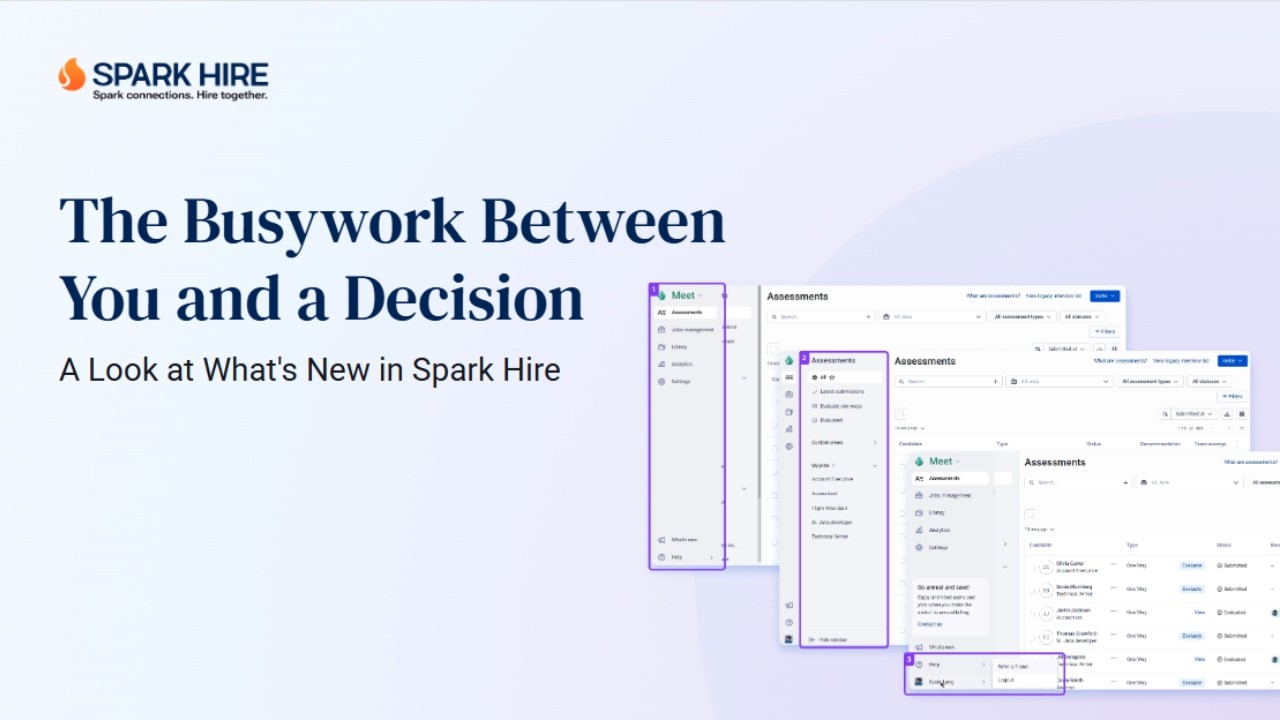
What’s New In Spark Hire: Less Busywork, Better Hiring Decisions
Spark Hire's Alisha Garlow and Ori Horvitz cover new updates for less manual work: smarter resume ranking, automated references, and AI interview sets.
Assessing for Culture Fit: Why it Matters and How to Do it Right
Spark Hire's Josh Tolan and Gary Schwake talk culture fit with Concurrency's Meghan Focht, from defining company culture to interviewing without bias.
Candidate Screening and Selection
Spark Hire's Let's Talk Hiring dives into candidate screening and selection, building a structured process for confident, informed hiring decisions.