
Small Hiring Team, Big Influence: Aligning Your Hiring Process and Business Goals
September 22, 2026
A hiring manager who hires once a year needs more structure, not less. Hear how lean teams build trust and influence without adding to a full plate.
Your hiring team doesn’t need to be big to have a big impact. But when capacity is limited, you can’t carry the entire hiring process yourself.
The strongest hiring teams build influence by helping everyone involved make better decisions.
That starts with getting hiring managers clear on what they actually need, giving them the structure and information to be active participants in the process, and creating an experience that builds confidence on both sides of the hiring decision.
That theme came through particularly strongly in the discussion around empowering hiring managers who may only hire once a year—and are already stretched because an open role means their team is short-handed.
In this session, you’ll learn how to:
- Get beyond the job description to define what’s truly nonnegotiable before the search begins
- Give busy or infrequent hiring managers the structure they need to participate effectively
- Create a consistent hiring experience that builds trust with candidates and hiring managers
- Use technology to remove manual work and create more capacity for the conversations and decisions that need a human
- Build influence by making hiring easier and more effective for everyone involved
People leaders Mackenzie Anderson (Keter) and Jennifer Howell (American Marketing Association) join Josh Tolan (CEO, Spark Hire) and Adam Kazansky (Senior Director of Commercial Revenue, Spark Hire) to share how they’ve built hiring processes that work within the realities of lean teams.
You’ll hear why transparency and communication throughout the candidate journey matter, how better alignment helps both candidates and hiring managers make more confident decisions, and why a great hiring experience shouldn’t be thought of as something you create only for candidates—it should work for everyone involved.
Walk away with practical ways to create more clarity, build trust, and increase your influence without adding more work to an already-full plate.
For those joining who aren’t familiar with Spark Hire, welcome. We’re glad to have you here. Spark Hire helps HR and talent acquisition teams close the gap between recruiters and hiring managers with multiple solutions, including an applicant tracking system, one way video interviews, and a predictive behavioral assessment, all which can be used together or separately for ultimate flexibility. You’ve been around since 2012, helping more than 10,000 customers, many of whom are just like you.
So I wanna dive a little bit deeper into this amazing historic panel that we have here today. First, have Josh To land, founder and CEO of Spark Hire. We also have Mackenzie Anderson, the manager talent acquisition and employee experience at Keter in the Americas. And we have Jennifer Howell, the director of people and culture at the American Marketing Association.
And both Mackenzie and Jennifer are Spark Hire customers, which is an added bonus here. All right, so let’s dive in and I think what’s really helpful for the audience, you know, because we’re gonna be asking you a bunch of questions and you’re gonna provide your experience and some tips, as they get some context in your world, in your environment. So I would love for each of you to tell us about your organization, your role, and the size and shape of your team, Jennifer, why don’t we start with you?
Sure, so thank you so much for having me. I am the Director of People and Culture at the American Marketing Association. We are a membership association that serves marketers through the entirety of their career, whether they’re a student joining AMA chapter at their school, a practitioner who’s looking for learning opportunities and career development and to continually upscale themselves for the job mastering the job they have or getting the job that they want, or academics and researchers who write for our journals, and we have five academic marketing journals. We are a fully remote team and have been for six and a half years. We have team mem we have 67 68 team members across 22 states. So that’s the environment that we’re in.
Excellent. Thank you so much for that context. And Mackenzie?
Yeah. So I lead talent acquisition and employee experience with Ketter. We are a home lifestyle manufacturer. So we make a lot of things that go in and around your home.
We make sheds, garden furniture, deck boxes, shelving units, all those fun things.
And I like to tell people that I’m positive everyone has one of our products in their home, even if they don’t realize it. So if you take a look, you’ll see our name somewhere in your home, I’m sure of it.
And we’ve got three manufacturing facilities in North America, and we’ve got our HR team spread throughout those facilities as well as remote and then some in our offices as well. So I am coming to the group from Michigan and excited to be here today.
Hey, everyone. I’m I’m Josh. Sorry, Adam. I didn’t mean to cut you off. I’m just jumping in the last last intro.
Adam said historic panel. Maybe that’s because I’ve been running the company for about fifteen years here at Spark Hire, launched it back in 2012. So it’ll be fifteen years this upcoming February. He did the read out about the company, so you all know what we do.
In terms of organization, we’re a little under 100 employees spread out across 12 different countries. So we are remote, very much global.
And, yeah, excited to be here with everybody today talking about this great topic.
Excellent. Well, thank you all again. Really appreciate it. So my first question and this one, we’ll start with you, Jennifer. Now how many people are actually doing the hiring work and how does that compare to the size of the business that you’re supporting?
So in total, I think currently if I look at people managers, there are 26 out of 67 manage another person. So at any point when we’re hiring for a role, it could be one of 26 people.
So and I work with all of them. So I am the only person within the AMA that does talent acquisition. So I rely really heavily on the tools at my disposal and really good processes to maximize my time since talent acquisition is not the only thing that I do. And I think a lot of my friends that are in this room who know that when you’re in a small team, you’re often doing talent acquisition benefits and open enrollment, like all of the other things, engagement and all the rest of it. So I use every tool I can possibly use to make sure that that’s efficient.
Great. Thank you for that context. And same question for you, Mackenzie, because I do think it’s helpful for the audience to have an understanding of who’s doing the hiring, how many people are doing the hiring versus how big is the company?
Yeah, definitely. So we have around 400 employees in North America, And I’m the only dedicated ta resource that we have.
We do have HR teams, like I mentioned before, spread throughout North America. And so each of those each of our sites have two HR business partners manager there on-site, and they do a lot of recruiting there. But there’s a lot of balance that we have to find with that. Right?
So I I recognize I have the luxury sometimes of focusing on TA, which is wonderful, but I’m partnering very closely with the HR managers at our sites who don’t have that luxury. And so similar to Jennifer, they are spread very thin. They’re focused on lots of different things. And I get the pleasure and the privilege of getting to help them streamline TA work.
Great. So I everybody in the audience, when we were talking about lean hiring teams in the title, clearly were not, we weren’t lying here. But you both brought up things that I actually wanna use for my next questions for each of you. So Jennifer, you did mention 68 employees across 22 states.
When you have a lean team like that and everyone is spread out so much, what does the influence look like? Like how are you influencing recruiting and engagement from different stakeholders in that spread out environment?
I think it all starts with a really good transparent process. If people know what to expect, it’s less daunting.
Some folks are really seasoned hiring managers and some this is their first time ever, or it was handled a little different way at a different company. So, kind of a lot of it is level setting expectations of who’s responsible for what, at what time. Here is, like, the swim lanes of who’s responsible for what.
Having a really thorough intake meeting with them so that they know I’m here to support, that this is not my, you have a big part to play in it as well because I’m not going to find out what you’re looking for, then I’ll move candidates through. But if you don’t share that with me, then Nora’s going land on your plate. So kind of a really clear transparent process has been probably the most successful way to sort of say it’s the same for everybody. This is the same for every hiring manager. As a candidate, you’ve been through it, and now you’re going to see it from the lens of a hiring manager. So that’s something that I, it just prevents more questions later if they know what to expect.
Absolutely. And, Mackenzie, you basically built the ATS, the implementation and that structure for Ketter. And I’m assuming there’s a lot of people on this call that are going to wanna hear, where do I begin and how does this even start? So what did the infrastructure or no infrastructure look like before you came in to make that change?
Yeah, definitely. So we had a really capable team of people that were working really hard, but they just have very fragmented practices when it came to the TA space. So there wasn’t a reliable place to find all of the candidate information. We were doing a lot of things in email, Excel.
You know, it was not streamlined by any means.
And the process did not look the same for every candidate. So as Jennifer mentioned, it is very important we have, oh, did I lose you? I’m sorry.
No, no.
Oh, you’re good on my side.
Okay, sorry about that. My screen went dark for just one second, but I’m back now.
As I was saying, it’s really important that we have a great candidate experience.
And for them to have a consistent experience that helps level set with the hiring managers and helps level set with the candidates.
And that’s really hard to do when it’s different across the board for everybody.
And so every site was doing something different. Every hiring manager was a little bit different. So first and foremost, I started by helping to understand what we’re doing, those struggles were, and where we had some opportunities. And then we implemented our first ATS in North America, which was awesome. It’s we use spark hire, and it’s been great.
And it’s been great in helping us to have a have a strong candidate experience. So both for the candidate and for the hiring manager. You know, they wanna get that person in the door as fast as they can. And they’re usually spread pretty thin because if there’s an opening, it’s because there’s a need for another person. Right?
So Yeah.
That’s that’s great. And, Adam, I just wanna jump in here. I think it’s it’s good to level set for everybody because you brought up small team, lean team, and that’s the topic, you know, we’re talking about on this webinar today. And just for everybody’s context, it’s all relative. Right?
It’s all relative to the number of managers that you’re supporting, the number of roles that you have open, the number of responsibilities outside of hiring that you have on your plate.
And so all of that is what makes it so critical to have that hiring manager engagement and participation in the process because you need them to be active. You need them to be empowered in order to run the type of process that you know, needs to be run-in order to find a great hire. But that makes it really, really hard when you’re in HR and you’re in TA and you’re strapped for capacity and you’re supporting all these managers across these wide ranges of positions. So I think that’s what we’ll dive into and talk a lot about today is how do we empower those hiring managers to be active participants in the process, especially when they’re not frequent hires. They might hire one time per year. Maybe they’ve never hired somebody at all. They’ve got different expectations of the hiring process.
They are also stressed with the capacity, as Mackenzie just said, because of everything on their plate and the open role. So it’s really about, like, how do you create the influence in order to empower those hiring managers to run the hiring process that needs to be run when everybody really just doesn’t have capacity?
Absolutely. And, you know, when you’re both talking about the talent acquisition structure at your company, and it sounds like you’re carrying the bulk of that weight. I think it sounds like a simple question, but I think the answers can be way more complex. Like when you open a new role, who truly owns it?
In when you are, let’s say a sole talent acquisition professional. And at what point do you start to pull the hiring managers in to step into that process? And Jennifer, start with you on that one.
Sure. So and this is something that’s evolved. So when I talk about processes and, like, here’s our plan and our map for things, like, that changes over time. You know, we adapt as we, you know, as we grow.
And from feedback from hiring managers and feedback that I may have or things that we learn from candidates.
By and large, it it is mine. I’m the one who opens a requisition. I’m the one who creates knockout questions and, you know, what are the things that we must have? What are the nice to haves?
Who’s on the interview team? What competencies do we assign to them? How much time are the interviews gonna take? Is there gonna be an assessment that’s gonna be due?
When is that going to be you? What are you targeting? The start date? Like, all of those things in advance, building it, and then saying to the hiring manager, well, while applications roll in, you don’t have to worry about it.
But I’m gonna have you have my 30 to 50 resumes in this bucket.
And when after I’m gonna give you a couple days to look through that bucket and see do you have enough to go to the next step. And if you do, then we unpublish. So that we’re setting expectations right away with candidates. If you’ve applied, expect to hear back from us within this period of time.
And and that way, it’s just very, very clear. It’s very, very clear.
Great. And, Mackenzie, same question to you. Who is the owner, and when are you pulling in those hiring managers?
Yeah, I like to pull in the hiring managers, honestly, at the beginning. So I do an intake call with them and just try to understand what it is that they’re what problem they’re looking to solve with this hire, right? So if this person didn’t join the org, what what issues would we have?
And to help them kind of think through those knockout questions like Jennifer mentioned, a lot of times they know their roles way more than I do. And so whether it’s using AI tools to review resumes or building those knockout questions or looking in a particular industry or company that we can source candidates from, just trying to understand as best I can from the hiring manager, like, tell me about this industry or tell me about this position. What is it that you want to accomplish with this? Or where should I be looking? Or how can we easily knock out candidates if I know that they’re not going to be qualified?
And then similar to what Jennifer said, a lot of it then comes down to me to look through resumes or whatever else as they’re rolling in.
And then we reinvolve the hiring manager right away once we’ve gotten through those initial resumes and it’s time for them to start screening them.
Great, so it sounds like the two of you have a lot of influence, and of course, not a big team to do it, but Mackenzie, what you said is the perfect segue into the next topic that I wanna go into, and it’s about hiring managers. What do they need? What do you need before that job description is even written? So you were talking about questions that you ask the hiring manager, but are there any questions you feel like you’re asking the hiring manager that most people probably skip? Then Jennifer, I’ll ask you the same question.
I like to ask my hiring managers to give me an elevator pitch. Like you’ve got your perfect candidate right in front of you. You’ve got the thirty seconds, whatever. Why do they want this job?
Because it’s important for us to remember also that it’s not just candidates coming to us.
Like they don’t, it’s not just a one way evaluation, right? Like they are also evaluating us as an organization. So it’s kind of like put your best foot forward.
Why do we want to get this like super stellar candidate?
And that’s a lot of context that I can’t necessarily put into on my own. And so that it’s fun to hear from hiring managers like, oh my gosh, this role’s got XYZ cool project, or they’re going to be doing this awesome thing.
They’re going to be interacting with these leaders in the organization.
And that helps me give a lot of great context, both in what kind of candidate we’re looking for, and then also to kind of help those candidates maintain and grow their interest in our company.
I really like that. Sell me on the role because ultimately you’re going to have to sell the candidate on the right, which is great. Jennifer, how about you? What questions are you asking those hiring managers that most people or some people will likely be skipping?
What quality do you need would is currently missing on your team?
So we all know that affinity bias is very it’s very real, and we’re always comfortable with the things that we know. We know somebody like like this person’s gonna be super successful because this person’s successful, whether or not that’s true or not.
And so we’re always comfortable with the familiar. But by asking, what’s what’s your team missing right now?
And that sort of pinpoints things that could be very real and very, like, I really need somebody who can present to a board. Okay. Well, that’s not in the must haves. So why don’t we change the job just the job posting in order to reflect what you’re missing? You know, and and that way it also gives hiring managers the critical eye to think about what are we missing.
Like, if we did a disc or, you know, some kind of a personality thing, are we all landing in the same place? Is that good or bad? In some places, could be super bad because you’re lacking perspective from other other ways of thinking. So that’s the question that we ask. It’s a little bit outside of the out of the norm but I love to ask it.
Yeah and and both great points. I think hiring managers know all this information. Sometimes it’s hard for them to maybe articulate it on like an intake call, especially if they haven’t prepped for that intake call.
You know, at Spark Hire, we have a very much a hiring manager first led hiring process. We don’t have an internal TEA function, so hiring managers are very involved. But in order to actually post the role, we require that there’s some documentation about that role before it ever goes live and I find that just having them write it down and then asking the hard questions and updating that documentation and fine tuning it until we feel like we’re in a good place is a really helpful exercise, both for them to reflect on it, but then also for somebody like me that’s helping out in the hiring process for me to really understand what they’re looking for and why they’re looking for those things.
I’ll share my screen as well, and I’ll drop this resource for everybody, but made a quick graphic to help a hiring manager define their ideal candidate profile if you all can see it. These are great questions that you all can ask in an intake process. One thing I will call out is I think often when we are working with hiring managers, we tend to focus on the questions that we need to answer in order to post a role and to screen and interview candidates, etcetera.
The last thing here is what I wanna call out and that’s what questions my candidates have about this position and I think it’s really important to answer those things upfront with the hiring manager. So, we are prepared to either proactively answer them in the hiring process or be prepared when they come up on an interview during the hiring process.
Because I think when you can deliver clarity on what you know candidates are going to ask, it gives them a lot more confidence in the organization, in the position, in the manager, etcetera. So I’ll drop the link to this resource. You guys can all check it out in your on your own time, but just thought it was helpful to pull up at this time given the topic.
Great. Thank you, and thank all three of you. Jennifer, so, let’s say you’re talking to a hiring manager, and it turns out they don’t really know what they’re looking for, and now the recruiting process has begun.
What does that cost you in terms of time and process and cost along the way if you have to kinda take a step back again?
I mean, when you’re in a lean team, your time is valuable and your time is expensive because, you know, if there’s a TA team or an HR person on staff, it’s an important role within the organization. So if a hiring manager is ill prepared, then I’m not gonna be able to confidently post it. I’m not gonna be confidently be able to sell it. And they won’t confidently be able to see, like, well, I don’t even know what I’m looking for, or it’s the I know what I know.
I know how I feel when I see it. And it’s like not helpful, like, at all. So, like, I don’t live in your brain. I don’t know what that I don’t know what that means.
There have been a couple of times where we have had to change stream maybe, once we posted a role because the candidates that we were getting weren’t what they were looking for. And I said, okay, well, let’s unpublish it. Let’s look and see, like, what is triggering the kind of reaction from the candidates that we are getting. It might not be evident to me.
So, like Mackenzie said, I might not be fully fluent in the job until they take me through it. So, that’s something that does happen, but it’s like how can we try and mitigate that in advance? Very rarely does a manager get a role unless it’s budgeted for and discussed with them. So it’s something that they should be well versed in, hopefully, but we know that’s not always the case.
Yeah, you want them all the last thing you wanna hear is go find me a rock star at this role. And then like, that’s all the info you need So for Mackenzie, same question to you. You know, let’s say a hiring manager doesn’t articulate well what they really were looking for, but you publish the role and that realization doesn’t come till after the fact. What is that internal cost?
I think it’s the time. It’s the goodwill of the candidates. It slows things down, which let’s be real budget is a real concern. Right? And so when you have a limited budget, being efficient is a great differentiator for candidates.
And so when we slow down, we lose that edge with our candidates.
So it could cost us a good candidate. It could cost us trust in the organization as well.
A lot of times the hiring managers get frustrated. Right? And so it erodes that trust in that relationship there as well.
So there’s a lot of those like, soft costs that we see. But then there is also the cost of the business, the loss of productivity or revenue, whatever else that role might be generating.
And that can be a big struggle. And so in those times, I like to try to if it’s a new role that I’m not familiar with, or if it’s a hiring manager that I didn’t really get a lot of confidence from. I like to calibrate with them pretty frequently. So, you know, if it’s a role I’m comfortable with, I might go screen the candidates, come back to them.
These are like my top five. I think you’re gonna love them all. Let’s get you scheduled. But if I’m not sure, then I might screen a couple, bring it to them, or even just in the resume review stage, just go through that with them.
Like, this is what I think you want. Is it? Because there have been plenty of times where I do that, and they’re like, no. Not at all.
Yep. Let’s Yep.
Move change directions. Right? And I’d rather figure that out in the first two days of having a job up than when I’m have spent, you know, eight hours on phone calls screening candidates. Agreed, Mackenzie. So agreed.
Great. I think that’s that’s the thing with, you know, and I can empathize with hiring managers. Mackenzie, to your point, the business outcome is we’re losing revenue or we’re losing productivity by having that seat open. And those business outcomes are honestly what drives the hiring manager in the first place to have this huge sense of urgency it relates to, like, we gotta post the role.
We gotta start finding candidates. We gotta start interviewing people. And what they might not realize at the front end of their process is if we rush getting the roll out into the wild, but we’re not really clear on what we’re looking for or how we’re going to evaluate for it, it’s actually just gonna take us longer. And so those business outcomes that you’re concerned about are actually just gonna become worse, because we don’t slow down on the front of the process.
And we’ve always had that hiring manager who’s really urgent at the front end, but then wants to add an additional interview or wants to think a few more days about the decision or wants to bring somebody into the interview process to give their input, even though we didn’t agree that that person would be part of the interview process from the start.
And so I think just back to the webinar topic in terms of influence, know what the business outcomes are. We need to make that higher because of their contributions to the organization, and we know the cost of not making that higher.
The best way to influence that business outcome is not from the actual physical work you do yourself. It’s more to empower and engage those hiring managers so they can help you run the process that’s going to take to get to that business outcome.
So I think that’s the challenge being on a lean or a small team where you don’t necessarily have all the capacity to really sit down and think about how I’m going to empower hiring managers. But, if you really break it all down, I think it just goes back to the start. If you can give them context on why these things matter, like why it matters to slow down on the front end of the process, and you can tie it to that business outcome at the end of the process, it starts to make more sense.
It starts to click, and that’s how you end up driving influence because you need them to be empowered in order to run that process to ultimately get to where you guys wanna And you also have to use influence to sort of determine somebody might have all of the skills that you’re looking for, but then once they get into the process, you’re like, the communication style is going to be too abrupt, or this is somebody who would have done great in an in person environment, probably wouldn’t thrive fully remotely.
And these are things you learn in the process. And having the influence to be able to bring that to a hiring manager to say, I know you’re super focused on the skill set. I also need you to think about the stakeholder sensitivity at play here. Can do they operate in a bubble? No. So, like, all of these other pieces come from observation within the interview, and you can wield your influence as a TA person to say, I see that they have all of these skills and also I’m seeing this too. And if I can raise it and if I can influence that decision by having a trust filled relationship, it worked out.
We’ve, you know, sometimes you don’t always get it right, but you try and get it right as often as you can.
Absolutely, and as a hiring manager, the more in I felt when I’ve been hiring, the more information I give to the talent acquisition manager about what I want, the more I can ask their advice when I’m torn, or I don’t know what to ask a candidate. I could say, all right, you know exactly what I’m looking for. Like, what do you think based on your phone screen or based on my notes from the interview? So you have an actual professional in recruiting, like they’re at your fingertips.
So the more information you give them, the more they can help guide you. I can talk about hiring managers and their impact in recruiting forever, but I do wanna throw out our first poll, and then I want us to kinda get to the next topic. So Conor, if you’d be so kind as to put up that first poll. So where does hiring manager misalignment cost you the most time?
Is it that you’re not digging past the job description, you skip talking to the team that is responsible for the role, the non negotiables aren’t defined upfront, or it just varies too much by hiring manager to even say.
So please feel free to respond, really curious to see what everyone thinks.
I’ll throw out what my response would be. It’s about the non negotiables upfront.
I think we just collectively humans, we think a longer list of requirements means we did a better job writing the job description. Mm But it it creates a lot of challenge if you’re not really clear about like what the must haves are versus the nice nice to haves and often times, what you’ll find is things that start as requirements start to become trade offs later in the process once the hiring manager has started to interview some people. So, I think it’s really important to get as clear about those that you possibly can upfront. If there’s changes during the process, you discover something, that’s okay. You recalibrate.
But when you can be really clear about those upfront, you’ll just run a much a much better process.
And so yeah. Just really thinking about those things matters a lot.
Absolutely. And you when you see the results coming in, Josh, it looks like the bulk of the audience does agree that the non negotiables for sure need to be better defined upfront or aren’t defined upfront. And then right behind that is yes, of course, it’s gonna vary hiring manager to hiring manager. So thank you everyone for responding, always really helpful, and it’s great to see where everyone lands on these issues. So I do wanna talk about something that we already talked about, which I love when that happens, and that is the candidate experience has a trust and business outcome, not just a nice to have. So we’re gonna start this one with Jennifer.
The last time had one of our conversations with Josh and with Spark Hire, you talked about human by design was a specific phrase that you used.
How does giving candidates a realistic, honest look at the role change the quality of who accepts and who stays?
I think by being transparent and honest from the job posting all the way through the process, I think it inspires trust. They know what to expect. I’m reiterating it at each step, communicating with every step before the step, during the step, after the step. They feel like they’re being taken care of, and they feel like they matter.
And when you are in an interview stage for a job, you’re competing with god knows how many people, and it’s it’s demoralizing and awful and, you know, you get ghosted and all these things. So if we can do it different and design our process to make sure that we’re treating every applicant, like, if they didn’t they didn’t meet the qualifications, if they live in a place where we can’t hire and we said we can’t hire, yeah, they’re gonna get an email rejection, but they’re gonna get it two days later because I wanna be a monster and be a dream killer because I know how that feels in itself. So
you can tailor these things kind of in how your process works in a way that can really help, like, help candidates feel seen so that at the end of the process, what I hear more than anything is that even when a candidate doesn’t get a job, they still connect with me on LinkedIn or they send a really lovely note saying it’s the best process they’ve ever been through. They feel like they’ve been seen. They felt like we cared about what they had to say, and they felt respected. And that’s that should be how it all works, right?
Like, it shouldn’t just be me. It shouldn’t just be the AMA. And so I think that’s something that if even candidates who don’t get the job still come away with good things to say, I think that’s a good place to be.
Absolutely. And Mackenzie, you’ve said in the past that and it’s clear from what you’ve said before that the candidate experience is way more than just a nice to have. Like it is absolutely an essential part of the process.
How does that translate for you into fewer declined offers or faster hires?
Yeah, that’s really a great question. I am such a big proponent of a strong candidate experience.
I think when our candidates have a strong experience, in many ways, they eventually, if we hire them, become our future hiring managers and that’s the experience they remember. And so we can help improve later by having a strong experience now. That is like a long term view though. The more near term, a strong candidate experience helps them walk away feeling like they’re winning, right? We I want this experience, this hiring experience to feel like a win for everyone involved. So the hiring manager should be feeling like, my gosh, I got the best candidate, The candidates should be feeling like, I’m so excited. I wanna say yes, because this organization is so amazing and the organization’s winning because they have such great talent coming in.
And yeah, I really believe that when we have that strong experience, the whole group wins. And we’ve seen that in a higher acceptance rate, in better retention.
Those candidates are predisposed to like the organization to have a positive experience. When they’ve had strong candidate experiences, they come in excited, they’ve got positive first impressions of both the organization and the team that they’ve interacted with, which really sets them off on a strong trajectory to be successful in the organization.
Well, best part, candidates and hiring managers actually really just both want the same thing. And so you don’t have to trade off the hiring manager experience with the candidate experience.
If you just deliver, like, if you just shoot the gap right down the middle, you’re gonna deliver on on both sides. Right?
At the end of the day, candidates want to have the information they need to make a confident decision about whether or not this is the right opportunity for them.
Hiring managers want information to help them feel confident that this is the right decision for them.
And then when you think about, like, how the metrics play out on both sides, it’s like, okay. Faster acceptance rates when candidates can make quicker decisions, when you’ve given them all the proactive information, or when you run a good process, you haven’t added extra interviews or brought people in that weren’t originally part of the process. Similarly, if you give hiring managers all the information or you’re lined up front about what you’re looking for later in the process, they can make faster decisions, which means you can turn around an offer faster to the candidate. So in a lot of ways, it’s like the same principles that you would apply to empowering and working with hiring managers, they also apply on the candidate side. The challenge is you’ve got to do the work for both sides, That’s where you’re in the middle, but that’s one part of what we do in talent acquisition.
But I think if you focus on that, it really helps you serve serve both needs, and you get to the best outcome for everybody.
Yeah. And, I mean, I think it’s just and and why not then frame it as just, like, it it is a good experience.
A good hiring experience or a good recruiting experience and not limit it to, you know, as an external stakeholder of a candidate, but like, who are the stakeholders? It’s gonna be me. It’s gonna be my hiring manager. It’s gonna be the people that are in the interview.
It’s the candidates. Like, all of those those are all my stakeholders every single So, it should be. It should be something positive, and I know that it can be. And, building your influence by saying, you know, when a hiring manager feels really good about a candidate and candidates already are like, I got all the information I need, obviously the hiring manager gave a ton of information to Jennifer.
She’s telling me she’s answering all of my questions, which is weird because I thought it was so job specific she wouldn’t know. That does ease the process a bit. And so that means that I think in the past six or seven years, I’ve only had three declined offers.
So it’s like, you know, and so it’s kind of like we can do all the work so that we extend an offer and within twenty four hours we have a response.
Yeah. And I think it’s also such a good point of the candidate is trying to answer, not only do I want to accept this role but will I be successful here? Like nobody wants to just take the role without considering what the future looks like at the company. And similarly that’s what you’re trying to work on with the hiring managers.
Like what do we need to evaluate in the process to determine if this person’s going to be successful at the organization? And so, I think when you can, again, when you can focus on those types of things, it helps that person make a much better decision and then, it’s way better, you know, for the long term fit for everybody. So, when you can anchor yourself on that is like, you know, when you’re delivering the experience, the good experience, it’s called, not the candidate experience, not the hiring manager experience. You’re delivering the good experience.
Candidates feel good about like, okay, the hiring manager knows what they’re talking about. They seem to know what they’re looking for. The person in HR or TA is also on the same page. Everybody seems well aligned.
The interview process flowed really smoothly. Like, that’s pretty indicative to me of how operations are going to go if I join the organization and so, I feel confident not only in joining but I feel confident that I’m going to be set up for success to be there for a long time and that’s like the ultimate goal for everybody. That’s the ultimate business outcome. Like, we’re not in the business of hiring people for twelve months.
We’re in the business of hiring people and growing them so they can continue to compound their results within the business.
And same thing for an individual. They’re looking to be somewhere for a good long term fit.
Absolutely. So we were talking a lot about transparency during the recruiting process, and that’s what you need to accomplish in a candidate experience. I’m sure a lot of the attendees are like, all right, how do you do that? Like, can you just give me some of the tips?
How do you handle transparency specifically, when it comes to things like timelines and next steps, so candidates aren’t left guessing? And how does that also show up in acceptance rates? But let’s start with the first part. Like, how are you handling transparency about timelines and next steps? And we’ll start this one off with you, Mackenzie.
Yeah. So I like to tell my candidates, you’re gonna hear from me between x date and x date, or, like, I’m gonna talk to my next meeting with a hiring manager is at this point, and then you’ll hear from me after that.
And then if I get to the point of not having an answer for them, maybe the meeting got pushed or the hiring manager is not sure.
That’s where I’ll just shoot them a quick note. Like, hey, I don’t have feedback for you yet.
I’ll circle back in a week or three days or whatever the timeline is. Or if I know right away, right? Like, gosh, your confidence expectations are above where we’re at. We can’t hire in this location or whatever the reason might be to let them know that right away. If it’s something that I think maybe we’d revisit in the future, you’re out of my budget right now, but I think I’m going to get more budget later. I tell them that like, I’ll just tell them our budgets not aligned right now or whatever the reason is, And then make myself a little note, whether it’s on the calendar or in the ATS, to revisit this person in, I’ll put it a month out or whenever I think the time is.
And so there’s a lot of great tools that are available that we can use to do that. Or perhaps it’s sending them like an automated text message, like three days after or whenever it is. Right? I, hey, I you’re still on my radar. I’ll be in touch soon. If you have questions, let me know.
Mine is similar to Mackenzie’s.
We tend to have a rush at the front. And so, what I will tell a hiring manager is it’s gonna be a rush at the front. And I’m gonna aim for 30 to 50 candidates in hiring manager review. Once you have that, then it’s on you to go through them. It’s your responsibility as a hiring manager. I’ll give you through this date. Please have the folks that you wanna move to the the first official step of the process.
Let me know by this date so that I’m setting expectations with hiring managers too of, like, your time is valuable, so is mine. Are you out? Like, are you know, is there a company event or a conference that is gonna monopolize all of our time? Let’s make sure we’re scheduling around that.
And then we’ll say, great. We’re gonna send all of these to the first stage in the interview on this day is due this day. So we’re time boxing. And that way, when we’re time boxing with the hiring manager and sort of saying this is what to expect from a timeline perspective, it makes it much easier for me when I’m talking to a candidate.
And I’ll say, alright. So I’m doing, you know, phone screens through next week. I would say at the latest, expect to hear from me by this date.
And then I’m just and then I I’m true to it, because those expectations were set at the front end, with the hiring manager. So that’s the way that I kind of keep it rolling. I start to feel real bad when I can’t live up to the timelines that candidates want because I never want it to be like, I am a nerd from you. I got something else.
Good for you. I’m not mad about it. But I never want to be the cause of somebody’s anxiety. Yeah.
If I could add one more thing too.
You know? Sometimes it’s it’s like we’ve got the best intentions in the world, and the hiring manager can be on their own timeline.
Right? And so when I find that that is the struggle that I’m having, I like to if I have reached out and I’m just not getting the responses that I need, I’ll just set up time for me and the hiring manager.
Like I usually call it like working session review resumes. And in that time, I intend to go through it with them. And we’re it’s we’re truly doing it together. Like I’ll share my screen, we’ll, walk through it all together.
And I’d say like half the time they see it and they’re like, okay, I gotta do this before that meeting. And then they’ll cancel the meeting, right? They’ll have it all done. And then right before they’ll be like, we don’t need to meet anymore.
But sometimes they don’t and we walk through it together. Maybe they just are super busy and they need the time on their calendar. But one way or another, it helps move it along a little bit faster when there’s that struggle.
Absolutely.
And I think you both brought up really, you both brought up different examples of what’s really good is to tell the candidate why you’ll get back to them next week. So Jennifer, you’re like, well, I’m doing phone screens for the rest of the week. And Mackenzie, you said, I have to talk to the hiring manager on Monday or whatever it is. But I think part of the candidate experience is like pulling the curtain back on the end, they’re like, well, why is it next week? Why isn’t it tomorrow? Just tell So me I think giving them that additional insight, which is easy to do and it doesn’t you don’t like give away the secret sauce of anything, is a really powerful experience for the candidate.
Hiring process Sorry. Go ahead, Jennifer.
Hire hiring somebody should not be a trick. Interviewing should not be a trick. Like, it it shouldn’t be. It should be honest and transparent.
And so, like, I’m not trying to trick anybody. So I always wanna make sure that I’m transparent at all steps. If something changes, I do exactly what Mackenzie does, and I’ll say, I’m so sorry. I said I knew I said I was gonna get back to you on this date.
We had a company wide event, blah blah blah.
But I agree. I’m right there with you, Mackenzie.
Yeah. And Josh, you were gonna say something?
I was just gonna say, you know, with absent information, people will make assumptions, and our nature is to assume the worst, especially in, an emotionally invested process, like the hiring process.
So you can never overcommunicate. You you know, the more transparent you can be, the better. Hire managers on vacation. That’s okay. Tell the candidates it’s gonna take a couple extra days to make sure they get evaluated in the same way that everybody else. People will understand that. But what you can’t do is not tell them, and they’re wondering why they didn’t hear back after a few days, and then they’ll drop out of your hiring process because they just think you’re not interested.
Absolutely.
So, you know, we’re talking a lot about what lean teams do, and in a lot of instances, lean teams use technology and automation to help. So I really want us to dive into that topic with our last few minutes before we do close out. So Jennifer, we’ll start with you. Where have you used technology and or automation to create that level of capacity, and then what did you do with the time that you got back from it?
Oh boy, a couple of things. So there are some things in an ATS that you can do that are automatic. If they don’t meet these criterias, if they answer this application question wrong, then you can automate a response to them in two days or whatever you wanna do.
If they don’t meet the you know, we say, here’s what you have to have. Our application, literally the question are those same things.
And so if they say, this job sounds rad, this company sounds amazing, but they don’t have the experience and they self select, oh, I only have six months experience in this, they’re gonna get filtered out. So that’s a place where automation has been really helpful for me, to help to narrow the funnel right away. The second place where, a tool has really helped and, is a lot of folks that are looking for work, if they don’t have a job or if they do have a job, how they show up in a first touch, can really vary. And so one of the things that we did, SparkR is actually our first interview stage and we’re like, you can do it on your phone. If you don’t have a laptop, you can do it on your tablet or your kid’s tablet. You know, it’s a free app that you can, that you can download.
You can use it in web based. It’s totally fine. You can do it when it’s most convenient for you and not based on my schedule. And so I will get those interviews coming through routinely six in the morning, seven in the morning, noon to 01:00, from 07:00 until midnight.
And so it’s happening when things are better for them and not better for me. And then they’re able to prepare more and show up in the space that they really wanted, like, this is how I want to come across. And if you’re thoughtful about that, then it can it saves you it saves you your time because you can’t spend all of your days reviewing them and having every single phone screen. And there are some people that, you know, will filter out after that first step.
So those are spaces where tools and automation have really showed up for me.
Great. And same question for you, Mackenzie. Where has, you know, technology and automation helped create capacity for you?
Yeah, so we use a lot of technology to automate communication processes, to do interview reminders, both for the hiring managers, for the interview teams, and then also for the candidates.
And that has been super helpful. So you know, we’ll set up a text message or an email, whatever, like, hey, we’re so excited to see you.
Let me know if you have any questions, and not having to have me remember, right, when is all these all these people going to be on-site? Or when are they interviewing? That does free up a lot of time and bandwidth for me, to be meeting with hiring managers to be creating more, strategic processes, to be looking at our analytics packages or whatever else for leadership to help them see all the great value add that that we’re able to do for the organization.
Absolutely, and then my last question before we get to our final poll is, and I’ll start with you, Mackenzie, where, and as people are listening, they’re like, oh great, automation is wonderful, but where do I use it? So where do you draw the line between automate this and no, a person needs to be in the room for this instead?
Yeah, we So I would say for us, is automating the simple things that don’t take a lot of strategic thought or that don’t take accountability. So the administrative tasks, not the things that we not responsibility for things. So it is that sending the text message reminder or the thank you or making sure that hiring managers get a little reminder if they haven’t reviewed the resume within a certain amount of time, those kinds of reminder things. But then where it’s really important to maintain an actual person is in reviewing candidates and assessing qualifications and making sure that we are reviewing them in an unbiased way, right? That even though the AI tool might say they’re not qualified or they are, that we’re still giving them eyes on it to make sure that that it is what we’re looking for.
Yeah. And very very similar to Mackenzie for me, you know, I always make sure they have eyes on every resume. So if they have, through the application process said, what state do you live in? Oh, I live in Wyoming.
Well, we can’t hire in Wyoming. So they’re gonna get that. Do you have experience in this platform? Or do you have nonprofit experience?
Whatever. No. I don’t have that. Okay. The people that do have it, my eyes are on it.
And so that is something key. And also for the candidates, it’s something that I see a lot on LinkedIn of candidates thinking that they just go into the void and a robot looks at their resume, that’s not the case.
Absolutely. Thank you both so much. So we’re gonna put up our final poll.
More Webinars
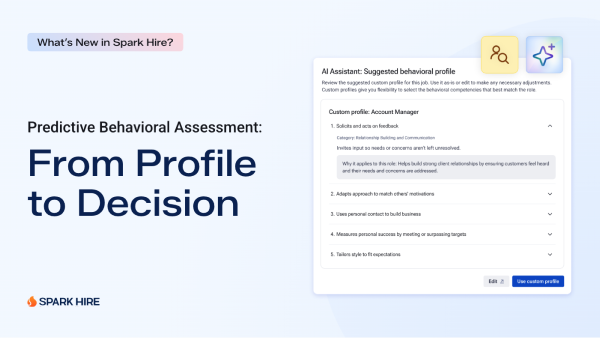
What’s New in Spark Hire: Assess the Behaviors That Predict Success
See Spark Hire’s Predictive Behavioral Assessment in action including the creation of a behavioral profile using AI based on the job description.
Upgrading Your HR Tech: How to Make the Business Case for Change
Learn how Holganix redefined its hiring strategy, strengthened communication, and accelerated hiring through better process design and thoughtful technology adoption.
Become an AI Powered Recruiter: Leveraging AI to Find Your Next Great Hire
Spark Hire's Josh Tolan and Adam Kazansky talk with 1Password's Amber White about adopting AI responsibly in recruiting, without losing the human touch.