
Hire Smarter in 30: A Live Hiring Sprint with Custom GPTs
April 13, 2026
Vague job descriptions and rushed kickoffs cause most of your hiring headaches. Watch a live, 30-minute demo of custom GPTs built for hiring teams.
In this live workshop, we walk through how to hire smarter in just 30 minutes using custom-built GPTs designed specifically for modern hiring teams.
Instead of relying on outdated job descriptions or slow, manual processes, we demonstrate how AI can help you:
- Run more effective hiring manager kickoff meetings
- Create clearer, more compelling job descriptions
- Identify gaps and blind spots in your hiring process
- Build structured, bias-resistant interview scorecards
- Attract higher-quality candidates faster
You’ll see real, live examples of how to use these tools—starting from intake to job description to interview design—all powered by custom GTPs in ChatGPT.
If you’re struggling with:
- Too many low-quality applicants
- Not enough qualified candidates
- Slow screening processes
- Misalignment with hiring managers
This session shows how creating clarity upfront can transform your entire hiring process.
Hello, hello and welcome to our workshop. Today we will be going through the custom GPTs that we here at Spark Hire built as part of our modern hiring toolkit, which many of you have access to and if you don’t yet, we will definitely send it in the follow-up. My name is Joshua and I am the CEO of SparkHire. I’m also joined by Mackenzie and Alicia who I’ll introduce themselves in a minute here.
While we get started to be great, everybody puts in where they are viewing from. I know Gary’s listening and I was about to say where they’re listening, where they’re calling in from like a radio host. But let’s see where everybody’s at in the world. I am in Highland Park, Illinois, which and I know Alicia is also in Chicago too.
We’re both in the Chicago area, but Alicia would say I’m not really in Chicago, which is very true. We were just talking about this offline.
You’re close. So close.
I’m close. To everybody outside of Chicago, I could say Chicago.
It’s closer than Dallas, so you win. That’s fair. That’s fair.
And also while people are putting that in there, speaking of Dallas, anybody if you’re gonna be at Sherm Talent next week, let us know in the comments because Mackenzie and I will both be there. So we’d love to see you there in person.
Good to see you So I mentioned the custom GPTs and I say custom because this is not just like us typing in chat GPT, we’re actually gonna pull up some tools that we built and talk through some live examples with them while we still get going here.
Jessica backstage, if you can pull up the poll about hiring bottlenecks or Anna, one of you guys pulled up in the backdrop. We’ll have everybody take this poll question. I’m just curious how everybody answers this.
So what is your biggest hiring bottleneck right now? We also asked everybody when they registered, what is their biggest hiring headache?
But type one, two, three or four in the chat. One for too many low applications or too many low quality applications. Two for not enough qualified candidates. Three, slow screening process. Four, hire managers not aligned.
What do you guys think it’s gonna be? What would you would you guys guess?
Two. Two for sure.
Yeah. I’d say two. I also feel like, I haven’t introduced myself, but I was a recruiter for seven plus years and actually used SparkHire as well when I was a recruiter. But I feel like one and two both would be the biggest bottlenecks that I went through.
Yes, sorry. I totally jumped over the place. I was like Mackenzie and Alicia are gonna have an opportunity to introduce themselves and then I just kept talking. So my bad Mackenzie, thank you for introducing yourself. Alicia, just quick introduction from you as well.
My name is Alicia. I am the manager of the customer success team here. I’m a hiring manager and I’ve been with the company about five years. So that’s why I would kind of go along with what Mackenzie is saying too. A one or two would probably be what my guess would be.
I think it’s kind of a trick question. Yeah. I think it’s like all the above. Yeah. And I say that because and what I saw in the registrations was a lot of chatter about the things we’re seeing on the screen today.
But thematically to me and I say it’s trick question because I think they’re also highly related and that’s really what we’re talking about today. A lot of it all comes back to creating clarity in the hiring process, specifically upfront in the hiring process because of all the effects that that has downstream, right? We’re really clear about what we’re looking for upfront that impacts everything we do from our sourcing strategy to how we’re evaluating resumes, to how hiring managers view the quality of people that are coming through to the questions we build, the scorecards we assess people on. All that stuff is related to creating clarity upfront. And so thematically when I was looking at a lot of the problems people put in when registering for this event, that was what I saw. It was a lot of stuff around what we see on the screen, a lot of stuff about trying to get on the same page with hiring managers or hiring managers not being able to make decisions.
And to me, all those are kinda intertwined. Mackenzie, Alicia, what do you guys think? Mackenzie, maybe from your background, is that something you ran into?
Yeah, I think it’s a trickle effect for sure. I think if there’s a lack of quality and clarification upfront, then it’s going to trickle down to a longer process and hiring managers not being aligned. So I think you’re totally right there that it is kind of a trickle effect of one causes the other, which causes the next, which causes the next.
So Yeah. The waterfall there is very true. I agree. It’s very interesting to see how they all correlate together, though, too.
For sure. For sure. And it’s great to have both of you on here today, not only because you’re on the Spark Care team, but what hopefully everybody heard in your bios is Mackenzie, your former recruiter. And Alicia, you are a hiring manager. I mean, you’re a manager of our customer success team, but right now, you are a hiring manager. Damn. You have an open position.
And that’s what we’re gonna jump into is our first example. I am gonna share my screen.
So bear with me here as it allows me to do so.
It’s been fun utilizing this whole Chat to BT for our process right now has been super enlightening and super fun to do and really helpful. So I’m excited to talk about it a little bit.
Great and can everybody see my screen maybe you two can confirm that it’s showing up because now I’m viewing it a different tab. All right so what I’m pulling up here this is the modern hiring toolkit that I was referencing again we’ll send this in the follow-up. But this is basically a series of custom GPTs that we built. So we took best practices from speaking with customers, from running our own processes, from talking to people, from a podcast I acquisition leaders, we consolidated all of that and we build these custom GPTs that you can chat with and chat GPT using your own account. So it’s not like just going into a blank chat and getting started and chat GPT answers based on whatever knowledge it has throughout the web. It’s using our guidance. So it’s using our knowledge doc, our instructions, our very clear output template.
And so I know some of you have been using this, and we have also started using it in our own hiring process as well. So this is a doc in the left hand side, you will see these GPTs. The first one we’re gonna start with this prep for hiring manager kickoff.
And the other GPTs are just stacked sequentially here. Now, the cool thing about these and the way that we’re using them is they compound. So one builds on the next. So the idea is that the output from one can be used in the next. And throughout the course of this, you create a lot more clarity in your hiring process and therefore can build a better process around it. So Alicia, you have a customer success manager role open on the team.
We probably haven’t hired for this, I don’t know, in over a year, maybe a little bit longer.
Fortunate to have some- Just about a year, yeah.
Yeah, okay, so just about a year.
And we last looked at the job description about six months ago. And you and I were talking about that before. That seems like a relatively short amount of time. You think. You would think, right.
But the reality is we’ve changed so much over the last six months in terms of some principles on the customer success team, tools they use, how they operate and what that role actually looks like in the day to day.
So even though it’s only been six months, a lot has changed.
And I think that’s really relevant today because I think oftentimes when we go into a hiring process and I say we like the industry. Yeah. We tend to rely on these legacy job descriptions or the hiring manager as the starting point of like, well, me what you got. But the reality is that those can be really outdated.
Good you and I point. Like people don’t think to go ahead and revisit it. A year is not that long. It’s fine. But each day you’re changing and you’re evolving as a company as a team and as the world evolves like we have to just take a look at it.
And we went into diving into it which is so beneficial to see those massive changes.
I’ll let you jump back in but we’re gonna make sure to call that out.
Yeah and also I want to say by the way, this is our first time doing this workshop. So we’re gonna like jump around a little bit. We want this to kind of feel like you all are in the room with us, even though even the three of us aren’t in the same room. So we want this to be very informal.
So jumping in the chat. We’ll try and answer questions as we go. Mackenzie, Alicia and I will probably cut each other off a lot. No big deal.
We talked about it beforehand or we said it’s all good. So we’re just trying to put something out here to really replicate what it’s like to be in the seat. So I’ve got this prep for hiring manager kickoff doc. And before I did a call with Alicia to talk about her position, I use this GPT.
So I followed the instructions in this doc and here is the transcript that I actually had preparing for my kickoff. So I went in, use the default prod help me prepare for my kickoff. And basically what I added, I copied and pasted, we’re not gonna read all of it. But I copied and pasted a bunch of objectives from the company, guiding principles for our customer success team, a legacy job description that like we said was outdated, but some things still carry through.
So I’m gonna scroll all the way through this and basically asked it with this information, how can I prepare for my kickoff? And the output was great. And it came in the structure that we’ve coached this GPT on to give us this output in this format for a thirty minute kickoff meeting.
But I thought it was a little bit long. That was the first thing that jumped out to me is I’m like, okay, I have this meeting with Alicia tomorrow. This is a lot. So then when I went back to it is and basically said, hey, turn this entire thing into a guide for my meeting tomorrow with the hiring manager.
It shortened it a little bit, gave me a little bit of a better guide. But what I really wanna get to it is the final output where I finally asked it essentially to make a one page cheat sheet, like literally just give me the questions and what I should be really tuning myself for to listen into in the conversation with the goal of coming out of that conversation with more clarity. So basically what I got to was this template where I have a few questions across a few different sections about why the role exists, what success looks like, what the scope and top priorities are for the position, what’s the ideal background for somebody in this position, what are things they need to know, what are things they may learn, they can learn on the job, what are the trade offs and flexibility.
So I think a lot of times if you just go to a hiring manager and ask for the requirements, they’ll just dump everything on you without separating must haves and nice to haves. And so that was a big area of focus for us is like, okay, well, where can we be a little bit more flexible? Like when we reject somebody if they don’t have x? If the answer is no, it’s like, okay, well then that’s not a hard, hard must have requirement.
It might be something that sets somebody apart from somebody else, but it’s not a hard requirement. So basically got to this output of questions and that’s when I got on my meeting with Alicia. So before I jump to the next GPT, let’s talk about that meeting, Alicia. So we got in the meeting.
We had these questions. How did it feel compared to other kickoffs that we’ve had with this structure that we came up with?
I think having the guided questions was super beneficial because it allowed me to set the job description aside that I’d looked at so many times and reviewed and thought like, I have this starting place. I need to stick with what I have already. It allowed me just to set that to the side and say okay great what is important to me now? What do I need to look at now and what am I really focusing on and honing in on at this exact moment?
And so it really allowed me to kind of you know pause and really think of the this and now and this time and my priorities. And I think with that, some of the questions that were asked, kind of like what you just said about the expectations of the must haves and the wants and wish haves the versus must haves is a question that really made me stop and pause a little bit of like what is truly something in the past that I might have said is a must have, but really is a teachable skill that I’m okay with developing here versus some experience and something that really comes from that person previous previous experience.
So I really think that that’s one of the questions that paused me there too, is just thinking about that and thinking about for this role specifically, for us, it’s a scale position. So volume versus past experience. Like, what does that look like and what’s gonna be my priority there? So I will say those questions were super beneficial and it made it come out with a job description that was so much more aligned with what I needed to the point where that was such a good base start because I wasn’t starting from scratch, and it was truly in this moment and in this quarter of what I’m looking for.
It really helped me actually hone in a little bit further too with that.
That’s great.
And I Real quick as a recruiter.
I oh, go ahead, Josh.
Go ahead. Ahead. Okay.
Go ahead.
I was gonna say, as a recruiter, I feel like in my previous experience, there were so many times where I was maybe hiring for a role really frequently or I already had a great relationship with the hiring manager. So I was like, oh, do we need an intake call? And, you know, if we were to do one, is our outcome really gonna be much different than what we went into that call discussing? And so I think being able to use this to come up with those questions that we really need to dig into and maybe those questions that aren’t really going to change that job description to really create that clarity. I think that having that and preparing that for the hiring manager to have Alicia’s perspective of, like, it was helpful, I think, you know, would have been really helpful as a recruiter, over over the last seven years. And like Yeah.
Great point. I think we all come into these Yeah. With like, the legacy job description and maybe these you know, the hiring manager comes in prepared and says, like, this is what we need. And I think it’s really what it should start with is these open ended questions that follow a template.
So it’s like we can uncover and get clarity about these things. And now this is where I wanna jump to the next GPT, which is the create clarity post kickoff. Yeah. This is I think where things start to get really cool and this is how we get to the job description Alicia was actually referencing.
So Alicia and I did that meeting on Zoom, we recorded it. And what I did is I used this create clarity post kickoff. And what this is intended to do is take information that you got from the kickoff meeting and help you realize your blind spots and the questions that you still need to answer. So I took the transcript, literally just downloaded it from Zoom, added it to the chat GPT, and also still added the most recent job description we had for this position.
And basically what this is trained to do is give you an assessment of the clarity you have after your kickoff meeting. And it comes in a very good structure and it will tell you what’s clear and what’s not clear. Unsurprisingly, we got the assessment that we’re ready to proceed with hiring AKA start to make a job description.
And that’s because we did a lot of work to create that clarity in the transcript and in that conversation. So what felt good to me was the questions we asked and we got from the prep GPT helped us get to clarity.
We were aligned with what we needed. They really set us up for success.
Totally. But still I was like, okay, well, I still think we can do better because we still don’t have a job description. There’s probably still some things that like we maybe totally have an answer. So in this output, again, there’s a lot of stuff that you can think through here.
But I really wanted to focus on the targeted follow-up questions that the GPT gave us. So it asked us five questions of things that would be helpful for it to know to create more clarity and ultimately get to a job description. So I took these four or these five targeted follow-up questions and just answered them. That’s it.
So I answered them, didn’t even write really robust answers, And that made everything even more clear. And so I wanted to do that for a couple more rounds. So again, came back now instead of five targeted follow-up questions, we had three.
And so I answered these questions and these got really into the nitty gritty of the role. I gave it short, very simple short answers.
And then we got to an even better place.
So you can start to see how like by having the questions answered by the hiring manager and then unpacking the things that still aren’t answered in this GPT, it starts to really, really sharpen what It’s working off of knows about the role.
Yeah. It’s like really worked off of itself super well to the point where it just kept building it up more and more.
Yep and then finally in this last step, just wanted to instead of keep going on the targeted follow-up questions, I wanted to focus on like what’s still unclear or assumed. So I gave it some pretty simple lightweight answers.
Again, it gave me a really good output of what it knows, some things that maybe still are unclear, but I feel like we got to a really, really good point. And so at that point, I said, hey, let’s let’s create a job description using this information that I’ve now provided you with. So the transcript, the targeted follow-up questions that I’ve answered, the things that I’ve cleared up. And this was the resulting job description. So we’re not gonna go through all of it. But Alicia, I just wanted to get quick sentiment from you of, I sent you this job description and said, here’s what the output was after all the work that you and I had done upfront.
I guess how much work was still needed to fine tune it? Like it was important to now have the Very low. To like make it like perfect Yeah. If you will. But I feel like we got to a good point. And how did it compare with, like, starting with a blank slate?
Oh my gosh. It was so much better than starting with a blank oh, blank slate and starting with the previous one. This was the perfect thing to have.
It I’ve had very little work that I needed to do to add on to it. Obviously, like you said, there’s little pieces you’re gonna do. You know, we tweaked a few terms in there and made it more smart hire friendly and, you know, drove down a little bit about, you know, who we are and what I wanna have with that, but it was not much work needed. And that really actually took a lot of time out of my planning, which was great in a way that I needed that to happen. I was able to get that job description up and get that job posted so much sooner, a day or two sooner than I, you know, initially anticipated, which a day or two seems like a short amount of time but in the end it’s not actually.
So it was really a valuable add and a valuable you know add to my time to be able to just to have this ready to go with very little tweaking meeting. And starting not from scratch was just so massive. What I found too is that there weren’t really any different gaps in there. There weren’t any, like, misalignments in there through you going ahead and utilizing, you know, where you the post clarity kickoff there, it really kind of finalized those gaps that were from that initial kickoff call there, and it really kind of, you know, brought those down a lot less. I think the other thing, that was super beneficial about this is that this the job description, clarity, and depth in general has allowed it to where now I am currently in the middle of hiring for this role.
And I have a lot of really good candidates to the point where I’m a little overwhelmed and shocked in a great way of how many good candidates because they’re finding that they’re aligned to it and candidates are really seeing everything that they need from that job description which I know Mackenzie can touch on as a recruiter that having a really well thought out job description is really important and key to it to get the right candidates and to get the right quality candidates as well.
Yeah, I think just to kind of mirror on that, right? Like when you think about intake call and job description, you’re immediately thinking about like that initial hire and like making that a faster process. But I think when you really dive into having that clarity of what you’re looking for, not just on your end, but on the candidate’s end too, it makes the process post hire even better. Right? You’re not worried about if that first ninety days are gonna be like, oh, this is the role I applied for because the job description didn’t match it. But when you really have that clarity and are able to dig in early in the process, I think that it helps not just hiring, but onboarding and beyond as well.
Love it.
Well, thanks so much for all the insight on that first example. We’re trying to keep this to thirty minutes. So I’m gonna jump now to example number two, which is actually external to our organization. So one of the things we wanted to do was use the other two GPTs, refine a job description and define an actionable scorecard. But we wanted to use it with some real examples from the audience. So fortunately, we were able to get a volunteer that was allowed us to use their job description for this. So I’m gonna pull that up.
We’ve got a little workspace for this session that we were working on. And so this is a job description from our commercial for a commercial loan officer. And we’re not gonna spend a ton of time on this doc. I know Mackenzie, Alicia, I all have comments on it, but I really wanna get into the GPTs.
But I actually thought this was a really good job description. So kudos to CVS Cooperative Business Services for putting together a really good job description.
Like, if I were to look at this, there were a few things that we called out that we thought could be improved. But overall, I thought it did a really good job. First of all, it’s an ad job ad and describing the company and pitching the benefits and why work there. I think where and I think what all of us aligned on when we were looking at this was there was just a little bit of ambiguity in terms of some of the terminology that was used, some language that might be used internally, but to a candidate on the outside, they might not know exactly what you’re talking about.
And then I think also one of the things that we saw is there’s a lot of responsibilities with this position. So if I was recruiting for this role, I want to know, is there like certain aspect of this role that’s gonna take higher priorities and other aspects that are mentioned and how do we have that show through in the job description. So we’re gonna jump ahead to the GPT. I know we were we were gonna go through some of these comments, but I just wanna give that backdrop before we got into it.
But again, thanks to As you jump into that GPT, think it’s important to know that that’s something that the clarity section of it really helped at least in the role that I’m working on to go ahead and to help me see the priorities to just find those there as well as thinking about those external and those internal verbiage for me, which I think is a big part to call out there too.
It’s like, is the candidate gonna know what I mean by this term in here? And it kind of helped kind of us identify that.
Totally. And we’ll go through this part relatively quickly for everybody on here. So don’t feel like you’ve gotta read everything on here. But basically what we did was we took the job description that was provided to us.
We put it in a refine a job description GPT, which is basically trained to look for ambiguity in the job description and call out again, similar to the create clarity post kickoff. This is now you’ve got a job description and it’s meant to call out things that you’d wanna clear up before proceeding to post it. So we put it in and basically it came back and said need some refinement. Unsurprisingly, it said there’s a lot of things that it’s doing well.
This output is in a structure that we’ve coached it on. So we’ll tell you things are working and the key gaps, suggested refinement areas. It will give you all of this. What I did after it gave me this is I just said, hey, give me three to five total questions that’ll help me clarify what’s needed to refine this.
And it gave me three to five questions, which if you look at them each individually or as a group, you’ll see how these tie back to what we were trying to get after in the kickoff meeting. So it gave me these great questions about what success looks like, what they’re primarily responsible for, what parts of the deal life cycle do they own, So on and so forth. And of course, this is not our company. We’re not hiring for this position.
So we had to make up some of the answers, but we did it the best we could. Fortunately, Mackenzie also has some background in the lending industry as a recruiter, so we were able to lean on some of her experience there.
But basically just answer these questions just as we did in the other GPT.
Now, again, this isn’t our role. Came back, said still need some refinement.
So we went through this, looked at it a little bit more and basically came back and said, I guess if I go back up to my last answer, just doing this in real time here. One of the things that I said is what differentiates a strong performer from an acceptable one?
For me looking at a loan officer from the outside, wanted to, how do I convey that it needs to be somebody that’s proactive, but not in a way that puts pressure on the potential borrower. So somebody that follows up that’s diligent, but as borrower first in the sense that they’re proactive to get the borrower the answers they need to feel comfortable moving forward and making a decision in the process. And so that was one of my answers here about what makes somebody really good in this position.
But it came back and said, hey, that’s a good thing to look for. But essentially that’s hard to like how do you evaluate for proactiveness in the hiring process? So what I asked it to do is convert proactiveness into essentially a couple of bullet points that are actually valuable in the hiring process. And that’s what we ended up adding to the job description. So again, we’re not gonna read through these.
And as I scroll a little bit more, if Mackenzie or Alicia, you guys have any comments on this, but I thought it got to a really good point of just making everything about the job description more clear, both in the language for external people to better understand versus the internal language. And then also like what we’re really looking for as a company.
Priorities were really well defined at the end of that, like, compared to initial as well as that verbiage was, like, much more clear as someone from the outside who has no experience with loans and was like, I have no idea what we’re talking about here. Yep. I found that really, the difference was stark.
Yep.
Yeah. And I just to kind of follow-up on, like, the proactiveness and, like, you know, really figuring out what is actually definable. I think every job description, every recruiter, every hiring manager is somewhat kind of guilty of, you know, throwing out things that you can’t actually measure. And how I would measure is different from the hiring manager. So really being able to dig into those and come up with, you know, questions or just being able to use those kind of clarifying questions or clarifying parts of the job description, being able to then make it consistent across the board, making sure that there are no biases, making sure that I’m gonna be evaluating these candidates the same exact way as the hiring managers will be as well.
Think that’s a really good call out there Mackenzie is the difference between the hiring manager and the recruiter. Because like you said in the past, like you as a recruiter had ideas for what you’re looking for for the company and for the different departments because you’ve done this for the entire company and the departments. Whereas a hiring manager, I know what I’m looking for for my specific role. I might not be thinking about it in the big scale, I am, but I’m really thinking for my specific role.
So this helps kind of create and close that gap right there together too, which I think is a big big pull out, big form piece to think about.
Awesome. Good insight. Well, I know we only have a few minutes left. I wanna jump to the last GPT.
So basically, again, as I mentioned at the beginning, these are meant to compound on each other. So what we did is we took the output from this refine a job description GPT, and we popped over to our define an actionable scorecard GPT. And basically what that means is you can tell it, hey, I need a scorecard for this step in the process. Here’s the job description, and it will help you not only build a scorecard, but the appropriate questions based on that step.
So in this example, because we’re Sparkcard and one of our solutions that we offer is one way video interviewing, we said we need a scorecard for a one way video interview, and we want the questions for as well. And here’s the job description, which again, I just pasted from the refine the job description GPT. It comes back with this really good output in a structured format that tells you essentially what it understands about the role. So it basically confirms to you that it’s anchoring the scorecard of these questions based on the job description, comes back with like the purpose for this interview round and what we’re gonna evaluate people for in the scorecard.
And then along with six to eight questions for a one way video interview that’s generally appropriate. Now, what I noticed in here though, is in the scorecard and you’ll see as I responded to it, it started mentioning something about credit decisions, which in the job description, we did not say they were responsible for credit decisions. So again, this is the importance of human in the loop. So I went back and said, this person’s not responsible for credit decisions.
And basically the output was an updated version where they just went back, updated that section of the scorecard, made it more about credit awareness and deal structuring, and updated the questions accordingly. And so then finally, I just said, give me the scorecard and questions in one clear format. And basically what you’ll see is the resulting output as a scorecard with a handful of things we’re trying to evaluate, why it matters anchored in the job description, what strong evidence would be like in the interview, what weak evidence would be like in the interview. And then finally, the six questions for the one way video interview, and you can see how each question is tied to an aspect of a scorecard.
So that was our output. And so what basically we’re trying to show you here is we didn’t wanna do anything crazy for this workshop. We’re not vibe coding anything. We’re not building anything, but we’re not using vanilla chat GPT.
We built these GPT specifically for hiring with all the best practices that we’ve learned over the years. And we wanted to show you how if you start the process upfront and really pursue clarity upfront and use tools like these GPTs to help you, you can get to a much better place very quickly in terms of the assets and the things that you need to run a really, really good process, which ultimately comes full circle to a lot of the pains that we were talking about at the beginning of the session. I know we’re the thirty and minute I’d love to, I think we’d love to go into questions and talk a lot more, but I wanna be respectful of everybody’s time.
So I think we’re gonna wrap up. So Alicia, Mackenzie, thank you so much for all of your insight throughout this. We got through a lot in a very short period of time. It was indeed indeed an an AI and hiring sprint.
So really happy we were we were able to do it. Hopefully, everybody enjoyed it and got some value out of this. We’ll send some great follow ups. And then, of course, if you’d love to learn more about SparkHire and our different solutions, head over to sparkhire.com.
Hit that book a demo button, and our team would love to talk to you about how you can accomplish all of these things in our software. So thank you all so much for joining, and have a wonderful day and weekend.
Thank you.
Bye.
Have a great weekend, everyone.
More Webinars
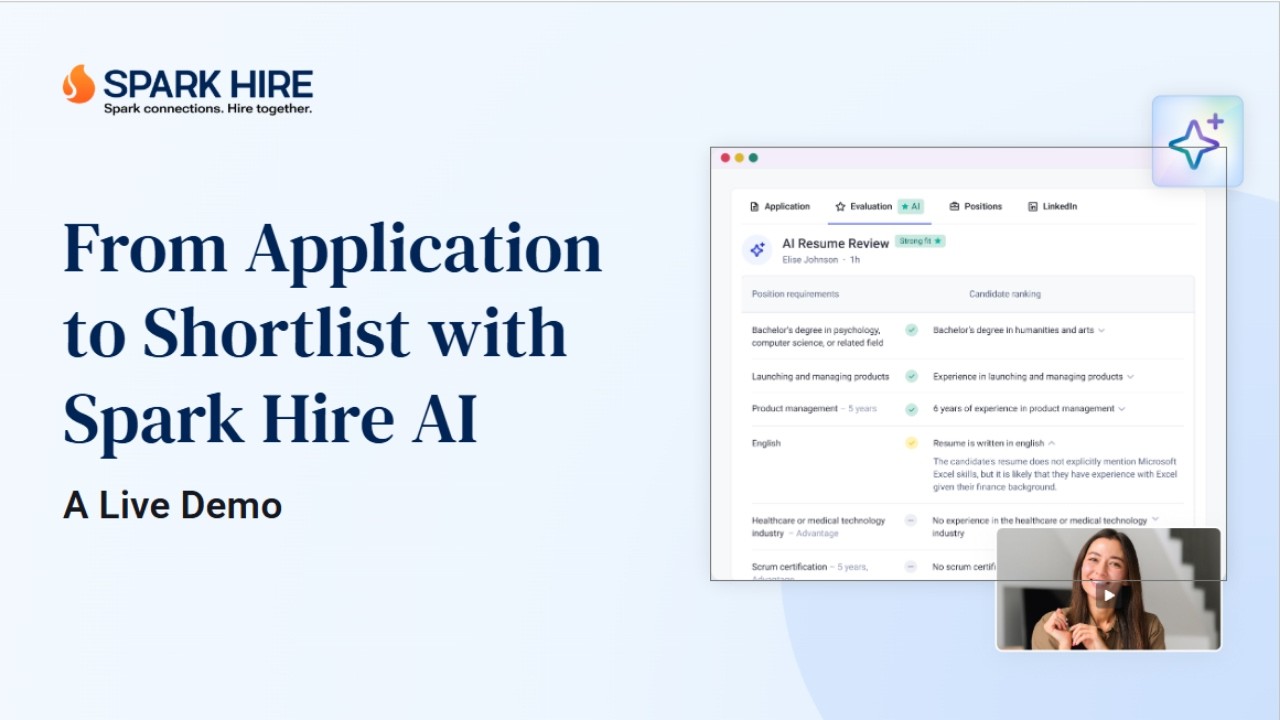
What’s New in Spark Hire: From Application to Shortlist with Spark Hire AI
Sorting applications takes time lean HR and TA teams don't have. Watch Spark Hire AI narrow a stack to a shortlist, while humans still make the call.
Hiring in the Age of AI: Ethics, Authenticity, and Tech
AI makes hiring faster, but it also makes a polished answer easier to fake. Watch hiring experts on using AI for scale without losing human judgment.
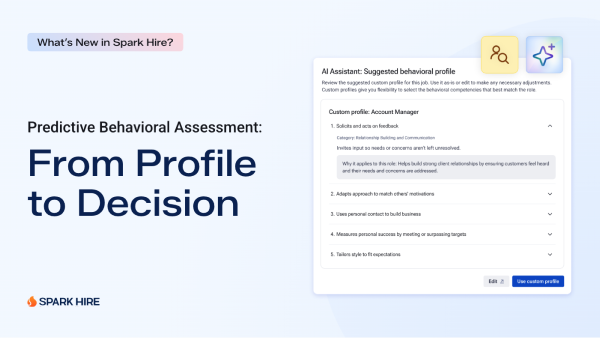
What’s New in Spark Hire: Assess the Behaviors That Predict Success
See Spark Hire’s Predictive Behavioral Assessment in action including the creation of a behavioral profile using AI based on the job description.