

Data can reveal surprising patterns in your hiring process – unusual spikes in application volume, inconsistencies between assessment scores and interview performance, or red flags in reference timing or submissions.
While these patterns might hint at larger issues, what’s more powerful is using data to build a hiring process so robust and fair that gaming it becomes pointless.
The best hiring decisions happen when you trust and lead with the data.
But knowing which metrics actually matter and how to use them to create better outcomes?
That’s where most teams need guidance.
For that, we’ve got you covered.
Worried about some shady behavior in your interview process? Here are some proven ways we’ve found to reduce candidate cheating and fraud. Get it for free in our guide.
Table of contents
Key Takeaways
- Look for patterns, not “proof”: Data can’t always confirm cheating, but it can reveal inconsistencies in applications, interviews, or timelines that warrant closer human review.
- Design processes that reward authenticity: Predictive talent assessments and structured video interviews make rehearsed or gamed answers far less effective.
- Use hiring technology to build mutual trust: Transparent tools with audit trails and ethical AI create accountability for both candidates and hiring teams.
- Continuously improve with feedback loops: Tracking metrics like conversion rates, time-to-hire, and quality-of-hire helps refine your process so it gets smarter and fairer over time.
How Data Can Help You Spot Unusual Hiring Patterns and Potential Issues
While data can’t definitively prove someone is cheating, it can highlight patterns that deserve a closer look – and more importantly, reveal opportunities to strengthen your hiring process.
Abnormal Application Data: Assessments and Reference Checks
The most obvious red flags show up in your application data. You might notice clusters of applications with suspiciously similar language or formatting, especially when candidates apply within minutes of each other.
Assessment inconsistencies are another telltale sign: when a candidate scores exceptionally high on a technical test but struggles to explain basic concepts during the interview, that’s worth investigating.
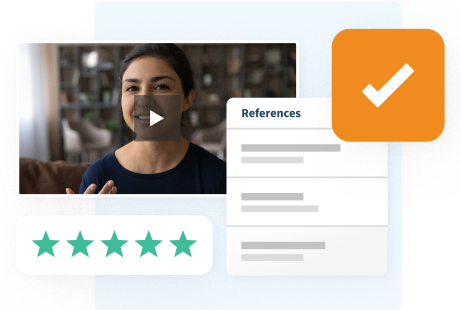
Reference checks can also reveal irregularities. Modern HR technology, such as Spark Hire’s automated reference checking software, can flag when reference requests and responses come from the same IP address, or when multiple candidates submit references with identical phrasing or unrealistic response times.
Behavioral Inconsistencies: Candidate Responses
Video interviews and talent assessment tools often reveal the clearest signs when something doesn’t quite add up.
For example, a candidate might deliver a flawlessly rehearsed answer to a scripted question but struggle when asked to expand on their thought process or respond to a follow-up. That contrast between polished delivery and real-time adaptability can signal memorization, external coaching with AI or other tooling, or a lack of genuine experience.
Talent assessment software, such as Spark Hire’s research-based and backed Predictive Talent Assessment, offers another lens.
Unlike skills tests, which are often scored based on “right” or “wrong” answers, Spark Hire’s behavioral assessment measures how candidates are likely to perform in real workplace scenarios. Because candidates don’t know which competencies are being measured, it’s far harder to game the system.

When assessment results show tendencies that don’t align with how the candidate presents themselves on video, that inconsistency is valuable data for deeper evaluation.
Timeline data across these touchpoints adds yet another layer. For instance, if a candidate races through complex assessment questions but hesitates or contradicts themselves during the live interview, it may indicate outside assistance on one end or exaggeration of skills and/or experience on the other.
Similarly, unusual pauses, delays, or overly uniform response timing across multiple interactions can flag areas for closer review.
These types of behavioral-based data help you identify which parts of your hiring funnel are vulnerable and guide you toward more effective candidate evaluation methods that naturally discourage gaming while better predicting job fit and success.
3 Smart Ways HR Technology Can Help You Overcome These Challenges
You can’t control whether a candidate tries to game the system – but you can control how resilient your process is.
By putting guardrails in place, you create a hiring experience that’s ethical, fair, and far less tempting to exploit.
Build Anti-Gaming Assessment Strategies
The first step is to rethink the kinds of candidate assessments you rely on.
Traditional skills tests often create a right-or-wrong scenario that’s easy for outside help or AI to manipulate. A candidate with the answers in front of them might ace the test, only to falter when asked to explain their reasoning. That’s why more teams are shifting to behavioral-focused tools.
A behavioral talent assessment tool, for example, measures how someone is likely to respond in real workplace situations rather than whether they can recall a single correct answer. Because candidates don’t know which competencies are being evaluated, it’s far harder to “game” the system.
Pairing these assessments with one-way video interviews makes the process even more cheat-resistant. On video, candidates must articulate their experiences in their own words. Rehearsed stories may sound polished at first, but when follow-up questions reveal gaps, authenticity quickly rises to the surface.
Introduce Data-Driven Feedback Loops
The real strength of HR technology lies in how it helps you improve with every hire. A one-off instance of fraud or bias is concerning, but the bigger issue is what it reveals about your process.
You’ll start to see patterns emerge by tracking key hiring metrics like:
- Conversion rates by talent assessment type
- Time-to-hire across different evaluation methods (i.e., a one-way video interview vs. a behavioral assessment)
- Long-term performance of new hires
For instance, you may find that candidates who perform strongly in predictive assessments consistently deliver better results on the job, while certain interview formats introduce delays or bias.
With dashboards that visualize these trends, teams can make informed adjustments before small issues become systemic problems.
Instead of “chasing cheaters,” you’re building a process that naturally rewards authenticity and efficiency — one that gets smarter and fairer over time.
Create a Hiring Culture of Transparency and Fairness
HR technology helps teams create a process that candidates and hiring teams alike can trust.
When candidates understand what to expect, they’re less likely to look for shortcuts. And when hiring teams have a clear record of how decisions were made, bias has fewer places to hide.
For example, standardized video interview platforms don’t just ask every candidate the same questions — they also create a digital record of responses. This transparency means hiring managers can revisit interviews, compare answers side by side, and share them across the team without relying on memory or impressions. The result is a fairer evaluation process where every candidate is measured against the same benchmarks.
Technology also makes it possible to layer insights across tools. For instance, tracking candidate timelines can reveal whether someone is moving unusually fast or slow through certain stages compared to the average. If a candidate breezes through a predictive assessment but then hesitates significantly during a structured interview, that contrast gives your team a cue to dig deeper.
This kind of transparency builds accountability on both sides. Candidates see a process that values fairness and consistency, while hiring teams gain confidence that their decisions are rooted in evidence, not bias or gut feel.
Tips To Structure Your Data-Driven, Cheat-Resistant Hiring Process
HR technology can do a lot, but it can’t fix a broken hiring process.
So that’s a great place to start!
Here are some ways to get to a hiring process that helps you find the right talent responsibly.
Start with Your Goals (Not Your Fears)
The best way to create a hiring process that’s resistant to cheating isn’t to focus on what you want to avoid — it’s to define what you want to achieve.
Start by asking:
- Why do we need this role, or what problem will this role solve both now and in the future?
- What does success look like in this role?
- Which behaviors and competencies are truly non-negotiable vs the ones that are simply nice to have?
When you’re clear on those answers, you can build candidate evaluation criteria that reward authenticity rather than rehearsed responses.
For instance, if adaptability is essential, structured video interview questions can surface how a candidate reacts in unfamiliar situations.
Choose Hiring Technology That Enhances Rather Than Replaces Human Judgment
When building a cheat-resistant, data-driven hiring process, the right HR technology should amplify — not replace — your team’s decision-making power. Look for tools that embrace transparency, maintain a clear audit trail, and center ethical AI usage.
Your hiring tech should never be a “black box.” Recruiters should always be able to see exactly why a candidate was scored a certain way and which evaluation criteria influenced the outcome. This level of transparency helps hiring teams understand algorithmic logic, question anomalies responsibly, and make better-informed decisions.
Look for hiring systems that leave robust digital footprints of every action, including:
- What interview or assessment questions were asked?
- How did candidates respond?
- How were candidates scored?
- Who made the final move-forward or hiring decisions?
Find a platform that integrates features such as interview summaries, standardized scorecards, and AI transcripts, which enable your team to trace every stage back to its source and review candidate interactions easily.
Last, but certainly not least, ethical guidelines should drive product design. Work with an HR technology solution rooted in fairness, data privacy, and bias reduction, with human oversight as a central tenet. You can cross-check this with regular audits and compliance measures like SOC 2 Type II reports.
If you’re using AI features (which you should, if you don’t want to get left behind), focus on ones built to assist hiring, not supplant human judgment.
That kind of disciplined alignment between tools and team helps turn data into a trusted partner — not a substitute — for decisive, fair hiring.
Improve Your Hiring Process With The Right Data
When data is used ethically and strategically, it strengthens every part of the hiring process — making it fairer, more consistent, and harder to game.
The goal isn’t to build a fortress against cheating, but to create a system so effective and transparent that dishonesty loses its appeal.
Ready to see how Spark Hire can help you build a smarter, cheat-resistant hiring process? Book a demo today.


