
Find the Signal: Separate Real Fit from Resume Polish
The applicant volume problem at the top of the hiring funnel didn’t happen by accident. Several things converged to create it:
- Easy Apply
- AI use by job seekers
- Remote and hybrid work
“Easy Apply” removed friction from the application process. The side effect is that applying to a role only takes a few clicks, so recruiters are bombarded with huge applicant volumes.
AI has made it easier to tailor a resume and cover letter to a specific job description in minutes, which means a larger volume of applications that look nearly identical.
Remote work expanded the geographic talent pool, adding volume to an already noisy hiring environment.
The resulting bottleneck these things have created isn’t just a time problem. It’s a quality problem.
When there are too many nearly-identical applications to review carefully, shortcuts take over: years of experience as a proxy for capability, brand-name employers as a signal of quality, keyword matches as a substitute for genuine fit. The candidates who clear those filters aren’t necessarily the strongest fit, but they’re the ones who look the part to an algorithm.
We’ve mapped out a four-step process for addressing these challenges. Each step has a quick breakdown of what to do, along with the common mistakes.
The steps build on each other, but you don’t need all four in place before the next role opens. One improvement at the right stage will have an immediate downstream effect.
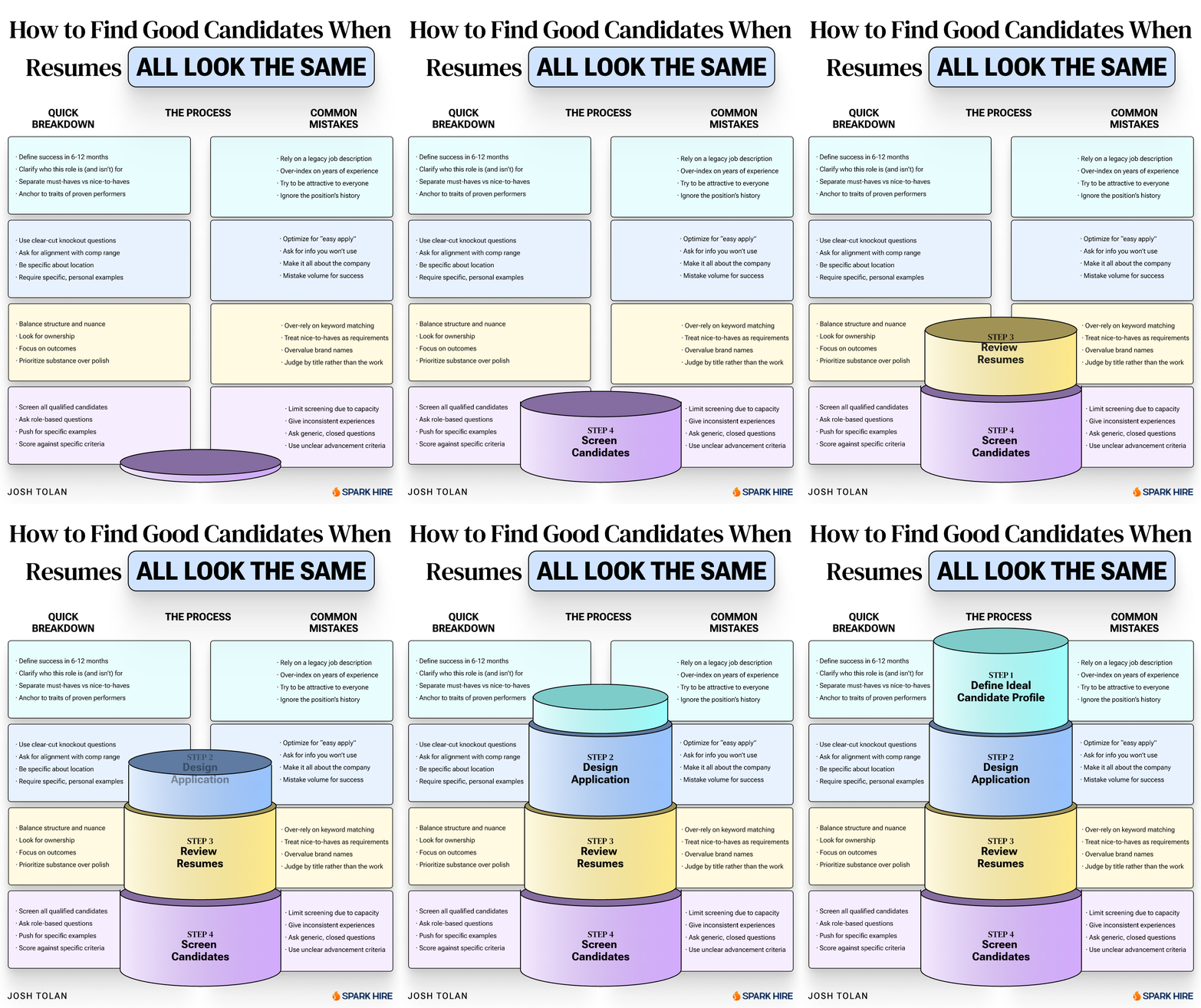
Four Steps to Identifying the Best-Fit Candidates
Define Your Ideal Candidate Profile
A job posting built on vague details will attract a vague pool.
The specificity you build in at this stage determines the quality of every application that follows, which is unsurprisingly why we spent a lot of time discussing this in Where it Starts: Create Alignment with your Ideal Candidate Profile.
- Define what success looks like in 6 to 12 months.
- Clarify who the role is and isn’t for.
- Separate must-haves from nice-to-haves.
- Anchor your criteria to the traits that have made people successful in similar roles.

The most common mistakes:
Relying on outdated job descriptions, over-indexing on years of experience, trying to appeal to everyone, and ignoring what the role’s history tells you.
Design the application
The mistakes that undermine this step include over-optimizing for an easy-to-submit application, asking for unimportant information just for the sake of asking, making the application entirely about the company without providing enough details for the candidate to self-filter, and treating high application volume as a sign of success.
Volume does not necessarily equate to quality. A smaller pool of genuinely aligned candidates is worth more than a large one that requires hours of manual sorting.
- Use clear knockout questions that surface dealbreakers.
- Ask for alignment on the compensation range early on.
- Be specific about location and work requirements.
- Ask for specific, personal examples rather than generic responses.
Review resumes
The common mistakes at this step are over-relying on keyword matching, weighing nice-to-haves and must-haves the same way, overvaluing brand-name employers, and judging candidates by title rather than the work they actually did.
A resume that reads well isn’t the same as a candidate who performs well. The review stage is where performance and appearance start to separate.
- Balance structure with nuance.
- Look for evidence of professional ownership, not just participation.
- Focus on project outcomes rather than individual responsibilities.
- Prioritize substance over polish.
Screen candidates
The goal at this stage is to give every qualified candidate a real look, not just the ones who had enough resume polish to rise to the top of a stack.
Screening limitations due to time constraints, inconsistent candidate experiences, and generic or closed-ended questions tend to be the most common challenges to overcome at this step.
- Ask role-based questions.
- Ask for specific examples rather than general descriptions of how someone would approach a situation.
- Score against a pre-set scorecard so decisions are based on evidence rather than impression, and the same criteria across every candidate.
Where to Start: Connecting the Beginning to the End
Pick the step where your current process is most likely to let a strong candidate fall through or a weak one advance. For a lot of lean teams, that’s either Step 1, where the role isn’t defined clearly enough to attract the right applicants, or Step 4, where capacity constraints mean not every qualified candidate actually gets screened.
Fix one.
Small improvements early in the process will make improving steps further within your hiring process easier, and the improvements further down the line will make the earlier problems more visible.
Real-Life Examples of How to Attract Stronger Candidates
Define Your Ideal Candidate Profile
But with all things in the hiring process, the better your inputs, the better your outputs.
More specificity upfront leads to a much clearer hiring process for all involved.
For example:
We often see things in a job description, such as “5+ years of experience in HR.”
But what does that actually mean?
5 years in one role at an organization can be a very different experience when compared to someone else’s 5 years of experience.
Unpacking this with a hiring manager is critical.
Flip the requirement and ask this question:
“What experience would you expect someone to have after working in HR for 5 years?”
Often, this is really what they’re looking for.
Design the application
A knockout question is an often-overlooked way to gain alignment as job seekers apply for your position.
The question is presented on the application, and you determine which answers may disqualify an applicant.
The common mistake that we see is that organizations will use something like:
“Do you have 5+ years of experience with X?” to which most applicants will just answer “Yes,” rendering the question ineffective.
Instead, knockout questions are a great way to set proper expectations about hard requirements or conditions.
For example:
- Question: The base salary for this position is $90,000. Does that align with your compensation expectations?
- Question: This position requires employees to be in our office located in Chicago, Illinois, 4 days per week. If hired, would you be able to meet this condition?
Applicants either answer “yes”, self-select out of the process, or “no,” and you can process the rejection (and associated candidate communication) with your applicant tracking system.
Review resumes
The work you do when defining your ideal candidate profile shows up big time when you’re reviewing resumes.
Whether you’re using AI to review resumes or doing it all manually, the “output” (aka your review) depends on the input (aka your clarity).
A common mistake is focusing too hard on the title or a logo seen on a resume.
For example:
-
Title: A VP of Marketing at a 10-person org is very different from one at a 500-person entity. What’s more aligned with the role you’re trying to fill and their responsibilities?
-
Logo: It’s easy to be impressed by “Ex-Amazon” on a resume or LinkedIn profile, but odds are, your organization is vastly different. That doesn’t mean someone with this on their resume should be excluded from your process. It means that you need to focus on the nuance of what they were actually responsible for.
Screen candidates
Two classic mistakes are made here, and both are byproducts of today’s hiring realities.
Mistake 1: Having a lot of applicants who look the part on paper, but not having the capacity to screen all of them, so only a fraction are given the opportunity.
This is where AI, automation, and asynchronous options (e.g., one-way video interviews) are your friend.
Yes, ideally, you’d have infinite bandwidth to concurrently speak with all applicants who are qualified on paper, but that’s just not your reality.
So, thinking outside of the box with solutions that already exist allows you to focus on what matters – ensuring candidates are given the opportunity they deserve (which also means you don’t leave any stone unturned).
Mistake 2: Asking generic questions that allow for easily scripted responses and no substance to understand who can actually do the job.
Everyone can make themselves “look the part” when you don’t get specific. Asking questions that require real-world experiences woven into the responses is how you separate who can talk about it from who can actually do it.
For example:
Rather than asking questions like:
- “Why should we hire you?”
- “What experience do you have with X?”
Ask questions like:
- Tell me about a time a major outage or platform failure occurred at a previous job. How did you lead your team through the escalation and communication process?
- Tell me about a time you dealt with a recurring customer issue that required partnering with Product or Engineering. How did you approach the problem, communicate with the customer through the process, and ensure alignment between teams?
- Tell me about a time you created or improved internal knowledge documentation for a technical product. How did it impact your team’s efficiency or customer outcomes? Have you improved or implemented other processes, outside of knowledge documentation?
When in doubt, reframe the question so the candidate has to give a real example.
As with everything in hiring, specificity wins.