
Why You Need an Applicant Tracking System
Most teams without an applicant tracking system know that their hiring process is broken. You feel it every time:
- You are searching for a resume buried in an inbox
- A hiring manager goes quiet
- Or a strong candidate accepts another offer before you can get back to them
These problems aren’t intent-based, but rather, a resourcing or infrastructure problem.
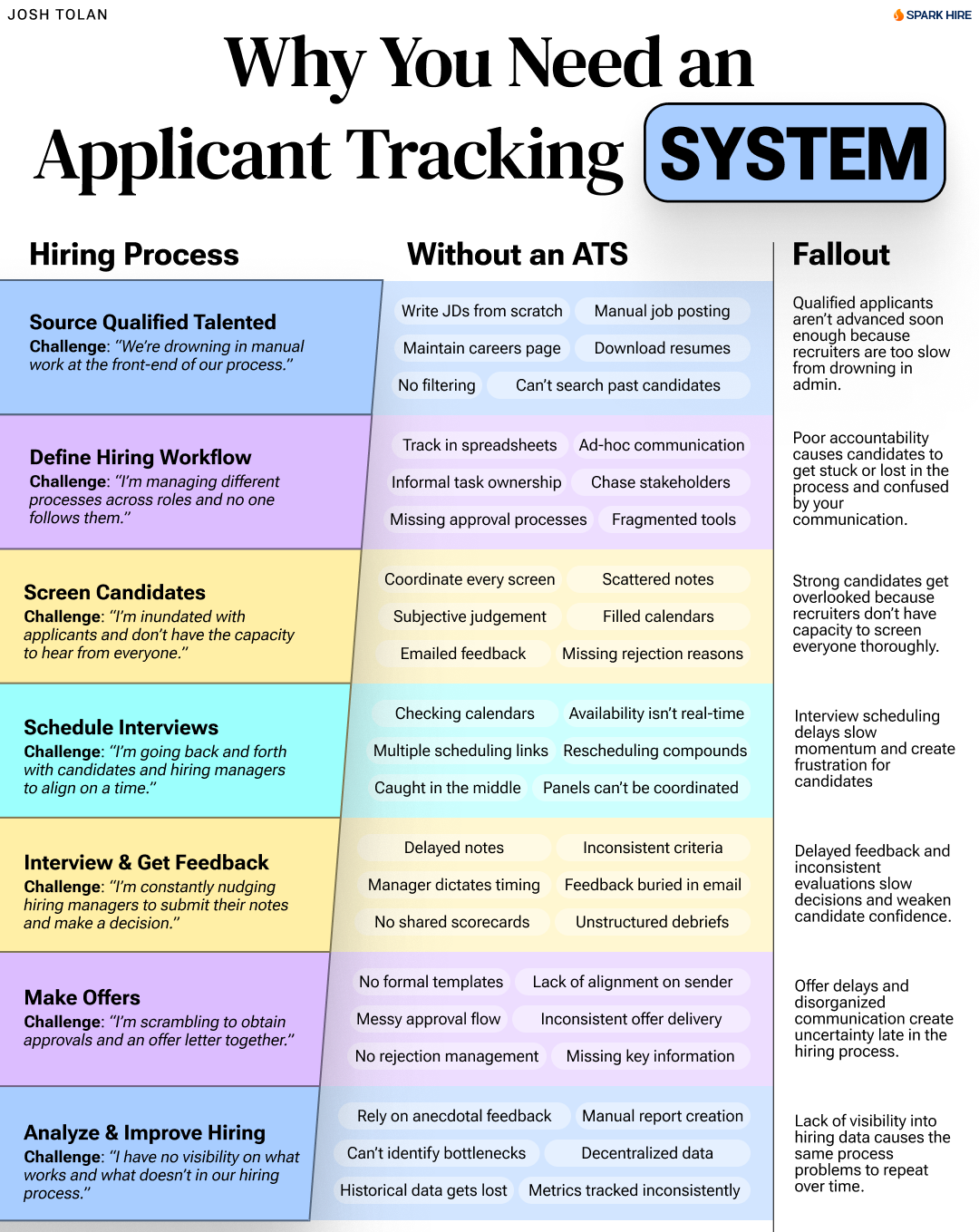
Every stage of the hiring process has its own version of this breakdown.
Sourcing Qualified Talent
At the top of the funnel, the admin work starts to build.
- Sourcing and posting jobs is manual, fragmented, and time-consuming before a single qualified candidate has been identified
- Resumes arrive through different channels with no central place to collect, filter, or revisit them
- There is no way to search past candidates when a new role opens
Defining a Hiring Workflow
Once applications are in, the process has no structure.
- Hiring workflows live in your head rather than in a system everyone can see and follow
- Different roles run different processes (or no process at all)
- Task ownership is informal or unclear
- Candidate approval happens over email (or not at all)
- Candidates move forward or stall based on who remembered to follow up, not because the system prompted the right action at the right time
Screening Candidates
Screening compounds the problem.
- With booked calendars and scattered notes, recruiters are forced to coordinate every phone screen manually
- Inconsistent evaluations often mean strong candidates have a higher possibility of being overlooked
Scheduling Interviews
Scheduling issues add another layer.
- Back-and-forth coordination between candidates and hiring managers
- Multiple scheduling links and calendars that aren’t connected
These last two cases can cause great candidates to disengage or move on to another opportunity.
Interviewing and Getting Feedback
Feedback collection is where most processes quietly fall apart.
- Without shared scorecards or structured interview prompts, hiring managers document what they remember, when they remember it
- Feedback arrives in email threads or side conversations
Hiring decisions slow down as you try to piece together feedback
Making Offers
Without structured templates, clear feedback workflows, or consistent communication, the last stage, offers and final decisions, carries the same fragility:
- Offer delays
- Inconsistent delivery
- Candidate uncertainty
Hiring Without a System: Lacking Visibility and Data
When a hiring process like the one described above ends, there is nothing to learn from it. No visibility into where things slowed down, which stage lost the most candidates, or why the last three roles took twice as long to fill as the ones before them.
The data exists somewhere, scattered across inboxes, spreadsheets, and calendar threads. But it’s not organized in a way that tells you anything useful.
So the same problems repeat. The same stages break down. The same candidates disengage at the same points in the process. And the HR or TA team absorbs it as the cost of hiring, because there’s no clear evidence pointing to a fixable cause.
And the business impact runs even deeper than the recruiter’s growing workload.
Every stage of the hiring process shown in the infographic above has a downstream consequence for the organization.
Candidates move on
Qualified applicants who don’t hear back quickly enough move on, and the team spends more time at the top of the funnel to compensate.
Damaged reputation
Poor accountability across the workflow means candidates get stuck or lost, which damages the employer’s reputation before the candidate has even met the hiring manager.
Strong candidates are overlooked
Inconsistent screening means strong candidates get overlooked, not because they weren’t the right fit, but because the process didn’t have the capacity to find them.
Lost momentum
Scheduling delays slow momentum at the exact moment candidates are most engaged.
Weakened confidence
Delayed feedback and unstructured debriefs weaken decisions and candidate confidence in the process.
Uncertainty during the process
Disorganized offer delivery creates uncertainty at the finish line.
And without any mechanism to track or analyze what happened, none of this improves.
Taken together, the fallout impacts your ability to be competitive in a saturated job market.
Remember: candidates are evaluating your company, your role, and your hiring process at the same time you’re evaluating them, in parallel with every other employer they’re talking to. A process that moves slowly, communicates inconsistently, and leaves candidates without a clear next step creates frustration and doubt.
Most of these frustrations get labeled as recruiter problems or hiring manager problems, when in fact, they are system problems.
The people running these processes are doing the best they can inside infrastructure that was never built to support them. The fix isn’t working harder inside a broken process. It’s building the process on a foundation that can actually hold it together.